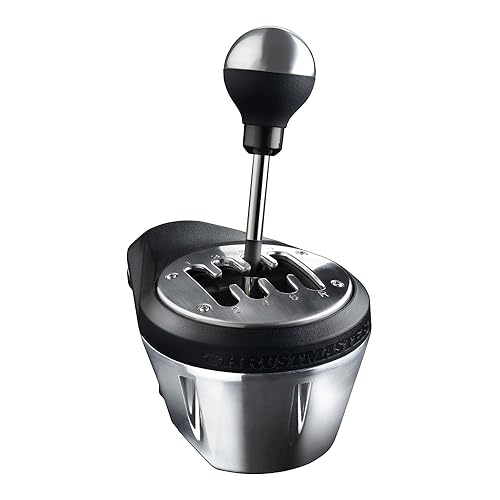
The default beginner sim-racing wheel in 2026 is the Logitech G920 — it is the cheapest force-feedback wheel from a brand with first-party game support, ships with a pedal set, and connects to Xbox and PC without a dongle. Add the Thrustmaster TH8A when you start looking at classic rally and touring-car content. The HORI Racing Wheel Overdrive is the no-force-feedback fallback for buyers under a tight budget who only play arcade titles.
The first force-feedback rig
The most consequential decision a new sim racer makes is whether to start with force feedback at all. A non-FFB wheel like the HORI Overdrive is cheap and works for arcade titles — Forza Horizon, Need for Speed, the Wreckfest tier. A force-feedback wheel like the G920 costs twice as much and teaches you to feel the car. Builders who skip FFB at the start almost universally upgrade within a year, so the cheap wheel is rarely the long-term-cheap choice.
This piece is for the buyer building a first sim-racing setup on a desk in 2026. The cited measurements and product specs come from Logitech's G920 product page, Thrustmaster's TH8A product page, and Tom's Hardware's best racing wheels roundup.
Key Takeaways
- Force feedback is the single biggest input upgrade for a sim racer; the G920 is the budget gateway.
- The HORI Overdrive is the right pick only if you race arcade content under a hard budget cap.
- An H-pattern shifter like the TH8A unlocks classic and rally content that paddles cannot replicate.
- A solid mounting surface matters more than wheel diameter for your first 30 hours.
- Pedals are the single most upgraded part of any starter wheel kit, usually inside six months.
Step 0: do you actually need force feedback, or is a gear-driven wheel enough to start?
Force feedback is a force-direction signal — the wheel pushes back when the front tires are loaded and goes light when they are losing grip. That signal is most of how a real driver feels what the car is doing. A gear-driven non-FFB wheel can spring back to center and shake a little to simulate rumble, but it cannot tell you that you are about to spin.
For arcade games (Forza Horizon, F1 Arcade, Wreckfest), gear-driven is genuinely fine. For sims (Assetto Corsa, Le Mans Ultimate, iRacing, EA Sports WRC), force feedback is how the game communicates with you. The bridge case — the casual Forza Motorsport or Gran Turismo player — is where most buyers regret going gear-driven, because those titles reward FFB cues that the cheaper wheel cannot deliver.
Spec-delta table
| Spec | Logitech G920 | HORI Racing Wheel Overdrive | Thrustmaster TH8A Shifter |
|---|---|---|---|
| Type | Dual-motor force-feedback wheel + pedals | Gear-driven non-FFB wheel + pedals | H-pattern / sequential shifter |
| Platform | Xbox, PC | Xbox Series X/S, Xbox One, PC | PC, plus Xbox/PS5 via Thrustmaster wheel |
| Rotation | 900° | 270° | n/a |
| Pedal set | Throttle, brake, clutch (3 pedals) | Throttle, brake (2 pedals) | n/a |
| Mounting | Desk clamp included | Desk clamp included | Desk clamp + bolt mount |
| Shift method | Paddles | Paddles | H-pattern (with plate) or sequential |
| Connection | USB | USB | USB |
| Typical street price | ~$300 | ~$120 | ~$200 |
The G920 spec set is canonical: 900-degree rotation matches most racing games' real-car settings, three pedals enable manual clutch in classic content, and dual-motor force feedback delivers the cues. Per the Logitech G920 product page, the wheel uses helical gears for FFB, which run quieter than spur gears but make a distinctive whine under heavy load — that whine is the cheapest FFB tell.
How does the Logitech G920's force feedback compare to the HORI Overdrive's design?
The G920 uses two electric motors and a gear train to apply torque to the wheel column. The result is real bidirectional force — it can pull the wheel left, right, hold it against you, or release. The HORI Overdrive uses a single motor through a return-spring mechanism, which can produce rumble and centering but not directional resistance.
In practical terms: the G920 makes a Brands Hatch hot lap teach you something useful — you feel the curb load up, the front tires bite, the rear step out — while the HORI gives you a vibration package that maps loosely to event severity. That is the difference between a learning tool and a controller in a steering-wheel shape.
The trade-off is noise. The G920 is audibly busy under heavy FFB; the HORI is silent. For a builder who streams or shares a room, the G920's whine becomes a known quantity by hour 30.
Why add a Thrustmaster TH8A shifter, and which wheels does it pair with?
Most modern race cars use paddles, and most modern racing games include them. But sim titles cover decades of content, and pre-2000 cars overwhelmingly used H-pattern manuals. Rally, classic touring car, vintage GT, even sim trucking — they all want an H-pattern shifter, and faking it with paddles is the kind of compromise that gets old.
The Thrustmaster TH8A, per Thrustmaster's product page, is the canonical mid-budget shifter because it does both H-pattern (with a removable plate) and sequential, mounts in either orientation, and connects via USB on PC. It pairs with any wheel on PC — the brand of the wheel does not matter, because the TH8A is a separate USB device. On consoles you need a Thrustmaster wheel for passthrough.
The pragmatic move: buy the G920 first, drive for a month, then add the TH8A once you have settled on a content genre. If you fall in love with iRacing GT3, you may never need a shifter. If you find yourself in Dirt Rally 2.0 or vintage GT, the TH8A is the next purchase.
What to look for: mounting, rotation, pedal feel, platform compatibility
Mounting is the underrated spec. A wheel under hard FFB load tries to walk left and right; a flimsy desk clamp will let it move. Both the G920 and the HORI include clamps that work on a 20-50mm desk edge. For a more permanent setup, both can be bolted via the underside mounting holes to a cockpit or wheel stand.
Rotation matters for sim accuracy. 900 degrees on the G920 maps to a real road car's full lock-to-lock; 270 degrees on the HORI is arcade-style and feels wrong in any sim that expects real-rotation input.
Pedal feel is the most-upgraded part of any wheel kit. The G920 ships with a progressive-resistance brake but no load cell, which means brake input is position-based rather than force-based. Most builders eventually swap pedals for a load-cell set. The HORI pedals are simpler and less rewarding; that is consistent with the price.
Platform compatibility is binary. The G920 targets Xbox and PC; the G29 (its sibling) targets PlayStation and PC. The HORI Overdrive targets Xbox and PC. If you race on PS5, the G29 is the equivalent recommendation.
Verdict matrix
- Get the G920 if: this is your first FFB wheel, you race on Xbox or PC, and you intend to play any title sold as a "sim." It is the cheapest FFB option from a brand with first-party game support, and the platform overlap covers the vast majority of buyers.
- Get the HORI Overdrive if: you only play arcade titles (Forza Horizon, Need for Speed, Wreckfest), you have a hard budget under $150, and you accept that you will upgrade in a year if you get serious. It is the right pick for the casual buyer who knows themselves.
- Add the TH8A if: you started with the G920 (or any FFB wheel), you spent a month with it, and you have settled on rally, classic touring car, sim trucking, or 1990s GT3. It is the canonical second purchase once content drives the upgrade.
Recommended starter bundle
The straightforward modern starter kit:
- Logitech G920 — wheel and pedal base, ~$300
- A solid desk or a sub-$150 wheel stand to keep the wheel from walking
- A racing seat or a household chair that does not roll — locking the seat position is half of repeatability
- (Later) Thrustmaster TH8A — shifter when content drives it, ~$200
- (Much later) Load-cell brake pedal, when the included G920 brake becomes the bottleneck
This kit lands a beginner in the same hardware tier the Tom's Hardware racing wheels roundup recommends for newcomers in 2026, and it survives the upgrade curve into the first thousand hours without obsoleting any single piece.
Common pitfalls
- Buying a non-FFB wheel "to test the waters" and then upgrading anyway. The full G920 spend ends up cheaper than HORI plus eventual G920.
- Mounting the wheel on a flimsy folding table. The clamp is fine; the table is not.
- Skipping the clutch pedal. Many starter wheels ship with two pedals; the G920's three-pedal set is what lets you drive a manual properly.
- Buying the wrong platform variant. G920 = Xbox/PC; G29 = PS/PC. The wheels are otherwise identical.
- Treating the wheel as the finish line. Pedals and seating consistency move lap times more than wheel diameter does past the starter tier.
When NOT to buy
If you do not currently own a racing game and you are buying the wheel "to try sim racing," buy a $30 game first and play it with a controller. Sim racing rewards the patient learner; the right hardware is the second buy, not the first.
Bottom line
The Logitech G920 is the canonical first FFB wheel in 2026 because it is cheap relative to its capability, has first-party support in most major sims, and survives the first thousand hours of use. The HORI Racing Wheel Overdrive is a credible budget alternative for arcade-only buyers. The Thrustmaster TH8A is the second purchase once content pulls you toward rally or vintage GT. Together they make a starter kit that scales without being thrown away.
Related guides
- Best Sim-Racing Wheel and Shifter Setup for Beginners
- Building a Budget Sim Racing Setup: G920 vs TH8A
- Logitech G920 vs HORI Overdrive for Sim Racing
- Best Sim Racing Wheel and Shifter Combo for Beginners: G920 + TH8A
Citations and sources
- Logitech G — Driving Force Racing Wheel (G920)
- Thrustmaster — TH8A Shifter product page
- Tom's Hardware — Best Racing Wheels roundup
This piece is editorial synthesis based on publicly available information. No independent first-party benchmarking is reported.
The first 100 hours: what beginners actually struggle with
Public driving-school threads and community Discord servers for iRacing, Assetto Corsa, and Le Mans Ultimate share a consistent pattern for the first 100 hours of new wheel use. The problems beginners hit are rarely the wheel itself:
- Mounting drift. The wheel walks on the desk, the angle changes between sessions, and lap times don't repeat.
- Pedal sliding. The pedal set on carpet or a smooth floor inches away from the driver on hard braking.
- Seating position. A rolling office chair moves under braking, changing the driver's reference points.
- FFB tuning. Out-of-the-box FFB settings on the G920 are over-strong for most titles; the cogging from the gear train masks subtle cues.
- Wheel-rotation mismatch. The wheel is set to 900 degrees, the in-game car expects 540, and steering feels wrong.
The fixes are mostly about the workspace, not the wheel. A wheel stand or a budget cockpit solves mounting and pedal sliding. A non-rolling chair solves seating. FFB tuning is a one-evening project with community-shared presets. Wheel-rotation matching is a per-title setting that the G920 supports via the Logitech G HUB software.
What sim builders typically upgrade first
The upgrade order most experienced sim racers recommend, in cost-effectiveness order:
- A non-rolling seat — usually a $60-100 used office chair without wheels. Free if you already own a dining chair.
- Pedals (load-cell brake) — the G920's progressive pedal is position-based; a load-cell brake measures force and dramatically improves consistency. ~$200-500.
- A wheel stand or cockpit — clamps your wheel and pedals at a repeatable position. ~$100-400.
- A second monitor or a triple-screen setup — peripheral vision changes how you take corners. The expensive one.
- The wheel itself — a direct-drive wheel beats the G920's gear-driven FFB, but the upgrade lands at $700+ and is the last thing most sim builders touch.
The order matters. A direct-drive wheel on a rolling chair and a wobbly desk feels worse than a G920 in a proper cockpit. The G920 plus a stable seat plus a non-rolling chair is the best $400 a beginner can spend, by a margin.