

LINKUP
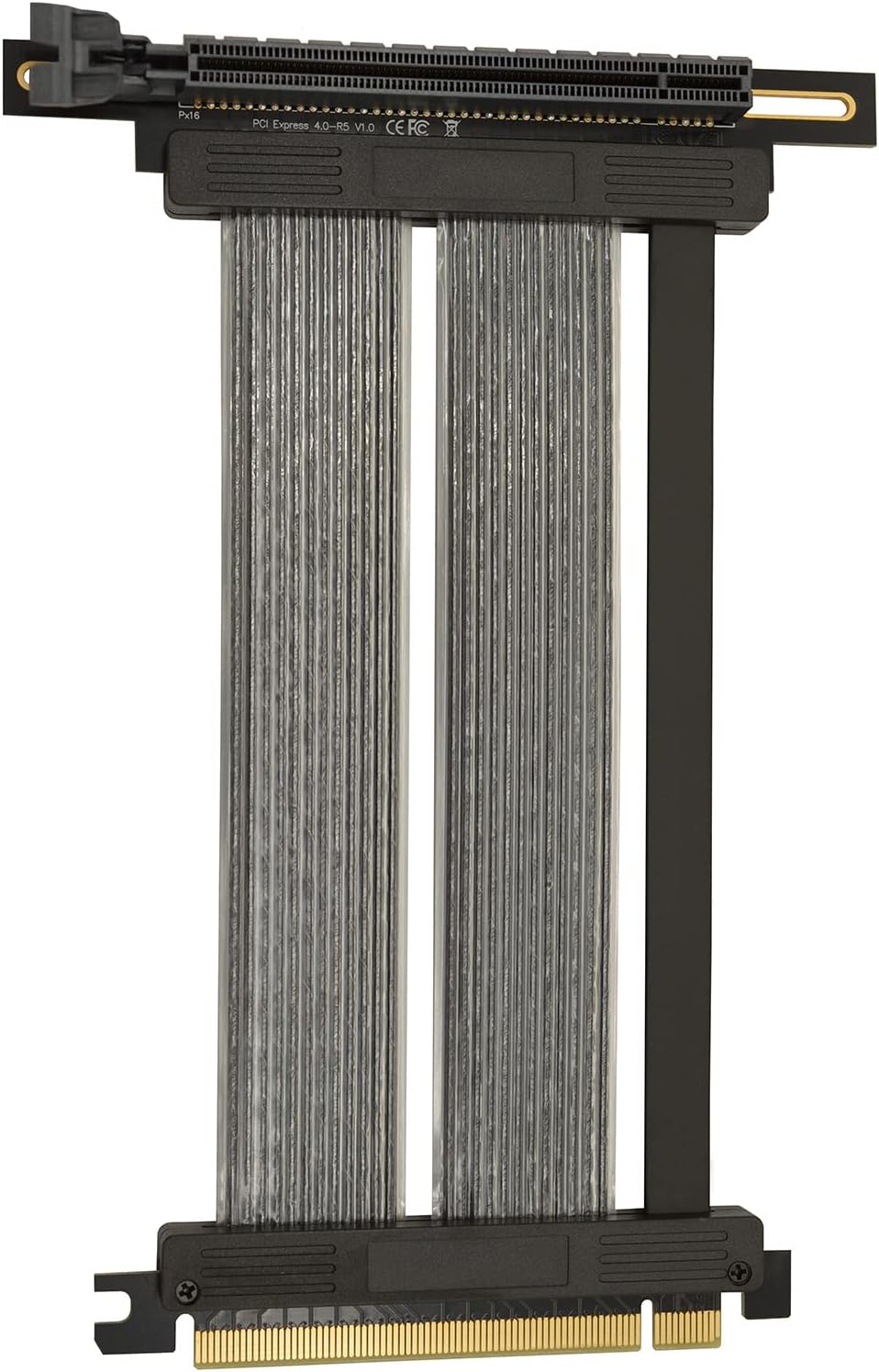
LINKUP PCIE 5.0 Riser Cable
Bottom line: The LINKUP PCIE 5.0 Riser Cable: Full PCIe 5.0 x16 bandwidth at 128GB/s, backward-compatible with PCIe 4.0; main trade-off: short 15cm span (19cm total) may not reach in larger tower layouts.
As an Amazon Associate, SpecPicks earns from qualifying purchases. Full disclosure →
Pros & Cons
Pros
- ✓ Full PCIe 5.0 x16 bandwidth at 128GB/s, backward-compatible with PCIe 4.0
- ✓ Multilayer shielding and tuned impedance suppress crosstalk and EMI under load
- ✓ Validated on ASUS WS WRX80SE WiFi II and WRX90E Gen5 workstation boards
- ✓ Vertical mounting frees intake airflow for thick shrouds and radiators
- ✓ Straight connector plus 2-35.4 inch length options fit ITX, tower, and bench builds
Cons
- ✗ Short 15cm span (19cm total) may not reach in larger tower layouts
- ✗ Straight connector only; angled routing needs a different SKU in the family
- ✗ Vertical mounts usually need a separate bracket, not included here
SpecPicks Verdict
SpecPicks scored LINKUP PCIE 5.0 Riser Cable using a rating × review-volume × price-fit model applied to published specs and reviews across the expansion cards category. LINKUP's expansion cards lineup sits within the broader category mid-tier; price and specs are the deciding factors over brand loyalty here. Judge it on the specification table and the price rather than on sentiment: check the figures that decide your use case, then put it side-by-side with two or three close alternatives in the Compare tool before clicking through.
Common buyer scenarios for expansion cards of this kind: matching it to an existing build, replacing a failing part, or upgrading from a previous-generation equivalent. Check the spec table below against your current setup — particularly socket / form-factor / power-rating fields — and confirm compatibility on the retailer's listing before purchase. Prices and stock are set by the retailer and may have moved since this page was last updated.
Key Features
- Verified Compatibility — Built for vertical GPU mount and standard layouts across towers, SFF/ITX sandwich cases, open benches, and water-cooled rigs. Fully backward-compatible with PCIe 4.0 and validated on ASUS WS WRX80SE WiFi II and WRX90E Gen5 boards. Ready for next-gen cards like RTX 5090 and RX 9070. Use this PCIe 5.0 riser cable to place the GPU exactly where airflow and aesthetics demand—without giving up stability.
- Gen5 x16 Performance & Shielding — Delivers full 128GB/s on PCIe 5.0 x16 with tuned impedance, premium conductors, and multilayer shielding to suppress crosstalk and EMI. The AVA design targets clean eye margins under load and tight bends, making it a dependable PCIe Gen5 riser cable for high-FPS gaming, AI, and storage workflows. Replace Gen 3 and Gen 4 PCIe cables while preserving upgrade headroom for future GPUs.
- Showcase Aesthetics, Improve Cooling — Move the card where it breathes. A vertical mount GPU clears intake for thick shrouds & radiators, reducing heat soak & noise while giving builds a clean, gallery-style look. Route like a tidy GPU extension cable & keep clocks steady thanks to robust shielding & low-loss geometry. Builders report good quality & that it simply works great when paired with the right bracket and case layout. View Product Description to ensure Compatibility with your PC case.
- Installation Instructions — Measure with a string from the motherboard slot to the GPU PCB to pick the correct span. Seat connectors fully until latched; Fold & Flex in any way. Use standoffs and support brackets if the chassis requires it. If fit seems tight, contact us before forcing parts—we’ll advise the best path for your case model. Clear guidance turns this into a straightforward PCIe cable install, even in cramped ITX routes.
- Choose the right Cable — Choose a length between 2–35.4 inches (see Installation Instruction) and the connector you need: right angle, straight, left angle, double reverse, single reverse right, single reverse left, or single reverse straight. One family covers ITX sandwiches, server trays, and vertical displays. Consistent Gen5 signal integrity across sizes makes it a flexible PCIe extender or GPU riser cable for clean cable management today with room to evolve tomorrow.
Full Specifications
| Brand | LINKUP |
|---|---|
| Color | Black |
| Model | AVA5 |
| Frequency | 128 GHz |
| Cable Type | Riser Cable |
| Item Shape | Round |
| Item Length | 19 Centimeters |
| Part Number | AG-P5-33SS-015BK |
| Connectivity | WiFi |
| Compatibility | PC |
| Connector Type | Pcie |
| Number of Pins | 16 |
| Number of Items | 1 |
| Special Feature | Heat Resistant, High Speed |
| Connector Gender | Male-to-Male |
| Specification Met | Pci-e 5.0 |
| Compatible Devices | Thermaltake CTE C700 (with Bracket), Thermaltake CTE C750 Series |
| Data Transfer Rate | 128 Gigabits Per Second |
| Indoor Outdoor Usage | Indoor, Outdoor |
| Compatible Phone Models | No compatible phone models |
| Full listing title | LINKUP PCIE 5.0 Riser Cable | for Vertical GPU Mount | Straight | Graphics Card GPU Ready | Usable with PCIe 4.0 & RX9070/ RTX5090 | 15cm (Total Length: 19cm) |
Ready to buy?
LINKUP PCIE 5.0 Riser Cable | for Vertical GPU Mount | Straight | Graphics Card GPU Ready | Usable with PCIe 4.0 & RX9070/ RTX5090 | 15cm (Total Length: 19cm) is listed on Amazon. Price, availability, shipping and returns are set by Amazon and its sellers — check the listing for current terms. SpecPicks earns a small commission on qualifying purchases — thank you for supporting independent review work.
Related Expansion Cards



More guides & deep dives from the SpecPicks archive
Browse all articles & guides →- Emulation Hardware in 2026: FPGA, Software, and Cart-Reader Ecosystems
- How to Build a Windows 98 Retro PC in 2026
- Best 1440p Gaming GPUs in 2026
- RTX 4070 Super vs RX 7800 XT — Which to Buy in 2026
- The Complete Voodoo5 5500 AGP Driver Guide (2026 Edition)
- Best Retro Handhelds in 2026 — From $35 to $500
- Best Budget Gaming PC Build 2026 — ~$1,000 ($800 on Sale)
More reviews from the SpecPicks archive
Browse all reviews →- Home Assistant on a Raspberry Pi 4 8GB: Full 2026 Setup
- Best Steam Deck Dock and 4K Monitor Setup for TV-Mode Gaming in 2026
- Logitech G502 Hero in 2026: Is the FPS Mouse King Still Worth It?
- Is My GPU Dying? 5 Warning Signs to Check Now
- Best Game Controller for Couch & Big-Screen PC Gaming in 2026
- FIDECO vs Unitek: Best IDE-to-USB Adapter for Retro Drive Imaging
- Best Budget Build for Local LLMs in 2026: How Far a Ryzen 5 5600G + RTX 3060 Gets You
- Build a Jellyfin Media Server on a Raspberry Pi 4 in 2026
- Samsung's 240Hz 1440p Gaming Monitor Drops to $169
- Memory Prices Climb as Samsung and SK Hynix Pour $590B Into Chips
- Qwen3 0.6B: Raspberry Pi 4 8GB vs Ryzen 5 5600G for Tiny-Model Hosts (2026)
- Best Budget Gaming Peripherals Under $100 in 2026
- Aider vs Cline vs Continue on a Local Coding Rig (RTX 3060, 2026)
- Run Soofi S 30B Locally: What a 12GB RTX 3060 Can Actually Do
- Framework Desktop & Ryzen AI Max+ 395 Review: Best Strix Halo Mini PCs in 2026
- The Best Retro Game Emulators for Mac in 2026
- Period-Correct Windows 98 Boot Drive: CompactFlash vs IDE SSD
- Ryzen 7 5800X3D vs Intel Core i7-14700K for DDR4 Gaming
- Raspberry Pi 500 Specs, Price & Real-World Use in 2026
- RTX 5070 Ti + Ryzen 7 9850X3D: Is It a Good Combo?
- Intel Arc Pro B60 AI Performance: 24GB VRAM Explained
- Flux.2-Klein Pipeline: Real-Time Webcam AI at 30 FPS
- CPU Cooler Bracket Fix: How to Secure Your CPU When It Fails
- Adafruit Ships a Triple LED Matrix Bonnet for the Raspberry Pi
Earliest SpecPicks reviews
Browse full archive →- Best GPU for Llama 3.1 8B (2026)
- Best GPU for Qwen 3 14B (2026)
- Best GPU for Qwen 3 32B (2026)
- Best GPU for Llama 3.1 70B (2026)
- Best GPU for DeepSeek-R1 32B (2026)
- Best GPU for Llama 3.1 405B (2026)
- How to run Llama 3.1 8B on NVIDIA GeForce RTX 5090
- How to run Qwen 3 14B on NVIDIA GeForce RTX 5090
- How to run Qwen 3 32B on NVIDIA GeForce RTX 5090
- How to run Llama 3.1 70B on NVIDIA GeForce RTX 5090
- How to run DeepSeek-R1 32B on NVIDIA GeForce RTX 5090
- How to run Llama 3.1 8B on NVIDIA GeForce RTX 4090