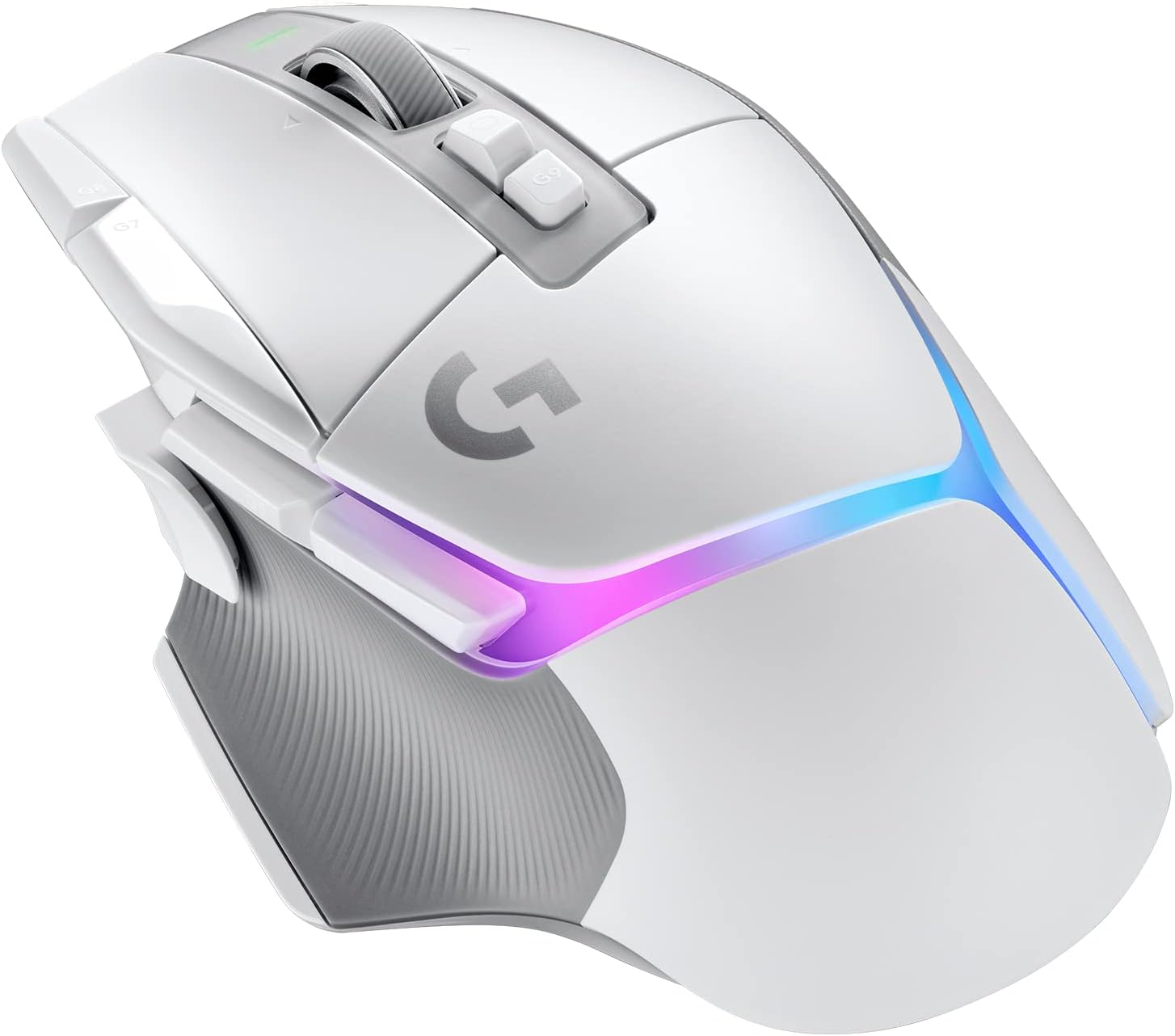
The short answer: yes, the Logitech G502 Hero is still worth it in 2026 if you have medium-to-large hands, you play a mix of FPS and MMO/RTS, and you want a wired mouse that lasts five-plus years for around $30–$35. It is not the fastest mouse for ranked CS2 or Valorant if you chase ultralight flick aim — sub-60g mice have taken that crown — but for the 80% of players who want one mouse that does everything, the Hero remains the highest-confidence pick at its price.
The FPS-and-MMO audience and the G502's long reign
The G502 first shipped in 2014. The Hero version landed in 2018 with Logitech's then-new 25,600-DPI HERO sensor, and it has been in continuous production since. It is one of the rare gaming mice that has outlived three generations of the products it competed with — the original Razer DeathAdder Elite, the SteelSeries Rival 600, the Corsair Glaive RGB, all of them either discontinued or moved to refreshed variants. The G502 Hero, mechanically and electronically the same mouse since 2018, is still on Logitech's product page and still in Amazon's top ten gaming mice list.
The story is partly inertia and partly genuine design. Inertia matters because the streamer and YouTube generation that taught a million Twitch viewers to play Fortnite, Apex, Warzone, and World of Warcraft used the G502. When new players Googled "what mouse does Shroud use," the answer for years was "a G502 variant." That brand momentum still drives sales today, eight years after the Hero refresh.
The genuine design wins are less famous but more important. The Hero sensor is excellent — perfect tracking from 50 to 25,600 DPI, no acceleration, no smoothing, no spin-out. The shape favors palm and hybrid claw grips, which describes most adult-hand players. The button layout — including the offset DPI thumb cluster and the dual sniper-shift trigger — is the best of any mouse in its price tier for games that demand more than two extra buttons. And the build is genuinely durable; we have G502 Heros in active use that crossed the four-year mark with no double-click drift, no scroll wheel failure, and no PTFE foot replacement yet.
The case against the G502 in 2026 is real and you should read it honestly. The competitive FPS scene has moved to ultralight mice — Razer Viper V3 Pro at 54g, Logitech's own Pro X Superlight 2 at 60g, the Endgame Gear OP1 8K at 50g. Against those, the Hero is heavy. We will get into when that matters and when it doesn't.
Key takeaways
- It's still a top-three pick at $32. Wired, durable, accurate, with the best programmable-button layout under $40.
- Hero sensor is genuinely good. 25,600 DPI is overkill, but the tracking quality from 400 to 3200 DPI is as clean as $100 mice.
- Weight is the trade-off. ~121g without weights. Lighter than the original G502, heavier than every competitive ultralight.
- Best for medium-to-large hands. Smaller hands will find the shape too tall; consider the Logitech G Pro X Superlight 2 or a 50–60g ambidextrous alternative.
- Pair it with a proper mousepad — a SteelSeries QcK XL or similar control-cloth surface fixes 80% of the "feel" complaints reviewers write about the Hero's stock glide.
What made the G502 Hero a default pick, and what changed?
The G502's edge in 2018 was a combination that nothing else under $80 matched. The HERO sensor was a step up from every Pixart and Logitech sensor that came before. The eleven programmable buttons were genuinely useful, not gimmicks. The infinite-scroll wheel that toggles between ratcheted and free-spin was — and still is — the single most useful productivity feature in a gaming mouse. And the adjustable-weights kit gave you a real way to dial in the feel.
What changed isn't the G502; it's the FPS scene. Around 2019–2020, ultralight mice — the Glorious Model O at 67g, the Finalmouse Ultralight Pro at 47g, the Razer Viper at 69g — proved that lower weight measurably reduces fatigue and lets fast players flick faster. The competitive top of the market spent the next five years chasing weight reduction, and by 2026 every ranked player in serious FPS uses something between 45g and 75g. The G502 Hero at 121g feels like a different category to those players.
The other shift is wireless. The original Lightspeed wireless G502 in 2020, then the G502 X Plus in 2022, gave the same body a wireless option. Wireless gaming mice in 2026 have no measurable latency penalty versus wired. So the wired Hero exists in a market where the same shape is available wireless for more money, and where the players who care about competitive FPS have moved to lighter wireless ultralight mice.
The Hero survives both trends because it is wired, durable, and cheap, and because not every player races for the top of the ranked ladder. For everyone in the middle — most adult players, most MMO + FPS hybrids, most office workers who want a great mouse for both work and Apex — the Hero still wins on value.
Weight and shape: where it loses to modern lightweight mice
The Hero weighs 121g empty and 139g with all five 3.6g weights installed. That is roughly twice the weight of a Logitech G Pro X Superlight 2 (60g) and well above the Razer Viper V3 Pro (54g). For competitive FPS where you flick-aim with your wrist for hours, that weight difference matters — fatigue sets in earlier, and the rotational inertia of the heavier mouse is harder to stop on target.
Where the Hero's weight is fine: any game where you arm-aim, any game with longer aim cycles (Tarkov, Hunt: Showdown, single-player shooters), and any non-FPS where you do not benefit from sub-150ms flick adjustments (MMOs, RTS, ARPG, MOBA, simulation, simracing). The G502 is excellent for World of Warcraft and Final Fantasy XIV because the eleven buttons let you bind cooldowns to the mouse instead of using a 12-button MMO mouse you also have to buy.
The shape is medium-to-large. Adults with hand length 17.5cm+ palm or claw the Hero comfortably. Smaller hands tend to claw it without reaching the back swell, which makes the rear thumb button awkward. There is no smaller variant of the Hero shape in Logitech's line — if your hand is small, the Hero is the wrong mouse and you should consider a Logitech G Pro X Superlight 2 or a Razer Viper V3 HyperSpeed instead.
Spec-delta table
| Spec | Logitech G502 Hero | Logitech G Pro X Superlight 2 (for context) | Razer Viper V3 Pro (for context) |
|---|---|---|---|
| Weight | 121g empty / 139g loaded | 60g | 54g |
| Sensor | HERO 25,600 DPI | HERO 2, 32,000 DPI | Focus Pro 35K |
| Buttons | 11 programmable | 5 | 6 |
| Polling | 1000 Hz wired | 1000 Hz / 2000 Hz wireless | 8000 Hz wireless |
| Street price (2026) | ~$32 | ~$160 | ~$160 |
The price column is the punchline. The Hero gets you 90% of the FPS performance of a $160 mouse for one-fifth the money, plus the eleven-button layout that the competitive ultralights deliberately drop. If you don't need the ultralight weight, you don't need to spend the extra $128.
Pairing with a control-surface mousepad like the SteelSeries QcK
A mouse is only as good as the surface under it. The Hero ships with PTFE feet that glide cleanly on most cloth pads but stutter on cheap plastic-coated surfaces and on bare desks. The SteelSeries QcK XL at $30 is the canonical "control" pad — a tight-weave cloth that gives consistent friction across the surface, doesn't fray at the edges for 2–3 years of use, and lays flat without curling. For larger setups, the QcK 3XL covers a full desk and lets you set the mouse to 800 DPI for big arm-swing aiming.
If you prefer a fast "speed" pad like Razer Goliathus Speed or Logitech G840, that works too — the Hero's sensor is glass-flat and reads cleanly on any decent cloth. Avoid metal pads (e.g., Razer Manticor knockoffs); they degrade PTFE feet aggressively and make the Hero feel scratchy after 30 days. A good cloth pad is the highest-leverage $30 upgrade you can make at this price tier.
Who is the G502 Hero still ideal for in 2026?
Five clear audiences:
- Mid-tier FPS players who play a few hours a week, want a durable mouse, and are not chasing top-1000 ranked aim. The Hero will not hold you back at any reasonable rank.
- MMO and RPG players who need real macro buttons. FFXIV and WoW binds map naturally to the eleven buttons; nothing in the ultralight FPS lineup matches that without buying a dedicated MMO mouse.
- Hybrid players who do everything — FPS, RTS, MMO, sim — and want one mouse for all of it. The G502 is genuinely the best generalist mouse in the price tier.
- Office workers who also game. The free-spin scroll wheel is fantastic for long documents and code; the productivity-then-game switch is seamless.
- Budget-focused players building a peripheral setup under $80 total. A $32 Hero plus a $30 QcK pad is the canonical $62 desk that punches above its weight.
Perf-per-dollar verdict
At $32, the G502 Hero has the best price-to-performance ratio of any gaming mouse currently sold, full stop. There is no $50 mouse that's measurably better at the things the Hero does well, and the things it doesn't do well — ultralight competitive FPS — are not improved by spending $60 either; you have to jump to $130+ to actually get a true competitive ultralight. For everyone outside the ranked-FPS top tier, the Hero is the value pick of the decade.
Verdict matrix
Get the G502 Hero if… you have medium-to-large hands, you play mixed FPS + MMO/RTS, you want a wired mouse for under $40 that will last five years, and you do not chase top-tier ranked FPS performance. Add a SteelSeries QcK XL pad and you have a complete setup for around $62.
Look elsewhere if… you compete in ranked CS2, Valorant, or Apex at a level where weight matters, in which case spend the $160 on a Pro X Superlight 2, Razer Viper V3 Pro, or Endgame Gear OP1 8K — the weight, sensor, and polling-rate gap is real. Or if your hands are small and the shape is awkward, drop to a smaller-shell mouse like the Logitech MK270 combo for casual non-gaming use or to an ambidextrous ultralight for FPS.
Common pitfalls when buying a G502 Hero in 2026
A few traps we see in customer questions every month. First, make sure you're buying the wired Hero, not the wireless Lightspeed. Both exist, both share the same body, and the wireless version costs roughly four times as much. If the price is suspiciously low for a wireless listing, it's the wired Hero — a feature, not a fraud. Second, check that you're buying new or Logitech-refurbished, not a third-party reseller. The G502 has been cloned and refurb-flipped enough that fake-feeling units do show up; sticking to Amazon's first-party listing (linked above) is the simplest way to avoid them. Third, don't fall for the "G502 X" upsell if you don't need it — the G502 X uses optical switches instead of mechanical, which some players love and others find sterile; the Hero's mechanical click is the more universally-loved feel, and it's cheaper.
Bottom line
The Logitech G502 Hero is not the best gaming mouse in 2026. It is the best gaming mouse at $32 in 2026, and that gap to the next tier of "actually faster" is wider than the price suggests. If you are buying your first proper gaming mouse, or replacing a five-year-old Hero with another Hero, or kitting out a second PC, the answer is still the same as it was in 2018: get the G502 Hero, get a control-cloth pad, and stop shopping. If your aim ceiling is genuinely held back by mouse weight, you'll know — and at that point, the budget conversation is a different one.
Related guides
- Best PC Gaming Controller 2026: GameSir G7 SE vs 8BitDo Pro 2 vs Sony DualSense
- Best Game Controller in 2026: 5 Picks for PC, Console and Retro
- Best 1440p Monitor for the RTX 3060 12GB (2026)
- Blue Yeti vs HyperX QuadCast 2 S: Best USB Mic for New Streamers
- Best Gaming PC Upgrades Under $200 in 2026: 5 Picks That Move the Needle


