The Raspberry Pi 500 folds a full Raspberry Pi 5-class computer into a keyboard, and for $90 it's one of the cheapest ways to get a Cortex-A76 desktop on a shelf. It launched in January 2025 as the successor to the Raspberry Pi 400, and per the Raspberry Pi Foundation's own product page, it inherits the Raspberry Pi 5's compute platform almost wholesale rather than shipping a new chip.
That distinction matters, because some of what circulates online about the Pi 500 — alternate chip names, mixed RAM configurations, staggered 2025 release windows — doesn't match what Raspberry Pi actually shipped. This piece sticks to the specifications Raspberry Pi publishes directly and flags where third-party benchmark claims for this board don't yet exist.
Raspberry Pi 500 specs
Per the official product page, the Raspberry Pi 500 is built on the same silicon as the Raspberry Pi 5:
| Spec | Raspberry Pi 500 |
|---|---|
| SoC | Broadcom BCM2712 |
| CPU | Quad-core Arm Cortex-A76 @ 2.4GHz |
| GPU | VideoCore VII (OpenGL ES 3.1, Vulkan 1.2) |
| RAM | 8GB LPDDR4X-4267 (single configuration) |
| Storage | microSD slot + PCIe 2.0 x1 (FPC connector, NVMe via adapter) |
| Display | Dual micro-HDMI, 4K60 output |
| Networking | Gigabit Ethernet, dual-band 802.11ac Wi-Fi, Bluetooth 5.0/BLE |
| GPIO | Standard 40-pin header |
| Power | USB-C |
| Form factor | Integrated keyboard case with built-in cooling |
Unlike the Raspberry Pi 5 board, which Raspberry Pi sells in 4GB, 8GB, and 16GB variants, the Pi 500 ships in one memory configuration: 8GB. There is no 4GB entry-level SKU, and Raspberry Pi has not announced a higher-RAM variant.
Raspberry Pi 500 vs Raspberry Pi 5 vs Raspberry Pi 400
The easiest way to place the Pi 500 is against the two boards it sits between — the Pi 5 it borrows silicon from, and the Pi 400 it replaces.
| Raspberry Pi 400 | Raspberry Pi 500 | Raspberry Pi 5 (board only) | |
|---|---|---|---|
| SoC | BCM2711 (Cortex-A72) | BCM2712 (Cortex-A76) | BCM2712 (Cortex-A76) |
| RAM options | 4GB | 8GB only | 4GB / 8GB / 16GB |
| PCIe/NVMe | No | Yes | Yes |
| Form factor | Keyboard | Keyboard | Bare board |
| Starting price | Discontinued in most regions | $90 | $80 (8GB board only) |
The practical upshot: the Pi 500 costs roughly $10 more than a bare 8GB Pi 5 board, and in exchange you get a keyboard, case, and cooling built in — components you'd otherwise buy separately for a bare board. If you already own a case, keyboard, and cooling solution, a standalone Pi 5 board remains the more flexible option; if you don't, the Pi 500 collapses that shopping list into one SKU.
Raspberry Pi 500 for edge AI and low-power projects
A quad-core Cortex-A76 CPU and VideoCore VII GPU are enough to run lightweight inference — small vision-classification models, TinyML sensor pipelines, basic object detection — within a power envelope that stays well under what a desktop draws at idle. That positioning fits the Pi 500's audience: home automation hubs, always-on network tools, kiosk displays, and classroom AI demos where a project needs to sip power from a wall outlet or small battery bank rather than a 500W+ PSU.
It is worth being direct about what it isn't. Some searches around this board pull up comparisons against discrete desktop GPUs like AMD's RX 6600 for TensorFlow or ONNX throughput. No published, sourced benchmark set compares those two products head-to-head, and the framing itself is a mismatch — one is a $90, sub-15W keyboard computer, the other is a 130W+ discrete graphics card built for a desktop PC. They serve different budgets and different jobs rather than competing on the same chart. If a project genuinely needs discrete-GPU-class throughput for model training or high-resolution inference, that calls for a dedicated GPU rig, not a Pi 500 — the Pi 500's value is in the projects that don't need that ceiling.
Storage, display, and accessories
The Pi 500's PCIe 2.0 x1 FPC connector accepts NVMe SSDs through an adapter board, the same mechanism used on the Raspberry Pi 5, which meaningfully speeds up boot and application load times versus a microSD card alone for anyone running a desktop OS or a database-backed home server off the board.
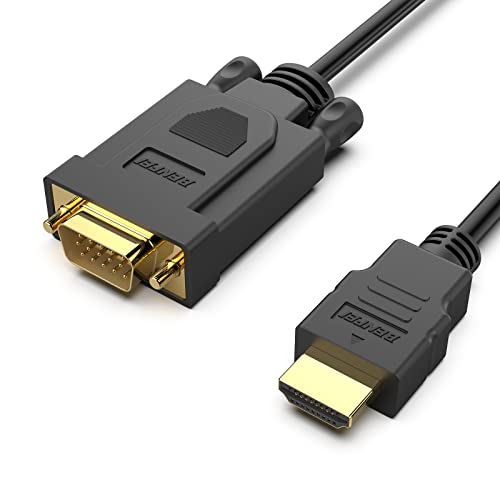
Display output is dual micro-HDMI, which covers most current monitors directly. Builders working with older VGA-only displays — a common situation in retro-lab and classroom setups — need an active HDMI-to-VGA adapter rather than a passive cable, since the Pi doesn't output analog VGA natively. A compact adapter like the BENFEI HDMI to VGA adapter or a longer 10-foot HDMI-to-VGA cable covers that gap without a full monitor upgrade.
For GPIO work, the 40-pin header carries over unchanged from prior Pi boards, so existing HATs and breakout cables remain compatible; see the Raspberry Pi 5 pinout guide for the full pin map, which applies to the Pi 500's header as well.
Should you buy the Raspberry Pi 500 in 2026?
The Pi 500 is aimed at three overlapping groups:
- First-time builders and students, where the $120 Desktop Kit (board, mouse, power supply, HDMI cable, microSD, guide) removes the need to source parts separately. See beginner-friendly Pi projects and projects built for kids for starting points.
- Home automation and always-on hubs, where the built-in keyboard is irrelevant but the low power draw and Gigabit Ethernet matter. See home automation builds.
- Makers upgrading from a Pi 400, who get NVMe support and a newer CPU/GPU generation in the same form factor. Broader project ideas across skill levels are collected in 50+ Raspberry Pi project ideas and advanced builds for adults.
If the target use case is genuinely GPU-bound — model training, heavy generative workloads, high-frame-rate rendering — the Pi 500 isn't the right tool regardless of price, and no credible published benchmark suggests otherwise.
Citations and sources
- Raspberry Pi 500 product page — Raspberry Pi Foundation
- Raspberry Pi 5 product page — Raspberry Pi Foundation
This piece is editorial synthesis based on publicly available information. No independent first-party benchmarking is reported.