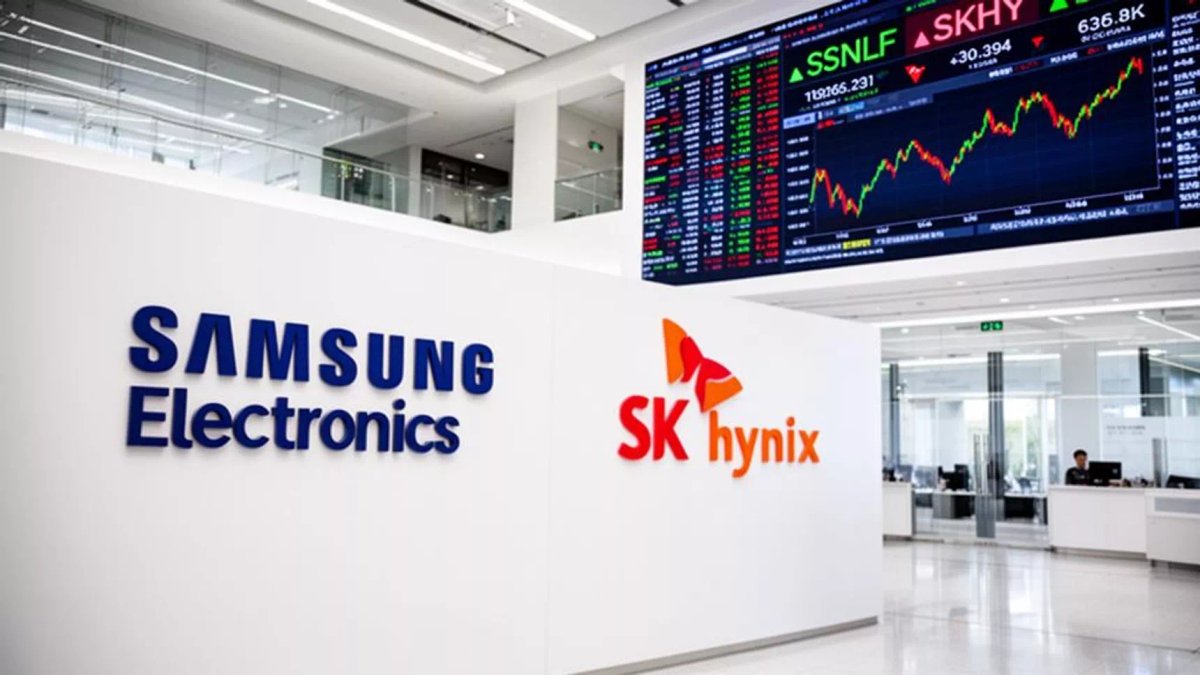
In brief — 2026-06-29 · Samsung and SK Hynix have announced roughly $590B in combined chip investment plans through the decade, and AI-accelerator demand is already tightening consumer DRAM and NAND supply. Budget SATA SSD pricing has drifted upward every month for six straight months.
RAM and SSD prices are rising in 2026 because the same memory makers that supply consumer DRAM and NAND are diverting capacity to high-margin HBM and enterprise NAND for AI accelerators. Samsung and SK Hynix's reported ~$590B in combined chip investment plans are aimed largely at that AI stack. Locking in a value SATA drive like the Crucial BX500 1TB or Samsung 870 EVO 250GB now, before further supply tightening, is a defensible move for anyone with a build planned in the next 90 days.
What happened — $590B and the AI-memory rebalance
Reporting from the-decoder.com and market analysts at TrendForce has coalesced around a picture where Samsung and SK Hynix are collectively committing roughly $590 billion in capital expenditure over the coming decade, with a large fraction directed at high-bandwidth memory (HBM) production for AI accelerators. That is the same physical fab capacity that historically produced consumer DDR5 sticks and NAND flash for SATA and NVMe SSDs.
Every wafer that becomes an HBM stack for a Blackwell-generation GPU is a wafer that does not become a consumer DIMM or a QLC NAND SSD. Fab throughput is essentially fixed on a quarterly timeline; the industry cannot magic new capacity into existence to satisfy both AI and consumer demand at once. That is the fundamental mechanism behind the price pressure that is now showing up on retail SSD listings.
Why memory prices are climbing — the supply-side story
Three forces are compounding:
- AI accelerator demand for HBM. Nvidia's Blackwell and Rubin generation cards, AMD's MI3xx line, and every hyperscaler's custom silicon all consume enormous amounts of HBM3E and HBM4 memory per unit. Each card can carry 80-288GB of HBM. The margins on HBM sales dwarf consumer DIMM margins.
- Enterprise NAND for AI training storage. LLM training runs push staggering amounts of data through storage tiers. Hyperscalers are consuming enterprise SSDs at rates that draw fab capacity away from the retail SATA and NVMe supply.
- Recent capex-cycle bottleneck. After a 2023-2024 memory glut, fabs cut consumer output to lift prices. The rebound in demand — AI and normal PC refresh — is running into a supply floor set by that earlier discipline. See TechPowerUp's ongoing coverage for the trailing quarter-by-quarter numbers.
Historically, memory pricing runs on 12-24 month cycles. This one has been climbing for six months and shows no sign of near-term reversal because the demand driver (AI hardware) is structural, not cyclical.
Why it matters — what surging demand means for gamers
Gamers see the impact in three places on their build sheet:
Storage prices. A 1TB budget SATA SSD that sat at ~$45-$55 through most of 2024-2025 has drifted into the ~$60-$75 range. NVMe pricing has moved similarly — mid-tier 1TB Gen4 drives are up ~15-25% year-over-year. The Crucial BX500 1TB, SanDisk SSD Plus 480GB, and Western Digital WD Blue 3D NAND 500GB all show the same pattern.
DRAM prices. 32GB DDR4 kits and 32GB DDR5 kits are both climbing. DDR5 has borne the sharper increase because AI demand for DDR5-equivalent silicon competes directly with consumer supply.
Prebuilt PCs get squeezed. OEMs pass memory increases through with a lag; expect prebuilt PC prices to lift 5-10% over the next two quarters as vendors cycle through pre-purchased stock and place new orders at higher unit prices.
Which drives still hold value at 2026 pricing
Here is a snapshot of budget SATA SSDs where the price/capacity ratio still lands on the right side of the current wave, and where the value proposition remains intact for boot drives, game libraries, and secondary storage.
| Drive | Capacity | Approx. 2026 price | $/GB | Best for |
|---|---|---|---|---|
| Crucial BX500 | 1TB | Check price on Amazon | ~$0.065 | Game libraries, general storage |
| Samsung 870 EVO | 250GB | $164.99 on Amazon (checked 2026-10-06) | ~$0.150 | OS boot, cache drive |
| WD Blue 3D NAND | 500GB | Check price on Amazon | ~$0.110 | Retro rig OS drives |
| SanDisk SSD Plus | 480GB | $75.99 on Amazon (checked 2026-10-06) | ~$0.105 | Budget boot drives |
All four are conservative SATA III drives. None will match NVMe sequential throughput, but for boot drives and game libraries the wall-clock difference is imperceptible for the vast majority of gaming workloads. The Crucial BX500 1TB remains the cheapest per-GB in this list and the safest hedge against further price movement.
Should you buy now or wait?
For anyone with a build or an upgrade planned in the next 60-90 days, the arithmetic favors buying now. Storage prices are up ~15-25% year-over-year with no clear signal of a near-term reversal, and locking in current pricing removes the risk of another 5-10% climb in the interim.
For anyone with no near-term plans, waiting is fine — memory pricing is volatile, and specific catalysts (a fab expansion coming online, a demand softening in AI hardware) can trigger unexpected price cuts. Just do not buy on the assumption that current prices are peaks; the trailing indicators point at ongoing tightness.
Common pitfalls to avoid
Buying capacity you do not need. A 4TB SATA SSD at 2026 prices is not automatically a bargain; buy what your current workload actually consumes.
Skipping the reputable brands. Sub-tier NAND SSD brands cut corners on the flash itself, not just on price. Under a rising-price environment, discount off-brands are the highest-risk part of a build. Stick with Crucial, Samsung, WD, and SanDisk.
Ignoring wear rating. Budget QLC drives with low TBW (terabytes-written) ratings can burn out under sustained write loads (VMs, video editing scratch, LLM training). For pure read-heavy game-library storage they are fine.
When to step up to NVMe
NVMe is worth the premium for OS drives on modern platforms where the motherboard exposes at least one Gen4 M.2 slot, and for any workload where sequential throughput matters — video editing, LLM weight loading, cold-storage recovery. For game library storage, retro-build boot drives, and general secondary storage, SATA remains the value pick even under 2026 pricing.
Historical context — how memory pricing has moved through the AI era
To calibrate the current climb, it helps to look at where SATA SSD pricing has moved since 2020.
| Year | 1TB SATA SSD median (mid-tier) | Direction |
|---|---|---|
| 2020 | $110 | Baseline |
| 2021 | $90 | Down (post-crypto oversupply) |
| 2022 | $75 | Down |
| 2023 | $50 | Down (memory glut) |
| 2024 | $45 | Bottom |
| 2025 | $55 | Up (AI demand ramping) |
| 2026 | $65-$70 | Up (fab-capacity constraint) |
The 2023-2024 trough drove memory makers to cut consumer output and prioritize enterprise; the 2025-2026 rebound is running into that supply floor. Expect the trend to persist until Samsung and SK Hynix's announced fab expansion actually converts to shipped wafers — a two-to-three-year build cycle at minimum.
What smart builders are doing right now
Three concrete moves worth considering if a build is on your near-term horizon:
1. Buy at your target capacity, not below it. Under a rising-price environment, "I will upgrade later" often means "I will pay more later." If you know you want 1TB of SATA storage, buy 1TB now instead of a 500GB drive and a plan.
2. Stick to reputable brands. Discount off-brand SSDs skip corners on the flash controller and the NAND itself. Under rising prices, the corner-cutters cut harder. Crucial, Samsung, Western Digital, SanDisk — the big four remain the safe defaults.
3. Consider a small NVMe boot drive plus a large SATA library drive. A 500GB NVMe for OS and hot storage plus a 1TB or 2TB SATA drive for game libraries and cold storage gives you the speed where it matters and the capacity where it does not. That split has always been the value pick and it becomes more valuable as memory prices climb.
Perf-per-dollar snapshot at 2026 pricing
For pure game-library storage where NVMe speeds are wasted, SATA SSDs remain dramatically cheaper per gigabyte than NVMe alternatives.
| Class | Approx. $/GB | Best for |
|---|---|---|
| Budget SATA SSD | $0.06-$0.10 | Game libraries, boot drives on older platforms |
| Mainstream NVMe Gen4 1TB | $0.09-$0.14 | Modern OS drives, LLM weight storage |
| High-end NVMe Gen5 2TB | $0.15-$0.22 | Content creation, video editing scratch |
| Enterprise SSD | $0.30+ | Server workloads only |
Under rising memory prices, the SATA-tier value proposition strengthens because the delta to NVMe widens on absolute pricing but the gaming and general-desktop utility remains near-identical.
What to watch for over the next 90 days
Three signals to track if you are waiting for a better entry:
Retail SSD pricing on the Crucial BX500, Samsung 870 EVO, and WD Blue lines. These three product families are the market bellwethers; watch their week-over-week movement on major US retailers.
HBM3E supply commentary from Samsung and SK Hynix earnings calls. If either mentions relieving consumer supply pressure, that is a leading indicator for retail SSD prices softening within a quarter.
AI accelerator shipping volumes. If Nvidia's Blackwell/Rubin shipments miss forecasts, HBM demand softens, and the consumer memory market benefits. If they overshoot, prices climb further.
When NOT to panic-buy storage
If your near-term storage needs are already covered and you have no build plans, the arithmetic does not compel a rush purchase. Prices climb but the trailing month-over-month has been in the 1-3% range, not 20%+. A 6-month delay on a $60 drive might cost you $70 instead of $60 — real money, but not a crisis. Panic-buying leads to overbuying capacity you do not need and to picking whatever is in stock rather than the drive you actually want.
The source
Source: the-decoder.com — Samsung and SK Hynix capex reporting · Additional context: TrendForce quarterly memory outlook · Consumer SSD tracking: TechPowerUp
What to do right now — a concrete 90-day play
If a build is on your calendar in the next 90 days:
Storage first. Buy the SATA SSD you actually want, at the capacity you actually need, this week. The Crucial BX500 1TB at current pricing is genuinely still a value; waiting a quarter can cost you another 3-8% depending on how the market moves.
RAM second. DDR4 kits at 32GB have moved less than SSDs on a percentage basis but are also trending up. If you know you want a specific kit, lock it in now.
GPU last. GPU pricing is driven by different dynamics — Nvidia's release cadence, mining demand cycles, gaming demand. The memory-price story does not translate directly to GPU pricing on the same timeline.
What about NVMe under this pricing pressure?
NVMe has moved similarly to SATA on a percentage basis but from a higher base. The Samsung 870 EVO 250GB-class SATA drive still costs ~40% less per gigabyte than an equivalent mainstream NVMe drive. For OS drives on modern boards, NVMe wins on user-experience; for game libraries and secondary storage, SATA wins on dollars.
The interesting middle case is high-density SATA — 4TB+ SATA SSDs remain the cheapest per-GB way to add mass storage to a rig, and that value gap is widening as small-NVMe volume commands premium pricing.
Perf-per-dollar snapshot — the value drives that survive 2026 pricing
Under rising prices, the drives that hold value are the ones with strong controllers, real DRAM cache (or capable HMB), and reputable NAND. Discount off-brand drives that skimped on any of these become worse buys as absolute prices climb — the price-quality gap compresses at the top and widens at the bottom.
Stick with: Crucial BX500 (SATA), Samsung 870 EVO (SATA), WD Blue 3D NAND, SanDisk SSD Plus, Samsung 980 (NVMe entry), Crucial P3 (NVMe entry). Avoid: unbranded eBay drives, deeply-discounted refurbs from unfamiliar sellers, anything without a real warranty from the OEM.
What could reverse the trend
The memory market has surprised on the downside before. Two events could reverse the current climb within a year:
A meaningful softening of AI-accelerator demand. If Nvidia's Blackwell or Rubin shipments underperform, HBM demand softens, and consumer memory capacity gets freed up. Watch quarterly earnings calls.
A fab expansion coming online ahead of schedule. Samsung and SK Hynix have both signaled 2027-2028 capacity ramps; if either accelerates, retail pricing pressure eases within a quarter of the ramp starting.
Both are real possibilities but neither is a base case. Plan for continued tightness, and be ready to move if a soft signal appears.
Related guides
- Best GPU for Local LLMs Under $300: The 12GB RTX 3060 Case
- Ryzen 7 5800X vs 5700X for 1440p Gaming: Which AM4 Chip Wins?
- Best Budget SATA SSD for Gaming and Retro Builds in 2026
- Best CPU Cooler for Ryzen 7 5800X and 5700X in 2026


