
ELFJMZP
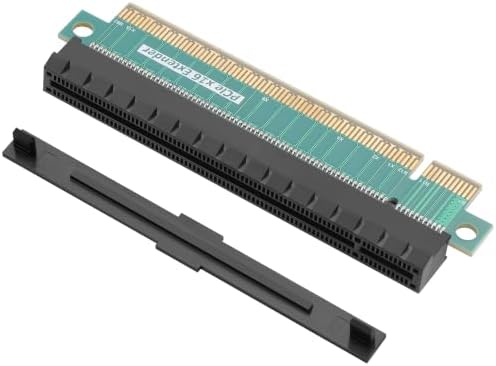
ELFJMZP PCIe 5.0 X16 Extender Riser Card
Bottom line: Per its Amazon listing, the ELFJMZP PCIe 5.0 X16 Extender Riser Card: supporting additional 40mm auxiliary fan or cooling fins.
As an Amazon Associate, SpecPicks earns from qualifying purchases. Full disclosure →
Pros & Cons
Pros
- ✓ Supporting additional 40mm auxiliary fan or cooling fins
- ✓ Backed by ELFJMZP's warranty and support channels
Cons
- ✗ Needs a free PCIe 5.0 x16 slot to run at its rated link speed — check which of your board's slots are wired for it
Manufacturer description
This high-end PCIe 5.0 X16 extension adapter features an ultra-compact height of 3cm and a precision-designed length of 10cm, making it ideal for space-constrained installations in 1U/2U servers,compact workstations, and custom water-cooled systems.The 4-layer gold-plated PCB ensures flawless high-frequency signal transmission, preserving the full PCIe 5.0 bandwidth of 128GB/s without signal degradation.Built for industrial-grade durability, the adapter is equipped with a reinforced black LCP plastic slot that can withstand over 100,000 insertions and removals,and a dust cover to protect the…
SpecPicks Verdict
SpecPicks has no buyer-rating or benchmark data for ELFJMZP PCIe 5.0 X16 Extender Riser Card, so this read rests on the manufacturer's listed specs (how we evaluate). Compare with similarly-priced alternatives in the expansion cards category before committing. Judge it on the specification table and the price rather than on sentiment: check the figures that decide your use case, then put it side-by-side with two or three close alternatives in the Compare tool before clicking through.
Before ordering, confirm the board side: this card needs a free PCIe 5.0 x16 slot. Your motherboard manual lists which slots share lanes with M.2 sockets or other slots. Prices and stock are set by the retailer and may have moved since this page was last updated.
Key Features
Quoted from the manufacturer's listing. Where it differs from the pros and cons above, those note the conditions the listing leaves out.
- Compact industrial design, breaking through the space limitations The ultra-thin 3cm height and 10cm precision structure design perfectly fits all kinds of compact chassis environments, such as 1U/2U servers, small workstations and customised water-cooling systems. The innovative height-enhancing architecture flexibly solves physical interference issues between high-end graphics cards (such as RTX 4090), CPU cooling modules and chassis frames, and supports precise spacing adjustment when multiple cards are deployed side-by-side. Translated with DeepL.com (free version)
- Selected 4-layer high-density PCB substrate with gold-plated surface treatment ensures zero loss of PCIe 5.0 UHF signal (32GT/s) transmission and maintains 128GB/s bi-directional bandwidth performance perfectly. The special black LCP material slot with reinforced protective cover design provides excellent high temperature and wear resistance, and can withstand more than 100,000 times of repeated plugging and unplugging. Translated with DeepL.com (free version)
- All-round safety protection, more peace of mind Strictly following the PCIe protocol specification and adopting the power-off operation design, it completely eliminates the risk of signal conflict caused by hot-plugging. Multiple precision fixing holes on the board can be combined with M3 screws to achieve rigid reinforcement of the graphics card, effectively preventing deformation and poor contact of heavy equipment (such as 4-slot computing cards).
- Intelligent thermal optimisation for full performance release The CFD-optimised hollow structure ensures that good airflow channels are maintained during intensive deployment. Supporting additional 40mm auxiliary fan or cooling fins, it is especially suitable for 24/7 high load scenarios such as mining/AI computing.
- Full coverage of professional scenarios, expansion without boundaries Widely compatible with all kinds of PCIe 5.0 devices, including new generation graphics cards, NVMe SSD expansion cards and AI acceleration cards. Optional professional-grade test reports (including eye chart analysis, vibration test, etc.) are available to provide data protection for data centres, research labs and other demanding environments.
Full Specifications
| Brand | ELFJMZP |
|---|---|
| Style | standard |
| Style Name | standard |
| Unit Count | 1 Count |
| Model Number | EP-00019 |
| Mfr Part Number | EP-00019 |
| Number of Items | 1 |
| Vibration/Rumble | Yes |
| Compatible Devices | Personal Computer, Graphics Card, NVMe SSD Expansion Card, AI Acceleration Card |
| Hardware Interface | PCIE x 16 |
| Warranty Description | NO |
| Item Dimensions L x W x H | 3.9"L x 0.38"W x 1.19"H |
| Full listing title | PCIe 5.0 X16 Extender Riser Card - Ultra Slim 3cm Height, 10cm Length, 4-Layer Gold-Plated PCB, Reinforced Black Slot with Dust Cover, for GPU/Mining/AI Computing Card |
Ready to buy?
PCIe 5.0 X16 Extender Riser Card - Ultra Slim 3cm Height, 10cm Length, 4-Layer Gold-Plated PCB, Reinforced Black Slot with Dust Cover, for GPU/Mining/AI Computing Card is listed on Amazon. Price, availability, shipping and returns are set by Amazon and its sellers — check the listing for current terms. SpecPicks earns a small commission on qualifying purchases — thank you for supporting independent review work.
Related Expansion Cards


More guides & deep dives from the SpecPicks archive
Browse all articles & guides →- RTX 4070 Super vs RX 7800 XT — Which to Buy in 2026
- Best Budget Gaming PC Build 2026 — ~$1,000 Parts List
- How to Build a Windows 98 Retro PC in 2026
- Best 1440p Gaming GPUs in 2026
- Emulation Hardware in 2026: FPGA, Software, and Cart-Reader Ecosystems
- The Complete Voodoo5 5500 AGP Driver Guide (2026 Edition)
- Best Retro Handhelds in 2026: Pocket, Mid-Tier and FPGA Picks
More reviews from the SpecPicks archive
Browse all reviews →- Why a Game Boy Clone Ran Too Fast — and the DIY Fix Makers Are Building
- Building a Local LLM Workstation on a Raspberry Pi 5 + Ryzen 7 5800X Hybrid
- Best Raspberry Pi Accessories for Home-Lab Builds in 2026
- Best CPU for the MSI RTX 3060 12GB: 5600G vs 5700X vs 5800X
- Did Anyone Actually Ditch iCloud or Google One for Self-Hosting?
- How to run Qwen 3 32B on NVIDIA GeForce RTX 5090
- Ryzen AI Max 385 Mini PC: Specs and What It's Really For
- Best CompactFlash and SATA/IDE Adapter for a Retro PC Boot Drive in 2026
- Open WebUI on a Raspberry Pi 4: A Self-Hosted LLM Front-End That Sips Power
- Best Gaming Monitor for 1440p in 2026
- AMD Ryzen 7 7700X3D Review: 7800X3D's OEM-Only Rival
- Intel llm-scaler-vllm 1.4: Arc Pro B70 Inference Support Lands
- Prime Day 2026: Gaming Monitor Deals Worth a Look
- Best Streaming Setup Under $400: G502 + QuadCast 2 S + Cam Link 4K vs the Bundle Alternatives
- Arc B580 12GB vs Arc A770 16GB: Which Intel GPU Wins at 1440p in 2026?
- Lossless Scaling on Steam Deck: Is It Worth It?
- VibeThinker-3B on an RTX 3060 12GB: Reasoning in 3 Billion Params
- Windows XP Gaming ISO: A Modern Hardware Setup Guide
- AI-Driven Sound Blaster Driver Recovery on Win98 in 2026
- Budget Ollama Build Under $500: What Actually Runs in 2026
- Qwen3.6 35B-A3B on a 12GB GPU: 95 tok/s on 4070 Super, 34 on 3060
- GPT-5.6 Sol vs Local Open-Weights: Why a 12GB Rig Still Earns Its Keep
- MCL8080+ Squeezes an Intel 8080 Emulator into an ATtiny85
- HiDream-O1-Image on an RTX 3060 12GB: Does It Fit?
Earliest SpecPicks reviews
Browse full archive →- Best GPU for Llama 3.1 8B (2026)
- Best GPU for Qwen 3 14B (2026)
- Best GPU for Qwen 3 32B (2026)
- Best GPU for Llama 3.1 70B (2026)
- Best GPU for DeepSeek-R1 32B (2026)
- Best GPU for Llama 3.1 405B (2026)
- How to run Llama 3.1 8B on NVIDIA GeForce RTX 5090
- How to run Qwen 3 14B on NVIDIA GeForce RTX 5090
- How to run Qwen 3 32B on NVIDIA GeForce RTX 5090
- How to run Llama 3.1 70B on NVIDIA GeForce RTX 5090
- How to run DeepSeek-R1 32B on NVIDIA GeForce RTX 5090
- How to run Llama 3.1 8B on NVIDIA GeForce RTX 4090