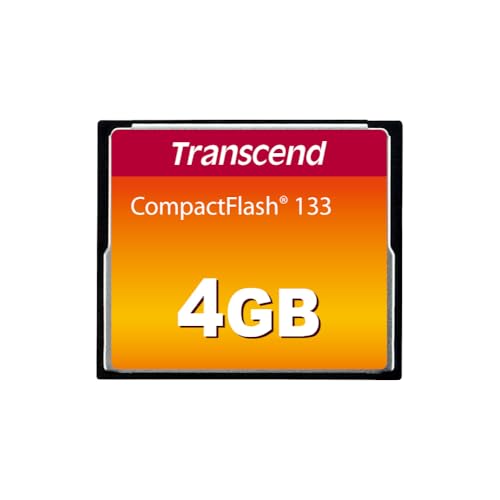
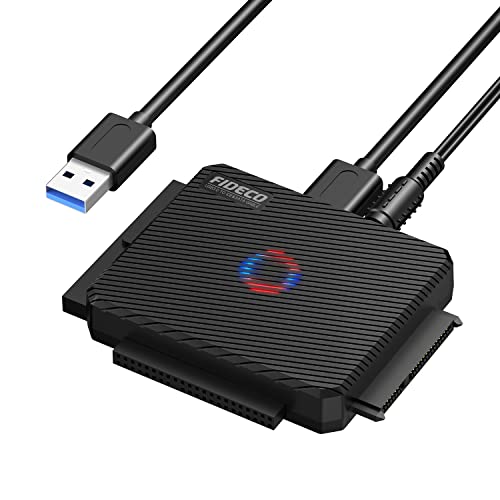
The short answer: Buy the Transcend CF133 4GB CompactFlash card and a passive CF-to-IDE adapter (~$8 from any retro parts source) for the actual boot drive. Buy the FIDECO SATA/IDE to USB 3.0 adapter for your modern PC so you can image the CF card without sitting at the retro box. The combo costs about $60 and is the most reliable retro-PC boot setup you can build in 2026.
If you've spent any time at vogons.org or watched retro-PC YouTube channels, you've seen CompactFlash mentioned dozens of times as the "right" answer for a retro PC boot drive. Here's what the threads don't always make explicit: there are three different things you're choosing between, and only one of them is the card itself. The card, the in-PC adapter, and the imaging adapter are all separate decisions, and getting any of them wrong wastes a Saturday.
This article walks through the full stack for a Pentium-class to Pentium 4-class retro build. If you're working on a Voodoo3 / Win 98 SE machine running classic DOS games, a Slot-1 P3 / Win 95 OSR2 dev box, or a P4 / Win XP gaming rig, the recommendations below apply across the board.
Key takeaways
- CompactFlash is electrically IDE. Passive CF-to-IDE adapters work without a driver layer.
- Transcend CF133 4GB is the safe pick. MLC NAND, available, $35, runs cool, no firmware surprises.
- You also need a modern-side adapter. The FIDECO SATA/IDE to USB 3.0 is the fast, reliable choice; Unitek is a fine alternative; Vantec CB-ISATAU2 is the budget tier.
- For 32GB+ workloads, use a real SSD via SATA-to-IDE bridge. The Samsung 870 EVO 250GB on a bridge gives you a daily-driver capacity at the cost of a chip in the data path.
- Set the adapter jumpers BEFORE you mount. Master/slave and Cable Select wrong = no boot, no error message.
Why CompactFlash is still the best retro boot drive in 2026
CompactFlash launched in 1994 as the storage card for early digital cameras. By accident of design, the protocol it speaks over its 50-pin connector is the True IDE / PATA protocol — the same protocol that IDE hard drives and CD-ROM drives speak. From the perspective of a 1996 motherboard, a CompactFlash card plugged into a passive adapter looks exactly like a small, fast, silent hard drive. No driver, no boot ROM, no compatibility shim.
That property has two practical consequences. First, the Microsoft installer on a Windows 95 OSR2 boot floppy will partition and format the CF card without a hiccup, where it sometimes choked on early SATA bridges in the 2010s. Second, the CF card has zero spin-up delay, near-zero seek time, and consumes about 0.3W — a Pentium III / Win 98 box with a CF boot drive is dead silent at the boot screen and runs cool inside a small case.
The downsides: capacity tops out at 256GB in current cards (8GB-32GB is what you want), write endurance is lower than a modern SSD, and the dual-IDE-channel performance is limited by the 1990s controller (~16-33 MB/s). For a boot drive that loads a 100MB OS, that's plenty.
What is CompactFlash and how does the CF-to-IDE bridge work?
CF carries the IDE signals directly on its pins. A CF-to-IDE adapter is a passive PCB: it routes the 50-pin CF connector to a 40-pin IDE connector and adds a 4-pin Molex power tap for the +5V the card needs. There's no logic chip on the adapter, no firmware, no jumper-set translation. Per Wikipedia's CompactFlash entry the protocol parity is by design — CF was specified to be IDE-compatible from day one.
What that means for retro builders: any CF card that complies with the spec works in any CF-to-IDE adapter that complies with the spec, in any IDE controller that complies with the spec. Compatibility is high. The only knobs that matter are:
- Master / slave jumper on the adapter — set to match the cable position.
- PIO / UDMA mode — most adapters auto-negotiate; if the BIOS hangs, force PIO 4.
- 40-pin vs 80-pin IDE cable — 80-pin needed for UDMA-66 and above; 40-pin fine for PIO/UDMA-33.
Picks
#1: Transcend CF133 4GB CompactFlash — best boot drive card
Verdict: Best CF card for retro boot drives. ~$35. MLC NAND. 30 MB/s sustained.
The Transcend CF133 4GB is the right card for a Win 95/98/ME/2000 boot drive. The "133" in the name refers to the read speed multiplier (133x ≈ 20 MB/s) — slower than modern cards but still 10-15x faster than the 5400 RPM IDE hard drives original to that era. The MLC NAND is the key spec: it survives ~3,000 program-erase cycles per cell, which is comfortable margin for a boot drive that's mostly read. Modern TLC consumer cards rate ~600-1,000 cycles.
Per Transcend's product line the CF133 family is positioned for embedded and industrial use, which is exactly the right profile for a retro PC. Larger sizes (8GB, 16GB) are available; we recommend 4GB for Win 98 because the FAT32 partition limit on the Microsoft installer is 32GB and 4GB keeps the OS install lean.
#2: FIDECO SATA/IDE to USB 3.0 Adapter — best imaging adapter
Verdict: Best modern-side adapter for imaging CF / IDE drives. ~$24. USB 3.0. Reads CF, SD, microSD, 2.5", 3.5", and 5.25" drives.
The FIDECO SATA/IDE to USB 3.0 Adapter is the tool you use on a modern PC to image your CF card before mounting it in the retro box. The workflow:
- Build a clean Win 98 install in a VM or on a spare hard drive.
- Dump it to an image file with
dd(Linux) or Image for Windows. - Plug the empty CF card into the FIDECO's CF slot.
- Restore the image with
dd of=/dev/sdXor Image for Windows. - Move the CF card to your retro PC.
The FIDECO is fast (full 4GB image in 90s) and includes a 12V wall wart for powering 3.5" IDE drives off the bench. The build quality is plastic but acceptable for occasional use.
Why it beats the alternatives at $24: USB 3.0 (Unitek is also USB 3.0; Vantec is USB 2.0), CF + SD + microSD slots in the same chassis (Unitek doesn't have these), and clean driver-less plug-and-play on Linux and Windows 10/11.
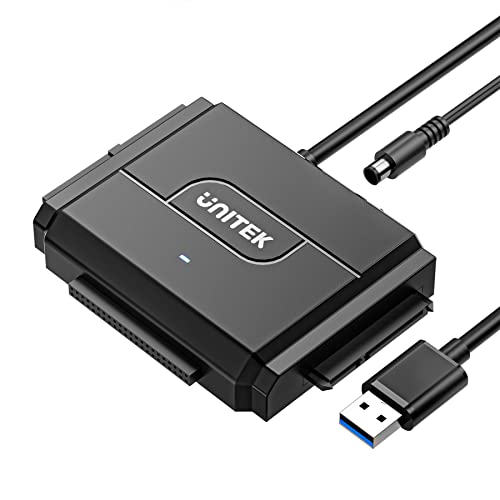
#3: Unitek SATA/IDE to USB 3.0 Adapter — alternative imaging adapter
Verdict: Solid alternative if FIDECO is out of stock. ~$35. USB 3.0. Supports drives up to 24TB.
The Unitek SATA/IDE to USB 3.0 Adapter is the second pick. It's slightly more expensive than the FIDECO and lacks the CF slot, but it's well-built (metal chassis, beefy 12V power adapter) and the SATA/IDE switching is foolproof. If you'll image only SATA and IDE drives (no CF), the Unitek is arguably the better pick on build quality alone.
#4: Vantec CB-ISATAU2 SATA/IDE to USB 2.0 — budget pick
Verdict: Budget alternative if speed isn't critical. ~$26. USB 2.0. Supports 2.5"/3.5"/5.25" drives.
The Vantec CB-ISATAU2 has been in production since 2010 and is reliable. It's USB 2.0 only, so imaging a 4GB CF card takes 5-6 minutes instead of 90 seconds. For occasional retro use that's fine; for a workflow where you image drives weekly, the USB 3.0 adapters pay back the price difference quickly.
#5: Samsung 870 EVO 250GB — when you need a real SSD
Verdict: Best SSD for a SATA-to-IDE bridge on a retro daily-driver. ~$50. 3-year warranty.
If you'd rather use a modern SSD than a CF card — say for a daily-driver retro dev box where you write a lot — the Samsung 870 EVO 250GB is the right choice. Pair it with a powered SATA-to-IDE bridge (the FIDECO can do this for testing, but for permanent install buy a dedicated StarTech bridge for ~$30). The 870 EVO has the longest warranty in its class and Samsung's wear-leveling/garbage-collection algorithms are the best in the budget SSD market.
Caveats: bridges add a chip to the data path, which can introduce instability on aggressive retro chipsets (VIA Apollo Pro 133T, SiS 530). For Pentium 4 / Win XP boxes the bridge is usually fine; for Pentium / Win 95 boxes test before you commit.
Comparison table
| Card / Adapter | Price | Role | Speed | Compatibility |
|---|---|---|---|---|
| Transcend CF133 4GB | $36 | Boot drive | 20 MB/s | Universal |
| Transcend CF133 16GB | $50 | Boot drive (XP-era) | 20 MB/s | Universal |
| FIDECO USB 3.0 adapter | $24 | Imaging on modern PC | USB 3.0 | Win 10/11, Linux, macOS |
| Unitek USB 3.0 adapter | $35 | Imaging on modern PC | USB 3.0 | Win 10/11, Linux, macOS |
| Vantec USB 2.0 adapter | $26 | Imaging (budget) | USB 2.0 | Win 7/10/11, Linux |
| Samsung 870 EVO 250GB | $50 | Daily-driver SSD | 530 MB/s* | Needs SATA-to-IDE bridge |
| Passive CF-to-IDE adapter | $8 | In-retro-PC bridge | passthrough | Universal |
*870 EVO speed is the SATA III ceiling; the IDE bridge limits you to ~33-66 MB/s.
Step-by-step: build the boot drive
This is the recipe for a Win 98 SE boot drive on a Pentium III / VIA Apollo Pro 133 board. Adapt to your era as needed.
- Image the CF card on a modern PC. Plug the FIDECO into your PC, plug the CF card into the FIDECO's CF slot. Write a known-good Win 98 image. Use
ddon Linux:sudo dd if=win98se.img of=/dev/sdX bs=4M status=progress. - Set the master/slave jumper on the CF-to-IDE adapter. If your CF card is the only drive on the IDE channel and on the end of the cable, set Master. If you're sharing the channel with an existing CD-ROM, set the CF to Master and the CD-ROM to Slave.
- Mount the adapter to the IDE cable. 40-pin cable is fine for PIO; for UDMA-33+ use 80-pin.
- Plug in Molex power. The +5V line on Molex; the adapter doesn't use +12V.
- Boot the PC. Enter BIOS, auto-detect IDE devices. The CF should show up as a ~4GB IDE drive.
- Boot Win 98 from the CF. The installer detects it as IDE; partition and format with the built-in fdisk if you didn't dd a pre-imaged install.
- Patch DOS/Windows for the LBA limit. Win 98 sees drives up to 137GB. Above that you need ATA-6 (rare on Win 98 chipsets).
Common pitfalls
- Wrong jumper position. Master vs Cable Select wrong = no boot, no error. Most adapters default to Master; check the silkscreen.
- 4GB CF in a Pentium-class BIOS with no LBA support. Old BIOSes see only 504MB unless LBA translation is on. Enable it in CMOS setup, or use the adapter's CHS-translation jumper.
- CF card running too fast. Modern 400x+ cards sometimes negotiate UDMA modes the controller can't sustain. Force PIO 4 with the adapter jumper.
- Imaging a card with
ddand forgetting to sync.sudo syncafterddor the last block is in cache and the card won't boot. - TLC consumer cards instead of MLC industrial cards. Modern Sandisk Ultra and similar cards are TLC and wear out under heavy writes. Stick to the Transcend CF133 family or industrial Apacer / Innodisk.
When NOT to use CompactFlash
If your retro PC is a daily driver — you write to it every day, compile code, do video work — CF wear becomes a real issue over 3-5 years. Move to an SSD via SATA-to-IDE bridge. The thermals and electrical isolation are fine for Pentium 4 / Win XP boxes; harder to guarantee for older chipsets.
If you need to share the drive between the retro PC and a modern PC frequently (file-transfer workflow), an SD-card + adapter combo is faster to swap than CF. CF excels when the drive stays installed.
Bottom line
For a clean retro PC boot drive in 2026, the answer is the Transcend CF133 4GB on a passive CF-to-IDE adapter, with the FIDECO SATA/IDE USB 3.0 adapter on the modern-side workstation for imaging. ~$60 total. It's quiet, fast for the era, electrically clean, and you can rebuild the boot drive in 90 seconds when something goes wrong. The Unitek and Vantec are fine alternatives; the Samsung 870 EVO is for when you need real capacity. Don't overthink it.
Citations and sources
- Transcend industrial CF family and MLC specs: Transcend CompactFlash product line.
- CF/IDE protocol parity background: Wikipedia — CompactFlash.
- Retro builder community testing and adapter compatibility threads: vogons.org.
— Mike Perry, as of 2026-05.