

FORE
FORE K1 Wireless Bluetooth USB MIDI Interface
Bottom line: The FORE K1 Wireless Bluetooth USB MIDI Interface ($29.99 on Amazon as of 2026-10-06): 3ms rated latency over 2.4 GHz, usable for live playing; main trade-off: iOS needs the app's Bluetooth MIDI panel, not system Bluetooth.
As an Amazon Associate, SpecPicks earns from qualifying purchases. Full disclosure →
*Price sourced from Amazon.com. Last updated 2026-10-06. Price and availability subject to change.
Pros & Cons
Pros
- ✓ 3ms rated latency over 2.4 GHz, usable for live playing
- ✓ Bundled USB dongle adds MIDI to PCs with no Bluetooth radio
- ✓ No driver install; pair straight from GarageBand or your DAW
- ✓ Two MIDI A units pair to each other, replacing a DIN cable run
Cons
- ✗ iOS needs the app's Bluetooth MIDI panel, not system Bluetooth
- ✗ Only one 5-pin DIN in/out pair per MIDI A unit
- ✗ 32ft/10m range caps stage placement
- ✗ Cable-free two-device mode requires buying a second MIDI A
Manufacturer description
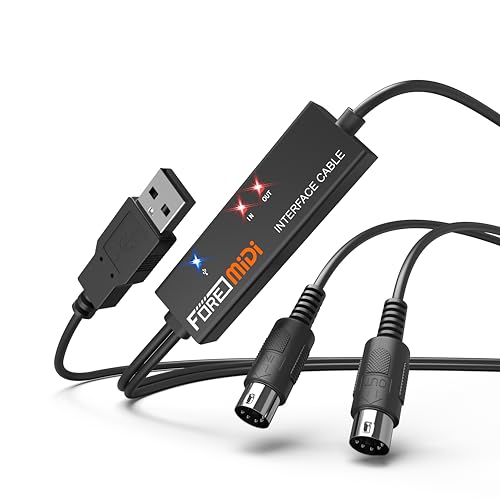
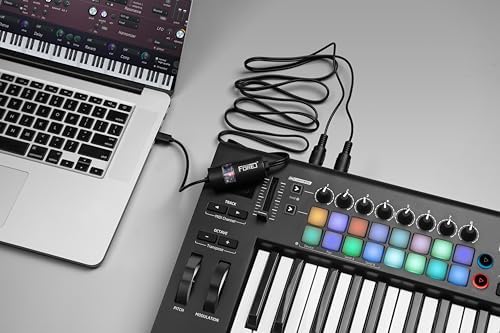
The FORE K1 Wireless Bluetooth USB MIDI Interface cuts the DIN cable run between your keyboard and your DAW without asking you to install a driver. Plug the "IN" connector into your instrument's MIDI Input and "OUT" into its Output, and the adapter pairs and passes note data with 3ms latency over a 2.4 GHz link rated to 32 feet (10 m). FORE ships it as a two-piece system: the "MIDI A" transmitter carries 5-pin DIN in and out, while the "MIDI B" USB Type-A dongle gives you a path to a desktop or laptop that has no Bluetooth radio of its own. The two halves auto-pair, and a second "MIDI A"…
SpecPicks Verdict
SpecPicks scored FORE K1 Wireless Bluetooth USB MIDI Interface using a rating × review-volume × price-fit model applied to published specs and reviews across the audio & midi category. FORE's audio & midi lineup sits within the broader category mid-tier; price and specs are the deciding factors over brand loyalty here. Judge it on the specification table and the price rather than on sentiment: check the figures that decide your use case, then put it side-by-side with two or three close alternatives in the Compare tool before clicking through.
Common buyer scenarios for audio & midi of this kind: matching it to an existing build, replacing a failing part, or upgrading from a previous-generation equivalent. Check the spec table below against your current setup — particularly socket / form-factor / power-rating fields — and confirm compatibility on the retailer's listing before purchase. Prices and stock are set by the retailer and may have moved since this page was last updated.
Frequently Asked Questions
Do I need to install a driver to use the FORE K1?
No. FORE lists it as plug, pair and play with no drivers and no complicated setup on iOS, Android, macOS, and Windows.
Why doesn't it show up in my iPhone's Bluetooth settings?
By design. It will not connect through the iOS system Bluetooth menu. Open GarageBand, go to Settings, then Advanced, then Bluetooth MIDI Devices, and tap MidiPortA.
How do I use it with a PC that has no Bluetooth?
Use both halves. Plug the MIDI B USB Type-A dongle into the computer and connect MIDI A to your instrument's DIN ports; A and B pair automatically.
How much latency and range should I expect?
FORE rates it at 3ms latency over a 2.4 GHz link with up to 32ft/10m of transmission distance.
Which DAWs and instruments does it work with?
GarageBand, FL Studio 12 and 20, Cubase, Sonar, CoreMIDI, and DirectMusic are listed, plus any keyboard, synth, or electric drum with a 5-pin DIN MIDI port.
Key Features
- FORE Wireless Bluetooth MIDI Interface Adapter is specifically designed for replacing the messy wiring harness, reduce the trouble caused by winding, and give you a fresh and clean studio. The Wireless MIDI System will replace wired transmission cable and change the traditional connection method in the past.
- Plug, Pair & Play. Without Complicated Settings & Without Installing Drivers, FORE Wireless Bluetooth MIDI Interface will be fast paired with iOS phone/ Pad, Mac OS and Windows system. Plug "IN" to "Input", Plug "OUT" to "Output".
- Support Wireless Bluetooth connection & PC connection. FORE Bluetooth MIDI System comes with 1 IN&OUT MIDI System Interface marked "MIDI A" and 1 USB Type-A Port marked "MIDI B". Bluetooth MIDI System "MIDI A" & "MIDI B" will be automatically paired. Use A and B, you can connect to PC even if the PC has no wireless function. If only use "MIDI A", you can connect to iOS Phone&Pad without "MIDI B".
- Four Modes to work. 1. [ Wireless "MIDI A" to iOS & Android Phone/Pad], 2. [ Wireless "MIDI A"+"MIDI B" to mac OS/Windows Computer, Laptop ], 3. [ Wireless "MIDI B" to iOS & Android Phone/Pad. Connecting the "MIDI B' to MIDI Keyboard with USB Cable, powerd the "MIDI B", and you can search the 'MidiPortB' on iOS & Android Phone/Pad, click it and the connection is established ], 4. [ Use 2-pack of "MIDI A" for two midi devices, two "MIDI A" will be Automatically Paired each other, then they work as midi cable to make the connection between two midi devices ].
- GarageBand, FL studio12, FL studio20, DirectMusic, CoreMIDI, Cubase, Sonar, MIDI Connections, etc. Any MIDI softare is Supported.
- Ultra low 3ms latency. FORE Wireless Bluetooth MIDI Interface Adapter supports MIDI keyboard, Synthesizer, Electric Drum and any device with 5 Pin-din MIDI port. Stable and fast speed MIDI data transmission. High-Quality 2.4 GHz Wireless Transmission, up to 32ft/10m transmission distance.
Full Specifications
| Brand | FORE |
|---|---|
| Unit Count | 1.0 Count |
| Connectivity | Bluetooth, USB, 2.4GHz |
| Model Number | Wireless MIDI |
| Compatibility | PC, Android, iOS, Mac |
| Item Type Name | Wireless MIDI Interface |
| Connection Type | Wired |
| Number of Channels | 16 |
| Supported Software | GarageBand, FL studio12, FL studio20, DirectMusic, CoreMIDI, Cubase, Sonar, MIDI Connections, etc. Any MIDI softare is Supported. |
| Warranty Description | 1 year manufacturer. |
| Connectivity Technology | MIDI / 5 PIN DIN, USB |
| Manufacturer Part Number | F-Wireless MIDI A+B K1 GER |
| Full listing title | FORE K1 Wireless Bluetooth USB MIDI Interface, MIDI IN/OUT Receiver, with Input&Output Works with MIDI Keyboard/Synthesizer/MIDI Deivce Compatible with iOS&Android, Windows/Mac OS Black |
Ready to buy?
FORE K1 Wireless Bluetooth USB MIDI Interface, MIDI IN/OUT Receiver, with Input&Output Works with MIDI Keyboard/Synthesizer/MIDI Deivce Compatible with iOS&Android, Windows/Mac OS Black is listed on Amazon. Price, availability, shipping and returns are set by Amazon and its sellers — check the listing for current terms. SpecPicks earns a small commission on qualifying purchases — thank you for supporting independent review work.
*Price sourced from Amazon.com. Last updated 2026-10-06. Price and availability subject to change.
Related Audio & MIDI



More guides & deep dives from the SpecPicks archive
Browse all articles & guides →- Best Budget Gaming PC Build 2026 — ~$1,000 ($800 on Sale)
- Best Retro Handhelds in 2026 — From $35 to $500
- How to Build a Windows 98 Retro PC in 2026
- The Complete Voodoo5 5500 AGP Driver Guide (2026 Edition)
- Best 1440p Gaming GPUs in 2026
- Emulation Hardware in 2026: FPGA, Software, and Cart-Reader Ecosystems
- RTX 4070 Super vs RX 7800 XT — Which to Buy in 2026
More reviews from the SpecPicks archive
Browse all reviews →- RTX 5070 Ti + Ryzen 7 9850X3D: Is It a Good Combo?
- Qwen3.7-Plus vs Gemma 4 12B for Local Agents on a 12GB GPU
- vLLM 0.21 Adds Intel GPU Support: What It Means for Budget AI Rigs
- Using a Raspberry Pi 5 with AI to Recover Lost Windows 98 INF Files (2026)
- Windows NT Now Boots on the Nintendo GameCube: What the Homebrew Port Actually Runs
- GeForce FX 5900 Won't POST or Crashes in WinXP: Troubleshooting Guide
- LM Studio on an RTX 3060 12GB: A Zero-Terminal Local LLM Setup
- Ryzen 7 9800X3D Hits Record-Low Price — and the 5800X Value Case
- Sound Blaster Audigy FX in a Period-Correct Win98 Gaming Build
- Dual Radeon AI PRO R9700 Workstation: 64 GB Local LLM Build
- RTX 3060 12GB vs Arc B580 for 1080p Gaming: Which Wins?
- Best Sim Racing Wheel Under $300 in 2026: Force Feedback That's Worth It
- Best GPU for Llama 70B Local Inference in 2026: RTX 3060 12GB Dual vs RTX 3090 vs Gorgon Halo
- Running Your Own AI Guardrail Model on a 12GB GPU in 2026
- How to run Llama 3.1 8B on Apple M4
- AI Coding Agents Find the Right File but Miss the Lines — What Local Code Models on a 12GB GPU Get Wrong
- Claude Fable 5 Launches at #1 on the Intelligence Index — What Local Builders Should Take Away
- Self-Host Jellyfin on a Raspberry Pi 4 8GB: Real Transcoding Numbers
- Best SSD for a Local AI / LLM Workstation in 2026
- RTX 5090 vs Mac Studio M4 Max for AI — which wins in 2026?
- Is the Logitech G502 Hero Still the Best FPS Mouse in 2026?
- How to run Qwen 3 14B on Arc B580
- $100 CPU Shootout: Ryzen 5 5500 vs Core i3-14100F vs i3-12100F
- DualSense vs 8BitDo Pro 2 vs GameSir G7 SE: Best PC Controller in 2026
Earliest SpecPicks reviews
Browse full archive →- Best GPU for Llama 3.1 8B (2026)
- Best GPU for Qwen 3 14B (2026)
- Best GPU for Qwen 3 32B (2026)
- Best GPU for Llama 3.1 70B (2026)
- Best GPU for DeepSeek-R1 32B (2026)
- Best GPU for Llama 3.1 405B (2026)
- How to run Llama 3.1 8B on NVIDIA GeForce RTX 5090
- How to run Qwen 3 14B on NVIDIA GeForce RTX 5090
- How to run Qwen 3 32B on NVIDIA GeForce RTX 5090
- How to run Llama 3.1 70B on NVIDIA GeForce RTX 5090
- How to run DeepSeek-R1 32B on NVIDIA GeForce RTX 5090
- How to run Llama 3.1 8B on NVIDIA GeForce RTX 4090