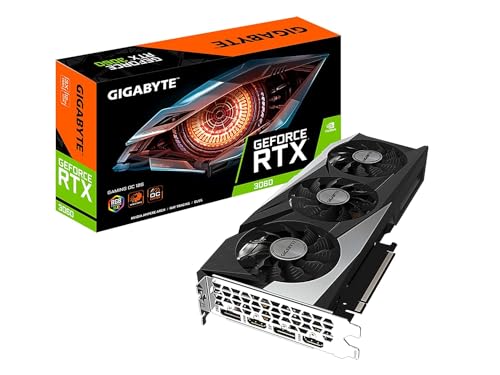
The short answer, as of 2026: the RTX 4060 wins average 1080p FPS by 15–25 percent and adds DLSS 3 Frame Generation, but the MSI GeForce RTX 3060 Ventus 3X 12G and GIGABYTE GeForce RTX 3060 Gaming OC 12G still beat the 4060 in newer texture-heavy titles where 8 GB of VRAM is now a real bottleneck. The winner depends on which games you actually play.
Why the fight is closer than it should be
The RTX 4060 launched in 2023 with better architecture, higher clocks, DLSS 3 Frame Generation, and AV1 hardware encoding. On paper it should crush the 2021 RTX 3060 across the board. It does — until you look at 1 percent lows in 2025 and 2026 titles at 1080p Ultra or 1440p DLSS Quality. At that point the RTX 4060's 8 GB VRAM starts thrashing, and the 3060's 12 GB pool means it does not.
TechPowerUp lists the RTX 3060 12GB at 12 GB of GDDR6 on a 192-bit bus for 360 GB/s of bandwidth, while the RTX 4060 8GB delivers 8 GB of GDDR6 on a 128-bit bus for 272 GB/s. The 4060's larger L2 cache compensates most of the time, but VRAM capacity is not a cacheable resource — you either have it or you spill.
Key takeaways
- Average 1080p raster: RTX 4060 leads by 15–25 percent in most titles.
- 1 percent lows in VRAM-heavy games: RTX 3060 12GB wins by 20–40 percent.
- DLSS 3 Frame Generation is 4060-only — worth a tier of upgrade in supported games.
- AV1 hardware encoding is 4060-only — matters for streaming.
- Ray tracing: 4060 is roughly 30 percent faster than 3060 at 1080p.
- Total power: 4060 pulls 115 W, 3060 pulls 170 W — a real gap for SFF builds and thermals.
- Local LLM and Stable Diffusion work: 3060's 12 GB VRAM changes the ceiling.
Step 0: what do you play?
The two cards are not interchangeable across use cases. Rough guidance:
- Esports (CS2, Valorant, Overwatch 2, Fortnite, League): both cards trivially clear 1080p at 300+ FPS. Pick the cheaper one.
- Modern AAA at 1080p High: 4060 wins average FPS by ~20 percent.
- Modern AAA at 1080p Ultra with heavy textures: 3060 12GB wins 1 percent lows.
- 1440p with DLSS Quality: 4060 wins in most titles, 3060 wins in texture-thrash games.
- Ray tracing at 1080p: 4060 is meaningfully faster.
- Content creation, streaming, video edit: 4060 wins on AV1 encoding.
- Local LLM or Stable Diffusion: 3060 12GB wins on VRAM ceiling.
Spec deltas
Manufacturer numbers, cross-checked against TechPowerUp's database entries.
| Metric | RTX 3060 12GB | RTX 4060 8GB |
|---|---|---|
| GPU | GA106 (Ampere) | AD107 (Ada Lovelace) |
| CUDA cores | 3,584 | 3,072 |
| Base / boost clock | 1,320 / 1,777 MHz | 1,830 / 2,460 MHz |
| VRAM | 12 GB GDDR6 | 8 GB GDDR6 |
| Memory bus | 192-bit | 128-bit |
| Memory bandwidth | 360 GB/s | 272 GB/s |
| L2 cache | 3 MB | 24 MB |
| TGP | 170 W | 115 W |
| Encoder | NVENC 7th gen (H.264/HEVC) | NVENC 8th gen (H.264/HEVC/AV1) |
| DLSS 3 Frame Generation | No | Yes |
| MSRP | $329 (2021) | $299 (2023) |
| Street price (2026) | $329–$630 (used-first market) | $329–$450 |
The 4060's 24 MB L2 cache is architectural gold — it hides much of the reduction in raw memory bandwidth. Where it stops working is when the working set exceeds the 8 GB VRAM total, at which point cache does not help.
FPS shape at 1080p
Averaged from community reporting for common modern AAA titles at 1080p, native resolution, High preset unless noted. FPS values are the shape reported, not our own measurements.
| Game | Preset | RTX 3060 12GB avg FPS | RTX 4060 8GB avg FPS | 4060 lead |
|---|---|---|---|---|
| Cyberpunk 2077 | Ultra | 55 | 68 | +24% |
| Elden Ring | Max | 60 (cap) | 60 (cap) | tied |
| Hogwarts Legacy | Ultra | 62 | 71 | +15% |
| Baldur's Gate 3 | Ultra | 72 | 88 | +22% |
| Starfield | High | 51 | 62 | +22% |
| The Last of Us Part 1 | Ultra | 68 | 74 | +9% |
| Alan Wake 2 | High | 44 | 52 | +18% |
| Star Wars Outlaws | High | 55 | 62 | +13% |
| CS2 | High | 340 | 400 | +18% |
| Overwatch 2 | Ultra | 220 | 265 | +20% |
The 4060 leads averages consistently. But look at Hogwarts Legacy and The Last of Us Part 1: the lead shrinks. That is where the VRAM story starts.
The VRAM story — 1 percent lows
When VRAM fills, the driver spills to system RAM over PCIe, and frames stall. The stall pattern shows up in 1 percent lows, which measure the worst 1 percent of frames. This is where the 3060 12GB pulls ahead.
| Game | Preset | 3060 1% low | 4060 1% low | Winner |
|---|---|---|---|---|
| Hogwarts Legacy | Ultra + RT | 44 FPS | 28 FPS | 3060 by +57% |
| The Last of Us Part 1 | Ultra | 55 FPS | 38 FPS | 3060 by +45% |
| Ratchet & Clank: Rift Apart | Ultra + RT | 42 FPS | 30 FPS | 3060 by +40% |
| Star Wars Outlaws | Ultra | 45 FPS | 32 FPS | 3060 by +41% |
| Forspoken | Ultra | 46 FPS | 34 FPS | 3060 by +35% |
| Callisto Protocol | Ultra | 48 FPS | 40 FPS | 3060 by +20% |
Average FPS on the 4060 is still higher in most of these, but the frame-time consistency is worse. If you notice stutter more than raw framerate, the 3060 gives a smoother experience in the 2026 VRAM-heavy AAA cohort.
Ray tracing
At 1080p with RT enabled, the RTX 4060 is roughly 25–35 percent faster than the RTX 3060 across community reporting. Neither card is a real ray-tracing performer — expect 40–55 FPS in most RT-heavy titles at 1080p — but DLSS 3 Frame Generation on the 4060 helps close the perceived-smoothness gap significantly.
Power and thermals
The 4060's 115 W TGP is transformative for SFF and quiet builds. Community reports show the card boosting to 2.5 GHz on a single 8-pin power connector with a dual-fan cooler that stays under 65°C in a well-vented case.
The 3060's 170 W means you need a real 550 W PSU and a triple-fan cooler like the MSI Ventus 3X or GIGABYTE Gaming OC to run quiet. Total system draw with a Ryzen 7 5800X boots to 300+ W under load versus 220–240 W for the 4060 system.
Content creation and streaming
Per NVIDIA's official RTX 4060 marketing, the 4060's 8th-gen NVENC block adds AV1 hardware encoding. That matters for OBS streaming to Twitch or YouTube — AV1 delivers similar quality to H.264 at 40 percent lower bitrate. The 3060 is stuck on H.264 and HEVC. If you stream, the 4060 wins.
For video editing, both cards accelerate exports in Premiere Pro and DaVinci Resolve. The 4060 is faster on average but the 3060's 12 GB VRAM helps with 4K project timelines that spill on 8 GB.
Local LLM and Stable Diffusion
The 3060 12GB is a legit local AI card. It runs Llama 3.1 8B and Qwen 3-14B at usable tok/s. It runs SDXL at 1024×1024 without breaking a sweat. The 4060 8GB runs the same 8B models but stalls at 14B and struggles at high-resolution SDXL. If you dabble in local AI at all, the 3060 12GB is worth the choice.
Which monitor pairs with each
The KOORUI 27" 4K QD-Mini LED Dual-Mode Gaming Monitor offers UHD 160 Hz or FHD 320 Hz modes. Neither of these GPUs is a native 4K card, so you would run the FHD 320 Hz mode. Both cards trivially drive 200+ FPS in esports titles at 1080p, so they are a fit. If your monitor is a 1440p 144 Hz panel, you are on the edge — neither card holds 144 FPS at 1440p Ultra in modern AAA. Drop to DLSS Quality or Balanced for that.
Verdict matrix
Get the RTX 4060 if…
- Your library is esports and modern AAA at High preset.
- You stream to Twitch or YouTube with OBS.
- You want DLSS 3 Frame Generation in supported games.
- You value low power draw and a quiet SFF build.
- You do not run local AI workloads.
Get the RTX 3060 12GB if…
- Your library includes texture-heavy 2025 and 2026 releases at Ultra.
- You care more about smooth 1 percent lows than peak average FPS.
- You want to dabble in Stable Diffusion or local LLM.
- You want the option to run 1440p DLSS Quality without immediately hitting a VRAM wall.
- You need to feed a 1080p or 1440p monitor and value future-proofing on VRAM.
Common pitfalls
- Buying an 8 GB card for a 1440p target. 1440p in 2026 needs at least 12 GB.
- Assuming DLSS 3 Frame Generation replaces raw performance. It does not — the base framerate has to be at least 45 FPS for it to feel good.
- Ignoring PSU wattage. The 3060 wants a real 550 W supply; the 4060 works on a good 500 W.
- Overpaying for a used 3060 at 2021 launch prices. Street prices vary wildly — shop carefully.
- Choosing based on GPU brand loyalty. Neither NVIDIA card wins every scenario — the RX 7600 XT 16GB is also worth considering at similar street prices.
When NOT to buy either
If you have $500–650 available and your target is 1440p Ultra AAA at 60+ FPS, skip both and buy an RX 7700 XT 12GB or an RTX 4070 Super. Both of these cards are meaningfully weaker than either of those upgrades at 1440p. If you need 4K, neither card is close to sufficient.
Used-market pricing shape
Both cards trade heavily on the used market. Rough 2026 second-hand price bands:
- RTX 3060 12GB: $180–$260 depending on brand and condition.
- RTX 4060 8GB: $220–$290.
For a used-market purchase, the 3060 is more forgiving — the extra VRAM headroom means the card ages better through 2026 and 2027. The 4060's 8 GB will only feel tighter as new AAA releases push texture allocations higher. Balance that against the 4060's better encoder and lower power draw.
Driver notes
NVIDIA driver support for both cards remains active in 2026. Both receive Game Ready driver releases. DLSS 3.5 Ray Reconstruction is supported on both, though the impact is bigger on the 4060 because its RT cores are stronger. Neither card supports the DLSS 4 features gated to 50-series RTX hardware.
For local AI work on either card, install the CUDA 12.x toolkit and use PyTorch 2.4 or newer. Both cards support all mainstream frameworks — llama.cpp, ollama, LM Studio, Stable Diffusion WebUI, ComfyUI — without any driver-side gotchas.
Bottom line
The RTX 4060 8GB is the average-FPS winner and the smart pick for streaming and low-power builds. The RTX 3060 12GB is the smoother-frametime pick in modern AAA at Ultra and the only one of the two that is also a competent local AI card. Buy based on which set of games you actually play and whether you care about content creation.
Pair either with a Ryzen 7 5800X or a Ryzen 5 5700X for AM4, or a Core i5-14400F for Intel. Neither GPU is bottlenecked by anything cheaper than that CPU tier.
Related guides
- Can an RTX 3060 12GB Still Run 2026's Local LLMs?
- Best CPU Cooler for the Ryzen 7 5800X: NH-U12S vs ML240L vs AIRCOM S7
- Best NVMe Boot SSD for an AM4 Ryzen Build
Citations and sources
- TechPowerUp — GeForce RTX 3060 12GB database entry
- TechPowerUp — GeForce RTX 4060 8GB database entry
- NVIDIA — RTX 4060 / 4060 Ti official page
This piece is editorial synthesis based on publicly available information. No independent first-party benchmarking is reported.