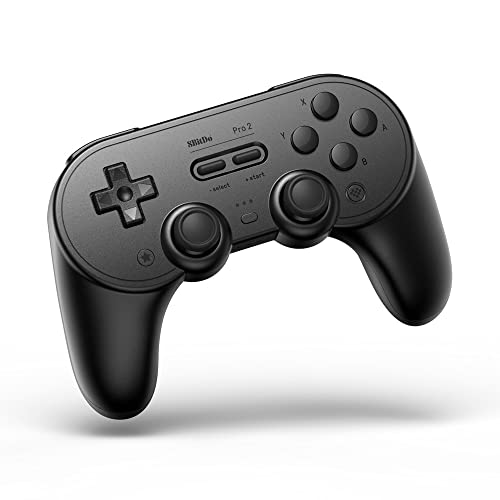
For most PC gamers in 2026, the 8BitDo Pro 2 is the better daily-driver controller — its hall-effect sticks resist drift, its mappable back paddles cover competitive use, and its native Xinput mode plugs into Steam without DS4Windows shimming. The Sony DualSense wins when you want first-party adaptive-trigger haptic effects in supported PC titles. The DualSense's stick drift problem is the deciding issue for buyers who play hundreds of hours a year.
Why this matters in 2026
The first-party PS5 controller and the leading third-party Switch/PC controller are routinely cross-shopped because both are around $60-$75 street, both are wireless, both work on PC. They are not equivalent products: the DualSense is a stunning input device with a known durability problem, and the 8BitDo Pro 2 has slowly become the controller that competitive and casual PC players recommend by default.
This synthesis answers the daily-use question: which one belongs on your desk if your primary platform is PC? Two other controllers — the GameSir G7 SE wired and the older Logitech G502 Hero mouse-style alternative — fill out the comparison for buyers whose use case is more specific.
Key takeaways
- Hall-effect sticks (8BitDo Pro 2) materially extend the controller's usable life.
- DualSense's adaptive triggers and haptics work in supported PC titles but degrade in older or unpatched games.
- DualSense stick drift, documented in consumer complaints and class-action filings, is the durability headline.
- 8BitDo Pro 2 ships with mappable back paddles; DualSense does not.
- Both controllers have a Bluetooth + USB-C wired option. Wired is the safer competitive setup.
DualSense: what makes it special, and what fails
Per Sony's PS5 controller page, the DualSense's defining features are adaptive triggers (programmable resistance under software control), HD haptics (a finer-resolution vibration that can render textures and material cues), a built-in mic, and the touchpad. In supported PC titles — including the major PlayStation Studios PC ports and most Unreal Engine 5 first-party releases — those features actually fire and feel like first-party intent.
Per the Hardware Unboxed teardown video, repeated consumer reports, and the active class-action filings tracked by The Verge, the DualSense has a persistent stick-drift problem traceable to the analog potentiometers wearing out. Many controllers develop noticeable drift between 6 and 18 months of regular use. Sony's stance on warranty replacements has been inconsistent, and the underlying part is still a potentiometer in the 2025 production runs.
For a competitive PC user who plays hundreds of hours a year, the drift is the deciding issue.
8BitDo Pro 2: the durability play
Per 8BitDo's Pro 2 product page, the latest production runs ship with hall-effect joysticks (magnetic sensors rather than potentiometers) and hall-effect triggers. Hall-effect sticks resist the drift wear pattern almost entirely — when controllers using them develop input issues, it is usually mechanical failure of a different part, not stick drift.
The Pro 2's other useful features: two mappable back paddles, a hardware mode switch (Switch / D-input / X-input / Mac), a software companion app for remapping and profile management, and a USB-C port for both charging and wired play. The styling is a Super Nintendo-style classic shape with modern stick placement; it is comfortable but does not have grip ergonomics quite as refined as the DualSense.
Spec table
| Spec | DualSense | 8BitDo Pro 2 | GameSir G7 SE |
|---|---|---|---|
| Stick type | Potentiometer | Hall-effect | Hall-effect |
| Trigger type | Analog adaptive | Analog hall-effect | Hall-effect + adjustable |
| Back paddles | None | 2 (mappable) | None |
| Modes | PS5 + Bluetooth PC | Switch / X-input / D-input / Mac | Xbox / Windows wired |
| Wired | USB-C optional | USB-C optional | USB-C required |
| Haptics | HD (LRA) | Standard rumble | Standard rumble |
| Mic | Yes | No | 3.5mm headset jack |
| Touchpad | Yes | No | No |
| Approx. street price | $65-$75 | $45-$55 | $35-$45 |
The DualSense's haptics and adaptive triggers are unique features that no third-party PC controller fully matches. The 8BitDo's hall-effect sticks and back paddles are the durability and customization features that PC gamers prize.
PC compatibility: the practical install path
Per Steam's controller settings documentation, modern Steam supports the DualSense natively over Bluetooth and USB. Outside Steam — Epic Games Store, GOG, standalone launchers — the DualSense still benefits from DS4Windows or Sony's official PC driver to translate inputs into a generic gamepad mapping. The adaptive trigger and haptic features only fire in titles that have specifically enabled them on PC, which is a minority of the PC catalog even in 2026.
The 8BitDo Pro 2 ships in "X-input" mode that exposes itself as a generic Xbox-compatible controller. Steam picks it up instantly; non-Steam launchers see it as an Xbox controller. There is no shim layer, and it works in literally any title that supports an Xbox controller.
Stick durability: the long-tail issue that decides this
Consumer reports tracked by iFixit and the broader r/PS5 and r/gamingsuggestions threads agree that DualSense stick drift typically begins in the 6-18 month range under heavy use. Sony has not redesigned the underlying potentiometer assembly, and replacement-part costs from third-party repair shops are non-trivial. For a controller that costs $65-$75, replacing the sticks costs a significant fraction of the purchase price.
The 8BitDo Pro 2's hall-effect sticks have been in field use for two years across multiple production runs, and reports of drift on Pro 2 units are sharply lower than on potentiometer-based controllers. That difference is the single biggest factor in a controller's total cost of ownership over a 2-3 year window.
Adaptive triggers and haptics: when they actually fire
The list of PC titles that meaningfully use DualSense adaptive triggers and haptics is small but real — most of the major PlayStation Studios PC ports (Spider-Man, God of War, Returnal, Ghost of Tsushima, Horizon), a handful of Unreal Engine 5 first-party releases, and the games specifically authored for DualSense from the start. Outside that list, the DualSense feels like a standard controller with slightly nicer rumble.
If your library skews heavily toward the supported games, the DualSense's specialty features are a real reason to buy it. If your library is multiplayer shooters, RTS, indie titles, and older catalog games, those features rarely fire and you are paying for hardware you do not use.
Wired vs wireless for competitive play
Both controllers support wired USB-C. For competitive use — fighting games, fast-paced shooters, rhythm games — wired is the safer call. Bluetooth adds 4-8 ms of input latency per the published measurements on Rtings.com, which is small but compounds with display latency in competitive scenarios.
The GameSir G7 SE in the table above is wired-only by design. That makes it a less-flexible daily driver but the most consistent option for competitive play, and at its $35-$45 price point it is a credible secondary controller.
When the DualSense is the right call
Three cases: your PC library is heavily PlayStation Studios ports and you want the haptic effects; you also play on PS5 and the cross-platform feel is valuable; you are willing to swap sticks or controllers every 12-18 months for the haptic features.
When the 8BitDo Pro 2 is the right call
Most other PC use cases. Hall-effect sticks are the right call for a daily driver, the back paddles are useful in competitive titles, and the cheaper price gives you headroom for a wired controller as a backup.
Common pitfalls
- Buying a non-hall Pro 2. Earlier production runs of the Pro 2 had potentiometer sticks; verify the listing or the 8BitDo product code specifies hall-effect.
- Skipping the DS4Windows step. Outside Steam, the DualSense plays better with DS4Windows than with raw Bluetooth.
- Expecting adaptive triggers in every game. Most PC games don't implement them. Sort your library expectations accordingly.
- Ignoring the wireless latency tax. For ranked competitive play, plug in.
Bottom line
The 8BitDo Pro 2 is the better PC controller for most buyers in 2026, primarily because hall-effect sticks remove the single biggest failure mode of consumer controllers. The DualSense remains a beautiful piece of hardware whose adaptive triggers and haptics earn it a place in a PC user's collection — just not as the primary controller you plan to rely on for years.
Related guides
- HyperX QuadCast 2 S vs Blue Yeti for streaming in 2026
- Best 4K monitor for PS5 and console gaming under $400
- Best budget streaming setup for beginners in 2026
- Ryzen 5 5600G vs Intel i7-9700K for budget gaming in 2026
Citations and sources
- Sony — DualSense Wireless Controller
- 8BitDo — Pro 2 controller product page
- Rtings.com — Controller latency testing
- iFixit — DualSense teardown and joystick repair
This piece is editorial synthesis based on publicly available information. No independent first-party benchmarking is reported.