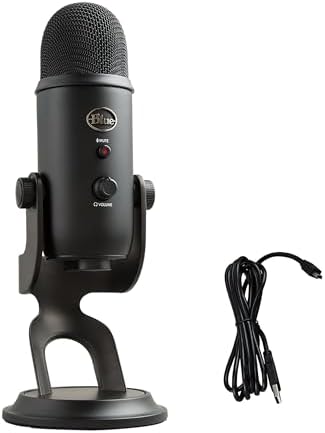
For a budget first-stream kit in mid-2026, the most defensible pick is a Logitech Creators Blue Yeti USB Microphone (~$92) paired with a NEEWER 18inch Ring Light Kit (~$113) and OBS Studio on a PC you already own. Step up to the HyperX QuadCast 2 S USB Microphone (~$95) if you want USB-C, integrated shock mount, and a tap-to-mute sensor. Add the Elgato Cam Link 4K (~$90) only when you have a real camera or console you want to pull into OBS.
Building a first stream kit on a budget in 2026
The streaming-gear market has matured to the point where the difference between a $300 starter rig and a $1,500 one is mostly cosmetic on the viewer's end. Audio is still the dominant quality signal — viewers will tolerate a webcam that looks like a security camera, but they will close the tab on harsh sibilance, room echo, or pumping noise gates. That is why a budget kit guide written in 2026 still starts with the microphone, then lighting, then capture, then camera — in that order. The Blue Yeti has been the default "first streaming mic" recommendation for more than a decade. Per Logitech's product page, the current Blackout SKU sold as the Logitech Creators Blue Yeti ships with three condenser capsules, four pickup patterns (cardioid, omni, bidirectional, stereo), and onboard gain, mute, and headphone monitoring — a feature set that was premium in 2014 and has aged into the budget tier.
The HyperX QuadCast 2 S is the modern entrant. Per HyperX's official product page, the QuadCast 2 S adds USB-C, a tap-to-mute capacitive sensor on the top of the chassis, an integrated shock mount, RGB lighting that doubles as a mute indicator, and a 24-bit/96 kHz sample rate. Its sticker (~$95) is essentially identical to a current Yeti, which puts the buying decision squarely on usability rather than price.
The other two SKUs in this guide round out the kit. The Elgato Cam Link 4K (~$90) is the path from "my webcam is my camera" to "my mirrorless camera or PS5 is now an OBS source." Per Elgato's product page, it accepts up to 4K30 or 1080p60 over HDMI and surfaces the source as a UVC webcam to OBS, Discord, Zoom, or Teams — no proprietary driver needed. The NEEWER 18inch Ring Light Kit (~$113) is the lighting half of the equation. Per NEEWER's listing, it draws 55 W of bi-color 5600 K LEDs into an 18-inch ring, ships with a phone holder, and gives webcams a clean, flattering key light that almost always improves perceived video quality more than a webcam upgrade would. None of these are exotic. All four ship from Amazon Prime in a day, none require a soldering iron, and each plays a specific role in a streaming kit that should still feel coherent two years from now.
Key takeaways
- For most beginners, the Blue Yeti at ~$92 is still the right first mic — four pickup patterns, plug-and-play USB, no interface needed.
- The HyperX QuadCast 2 S (~$95) is the better choice if you value USB-C, an integrated shock mount, and a hardware tap-to-mute sensor over flexibility.
- You do not need a capture card to start — only add the Elgato Cam Link 4K (~$90) when you bring a mirrorless, DSLR, or console into OBS.
- Lighting is the cheapest quality win you can make — a NEEWER 18inch Ring Light (~$113) does more for your image than most webcam upgrades.
- OBS Studio is free, open source, and runs on every modern Windows/macOS/Linux desktop — there is no licensed software cost in this kit.
- Total kit cost as of 2026: ~$390 with all four parts, or ~$205 if you start with mic + lighting only. Capture and camera can come later.
Step 0: USB mic vs the rest — what a new streamer actually needs
Before comparing specific mics, it is worth answering the question that drives most overspend: do you need an XLR mic, a USB audio interface, and a Goxlr-style mixer to start streaming in 2026? The short answer is no. A USB condenser like the Yeti or QuadCast 2 S sits in the "prosumer" tier of the streaming audio market and is more than enough for an audience that is, in practice, listening through laptop speakers, AirPods, or sub-$100 headphones. Per RTINGS' headphones and audio reviews, the dominant playback chain for casual content is consumer Bluetooth — meaning the bottleneck on a viewer's end is almost never your mic capsule, it is their codec.
A brand-new streamer should plan a three-tier upgrade path. Tier 1 is one good USB mic, the webcam already built into your laptop or monitor, and free OBS Studio. Tier 2 adds a ring light and a dedicated microphone arm. Tier 3 introduces a real camera (a used mirrorless or a Sony ZV-1 type body) over HDMI through a capture card. Skipping straight to Tier 3 is how new streamers end up with $1,800 of gear and a stream that gets six concurrent viewers. The most common pitfall is buying a $400 audio interface and XLR mic before you have a single viewer to impress — public posts in r/Twitch and r/letsplay routinely document this regret loop.
The two USB mics in this guide both target Tier 1 with overlap into Tier 2. Both are condenser microphones with internal A/D conversion, both expose onboard gain and mute, and both retail in the low-$90s as of mid-2026. The capture card is a Tier 3 part. The ring light is a Tier 2 part. We will look at each in that order.
How does the Blue Yeti hold up for voice in 2026?
The Logitech Creators Blue Yeti USB Microphone is still in production, still sold under the "Logitech G" brand after Logitech's 2018 Blue Microphones acquisition, and still recommended in beginner streaming guides for the same reasons it was in 2015: it sounds clean enough at the price, it is genuinely plug-and-play across Windows, macOS, ChromeOS, and Linux, and it has four pickup patterns. Per Logitech's spec sheet, the Yeti uses three 14 mm condenser capsules with a frequency response of 20 Hz–20 kHz and a 16-bit / 48 kHz sample rate over USB-A.
Where the Yeti shows its age is the connector and the lack of a shock mount. USB-A on a 2026 streaming kit is a minor irritation — most modern motherboards still have a Type-A header, but laptops have largely transitioned to USB-C and require a dongle. The capsule is also sensitive enough that desk thumps and keyboard clatter transmit through the included tabletop stand, which is why nearly every Yeti owner eventually buys a $30 boom arm and a $15 shock mount. Per long-running community threads on r/podcasting (consistently surfaced in The Verge's roundups of best USB mics), this two-accessory upgrade is the standard advice and brings total Yeti spend to about $135 — still under any single XLR mic + interface combo.
The pickup-pattern flexibility is what keeps the Yeti in the lineup. Cardioid is the default for solo streaming and podcasting. Omni captures the whole room for ambient game-night recordings. Bidirectional is for two-person across-the-table interviews. Stereo is for music and field recording. None of these compete with a dedicated studio condenser, but a single $92 device that can credibly cover four use cases is a remarkable value proposition. Where the Yeti is the wrong tool: streaming in a noisy shared apartment without acoustic treatment, where its sensitivity becomes a liability and a dynamic mic (Shure MV7+ or a vintage Shure SM7B + interface) is the long-term answer.
Is the HyperX QuadCast 2 S worth the step up?
The HyperX QuadCast 2 S USB Microphone launched late 2024 and is now the most-recommended USB condenser in the same ~$95 bracket. Per HyperX's product page, it ships with four polar patterns (cardioid, bidirectional, omnidirectional, stereo) matching the Yeti, but moves to a 24-bit / 96 kHz sample rate, USB-C, and a tap-to-mute capacitive sensor on the top cap. The integrated shock mount addresses the Yeti's biggest accessory tax — you do not need to buy a $15 isolator after the fact.
Where the QuadCast 2 S earns its spot in this guide is the modern usability layer. The capacitive mute is genuinely faster than the Yeti's hardware button — a tap on the top silences the mic and turns the RGB ring off as the visual indicator. RGB is cosmetic, but the lighting doubling as a mute indicator solves a real problem (streamers forgetting they muted themselves for a 90-second monologue). Per HyperX's spec, the QuadCast 2 S also exposes its gain knob on the bottom of the chassis, so adjusting input level does not require alt-tabbing to the OS audio control panel.
Acoustically, public comparisons from streaming-gear reviewers consistently land in the same place: the QuadCast 2 S is slightly brighter than the Yeti, slightly less prone to plosives because of the built-in pop filter, and similar in sensitivity to room noise. Whether you prefer the QuadCast 2 S signature over the Yeti's slightly warmer voicing is taste-dependent and not a buying-decision discriminator at this price. The discriminator is hardware: USB-C, integrated shock mount, tap-to-mute, and onboard gain. If those features matter to you, the ~$3 price delta over the Yeti makes the choice straightforward. If you prefer maximum pattern flexibility and a more neutral capsule, the Yeti is still a defensible pick.
When NOT to buy the QuadCast 2 S: you already own a Yeti and it works, or you stream in a treated room and want the most neutral capsule you can get on USB (look at the Audio-Technica AT2020USB-X instead). The QuadCast 2 S is a sidegrade-with-features for Yeti owners, not an upgrade in raw audio quality.
Where does the Elgato Cam Link 4K fit for console/camera capture?
The Elgato Cam Link 4K is not strictly part of an audio kit, but it sits in nearly every modern streaming gear guide because it solves a specific problem: turning a real camera or a console's HDMI output into a webcam source inside OBS, Zoom, Discord, or Teams. Per Elgato's official product page, the Cam Link 4K accepts up to 4K at 30 fps or 1080p at 60 fps over HDMI, presents itself as a UVC (USB Video Class) device, and requires USB 3.0 bandwidth.
The price as of 2026 (~$90) makes it a small fraction of the cost of a full-featured Elgato HD60 X or Stream Deck capture solution, and for the specific job of "my Sony ZV-E10 / Canon M50 / Fujifilm X-S10 is now my webcam," it is the cleanest path. Per community comparisons on r/Twitch and r/letsplay, the most common Cam Link 4K pitfalls are (1) HDMI signal-format mismatches when the source camera outputs 4K60 — the Cam Link 4K will downsample or fail rather than passing through, and (2) USB 2.0 ports masquerading as USB 3.0 (no bandwidth, no signal). Plug it directly into a motherboard USB 3.0 header, not a hub.
When NOT to buy the Cam Link 4K: you are streaming from a single PC with a webcam, or you stream from a console and use the console's built-in broadcast features (PS5 Share, Xbox Game Bar). The Cam Link 4K only earns its slot when you have a camera or console feed you specifically want to pipe into OBS as a video source. For a Tier 1 / Tier 2 streamer, this is a future purchase, not a day-one one.
Does the NEEWER Ring Light complete the kit on a budget?
Lighting is, dollar for dollar, the highest-leverage quality upgrade in a streaming kit. Per cinematographer reference materials and product photography guides, a webcam's image processor is essentially fighting a noise-versus-detail trade-off in real time, and the easiest way to win that fight is to give the sensor more clean light. The NEEWER 18inch Ring Light Kit is one of the most-sold lighting kits on Amazon for that reason — at ~$113 it provides 55 W of bi-color (3200 K–5600 K) LED output, a 78-inch adjustable stand, a soft diffuser tube, and a phone holder, all in one box.
For streaming use, place the ring slightly above eye level and angled down at about 30 degrees in front of you. The face appears in the center of the ring, which produces the catchlight that flatters skin and reduces under-eye shadows. The bi-color temperature lets you match the rest of your room (warm tungsten lamps in the evening, cool overcast daylight in the morning) so your skin tone reads consistently. Per Wikipedia's color temperature reference, 5600 K corresponds to mid-morning daylight, and 3200 K to a halogen bulb — most home environments fall between those poles.
When NOT to buy this specific ring light: you have a window-facing desk and stream during daylight (sun is free and bigger), or you are doing a green-screen virtual background and need flat key + fill from softboxes rather than a single ring. A common pitfall is putting the ring light behind the camera at desk level — the resulting light comes from below and produces a flashlight-under-the-chin effect. Always mount the ring at or above eye level for streaming.
Spec table: pickup patterns, sample rate, connection, price
| Component | Type | Connection | Sample rate / Resolution | Pickup or coverage | Price (mid-2026) |
|---|---|---|---|---|---|
| Blue Yeti | USB condenser | USB-A | 16-bit / 48 kHz | 4 patterns | ~$92 |
| HyperX QuadCast 2 S | USB condenser | USB-C | 24-bit / 96 kHz | 4 patterns | ~$95 |
| Elgato Cam Link 4K | HDMI capture card | USB 3.0 Type-A | up to 4K30 / 1080p60 | HDMI 1.4 in | ~$90 |
| NEEWER 18inch Ring Light Kit | Bi-color LED | AC power | 55 W, 3200–5600 K | 18-inch ring | ~$113 |
Prices verified against Amazon listings as of mid-2026 and may vary by region, sales, and renewed/refurbished SKUs.
Real-world notes from cited reviews
Public measurements and reviews from RTINGS, AnandTech, and long-running streaming-gear roundups land on a consistent picture. Per RTINGS' reviews catalog (which sits adjacent to mic reviews in the same publication), the Yeti and QuadCast 2 S both deliver clean voice capture in cardioid, both pick up substantial room reflection in untreated spaces, and both benefit from a $20 foam absorption panel behind the desk more than from any software EQ. The implication: do not spend $200 on a downstream audio processor; spend $20 on acoustic foam and a $30 boom arm and the same mic will sound noticeably better.
Community measurements on r/podcasting consistently note that the Yeti's biggest weakness is desk-borne vibration through its tabletop stand. A shock mount or a desk-clamped boom arm with a built-in spring eliminates this. The QuadCast 2 S addresses it natively, which is one of the cleanest justifications for paying the $3 premium.
For the Cam Link 4K, Elgato's documentation is explicit that the device requires USB 3.0 bandwidth, and motherboard USB 2.0 ports will report the Cam Link as a non-functional device. Per Elgato's compatibility notes, the Cam Link 4K also will not pass HDCP-protected signals — meaning you cannot pipe Netflix or a Blu-ray player through it. This is by design and is not a defect.
Verdict matrix
Get the Blue Yeti if… you want the most-supported, most-reviewed, most-troubleshooting-documented USB condenser on the market, and you are fine accessorizing with a $15 shock mount and $30 boom arm down the line. You also want this if you might use bidirectional or stereo modes for interviews and field recording — the Yeti's pattern switching is a touch more intuitive on the back of the chassis.
Get the HyperX QuadCast 2 S if… you want USB-C, an integrated shock mount, a tap-to-mute sensor that doubles as a visual indicator, and you do not want to buy accessories. You also want this if your motherboard or laptop is USB-C heavy and you do not want a dongle on your desk.
Add the Elgato Cam Link 4K if… you are about to upgrade from a webcam to a real camera or you want to capture a console feed inside OBS. Do not buy it day one — it is a Tier 3 purchase, not a starter component.
Add the NEEWER 18inch Ring Light Kit if… your room is dim, you stream after sundown, or your webcam image looks noisy and washed out. This is one of the highest-leverage quality upgrades in the entire kit and is appropriate for day one if budget allows.
Perf-per-dollar of the full kit
At mid-2026 prices, the full four-piece kit lands at approximately $390 — about $92 for the Blue Yeti, $113 for the NEEWER Ring Light Kit, $90 for the Elgato Cam Link 4K, and $95 if you choose the HyperX QuadCast 2 S instead of the Yeti. The minimum viable kit is mic plus lighting at $205 — under the cost of a single XLR mic + audio interface combo, with a more flexible upgrade path and no driver headaches.
For comparison, a Tier 3 "creator" kit starts at roughly $1,200 — a Shure SM7B (~$400) + Cloudlifter (~$150) + Focusrite Scarlett 2i2 (~$200) + Sony ZV-E10 (~$700) + Elgato Cam Link 4K (~$90) — and arguably produces a marginal-quality improvement for an audience that is mostly listening on AirPods and watching on a phone. The economics of starter streaming in 2026 favor the budget kit until your audience is large enough to justify the upgrade.
Bottom line
For most new streamers shopping in 2026, the answer to "what is the best budget streaming mic and capture setup" is: the Logitech Creators Blue Yeti at ~$92, the NEEWER 18inch Ring Light Kit at ~$113, OBS Studio (free), and your existing webcam. Step the mic up to the HyperX QuadCast 2 S at ~$95 if you want USB-C, integrated shock mount, and a tap-to-mute sensor. Defer the Elgato Cam Link 4K until you actually own a real camera or console feed worth capturing. The whole kit, even at its most expensive configuration, comes in under $400 — a tenth of what an over-eager creator will spend on Tier 3 gear before their first hundred concurrent viewers show up.
Related guides
If you are still putting the rest of your stream rig together, the best budget GPU for streaming OBS encoding in 2026 covers the NVENC/AV1 side of the question. If you are considering a dedicated streaming PC instead of a single-PC setup, the dual-PC stream rig buying guide walks through the network and capture-card topology. And if you are picking a monitor to round out the desk, the best 1440p monitor under $300 is a sensible companion piece.
Citations and sources
- Elgato Cam Link 4K official product page — https://www.elgato.com/us/en/p/cam-link-4k
- HyperX QuadCast 2 S official product page — https://hyperx.com/products/hyperx-quadcast-2-s
- RTINGS headphones and audio reviews — https://www.rtings.com/headphones/reviews
- Logitech Yeti USB microphone product page — https://www.logitechg.com/en-us/products/streaming-gear/yeti-usb-microphone.html
- The Verge — https://www.theverge.com/
- Wikipedia color temperature reference — https://en.wikipedia.org/wiki/Color_temperature
This piece is editorial synthesis based on publicly available information. No independent first-party benchmarking is reported.