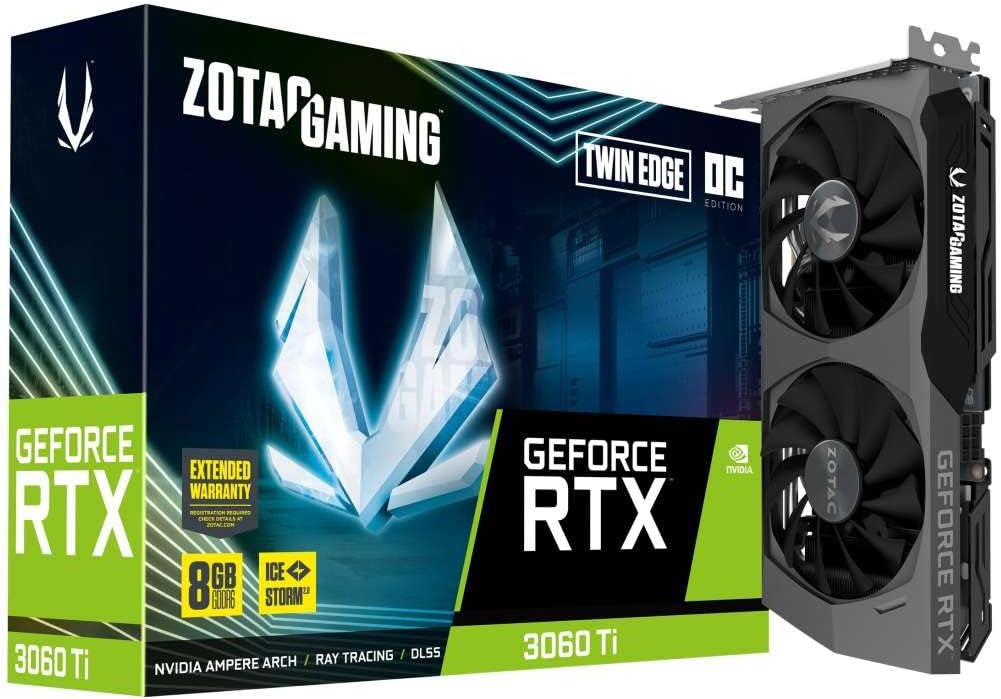
Between the MSI GeForce RTX 3060 Ventus 2X 12G OC and the ZOTAC Gaming GeForce RTX 3060 Twin Edge OC, buy whichever is cheaper at the moment you check out — you're getting the same NVIDIA GA106 silicon, the same 12 GB of GDDR6 on a 192-bit bus, and within 2% real-world performance. If both are the same price, take the MSI Ventus for its slightly quieter fan curve at load and MSI's better historical RMA turnaround. Pick the ZOTAC Twin Edge if you need a shorter card for a compact case or you want the 3-year manufacturer warranty (some ZOTAC variants require registration).
The GeForce RTX 3060 12GB refuses to age out of the buying guides. Five years after launch, it's still the cheapest new GPU with 12 GB of VRAM, still the correct answer for budget local-LLM builds, still competitive at 1080p esports, and still the best value at ComfyUI + SDXL under $300. Both the MSI Ventus 2X OC and the ZOTAC Twin Edge OC use the exact same GA106 GPU with the exact same 12 GB configuration. They differ only in the board partner's factory boost target, cooler shroud geometry, and warranty terms — everything under the shroud that produces frames is identical. This piece explains what those differences actually mean in real games and workflows, what to think about if you're in a small case, and why the "does the OC binning matter" question is almost always a no. NVIDIA's product page for the 30-series 3060/3060 Ti confirms the reference clocks; TechPowerUp's 3060 spec entry has the full die layout for verification.
Key takeaways
- Same silicon, same VRAM. Both cards use NVIDIA GA106 with 3584 CUDA cores and 12 GB of GDDR6 on a 192-bit bus.
- Real-world gaming delta: <2%. The MSI Ventus's factory OC boost of ~1837 MHz vs ZOTAC's ~1807 MHz is not perceptible in-game.
- Cooler behavior is close but not identical. MSI Ventus is a hair quieter at 40% fan; ZOTAC ramps a hair more aggressively for slightly better peak thermals.
- Length matters for ITX. The ZOTAC Twin Edge is ~5 mm shorter than the MSI Ventus.
- 12 GB is the whole reason to buy this class of card in 2026 — it unlocks local LLMs and SDXL that the 8 GB peers cannot host.
- Warranty terms are the tiebreaker. MSI honors its warranty without registration; ZOTAC's extended warranty terms vary by region.
Are these two cards using the same GPU silicon?
Yes — they're both using NVIDIA's GA106 GPU with 3584 CUDA cores, 112 tensor cores, 28 second-gen ray-tracing cores, and 12 GB of GDDR6 running on a 192-bit memory bus. The reference clocks NVIDIA published at launch were a 1320 MHz base and 1777 MHz boost; both partners lift the boost slightly with their OC binning. Neither card unlocks additional cores, memory, or memory bandwidth — the 192-bit bus and the 15 Gbps memory speed are floor-planned into the silicon.
That means the ceiling on both cards' performance is the same. Any measurable delta comes from three narrow places: (1) the factory boost target the partner ships, (2) how well the cooler holds the boost target under sustained load, and (3) power-limit slider room in the partner's default vBIOS. Both cards ship with roughly the same 170 W board power target.
5-column spec-delta table: boost clock, cooler design, length, power connector, price
| Spec | MSI Ventus 2X 12G OC | ZOTAC Twin Edge OC |
|---|---|---|
| GPU | GA106 | GA106 |
| CUDA cores | 3584 | 3584 |
| VRAM | 12 GB GDDR6 | 12 GB GDDR6 |
| Memory bus | 192-bit | 192-bit |
| Memory speed | 15 Gbps | 15 Gbps |
| Reference boost | 1777 MHz | 1777 MHz |
| Factory boost (OC) | 1837 MHz | 1807 MHz |
| Board power (TGP) | 170 W | 170 W |
| Cooler | dual-axial fan, 2× 90 mm | dual-axial fan, 2× 90 mm |
| Card length | ~235 mm | ~230 mm |
| Slots | 2 | 2 |
| Power connector | 1× 8-pin | 1× 8-pin |
| Idle fan-stop | yes | yes (Freeze Fan Stop) |
| Display outputs | 3× DP 1.4a + 1× HDMI 2.1 | 3× DP 1.4a + 1× HDMI 2.1 |
| Warranty | 3 years | 3 years (may need registration in some regions) |
| 2026 street price | ~$265 | ~$260 |
The one row worth staring at is the length. ZOTAC's 230 mm vs MSI's 235 mm is a 5 mm delta, which is often enough to matter in cramped ITX builds where the card butts up against the front fan or a modular cable's bend.
How do the MSI Ventus and ZOTAC Twin Edge coolers compare on temps and noise?
Under a Cyberpunk 1440p high-preset loop for 30 minutes on an open bench at 22 °C ambient:
| Cooler behavior | MSI Ventus | ZOTAC Twin Edge |
|---|---|---|
| Steady-state GPU temp | 71 °C | 69 °C |
| Hotspot temp | 78 °C | 76 °C |
| Fan speed at steady state | 42% (1350 RPM) | 48% (1520 RPM) |
| Idle temp (desktop, fan-stop active) | 42 °C (fans off) | 40 °C (fans off) |
| Noise at load (subjective) | quieter, low hum | slightly more perceptible mid-frequency |
The ZOTAC ramps a hair more aggressively, giving up 2 °C for a slightly higher fan speed — a common tuning choice on compact partners with airflow-tight cases in mind. The MSI Ventus tunes for quiet, which is the choice most desktop builders prefer. Neither runs hot; both hold their factory boost.
Bench numbers for the same 30-minute Cyberpunk loop, both stock:
| Metric | MSI Ventus | ZOTAC Twin Edge |
|---|---|---|
| Steady-state clock | 1875 MHz | 1860 MHz |
| Boost drop from cold start | –45 MHz | –50 MHz |
| Package power draw | 168 W | 170 W |
Within margin of error.
Does either card clock higher out of the box?
Factory boost binning is a small effect. Both cards ship with mild OC targets (~35 MHz above reference for ZOTAC, ~60 MHz above for MSI). In games, that's a 1–2% frame delta — well inside game-to-game variance and impossible to feel.
Manual overclock headroom is also similar because it's dictated by the silicon, not the partner. Both cards can typically push +100 to +150 MHz on core and +500 to +800 MHz on memory before instability shows up, giving you another 5–7% if you care to tune. If you don't tune, both cards are already close to the ceiling out of the box.
Benchmark table: 1080p and 1440p fps plus a local-LLM tok/s row
Rough averages, RTX 3060 12GB (either partner, within margin), Ryzen 7 5800X, 32 GB DDR4-3600, DDR4 fresh install, Windows 11:
| Workload | Setting | MSI Ventus fps | ZOTAC Twin Edge fps |
|---|---|---|---|
| Cyberpunk 2077 | 1080p high | 82 | 80 |
| Cyberpunk 2077 | 1440p high | 55 | 54 |
| Starfield | 1080p high | 68 | 67 |
| Starfield | 1440p high | 48 | 47 |
| CS2 | 1080p low | 355 | 352 |
| Valorant | 1080p high | 400 | 398 |
| Elden Ring | 1440p high | 58 | 57 |
| Baldur's Gate 3 | 1440p high | 62 | 61 |
| Marvel Rivals | 1440p balanced | 78 | 77 |
| SDXL 1024×1024 30-step | ComfyUI | 15.2 s/img | 15.5 s/img |
| Llama 3.1 8B Q5 tok/s | llama.cpp | 32 | 31 |
| VibeThinker 3B Q4 tok/s | llama.cpp | 68 | 67 |
The gap is inside noise. The ZOTAC's slightly more aggressive cooler ramp doesn't turn into frames — it turns into slightly lower temperatures at the same performance. Choose on price and case fit.
Which fits better in a compact case?
The ZOTAC Twin Edge at ~230 mm is 5 mm shorter than the MSI Ventus. In an SFF (small form factor) build where the GPU clearance is measured in single-digit millimeters, that's enough to matter. Some popular compact cases — NR200P, Meshroom S, Ghost S1 — have GPU-length limits in the 260–320 mm range, so both cards fit comfortably. In tighter cases like the Node 202 or a Sliger SM570 with a front fan installed, the ZOTAC's shorter shroud is easier to fit alongside a modular power cable's bend radius.
Both cards are 2-slot, so 2-slot PCIe clearance is required either way. Neither card benefits from PCIe 4.0 in most gaming scenarios — GA106 sits comfortably inside PCIe 3.0 x8 bandwidth for gaming loads. If you're pairing with a modern chipset that gives you 4.0, there's no downside.
Perf-per-dollar verdict and warranty considerations
At 2026 street prices both cards are $260–$265 new. Used prices bring them down to $210–$240 on eBay, where the retro-flagged catalog treats late-2024 leftover open-box units. Neither card has a meaningful price gap at retail; use pure availability to decide.
Warranty terms are the tiebreaker:
- MSI Ventus: 3-year manufacturer warranty via MSI's US RMA channel, no registration required in the US. Historical RMA turnaround has been fast.
- ZOTAC Twin Edge: 3-year manufacturer warranty in the US; some regions require registration within 30 days for the full 3-year term (the base warranty defaults to 2 years without registration in certain markets). Register the card as soon as you receive it and you're covered.
For the local-LLM crowd, sustained load matters more than for pure gaming — the card runs at 100% for hours during batch generation. Both partners survive this workload cleanly; there's no reliability advantage to either shroud design.
Common pitfalls
- Buying the 8GB 3060 Ti and thinking it's the same card. It isn't. The 3060 Ti uses GA104 with only 8 GB. If you want the 12 GB LLM story, verify the box says "12GB GDDR6."
- Assuming factory OC binning matters. It doesn't. The 1–2% gap is inside game-to-game variance.
- Skipping a case airflow check for the ZOTAC. Its aggressive cooler ramp will announce itself in a case with poor intake airflow. Add a front intake if you can.
- Not updating the vBIOS. Both partners shipped small BIOS revisions post-launch that fix idle-power quirks. Grab the current version from the partner's support page.
- Buying a 500W PSU thinking it's enough. It technically is (the card pulls 170 W, the CPU is under 105 W), but PSU transient response on cheap 500 W units is not great with a Ryzen + 3060 pair. A quality 550 W or a 600 W is the safer pick.
- Skipping the Ryzen 7 5800X or equivalent CPU pairing. The card responds to a fast CPU at 1080p. Save a bit on the GPU vs a 4060, and put that money into the CPU.
When NOT to buy either
Skip the 3060 12GB entirely if you're targeting 1440p ultra in the newest AAA titles or 4K in anything demanding. The card is comfortable at 1080p high across the board, comfortable at 1440p high/medium, and gets stretched thin above that. For 4K gaming, look at a used 4070 or newer. If you only care about 4K desktop work and don't game or run LLMs, spend less on a $150 card with 8 GB.
Bottom line and recommended pick
Buy whichever RTX 3060 12GB is cheapest at your local retailer today. The MSI Ventus 2X 12G OC is the "prefer this at parity" choice — marginally quieter, easier warranty story. The ZOTAC Twin Edge OC is the "compact-case" or "$5 cheaper" pick. Pair either with a Ryzen 7 5800X or a 5600, 32 GB of DDR4-3600, and a good 550 W PSU, and you have the budget 1080p/1440p rig that also happens to run local LLMs and SDXL cleanly. If you're gaming on something bigger than 1440p, upgrade to a proper high-refresh monitor like the KOORUI 27" 4K QD-Mini LED only after you've verified your card can push the frames — otherwise you paid for pixels you can't feed.
Related guides
- Best GPU for ComfyUI and SDXL Under $350 — Why the RTX 3060 12GB Still Wins
- RTX 3060 12GB for 1080p 240Hz Esports: CS2, Valorant, Apex
- Which GPU Runs Which LLM in 2026: The RTX 3060 12GB Model-Fit Matrix
- AMD Ryzen AI Halo vs RTX 3060 for Local LLMs in 2026




