As an Amazon Associate, SpecPicks earns from qualifying purchases. See our editorial methodology.
Step 0: figure out which of the three jobs you are actually building for
"Speech and vision AI box" covers three workloads that bottleneck on completely different parts, and buying for the wrong one is how these builds go wrong.
Batch transcription — recorded meetings, podcast archives, a backlog of voice memos. Throughput matters, latency does not. This job runs overnight and a fast CPU handles it acceptably.
Live captioning — real-time subtitles, a voice assistant, a dictation pipeline. There is a hard latency budget per audio chunk. Miss it and the queue backs up forever. This is the job that requires a GPU, full stop.
Image and video understanding — captioning a photo library, extracting text from scans, running a vision-language model over frames. This is VRAM-bound before it is anything else, because the vision tower loads on top of the language weights.
The most-missed step in these builds is sizing for one model when the pipeline actually holds two. A workflow that transcribes audio and then reasons over the transcript, or captions an image and then describes it, needs both models in memory simultaneously — swapping per request adds seconds of load latency to every single call.
Here is the arithmetic that decides the whole build. Per the faster-whisper project's published benchmarks, Whisper Large-v2 in int8 uses 2,926 MB of VRAM. Per llmrun.dev's RTX 3060 12GB database, a 12B-class vision-capable model at Q4_K_M uses 8.2 GB. Sum: 11.1 GB. Twelve gigabytes is not a generous target — it is the minimum that makes the pipeline work without swapping.
That sets the winner before any other part is chosen.
The picks at a glance
| Pick | Best for | Key spec | Price range | Verdict |
|---|---|---|---|---|
| MSI RTX 3060 12GB | Best overall | 12 GB GDDR6, 170 W | $450-500 | Cheapest VRAM that holds both models |
| AMD Ryzen 7 5800X | Best performance | 8C/16T, 105 W | $230-270 | Batch transcription and audio staging |
| Crucial BX500 1TB | Best value | 1 TB SATA | $60-170 | The model library and corpus live here |
| Noctua NH-U12S | Best for always-on | 120 mm tower | $70-90 | An overnight box is a noise problem first |
| AMD Ryzen 5 5600G | Budget pick | 6C/12T + Radeon iGPU | $180-210 | No discrete card needed to start |
Prices are SpecPicks catalog snapshots and street ranges as of 2026-09-16 and change frequently.
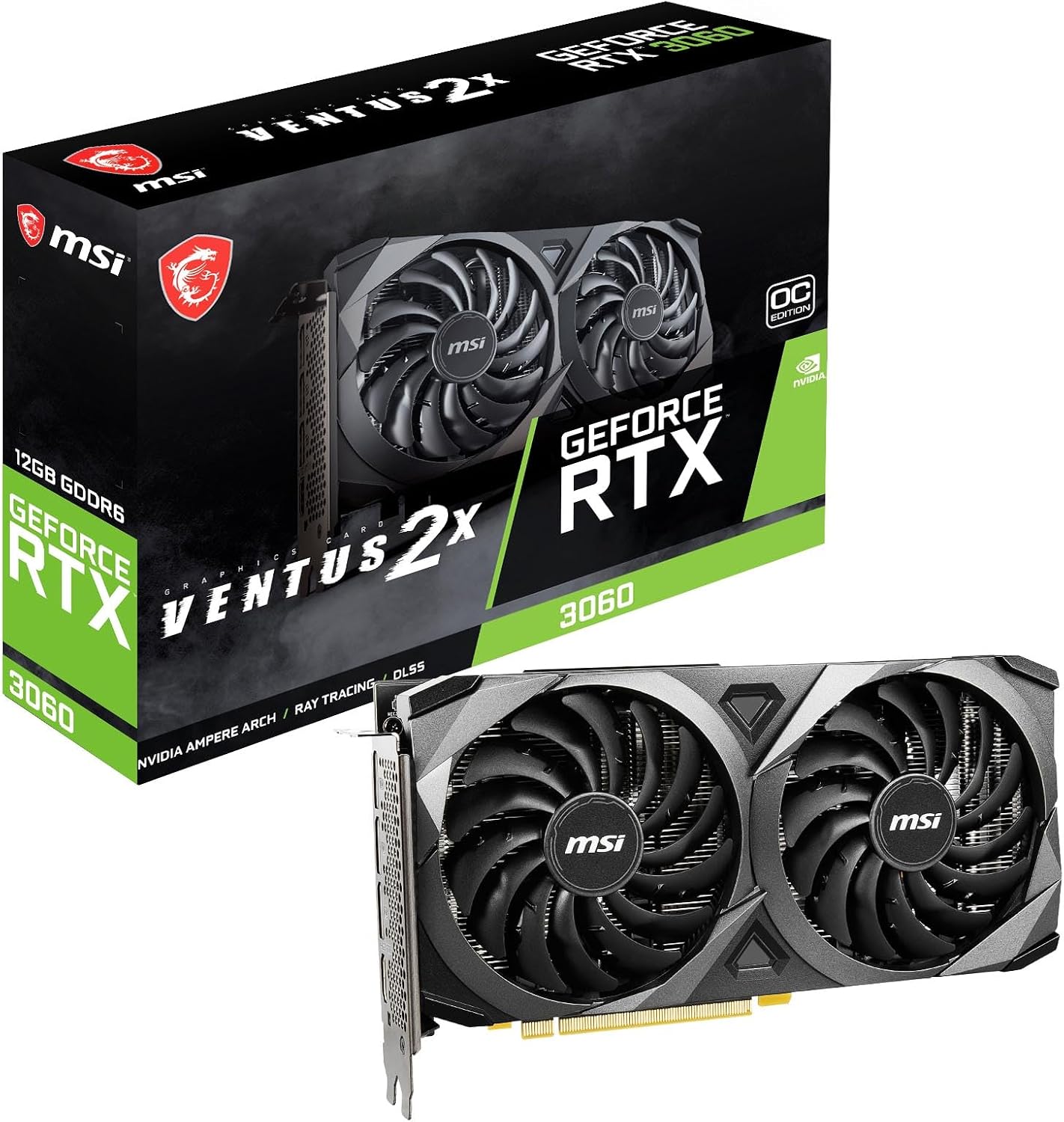
🏆 Best Overall: MSI Gaming GeForce RTX 3060 12GB
Key specs: 12 GB GDDR6 · 192-bit interface · 3,584 CUDA cores · 1.78 GHz boost · 170 W board power
Per NVIDIA's 30-series specifications, the RTX 3060 pairs 12 GB of GDDR6 with a 192-bit interface, 3,584 CUDA cores and a 170 W "Graphics Card Power" figure, on a specified 550 W system supply. TechPowerUp's database entry lists the resulting memory bandwidth at roughly 360 GB/s.
The reason this card is the pick is the 12 GB, not the speed. Two models resident at once is the whole requirement, and 11.1 GB of combined footprint leaves 0.9 GB of margin — enough headless, not enough if a monitor is plugged into the same card. Every cheaper card in this class ships 8 GB, which forces model swapping and reintroduces the seconds-per-request load penalty the build exists to avoid.
On throughput, llmrun.dev records Q4_K_M results on this exact card: 28.4 tok/s at 8.2 GB for a 12B vision-capable model, 29.0 tok/s at 8.1 GB for Mistral Nemo 12.2B, and 24.6 tok/s at 9.5 GB for Phi-4 14B. That 9.5 GB Phi-4 figure is worth noting — it is the point where the card is too full to also hold a speech model, which is why the 12B tier rather than the 14B tier is the right target for this build.
Pros
- 12 GB is the cheapest VRAM that holds a large speech model and a 12B vision-language model simultaneously
- 170 W board power is a flat, manageable sustained load (NVIDIA)
- 28-29 tok/s on 12B-class models leaves real headroom for a captioning pipeline (llmrun.dev)
- CUDA support means faster-whisper, ctranslate2 and llama.cpp all work with no adaptation
Cons
- 0.9 GB of margin with both models loaded is thin; drive the display off the iGPU
- 360 GB/s is modest by 2026 standards — fine for 12B, limiting above it
- An end-of-life card, so pricing is supply-driven rather than MSRP-driven
View the current price on the MSI RTX 3060 12GB · price may vary.
⚡ Best Performance: AMD Ryzen 7 5800X
Key specs: 8 cores / 16 threads · 105 W default TDP · DDR4 up to 3200 MT/s · TSMC 7nm
Per AMD's product page, the 5800X is an 8-core/16-thread part with a 105 W default TDP, built on TSMC 7nm, supporting DDR4 "up to 3200 MT/s".
The CPU in this build is not a fallback inference engine. It is the part that decodes audio, resamples it, runs voice-activity detection, chunks the stream, and stitches transcripts back together — all of which is CPU work that never touches the GPU and all of which parallelizes cleanly across eight cores.
There is one case where the CPU does the inference outright, and the faster-whisper benchmarks quantify it. On an Intel Core i7-12700K with 8 threads, transcribing 13 minutes of audio with the small model:
| Implementation | Precision | Time | RAM |
|---|---|---|---|
| openai/whisper | fp32 | 6m58s | 2,335 MB |
| whisper.cpp | fp32 | 2m05s | 1,049 MB |
| faster-whisper | int8 | 1m42s | 1,477 MB |
| faster-whisper (batch_size=8) | int8 | 51s | 3,608 MB |
Read that table carefully, because its most important feature is what is missing: the project benchmarks the small model on CPU and the large-v2 model on GPU. That asymmetry is the answer to "can a fast CPU do this" — the reference implementation does not publish large-model CPU numbers, because large-model CPU transcription is not how anyone runs it.
Still, 51 seconds for 13 minutes of audio is roughly 15× real time on the small model. For an overnight archive job, that is entirely sufficient.
Pros
- Eight cores handle audio pre/post-processing without contending with the GPU pipeline
- Batch transcription on CPU is viable at small-model quality (faster-whisper)
- 105 W TDP is a known, well-cooled quantity on AM4 (AMD)
- Drops into existing AM4 boards, so this is often an upgrade rather than a platform change
Cons
- No integrated graphics — the display has to come off the discrete card, eating VRAM
- 105 W under sustained load runs hot with a stock-class cooler; budget for the Noctua
- Dual-channel DDR4-3200 is the ceiling (AMD), which caps any CPU-side inference
View the current price on the AMD Ryzen 7 5800X · price may vary. Cooler pairing is covered in best CPU cooler for a Ryzen 7 5800X.
💰 Best Value: Crucial BX500 1TB SATA SSD
Key specs: 1 TB · SATA 6 Gb/s · 2.5-inch · 3D NAND
This is the cheapest part of the build and the one that is most consistently under-bought.
Count the working set honestly. A large speech model, a 12B vision-language model in two quants, the separate vision projector that multimodal models ship alongside the language weights — bartowski's Gemma 3 12B repository lists that mmproj file at 0.85 GB in BF16, and its Q4_K_M language weights at 7.30 GB — plus two or three general chat models kept around for comparison. That is well over 50 GB before a single audio file or image is stored, and a serious library runs into the hundreds of gigabytes.
SATA is deliberate, not a compromise. Storage throughput affects one thing: how long it takes to get weights off disk and into memory the first time. Once they are resident, the drive is idle for the entire inference run. NVMe shortens the wait before the first token; it does not add a single token per second afterward. Spending the NVMe premium on capacity instead is the better trade for this workload — the reasoning is laid out in NVMe vs SATA SSD for a local LLM model library.
Pros
- 1 TB is the practical floor for a two-model pipeline plus a media corpus
- SATA costs less per gigabyte than NVMe with no inference-speed penalty
- 2.5-inch SATA fits any case, including builds with no free M.2 slot
- Frees budget for the part that actually matters — VRAM
Cons
- SATA's ~550 MB/s ceiling makes initial model loads noticeably slower than NVMe
- Entry-tier 3D NAND endurance is modest; not the drive for heavy write workloads
- Occupies a drive bay and needs two cables in a build that could otherwise be cable-free
View the current price on the Crucial BX500 1TB · price may vary.
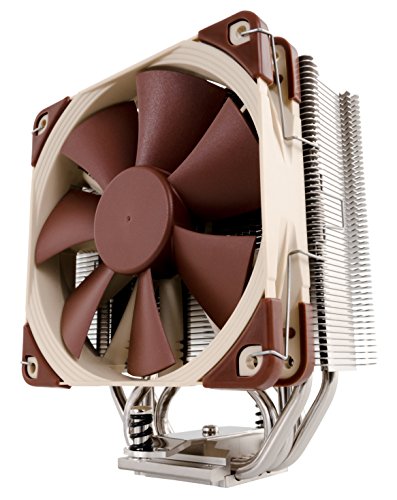
🎯 Best for Always-On: Noctua NH-U12S
Key specs: 120 mm single-tower · NF-F12 PWM fan · six heatpipes · AM4/AM5 and LGA support
A box that transcribes overnight is an acoustic problem before it is a thermal one, and that reframing is what most build guides get wrong.
The load shape here is unusual. Gaming spikes and idles; sustained inference does neither. The 105 W CPU (AMD) and the 170 W card (NVIDIA) both sit at a high, flat draw for hours. A cooler that is quiet in a benchmark run but ramps to keep up over four hours is the wrong cooler, because the machine is usually in a room where somebody sleeps.
NVIDIA specifies a 93°C maximum GPU temperature for this card, so thermal headroom is not the binding constraint — the fan curve needed to stay comfortably under it is. A 120 mm tower with a large, slow-spinning fan holds a 105 W part at a low, constant RPM instead of cycling, and constant is what makes a machine disappear acoustically.
The single-tower form factor matters for a second reason: a dual-tower cooler and a triple-slot graphics card fight over the same air in most mid-towers. A single 120 mm tower leaves the card's intake unobstructed.
Pros
- Holds a 105 W sustained load at a low constant fan speed rather than cycling
- Single-tower clearance does not obstruct a triple-slot card's intake
- Broad socket support, including AM4 for both CPUs in this guide
- Fanless-adjacent acoustics at the sustained loads this build actually produces
Cons
- More expensive than adequate tower coolers that are merely louder
- Single tower is outclassed by dual-tower designs if the CPU is ever overclocked
- 158 mm height needs checking against slim cases
View the current price on the Noctua NH-U12S · price may vary. Head-to-head data is in NH-U12S vs H150i vs Kraken M22 on a 24/7 Ryzen 5800X host.
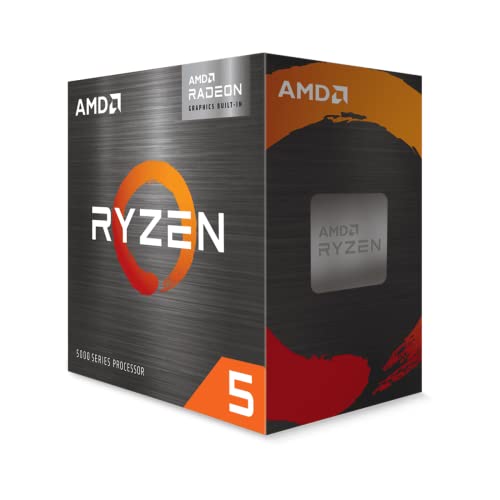
🧪 Budget Pick: AMD Ryzen 5 5600G
Key specs: 6 cores / 12 threads · integrated Radeon graphics · 65 W TDP · AM4
The 5600G is the entry that makes this build affordable in two stages instead of one. It is a 6-core/12-thread AM4 part with integrated Radeon graphics and a 65 W TDP — 40 W lower than the 5800X (AMD lists the 5800X at 105 W).
Two things that buys. First, the box runs with no discrete card at all, doing small-model speech work and every non-inference service a homelab machine handles, at a much lower idle draw. Second — and this is the detail that repays itself later — the integrated graphics drive the display, so when the RTX 3060 goes in, its full 12 GB stays available to models instead of losing 0.5-1 GB to the desktop compositor. On a build whose two models need 11.1 GB of a 12 GB card, that margin is the difference between working and swapping.
Buying the host first and the card second also spreads the cost, which matters more for a first build than any single benchmark.
Pros
- Integrated graphics free the entire 12 GB of the discrete card for models
- 65 W TDP suits an always-on node with a low idle floor
- Runs small speech models with no discrete card at all
- Upgrades cleanly — drop the 3060 in later with no platform change
Cons
- Six cores is a real reduction for CPU-side batch transcription
- Halved PCIe lanes on the G-series limit a future high-bandwidth card
- The iGPU is not a useful inference accelerator for models at this scale
View the current price on the AMD Ryzen 5 5600G · price may vary.
What to look for in a local speech and vision box
VRAM budget when two models are resident
This is the specification that decides the build. faster-whisper puts Large-v2 at 2,926 MB in int8, 4,525 MB at fp16, and 6,090 MB at fp16 with batch_size=8. Add the 8.2 GB a 12B vision-capable model needs at Q4_K_M (llmrun.dev) and the int8 configuration lands at 11.1 GB while the batched fp16 configuration lands at 14.3 GB — over the ceiling. Int8 speech quantization is not an optimization here; it is what makes the build fit.
Speech precision is a bigger lever than anything else
From the same faster-whisper table, transcribing 13 minutes of audio with Large-v2 on GPU: the reference openai/whisper implementation takes 2m23s at 4,708 MB; faster-whisper at fp16 takes 1m03s at 4,525 MB; at int8 it takes 59s at 2,926 MB; and with batch_size=8 at int8 it takes 16 seconds at 4,500 MB. That is roughly a 9× speedup and a 208 MB VRAM saving against the reference implementation. Choosing the runtime correctly is worth more than any plausible hardware upgrade.
Memory bandwidth versus core count
For the model that generates text, bandwidth governs — the card's ~360 GB/s (TechPowerUp) against dual-channel DDR4-3200's 51.2 GB/s theoretical is why inference belongs on the card. For audio pre-processing, core count governs, which is why the CPU choice is about cores rather than clocks.
Storage throughput for large corpora
Capacity over speed. Weights load once per session; audio and image corpora are read sequentially. A 1 TB SATA drive is the right shape of purchase.
Sustained-load acoustics and thermals
Plan for hours of flat draw, not minutes of spikes. NVIDIA's 93°C maximum GPU temperature (NVIDIA) gives ample headroom; the constraint is the fan curve required to stay well under it without cycling. Broader treatment: cooling a 24/7 local LLM rig, air vs AIO.
PSU headroom for a flat multi-hour load
NVIDIA specifies 550 W of system power for this card (NVIDIA). With a 105 W CPU alongside it, a 650 W 80+ Gold unit is the sensible buy — not because 550 W will fail, but because sustained inference holds a unit near its load point for hours instead of passing through it, and a supply running at 60% of rating runs cooler and quieter than one running at 85%.
The most-missed step
Size for both models at once, not for the larger one. It is the single mistake that turns a working pipeline into one that reloads weights on every request.
FAQ
Do speech models and vision models need to be resident at the same time?
For any pipeline that captions an image and then narrates it, or transcribes audio and then reasons over the transcript, yes — swapping models per request adds seconds of load latency to every call. Sizing VRAM for the larger of the two models is the most-missed step in these builds; the correct budget is both models plus their KV caches plus whatever the display is using.
Is a GPU even necessary for speech-to-text, or will a fast CPU do?
A modern 8-core CPU handles batch transcription of recorded audio acceptably, because throughput matters more than latency when the job runs overnight. Live captioning is the case that needs a GPU: real-time work has a hard latency budget per chunk, and CPU inference on a large speech model misses it. Decide which of the two jobs is primary before buying the card.
How much storage does a serious local model library actually need?
A working set of one large speech model, one vision-language model and two or three general chat models in Q4 and Q8 variants runs to several hundred gigabytes before any audio or image corpus is stored. A 1 TB SATA drive is the practical floor and the cheapest part of the build; NVMe speeds up first-load time but does not change inference throughput once weights are in memory.
Does this box need more than 32 GB of system RAM?
32 GB is comfortable for a GPU-resident workflow where the CPU is only staging audio and images. It becomes the bottleneck in two situations: CPU-offloaded inference of a model too large for 12 GB of VRAM, and batch pipelines that hold many decoded frames or audio buffers in flight. Builders planning either of those should budget 64 GB and dual-channel kits rather than a faster CPU.
When is it wrong to build this at all and right to use a hosted API?
When the volume is low and the data is not sensitive. A few hours of transcription a month costs less through an API than the electricity and the parts. The build pays off on two axes only: sustained volume, where per-minute pricing compounds, and privacy, where the recordings or images cannot leave the premises at any price. If neither applies, the hardware is a hobby purchase, which is a fine reason but a different one.
Related guides
- Best budget local LLM workstation components
- Best always-on local LLM server parts
- Best mic and GPU for local Whisper transcription
- Best 12 GB GPU for local LLMs in 2026
- RTX 3060 benchmark data
Sources
- faster-whisper (SYSTRAN) — published benchmark tables — Large-v2 GPU transcription time and VRAM by precision, small-model CPU results (accessed 2026-09-16)
- NVIDIA — GeForce RTX 3060 / 3060 Ti specifications — 12 GB GDDR6, 192-bit, 3,584 CUDA cores, 170 W board power, 550 W system requirement, 93°C max (accessed 2026-09-16)
- llmrun.dev — RTX 3060 12GB model database — 12B/14B Q4_K_M generation rates and VRAM footprints (accessed 2026-09-16)
- AMD — Ryzen 7 5800X product specifications — 8C/16T, 105 W TDP, DDR4-3200 (accessed 2026-09-16)
- TechPowerUp — GeForce RTX 3060 12 GB database entry — memory bandwidth (accessed 2026-09-16)
- Hugging Face — bartowski/google_gemma-3-12b-it-GGUF — Q4_K_M and vision-projector file sizes (accessed 2026-09-16)
— Mike Perry · Last verified 2026-09-16
Citations and sources
- faster-whisper (SYSTRAN) — speech transcription time, precision and VRAM benchmarks (accessed 2026-09-16)
- NVIDIA — GeForce RTX 3060 / 3060 Ti specifications (accessed 2026-09-16)
- llmrun.dev — RTX 3060 12GB model database (accessed 2026-09-16)
- AMD — Ryzen 7 5800X product specifications (accessed 2026-09-16)
- TechPowerUp — GeForce RTX 3060 12 GB (accessed 2026-09-16)
- Hugging Face — bartowski/google_gemma-3-12b-it-GGUF (accessed 2026-09-16)
This piece is editorial synthesis based on publicly available information. No independent first-party benchmarking is reported.
As an Amazon Associate, SpecPicks earns from qualifying purchases. Prices shown are catalog snapshots and street ranges as of 2026-09-16 and may vary.