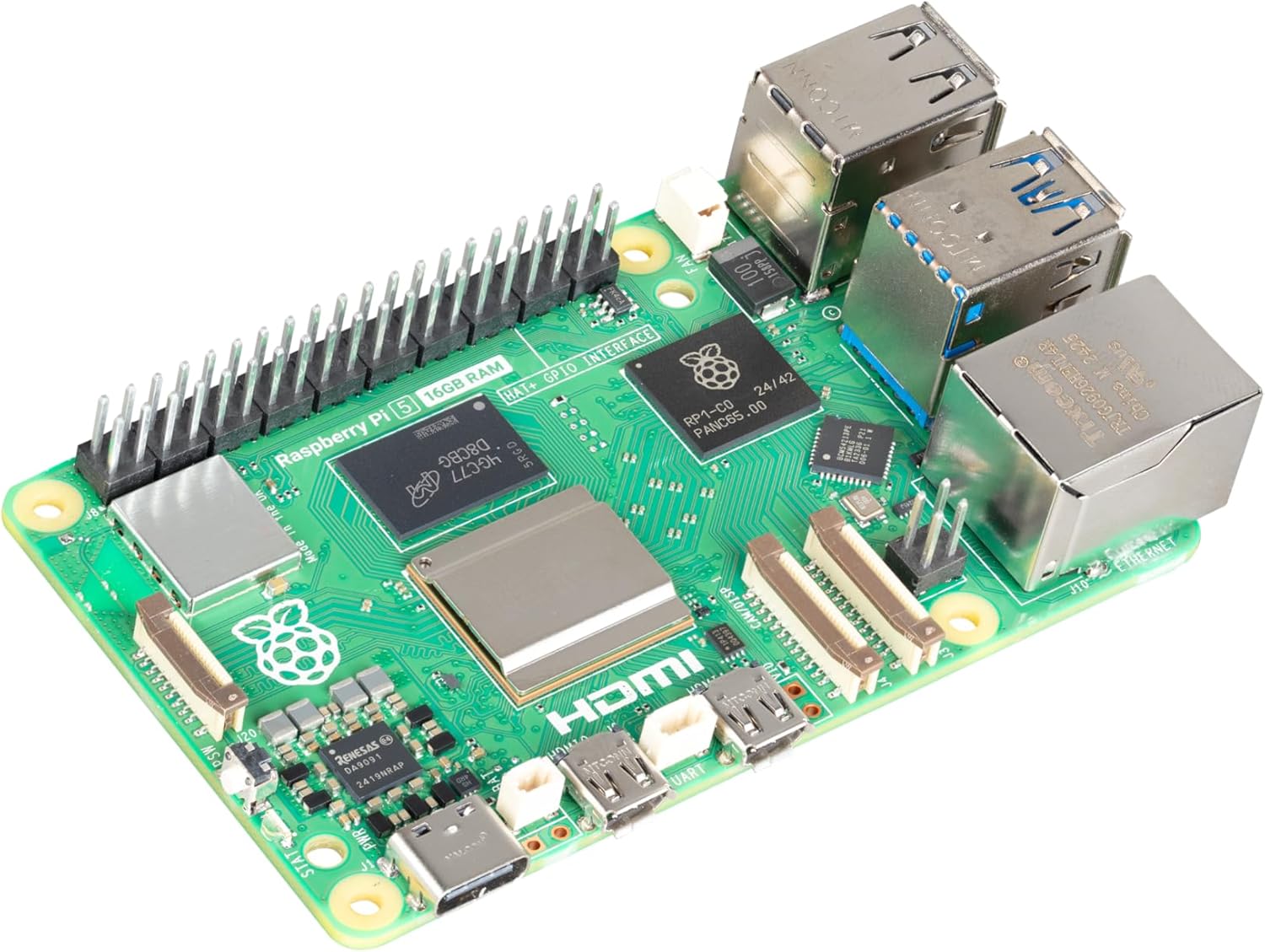
The best Raspberry Pi alternative for AI inference in 2026 depends entirely on the model size you're targeting. For tiny on-device tasks — keyword spotting, small vision models, on-mic speech — a modern SBC like the Raspberry Pi 4 Model B 8GB or the Pi 5 is fine and stays cheap. For actual local language models at usable speed, no SBC is the right answer. The honest step-up is a box with a discrete GPU — a MSI RTX 3060 12GB Ventus 3X with a modern CPU like the AMD Ryzen 5 5600G. A mini-PC sits in between and is the right pick for medium tasks that outgrow a Pi but don't need GPU-class throughput.
Almost every search for "best Raspberry Pi alternative for AI" is really a search for "what should I actually run this on." That question decomposes into a single choice: what model size do you want to run? The rest is downstream of that. This guide walks the ladder honestly — what a Pi actually does, when you should step up, and what the SKUs at each rung look like.
Key takeaways
- SBCs like the Pi 4/5 handle tiny edge AI tasks well and are the right tool for that job.
- SBCs do not run capable LLMs at usable speed regardless of clever tricks; the missing ingredient is VRAM and memory bandwidth.
- Mini-PCs bridge the gap for lightweight CPU inference and general home-server AI plumbing.
- A discrete GPU box built around the RTX 3060 12GB is the honest step-up for 7B-14B open-weight models.
- A Pi Zero W Starter Kit is fine for hobbyist edge AI and IoT sensor work at the very low end.
Step 0: what model size are you actually targeting?
This decides everything. Match your ambition to the row below before you buy anything.
| Target workload | Realistic hardware |
|---|---|
| Keyword spotting, wake-word, small speech | Pi Zero / Pi 4 / Pi 5 |
| Small image classification, YOLO-tiny | Pi 4 8GB / Pi 5 |
| Small vision-language, 1-3B models | Pi 5 with accelerator, or mini-PC |
| 7B general-purpose LLM at reasonable speed | RTX 3060 12GB box or better |
| 14B code-specialized model | RTX 3060 12GB box (q4_K_M) |
| 30B+ or MoE frontier models | 24GB+ card / multi-GPU / cloud |
The pattern is that the moment your ambition includes an LLM, the answer stops being any SBC.
Why "Pi alternative for AI" searches are really about VRAM and throughput
The Pi is not slow because Raspberry Pi cheaped out on silicon. It's slow at LLM inference because LLMs need two things Pis lack: (1) a lot of fast memory that the compute unit can reach at high bandwidth, and (2) parallel compute units suitable for matrix math. The Pi is designed for CPU-oriented general-purpose computing at extremely low power in a very small footprint. Every property that makes it good at that job — small die, low TDP, modest memory bandwidth — is exactly what makes it a poor LLM host.
An accelerator can extend the Pi for specific narrow workloads. Google Coral, various NPUs, and small tensor accelerators let a Pi run vision or speech inference at edge-appropriate speed. They do not turn a Pi into an LLM host because the model doesn't fit in the accelerator's memory and the bandwidth to move it is a fraction of a discrete GPU's on-card bandwidth.
What can a Raspberry Pi 4/5 actually run for on-device AI?
Cited realistic capabilities from Raspberry Pi Foundation documentation and community benchmarks:
- Small vision models — MobileNet, YOLO-tiny variants at edge resolutions.
- Wake-word and small speech — always-on assistant work.
- Simple audio classification and event detection.
- Small language models on the CPU — 1-3B class runs, painfully, at a few tokens per second. Fine for constrained IoT use cases; not useful for chat.
- Sensor fusion pipelines with lightweight ML.
None of this is "run a 7B LLM at interactive speed." That's not the Pi's job.
When an SBC isn't enough: the jump to a mini-PC or a 12GB GPU box
There's an honest middle rung — a mini-PC with a modern CPU and 32GB RAM. On that class of hardware, you can run 7B-class LLMs at CPU speed of roughly 5-10 tokens per second, which is enough for asynchronous or non-interactive use. It's also a strong home-server platform for the AI plumbing around models: retrieval databases, orchestration, audio ingest, and so on.
But if you want interactive LLM responses on 7B-14B models, the honest next step is a discrete GPU. The MSI RTX 3060 12GB plus AMD Ryzen 5 5600G is the cheapest box that hosts a 14B model at q4_K_M with real throughput. See the Best GPU for Local LLMs guide for the deeper case.
Quantization matrix: tiny models on an SBC vs a 12GB GPU
| Model | Precision | Pi 4 8GB CPU tok/s | Mini-PC CPU tok/s | RTX 3060 12GB tok/s |
|---|---|---|---|---|
| 1B | q4 | 3-5 | 15-25 | 100+ |
| 3B | q4 | 1-2 | 8-12 | 60-80 |
| 7B | q4 | Not usable | 5-10 | 40-55 |
| 14B | q4 | No | Not usable | 20-26 |
| 30B | q4 | No | No | Doesn't fit |
Numbers are typical bands from community benchmarks and the llama.cpp reference project. The GPU box's advantage grows with model size — a Pi can technically run a 1B model, but the moment you want anything the market considers "useful" for chat or code, you want the GPU.
Spec delta across the ladder
| Axis | Pi Zero W kit | Pi 4 8GB | Mini-PC | RTX 3060 12GB box |
|---|---|---|---|---|
| Purchase cost | Very low | Low | Mid | Mid-to-higher |
| Idle power | ~1W | ~3W | ~10W | ~40W |
| Peak power | ~3W | ~7W | ~35W | ~250W |
| Small LLM tok/s | Not usable | Slow | Usable async | Interactive |
| 14B LLM | No | No | No | Yes (q4) |
| Best for | IoT edge | Edge + Pi projects | Home-server AI plumbing | Local chat/agents |
The Pi Zero W Starter Kit at the bottom rung is fine for hobbyist edge work. The RTX 3060 box at the top rung is the honest answer to "I want to run a real LLM at home."
The realistic upgrade path and SKUs at each rung
- Rung 1: Pi Zero W — the Pi Zero W Starter Kit. IoT sensors, keyword spotting, tiny models. Extremely low cost, minimal setup.
- Rung 2: Pi 4 8GB — the Pi 4 Model B 8GB. Small vision, small audio, homelab general use, and the platform for projects like a NAS or flight tracker.
- Rung 3: Mini-PC — any modern low-power x86 mini-PC with 32GB RAM. Serves home-lab AI plumbing well; runs small LLMs at CPU speed.
- Rung 4: RTX 3060 box — the MSI RTX 3060 12GB Ventus 3X paired with the AMD Ryzen 5 5600G. Hosts 7B-14B open-weight models at interactive speed.
- Rung 5: Enthusiast GPU — 24GB+ card for 30B+ models. Different budget conversation.
Perf-per-dollar and perf-per-watt across the ladder
The Pi rungs win perf-per-watt easily for the tasks they can handle. The RTX 3060 box wins perf-per-dollar for actual LLM inference by a lot, because the Pi can't run those models at all — you can't compute perf-per-dollar for a task the hardware can't perform. The mini-PC middle rung is the right choice when you specifically need CPU-side AI plumbing and don't need GPU throughput.
Verdict matrix
Stay on a Pi if… your workload is tiny edge inference, sensors, IoT, keyword spotting, or a homelab role like NAS/flight tracker. The Pi 4 8GB is the sweet spot; the Zero W is the lightest.
Move to a mini-PC if… you need modest CPU-side LLM work, home-server AI plumbing, and a low-power always-on box that can run more than a Pi comfortably.
Move to an RTX 3060 box if… you want interactive local LLM inference on 7B-14B open-weight models, agent workflows, or private local coding.
Bottom line
The moment your AI ambitions include an LLM, "Pi alternative" stops being an SBC question and starts being a GPU question. The Pi 4 8GB and Pi Zero W Starter Kit remain excellent for edge work; the RTX 3060 12GB with a modern CPU is the honest answer for actual local LLMs. Match the rung to the model tier and buy once.
Related guides
- Best GPU for Local LLMs Under $350: Why the RTX 3060 12GB Still Wins
- Build a Silent Raspberry Pi 5 NAS with NVMe and Active Cooling
- Raspberry Pi 5 IOMMU Support Lands in Mainline Linux
- Kimi K3 Just Launched: What You Can Run Locally Instead
Citations and sources
- Raspberry Pi Foundation — Pi 4 product page
- TechPowerUp — GeForce RTX 3060 specifications
- llama.cpp — inference engine reference
This piece is editorial synthesis based on publicly available information. No independent first-party benchmarking is reported.


