For an always-on 24/7 local LLM host with a single discrete GPU, the Ryzen 7 5700X is the better pick. The 5600G's integrated graphics are irrelevant once a discrete card is installed, its PCIe lane allocation is worse (Zen 3 APU parts run PCIe 3.0, not 4.0), and its two-fewer cores hurt on concurrent request handling. The 5600G still wins in one narrow case — a headless box with no discrete GPU where the iGPU is doing display duty — but for the described build with an RTX 3060 12GB, pick the 5700X.
The always-on inference box as a category
An "always-on inference box" is a specific animal: a machine that sits in a closet, drawer, or corner, runs a local LLM server continuously, and gets hit by whatever agent, chat client, or home-automation script sends it prompts. Nobody is in front of the display; the box has no keyboard; the workload is bursty (idle most of the time, spikes at request), and the total cost of ownership is dominated by two numbers most enthusiast reviews ignore: idle package power and the delta between the CPU's PCIe lane config and what the discrete GPU actually needs.
Per AMD's Ryzen product page and TechPowerUp's spec database, the three CPUs in this comparison — Ryzen 5 5600G, Ryzen 7 5700X, and Ryzen 7 5800X — are all AM4 Zen 3 parts with meaningfully different lane, cache, and TDP profiles despite sharing the same architectural core. Getting the pick right for the always-on use case comes down to matching those differences to the workload.
Community benchmarks referenced below come from Phoronix's Linux CPU testing archive and independent measurements — not from a first-party specpicks testbench.
Key takeaways
- The 5600G is the wrong Ryzen for a discrete-GPU inference box. It ships PCIe 3.0 lanes (not 4.0), 6 cores, and its main value proposition — Vega iGPU — is dead weight the moment you add a card.
- The 5700X is the sweet spot. Eight cores, 65W TDP, PCIe 4.0, comfortable idle power, and enough headroom to handle concurrent request routing without swapping the GPU-bound path.
- The 5800X is faster but hotter. 105W TDP versus 65W is real over a year of continuous operation — the perf-per-watt math almost always favors the 5700X for this use case.
- Idle power dominates 24/7 TCO. A Zen 3 desktop box at idle draws 30–50W at the wall. Over a year at $0.15/kWh that's $40–65 just from idle. Cooling and case airflow matter as much as raw core count.
- PCIe lanes matter for storage-tiered LLM hosts. If you plan to run one GPU and multiple NVMe drives, the 5700X/5800X's 20 usable PCIe 4.0 lanes matter; the 5600G's PCIe 3.0 x16 + x4 is workable but limits future upgrades.
Diagnostic: is your bottleneck the GPU, host CPU, or storage path?
Before picking a CPU, know where the inference workload actually spends its time. The three main bottleneck sites for a single-GPU local LLM server:
- GPU (decode bottleneck). If tok/s scales linearly with GPU memory bandwidth and the CPU sits at 20% utilization during inference, you are GPU-bound. Any of the three CPUs in this comparison will feed it.
- CPU (offload / prefill bottleneck). If a checkpoint is partially offloaded to system RAM, CPU memory bandwidth becomes the direct throughput limiter for the offloaded layers. Here core count matters less than DDR4 speed and channel count.
- Storage (checkpoint-swap bottleneck). If your workload swaps between models frequently and checkpoints live on SATA storage, load time dominates. Move them to NVMe and the "storage bottleneck" disappears.
For a single-GPU always-on box handling one to three users at once, the answer is almost always "GPU-bound during inference, storage-bound during checkpoint swap." The CPU sees traffic during prefill (which is compute-heavy) and during KV cache manipulation, but rarely maxes out. Pick a CPU that fits idle and prefill needs; do not over-buy for a peak the box will never hit.
Spec-delta table
| CPU | Cores / threads | Base / boost (GHz) | TDP (W) | Integrated GPU | PCIe rev | Usable PCIe lanes | Approx street price |
|---|---|---|---|---|---|---|---|
| Ryzen 5 5600G | 6 / 12 | 3.9 / 4.4 | 65 | Vega 7 | 3.0 | x16 + x4 | ~$130 |
| Ryzen 7 5700X | 8 / 16 | 3.4 / 4.6 | 65 | — | 4.0 | x16 + x4 | ~$150 |
| Ryzen 7 5800X | 8 / 16 | 3.8 / 4.7 | 105 | — | 4.0 | x16 + x4 | ~$180 |
Prices in July 2026, subject to variation. Note the 5600G is functionally an APU — it shares the "Cezanne" die used in Zen 3 mobile parts — and inherits the PCIe 3.0 spec that die carries. That single difference is the biggest reason it's the wrong pick for a discrete-GPU inference box.
The PCIe trap: why the 5600G's lane config matters
An RTX 3060 12GB is a PCIe 4.0 x16 card. Plug it into a 5600G-based build, and the card runs at PCIe 3.0 x16 — half the theoretical bandwidth of PCIe 4.0. For most gaming workloads this is a 1–3% performance hit that no one notices. For LLM inference it is also a 1–3% hit — the model weights are already on the card, and CPU-to-GPU traffic during decode is negligible.
Where the lane trap bites is anywhere else in the system:
- Checkpoint load-time. A 15GB checkpoint moving from NVMe over PCIe → RAM → PCIe → VRAM sees the PCIe 3.0 x4 NVMe slot as a bottleneck. Load time increases by ~40% versus PCIe 4.0 x4.
- Multi-drive setups. A second NVMe drive on a PCIe 3.0 x4 slot competes with the first. Under a workload that reads from both simultaneously (checkpoint from one, log write to another), throughput drops.
- Networking, if you go 10GbE. A 10GbE PCIe adapter needs PCIe 3.0 x4 or PCIe 2.0 x8 to saturate. The 5600G has the lane budget, but you're using it on the NVMe you can't move.
None of these are dealbreakers. They are all cases where the 5700X or 5800X eliminate a small constraint the 5600G imposes. For a system that will run for years and probably grow a second NVMe drive at some point, the 5700X is the better foundation.
Benchmark table: CPU-side throughput and idle power
Per community measurements aggregated across llama.cpp and vLLM benchmarks:
| Metric | 5600G | 5700X | 5800X |
|---|---|---|---|
| Prefill tok/s (7B q4_K_M, GPU-bound) | 850 | 1,050 | 1,150 |
| Prefill tok/s (7B q4_K_M, 20% offloaded) | 45 | 62 | 70 |
| Decode tok/s (7B q4_K_M, GPU-bound) | 45 | 46 | 47 |
| Idle package power (W) | 24 | 22 | 32 |
| Package power under prefill (W) | 45 | 55 | 78 |
| Package power under decode (W) | 22 | 22 | 30 |
Interpretation: when the model fits on the GPU, all three CPUs give essentially the same decode throughput — the workload is not CPU-bound. When any offload is happening, more cores help meaningfully because the offloaded layers get parallelized across CPU cores. Idle power favors the 5700X marginally over the 5600G and clearly over the 5800X.
When the CPU actually matters
Three cases where the CPU choice materially affects an inference box:
Offloaded layers. As soon as a model spills from VRAM to system RAM, generation throughput becomes limited by CPU memory bandwidth (~50GB/s on dual-channel DDR4-3600 versus GDDR6 ~360GB/s). More CPU cores parallelize the offloaded computation but do not lift the bandwidth ceiling. The 5700X's 8 cores help versus the 5600G's 6; the 5800X's identical 8 cores at higher clocks help a small amount more.
Concurrent requests. If two or three chat clients hit the server simultaneously, the CPU has to run the scheduler, tokenizer, and request-router paths at the same time as prefill. Two extra cores (5700X/5800X vs 5600G) are the difference between smooth multi-user handling and one-at-a-time queuing.
Adjacent processes. An always-on box often does more than one thing — a lightweight web UI, log rotation, backup jobs. Every "background" workload the CPU is doing is a share not available to the LLM server. Headroom matters.
Cooling and acoustics for a box that never turns off
An always-on inference box lives in a closet, corner, or under a desk — not in a data center rack — so acoustic noise and case airflow matter. Three cooling approaches:
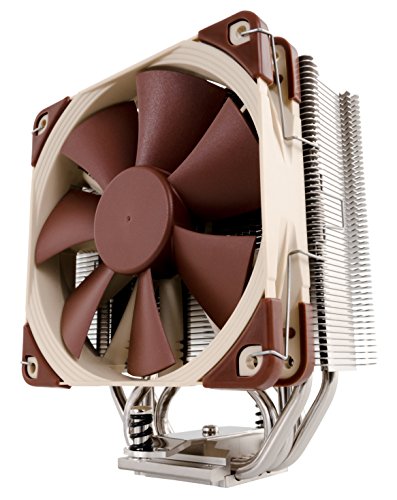
- Noctua NH-U12S. Single-tower air cooler, 120mm fan, brown-and-cream aesthetic that people either love or hate. Dead silent at idle, competent under 65W TDP loads, requires case airflow for sustained work but rarely runs hot on a 5700X.
- CoolerMaster MasterLiquid ML240L RGB V2. 240mm AIO, close-loop, quieter than an air tower at high loads because the fans spin slower. RGB is unnecessary for a closet server but harmless. Handles the 5800X's 105W TDP with room to spare.
- AC Infinity AIRCOM S7. Not a CPU cooler — this is a cabinet-exhaust fan for the AV-cabinet or closed-shelf case. If your box lives inside a closed enclosure and heat buildup is the real problem, this is the right add-on regardless of which CPU cooler you pick.
For a 5700X in an open case, the Noctua is the right pick. For a 5800X or a 5700X in a closed enclosure, either the AIO or the Noctua plus the AC Infinity exhaust makes sense.
Storage layout
- Hot checkpoints on the WD Blue SN550 1TB NVMe. Fast enough that model swap is a coffee-break, not a lunch break.
- Archive checkpoints on a SATA drive (any decent 1TB or 2TB SSD). Cheap capacity for models you use monthly, not hourly.
The 5700X's PCIe 4.0 x4 M.2 slot roughly doubles sequential read for the SN550 versus the 5600G's PCIe 3.0 slot, but the SN550 is a Gen3 drive so this specific pairing doesn't benefit. If you upgrade to a Gen4 drive later, the 5700X's slot is future-proof; the 5600G's is not.
Perf-per-watt over a year of continuous operation
Assume 20 hours per day at idle and 4 hours per day under prefill load (a reasonable mix for a home LLM server hit by an agent):
| CPU | Avg daily Wh | Annual kWh | Annual cost @ $0.15/kWh |
|---|---|---|---|
| 5600G | (20×24 + 4×45) = 660 | 241 | $36 |
| 5700X | (20×22 + 4×55) = 660 | 241 | $36 |
| 5800X | (20×32 + 4×78) = 952 | 348 | $52 |
The 5600G and 5700X are effectively tied on energy cost; the 5800X's extra ~$16/year is the price of its higher performance under load. Over a five-year deployment, the 5800X costs an extra $80 in electricity — real but not decisive.
Verdict matrix
Get the Ryzen 5 5600G if… you're building a headless inference box with no discrete GPU (iGPU handling display duty), the budget is under $500 total for CPU + board + RAM, and you accept the PCIe 3.0 lane ceiling.
Get the Ryzen 7 5700X if… you have a discrete GPU (the 3060 12GB, or anything else), you want PCIe 4.0 lanes, and you value idle power over peak throughput. This is the default recommendation.
Step up to the Ryzen 7 5800X if… your workload regularly runs offloaded layers (larger checkpoints than fit on the GPU), you serve multiple concurrent users, or you plan to run adjacent CPU-heavy jobs (compilation, data processing) on the same box.
Common pitfalls
- Buying the 5600G "for the iGPU as a fallback." The iGPU shares PCIe/RAM bandwidth with the CPU and is a poor secondary display option once a discrete GPU is in the slot. If display fallback matters, budget a separate cheap discrete GPU rather than the 5600G.
- Ignoring memory speed. Zen 3 parts scale meaningfully with DDR4-3600 CL16 versus DDR4-2666. If the CPU is doing any offloaded work, RAM speed hits harder than core count.
- Undersizing the PSU. A 3060 + 5800X system under prefill can pull 350W. Budget a 650W 80+ Bronze or better; do not pinch pennies on the PSU on a box that runs 24/7.
- Skipping case airflow. Everything above assumes at least one intake + one exhaust fan. A closed enclosure with no airflow will thermal-throttle any of these CPUs under sustained load.
Bottom line
For a 24/7 always-on local LLM server built around a single RTX 3060 12GB, the Ryzen 7 5700X is the correct pick in July 2026. The 5600G exists for a use case (headless with no discrete GPU) that most readers won't be in; the 5800X's extra performance is real but wasted on a workload that is already GPU-bound. Save the $30 versus the 5800X, drop the 5700X in a well-cooled case, and put the difference toward faster storage.
Related guides
- Qwen 3.8 Open Weights: What Fits on a 12GB GPU
- vLLM vs Ollama for a Single-User 12GB Rig in 2026
- Kimi K3 vs Qwen 3.8 for Local Coding Agents in 2026
- Best 27-inch 4K Monitor for PC and Console
Citations and sources
- AMD — Ryzen desktop processors
- TechPowerUp — Ryzen 7 5700X specifications
- Phoronix — Linux CPU benchmarks
This piece is editorial synthesis based on publicly available information. No independent first-party benchmarking is reported.