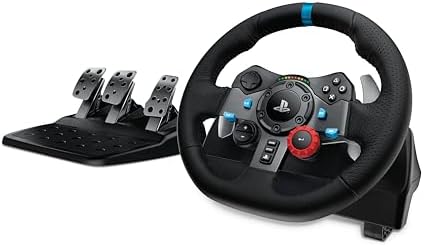
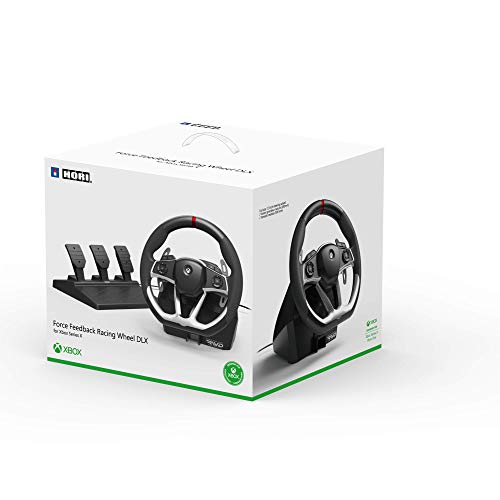
A beginner's first sim-racing rig in 2026 should be a force-feedback wheel with 900° rotation, a pedal set with a firm brake, and a rigid mounting point — for most people that means the Logitech G29 Driving Force Racing Wheel with its bundled pedals, clamped to a solid desk, played on a 1080p or 1440p monitor you already own. Add a shifter and a display upgrade only after a full season of driving.
Sim racing has one of the widest quality gaps in PC gaming. A gamepad costs $60 and a top-end direct-drive setup costs more than a used car, and the middle where beginners actually live is confusing because two wheels at the same price can teach you very different lessons about how a car behaves. This guide sorts the entry tier for 2026, ranks the four wheel-and-shifter combinations that keep showing up on best-of lists year after year, tells you what a first rig actually costs after tax and shipping, and — importantly — tells you when the honest answer is don't buy a wheel yet, buy a better gamepad. The pattern below prioritizes learning curve, upgrade path, and platform lock-in rather than raw specs, because beginners rarely bounce off sim racing due to peak torque; they bounce off flex, wrong-console purchases, and pedals that make trail-braking impossible to learn.
Public reviews across Tom's Hardware's racing-wheel roundup, the sim-racing community on r/simracing, and manufacturer spec sheets from Logitech G and Thrustmaster point in the same direction: a hybrid gear-and-belt wheel with 900° rotation and a decent pedal set is still the correct beginner buy in 2026, even though direct-drive prices have fallen. The bracket below reflects that consensus, adjusted for what you can actually order today.
The 2026 beginner picks at a glance
| Pick | Best for | Key spec | Price range | Verdict |
|---|---|---|---|---|
| Logitech G29 Wheel + Pedals | Best overall PS/PC entry | 900° rotation, hybrid gear+belt FFB, 3-pedal set | $250-$350 | Buy this first |
| Logitech Driving Force Shifter | Best value H-pattern add-on | 6-speed + reverse, G29/G920/G923 compatible | $50-$80 | Add after season one |
| HORI Force Feedback Racing Wheel DLX | Best Xbox-first crossover | Officially licensed for Xbox Series X/S + PC | $180-$260 | Buy if Xbox is your main platform |
| Thrustmaster TH8A Shifter | Best enthusiast shifter | Metal, 7+R H-pattern or sequential, USB | $180-$220 | Upgrade path when the DF shifter feels toy-like |
| GameSir G7 SE Controller | Best "start here first" pad | Hall-effect sticks and triggers, wired Xbox+PC | $40-$55 | Buy this if you're not sure you'll stick with the hobby |
| Samsung 27" Odyssey 4K UHD 144Hz | Best beginner display | 27", 4K UHD, 144Hz, IPS | $500-$700 | Upgrade the monitor before you upgrade the wheel |
Dollar figures in this article are approximate and change often; each pick's product card shows the latest tracked Amazon price or links to the live listing. Treat the ranges above as sighting shots, not quotes.
Top picks
#1 Best overall: Logitech G29 Driving Force Racing Wheel
Verdict: The correct default for almost every beginner on PC, PlayStation 4, or PlayStation 5. It is neither the cheapest nor the most powerful wheel you can buy, but it is the wheel with the widest game support, the deepest secondhand market for accessories, and the longest track record of surviving daily use.
The Logitech G29 Driving Force Racing Wheel uses a hybrid gear-and-belt drive: the motor turns a small pulley through a belt to reduce noise, and gears then translate that motion to the wheel shaft. Per Logitech's product page, it delivers 900° of rotation lock-to-lock (2.5 turns), a 24-position dial for in-game menu adjustment, and a full three-pedal set with a progressive rubber "brake stop" that stiffens as you push. It works on PS4, PS5, and PC out of the box. It does not work on Xbox — that is the G920, and it is the single most common return reason in this category, so verify your platform before ordering. See the official Logitech G Driving Force page for the full spec table and current game compatibility list.
For a first wheel this hits the important beats: real force feedback (not rumble), a rotation angle that matches real cars, a pedal set that lets you learn threshold braking without swapping hardware, and a stitched-leather wheel rim that survives sweaty hands. The gear component in the drivetrain is audible under strong effects and slightly notchy at low speeds, which enthusiasts eventually outgrow — but the point of a beginner wheel is to teach you whether you want to stay in the hobby before you spend $700+ on direct drive. Sim-racing community reports across YouTube reviewers and forum threads consistently place the G29 and its Xbox twin G920 as the entry point that produces the fewest regretful purchases in the first year.
Pair it with: the Driving Force Shifter for H-pattern cars, and a wheel-stand or a solid desk clamp. Do not pair it with a folding card table.
#2 Best value H-pattern shifter: Logitech Driving Force Shifter
Verdict: The cheapest way to unlock manual-gearbox cars, and the correct add-on if you already own a G29, G920, or G923.
The Logitech Driving Force Shifter is a 6-speed H-pattern shifter with a push-down reverse, a leather-wrapped knob, and a mounting-clamp system that shares the desk-lip aesthetic of the G29. It plugs into the wheel base, not into a separate USB port, which is a small but genuine advantage on cluttered desks. Per Logitech's spec sheet it is compatible with G29, G920, G923, and G920/G29 wheelbases only — it will not work with a Thrustmaster or Fanatec wheel and is not a universal shifter.
Public reviews consistently note two things: the throw is longer than a real short-shifter, and the mechanism uses a spring-loaded plate rather than a metal ratchet, which means the "click" into gear is soft. Neither is a defect at this price. What you get for $50-$80 is functional H-pattern shifting for classics, rally cars, and truck sim without touching the wheel paddles, which is exactly the feature you are paying for. If you outgrow it, the natural upgrade is the Thrustmaster TH8A (below), which is roughly three times the price and roughly three times the mechanism.
Buy it after you have driven the G29 for a month or two — most beginners discover which cars they enjoy before they realize they miss the gear lever.
#3 Best Xbox-first crossover: HORI Force Feedback Racing Wheel DLX
Verdict: Buy this instead of the G29 only if Xbox is your primary platform, or if you split time between Xbox Series X/S and PC. On PlayStation, the G29 is still the correct answer.
The HORI Force Feedback Racing Wheel DLX is officially licensed by Microsoft for Xbox Series X/S and works on PC via the same USB connection. It delivers real motorized force feedback (not rumble), a 270° default rotation with software adjustment to a wider range, and a two-pedal set with clip-on paddles. The build is lighter than the G29, the pedals are shorter-throw, and the wheel diameter is slightly smaller — all appropriate for a couch or lap-based setup, which is how many Xbox owners actually play. Per HORI's product page and confirmations in the racing-wheel community, it is designed as an Xbox-native alternative to the Logitech G920, undercutting it on price and matching it on core capability.
Concessions to the price: the pedal set is two-pedal rather than three, meaning you do not get a physical clutch for H-pattern cars. Force-feedback strength is lower than the G29's, which forgives beginner over-corrections but eventually becomes the reason to upgrade. Compatibility is Xbox + PC only; do not buy this for a PlayStation household.
If your household has both consoles, the honest answer is to pick the wheel for your primary platform and use the second console with a gamepad. Sim racing hardware does not cross console generations gracefully and probably never will.
#4 Best enthusiast shifter upgrade: Thrustmaster TH8A
Verdict: The shifter you buy when the Driving Force Shifter's soft click starts to bother you. Not a beginner purchase.
The Thrustmaster TH8A Shifter is a metal-body, 7-speed H-pattern shifter that also converts to sequential mode via a lever on the base. Per Thrustmaster's TH8A product page it uses Hall-effect magnetic sensing (contactless, so it does not wear out from friction), it weighs roughly 2 kg, and it connects via its own USB cable independent of any specific wheel base — which means it works with Thrustmaster, Logitech, and Fanatec wheels alike. That platform-neutrality is a significant feature, because it protects the purchase across a future wheel upgrade.
The mechanism is genuinely different from the Logitech shifter: the plate is metal, the detent is aggressive, and the throw is short. Sim-racing community reports converge on the same phrase — "it feels like a real gearbox" — which is high praise at this price, though it is emphatically not a Fanatec Clubsport level of solidity. Realistic expectation for beginners: you will not be able to tell it apart from a $500 shifter for at least a year.
Skip this on your first purchase. Come back to it after your first upgrade cycle.
#5 The honest starter: GameSir G7 SE Wired Controller
Verdict: Buy this instead of a wheel if you are not yet sure whether sim racing will stick. A $700 wheel-stand collecting dust in a closet is a much worse outcome than a $50 controller you used for a month and returned.
The GameSir G7 SE Wired Xbox Controller is a wired Xbox and PC controller with Hall-effect analog sticks and Hall-effect analog triggers, meaning it is immune to stick drift and trigger wear — the two failure modes that kill first-party Xbox controllers for racing games. Public reviews across gaming outlets and controller enthusiast forums place it as one of the best sub-$60 Xbox-compatible pads in 2026, and its Hall-effect trigger travel is genuinely useful for throttle and brake modulation in games like Forza Horizon.
Why include a gamepad in a sim-racing gear guide? Because the first honest step for many beginners is to play the games you already own with a better gamepad, decide whether you actually enjoy driving as a hobby, and only then commit to a wheel. That order avoids the most common regret in the category: buying a $300+ setup, discovering you don't have the hours or the space, and reselling at a loss.
#6 The display upgrade beginners overlook: Samsung 27" Odyssey 4K UHD 144Hz
Verdict: Once you have a wheel, upgrade the monitor before you upgrade the wheel base. A wider or higher-refresh display improves apex-spotting and braking-point recognition more than another 2 Nm of torque will.
The Samsung 27" Odyssey 4K UHD 144Hz Gaming Monitor is a 27-inch 4K IPS panel running at 144Hz, which is the sweet spot for sim racing on a mid-range GPU: sharp enough to read distant apex cones, fast enough to render smooth car body-roll under steering-wheel-induced whip-pans. Sim-racing community reports consistently rate 144Hz as the point where camera motion feels natural in cockpit view — 60Hz creates a mild strobing that beginners often mistake for their own steering inputs.
Do not chase triple-monitor setups until you have logged serious hours. A single well-chosen 27" 4K 144Hz panel outperforms a triple-1080p 60Hz array for beginners on every metric except peripheral immersion, and it costs less.
What a first rig actually costs
The realistic tiers for a 2026 beginner sim-racing setup, using the picks above and typical Amazon prices as of July 2026:
| Component | Beginner budget $ | Mid budget $ | Notes |
|---|---|---|---|
| Wheel + pedals | 250 (G29 or HORI DLX) | 350 (G29 + wheel-stand) | Buy first; single largest quality-of-life vote |
| Shifter | 0 (skip season one) | 60 (Driving Force Shifter) | Add only after H-pattern cars become boring on paddles |
| Mounting | 0 (existing desk + clamps) | 150 (dedicated wheel-stand) | Rigidity matters more than fanciness |
| Monitor | 0 (existing 1080p/1440p) | 500 (Samsung Odyssey 27" 4K 144Hz) | Upgrade before torque, after wheel |
| Headset | 40 (existing pair) | 80 (dedicated closed-back) | Sim racing benefits from engine-note isolation |
| Games | 30-60 (Forza Horizon 5 or F1 24) | 60-120 (add Assetto Corsa Competizione) | Buy on sale; wait for Steam events |
| Total | ~$320 all-in | ~$1,150 all-in | Sim racing is not cheap even at entry |
Two calibration notes. First, a wheel-stand is worth its money the moment you discover your desk flexes under braking pressure — which happens sooner than you think. Second, the monitor line assumes you already own a display; if you don't, prioritize the monitor over the wheel-stand because it improves both racing and every other game.
What to look for in a beginner sim-racing setup
Force-feedback type. Gear-driven wheels are noisy and slightly notchy but affordable; belt-driven wheels are quieter and smoother but pricier; direct-drive wheels are the smoothest and most detailed but start around $700 for entry models like the Moza R5 or Fanatec CSL DD. As a beginner in 2026, hybrid gear+belt (the G29's design) is still the right price-to-learning-value ratio.
Rotation angle. Real road cars turn roughly 900° lock-to-lock. Cheap wheels lock at 270°-360°, which forces the game to translate small inputs into huge on-screen motion — the effect is twitchy and unrealistic. The G29, TH8A-compatible wheels, and most HORI wheels support at least 900°. Rotation should be adjustable in software per game.
Pedal-set quality. The pedal set matters more than the wheel base for lap-time consistency. A rubber-brake-stop pedal set (like the G29's) is the minimum acceptable; a load-cell brake (which measures pressure rather than travel) is the single most transformative first upgrade experienced sim racers recommend. That upgrade typically costs $200-$400 on its own.
Mounting and desk clamps. Every wheel in this guide includes desk clamps. Their job is to survive braking force without allowing the wheel to rock. A metal desk edge is ideal, a solid wooden edge is fine, a folding table or a hollow-core IKEA desktop is not. If your desk flexes, brace the pedal set against a wall.
Platform compatibility. This is the return-reason category. G29 = PS4/PS5/PC. G920 = Xbox/PC. HORI DLX = Xbox/PC. Thrustmaster and Fanatec wheels vary per model. Check the specific SKU against your specific console generation before ordering.
Upgrade path. Buy hardware whose accessories survive the next wheel base. The Thrustmaster TH8A shifter is the best-in-class example: it works with Thrustmaster, Logitech, and Fanatec wheels via its own USB cable, so you keep it across an upgrade. Wheel-specific shifters like the Logitech Driving Force Shifter do not survive a Logitech-to-Thrustmaster upgrade.
Common pitfalls that ruin beginner rigs
- Wheel not clamped to a rigid surface. A wheel bolted to a flexible desk transmits the flex back through the force feedback, which teaches you the wrong lessons about grip. Brace the desk against a wall, or buy a dedicated stand.
- No shifter mount. A shifter sitting loose on the desk migrates during downshifts. Even a $30 clamp accessory fixes this; a wheel-stand with an integrated shifter mount fixes it permanently.
- Gear-driven wheels feel notchy. This is not a defect — it is the drivetrain design. Live with it for a year, then upgrade to belt or direct drive if it still bothers you. Do not return a working G29 because a YouTube reviewer said the gears are audible.
- Driving USB hub power limits. A wheel base plus a shifter plus pedals plus a controller plus a headset on the same unpowered USB hub can starve the wheel of current and cause dropouts under strong force feedback. Plug the wheel directly into the PC or into a powered hub.
- Wrong console generation. As above: verify the specific wheel SKU against your specific console generation. Every year in the racing-wheel subreddits, people post the exact same "why doesn't my new G29 work on Xbox" thread. It does not, and it never will.
When not to buy a wheel yet
A wheel is a poor purchase in the following cases, and honesty about them prevents most regretful returns:
- You play one casual racing game a month. The setup and teardown time exceeds the play time.
- You do not have a place to leave the wheel clamped. Setting up a wheel takes several minutes each session; if you have to do it every time, you will not.
- You have not yet tried the games you own with a good gamepad — the GameSir G7 SE is $40-$55 and gives you a genuine feel for whether you enjoy driving-as-hobby before you commit to $250+ of hardware.
- You expect it to work on all your consoles. It will not. Sim racing hardware is platform-locked in ways that other peripherals are not.
- You want it primarily for a game that does not natively support wheels (many arcade racers do not, and third-party workarounds are inconsistent).
Three worked scenarios
The casual Forza Horizon 5 player on Xbox Series X. You play two or three evenings a week, mostly open-world drives, some multiplayer. You do not care about lap times. The correct answer is the HORI Force Feedback Racing Wheel DLX, clamped to your existing desk, plugged into the Xbox directly. Skip the shifter — Forza's cars are almost all paddle-shifted anyway. Do not upgrade the monitor unless you already know you want to; Forza Horizon 5 is generous about camera clarity and reads fine at 60Hz. Total spend: $200-$260 all-in. This is a "I already own the console, I want driving to feel better" purchase, not a hobby commitment.
The aspiring iRacing hobbyist on PC. You want to run a proper racing series, you have a mid-range PC (RTX 4070 or similar), and you have a desk you're willing to dedicate to the hobby. Start with the Logitech G29 on the desk, run one full iRacing season on the bundled pedals, and then decide whether to upgrade. Most beginners find the pedals limit them before the wheel does, so the correct first upgrade is a load-cell brake pedal ($200-$400), not a direct-drive wheel. Add the Logitech Driving Force Shifter if you enjoy classics and vintage cars; add the Thrustmaster TH8A instead if you know you're staying in the hobby and want an upgrade-proof shifter. Upgrade the monitor to the Samsung Odyssey 27" 4K 144Hz before you upgrade the wheel base; the visual clarity of a 4K panel at 144Hz makes apex-spotting materially easier. Total spend to a "real" beginner iRacing rig: $800-$1,200 over six months if paced correctly.
The console-only PS5 player who wants Gran Turismo 7 to feel real. You do not have a PC and you're not building one. You want Gran Turismo 7 to feel the way trailers make it look. The correct answer is the Logitech G29, full stop. It's the wheel Gran Turismo 7 is designed around, the pedals are compatible with GT7's brake-mapping system, and it works on both PS4 and PS5. You do not need a shifter for GT7 — the car list is overwhelmingly paddle-shifted. You do not need to upgrade the monitor if your TV is already a 120Hz OLED (many recent LG and Samsung sets are). Total spend: $250-$320. If GT7 was the whole reason you were considering a wheel and the G29 is out of stock, the G923 is the same wheel with slightly newer force-feedback firmware and is a fine substitute.
Bottom line
For 2026 beginners, the correct default is the Logitech G29 Driving Force Racing Wheel if you're on PlayStation or PC, and the HORI Force Feedback Racing Wheel DLX if you're on Xbox. Both give you real motorized force feedback, a pedal set that will teach you threshold braking, and 900° rotation that matches real cars. Skip the shifter for the first season, buy the Logitech Driving Force Shifter if you find yourself missing manual gearboxes, and upgrade to the Thrustmaster TH8A only when your first shifter starts to feel toy-like. Consider the GameSir G7 SE as an honest starter if you are not yet sure sim racing will stick — a good gamepad is a much smaller regret than a closet full of unused racing hardware. When you're ready for the display side, the Samsung 27" Odyssey 4K 144Hz is the panel most beginners should upgrade to before they upgrade the wheel base.
The gear does not make the driver. Every review in this space eventually says the same thing: buy the cheapest complete setup that gives you real force feedback, a firm brake, and 900° of rotation, then spend a year using it before upgrading anything. That advice is still correct in 2026.
Citations and sources
- Logitech G — Driving Force Racing Wheel product page — G29 specifications, rotation angle, force-feedback design, and platform compatibility.
- Thrustmaster — TH8A Shifter product page — TH8A build, Hall-effect sensing, weight, and cross-brand USB compatibility.
- Tom's Hardware — Best Racing Wheels — independent editorial roundup of current racing wheel picks used as a cross-check for the recommendations above.
This piece is editorial synthesis based on publicly available information. No independent first-party benchmarking is reported.