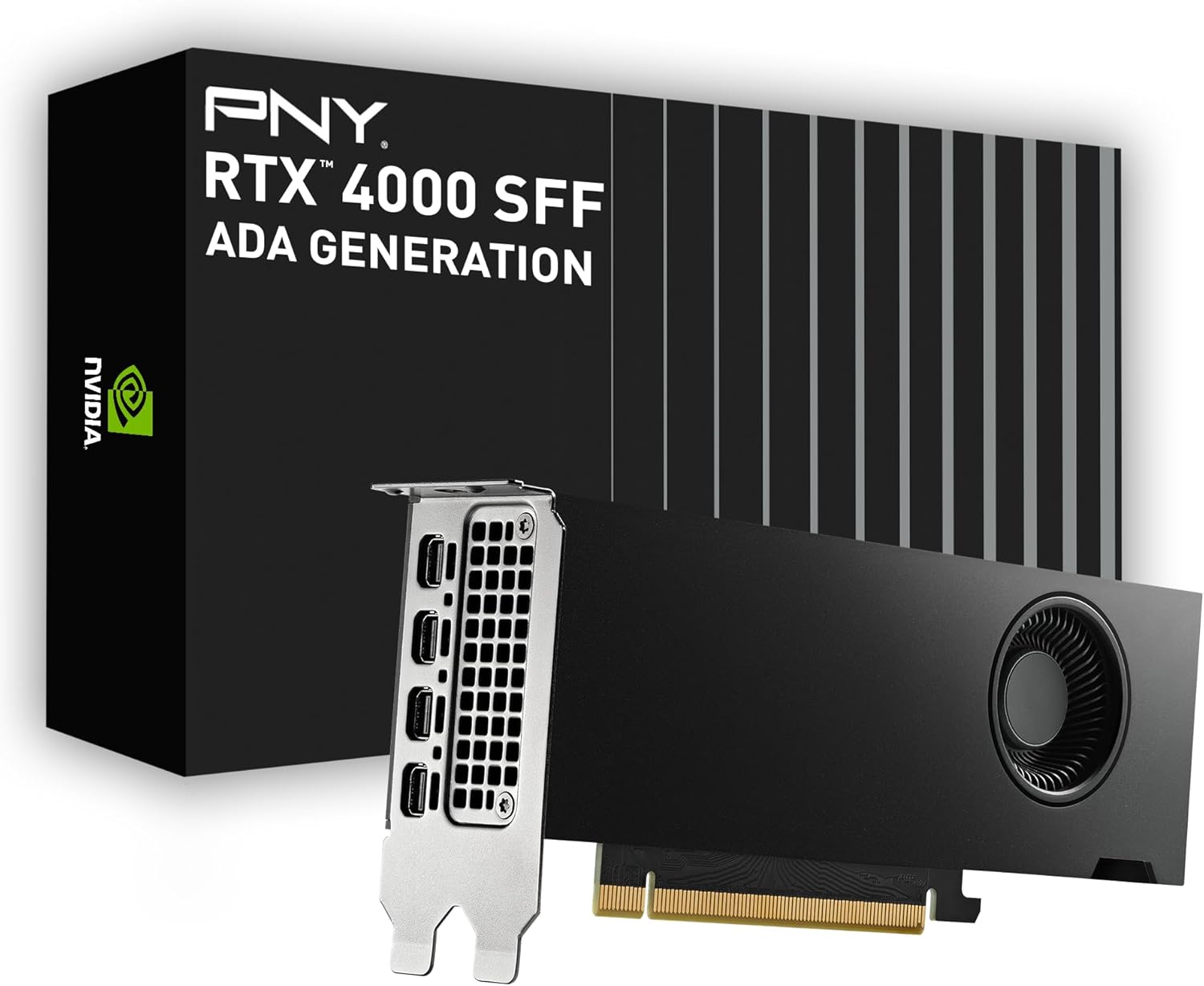
RTX 4000 SFF Ada vs RTX PRO 4000 SFF Blackwell for Local LLMs: 20GB vs 24GB at 70W
Two slot-powered, low-profile workstation cards for SFF AI boxes: what the extra 4GB and GDDR7 change for local LLMs.
By Mike Perry, Founder & Editor-in-Chief · Published 2026-11-09 · Updated 2026-11-11 · 14 min read
Quick Answer
Is the RTX PRO 4000 SFF Blackwell worth it over the RTX 4000 SFF Ada for local LLMs? Yes, if you run 27B-32B models or long contexts. Both cards fit the same 70W low-profile slot, but the Blackwell card has 24GB of GDDR7 at 432 GB/s, per PNY's PRO 4000 SFF spec page, against 20GB of GDDR6 on the Ada card, per NVIDIA. For 7-14B models, a used Ada card is the better value.
Introduction
A 70W low-profile workstation card is a niche purchase, and the people who need one usually have no other option. OEM small-form-factor towers such as the Dell Precision compact line and Lenovo ThinkStation P3 Tiny and Ultra ship with power supplies that have no PCIe 8-pin connector, and with half-height slots. Quiet homelab boxes and 2U short-depth servers have the same constraints. In those machines, a consumer RTX card isn't a choice at all. The choice is between NVIDIA's two slot-powered SFF cards: the RTX 4000 SFF Ada Generation, launched in 2023, and its successor, the RTX PRO 4000 SFF Blackwell.
Both cards draw a maximum of 70W, both carry ECC memory, and both are dual-slot, low-profile boards. The differences that matter for local LLM inference are memory capacity (20GB vs 24GB), memory bandwidth (280 GB/s vs 432 GB/s) and the PCIe interface (Gen4 x16 vs Gen5 x8).
Step 0: is your workload memory-bound or compute-bound?
Answer this before you compare anything else. Token generation, the part of inference where the model writes its answer one token at a time, reads every active weight once per token. Its speed is limited mainly by memory bandwidth, so more GB/s means more tokens per second. Prompt processing (prefill), where the model reads your input, is limited by compute. Prefill matters most for retrieval-augmented generation (RAG), long documents and agent loops that re-send large contexts.
Capacity comes before either: a model that doesn't fit in VRAM falls back to system RAM and slows down by an order of magnitude. So the decision order is: does it fit (capacity), how fast does it talk (bandwidth), how fast does it read (compute).
Key Takeaways
The PRO 4000 SFF Blackwell has 24GB vs 20GB and 432 GB/s vs 280 GB/s in the same 70W envelope, per PNY's and Hardware Corner's published specs.
Published runs on the RTX 4000 SFF Ada put Llama 3.1 8B Q4_K_M at 44.4 tok/s and Qwen2.5 14B Q4_K_M at 24.7 tok/s, per LocalScore.
On the 20GB Ada card, 32B models need a sub-Q4 quant (IQ4_XS ran at about 16.4-16.9 tok/s, per Hardware Corner). The 24GB card fits Q4_K_M with room for context.
No public LLM benchmarks for the PRO 4000 SFF Blackwell were found as of November 2026. The bandwidth ratio suggests generation up to about 1.5x faster, but that is an estimate, not a measurement.
If your chassis takes a full-height, 170W card, an RTX 3060 12GB matches the Ada SFF on small models for a fraction of the price.
One detail is easy to miss: the Blackwell card's PCIe 5.0 x8 link matches Gen4 x16 bandwidth only in a Gen5 slot. In an older Gen4 workstation it runs at Gen4 x8, half the host bandwidth. For single-card inference with the whole model in VRAM, that barely matters after the model loads. It matters more if you offload layers to system RAM.
What tok/s does the RTX 4000 Ada class deliver on 7-9B models?
Read the card column carefully. The XiongjieDai and llama.cpp #15013 rows were measured on the full-height RTX 4000 Ada, a higher-power card with the same 20GB memory configuration. It is not the 70W SFF. The SFF-specific LocalScore run is lower: 44.4 tok/s against 58.59 tok/s on the full-height card's closest comparable row. Different runtimes and settings explain part of that gap, and the power cap explains the rest. Hardware Corner's SFF guide reports 58.59 tok/s for Llama 3.1 8B Q4_K_M, which matches the full-height XiongjieDai figure exactly, so treat it with caution. Plan on mid-40s tok/s for an 8B Q4 model on the SFF card. That is still faster than you can read.
What does the PRO 4000 SFF Blackwell measure?
No published llama.cpp, Ollama, vLLM or LocalScore run for the RTX PRO 4000 SFF Blackwell could be found as of November 2026. The card is new, it sells mostly into OEM workstation channels, and benchmark sites haven't caught up. So the numbers below are an estimate, labelled as one.
Token generation tracks memory bandwidth closely, so the simplest projection scales the Ada SFF's measured results by the bandwidth ratio: 432 / 280 = 1.54x.
Treat these as ceilings. Real cards rarely reach their full theoretical bandwidth during inference, and the 70W cap limits clocks on both generations. If you find a published run for this card, trust it over this table. Measured rows will be added to the RTX 4000 SFF Ada benchmark page and its Blackwell counterpart as public data appears.
What fits in 20GB vs 24GB?
The table below estimates weight sizes from each GGUF quant's average bits per weight (about 4.85 for Q4_K_M, 5.7 for Q5_K_M, 6.56 for Q6_K, 8.5 for Q8_0, 16 for FP16), multiplied by the parameter count. It is arithmetic, not a measurement. Allow roughly 1GB more for the CUDA runtime and compute buffers.
Model
Q4_K_M
Q5_K_M
Q6_K
Q8_0
FP16
Qwen2.5 14B (14.8B)
9.0GB, fits both
10.5GB, fits both
12.1GB, fits both
15.7GB, fits both
29.6GB, neither
Gemma 3 27B (27B)
16.4GB, fits both
19.2GB, 24GB only
22.1GB, 24GB, tight
28.7GB, neither
54GB, neither
Qwen2.5/Qwen3 32B (32.8B)
19.9GB, 24GB only
23.4GB, neither in practice
26.9GB, neither
34.8GB, neither
65.6GB, neither
gpt-oss 20B (MXFP4 native)
about 13GB as shipped, fits both
n/a
n/a
n/a
n/a
KV cache comes on top. For a model with Qwen2.5-32B's attention layout (64 layers, 8 KV heads, head dimension 128), FP16 KV cache costs about 0.25MB per token: roughly 2GB at 8K context and 8GB at 32K. Qwen2.5 14B's layout (48 layers) costs about 0.19MB per token: 1.5GB at 8K and 6GB at 32K. gpt-oss 20B uses a sliding window on half its layers, so its KV cache stays under about 1GB even at 32K by the same arithmetic.
The practical upshot:
14B models: both cards run Q8_0 with 8K context. The 24GB card adds room for 32K context at Q6_K.
27B models: the 20GB card runs Q4_K_M with a short context. The 24GB card runs Q5_K_M or Q4_K_M with 16K+ context.
32B models: the 20GB card needs IQ4_XS or Q3_K_M, which is what Hardware Corner ran. The 24GB card runs Q4_K_M with about 12K tokens of FP16 KV cache (19.9GB of weights plus about 1GB of overhead leaves about 3GB), or about 24K with 8-bit KV cache.
Prefill vs generation: where GDDR7 helps and where 70W limits it
GDDR7's bandwidth lifts generation, the memory-bound phase, close to linearly, as long as the GPU core can keep up. At 70W both cards spend most of their power budget on the memory and core during generation. The Blackwell card's 8,960 CUDA cores and fifth-generation tensor cores, per PNY, give it more compute per watt for prefill. LocalScore measured the Ada SFF at 2,004 tok/s of prefill on Llama 3.1 8B Q4_K_M and 1,051 tok/s on Qwen2.5 14B Q4_K_M. A 10,000-token RAG prompt on 14B therefore takes about 10 seconds before the first output token on the Ada SFF.
Blackwell also adds native FP4 tensor-core support. Runtimes that use NVFP4 or MXFP4 weights, including gpt-oss's native MXFP4 checkpoints in recent llama.cpp and vLLM builds, can use it. Ada falls back to slower paths for those formats. For agent workloads with long, repeated contexts, that is the Blackwell card's largest practical advantage after capacity.
What the 70W cap costs: under sustained load, both cards hold lower clocks than their full-height siblings. That is why the SFF Ada's LocalScore result sits below the full-height card's XiongjieDai result. Expect the same pattern from Blackwell versus the full-height RTX PRO 4000 Blackwell, a separate, higher-power card listed as the PNY RTX PRO 4000 Blackwell.
Context-length impact: what the extra 4GB buys at 27B Q4
Take a 27B model at Q4_K_M (about 16.4GB of weights) and add about 1GB of runtime overhead:
20GB card: about 2.6GB left for KV cache. With a 0.25MB-per-token layout, that is roughly 10K tokens at FP16 KV, or about 20K with 8-bit KV cache.
24GB card: about 6.6GB left, roughly 26K tokens at FP16 KV, or about 52K with 8-bit KV.
The extra 4GB buys about 16K tokens of FP16 context at this size. For document Q&A, coding agents or long chat histories, that is a bigger day-to-day difference than the speed gain.
On the 7-9B runs collected on our RTX 3060 12GB benchmark page, the consumer MSI RTX 3060 12GB matches or beats the Ada SFF at small-model generation. On 12-15B models its median is about 29.4 tok/s across 27 published runs from 12 sources, slightly ahead of the SFF Ada's 24.7 tok/s on Qwen2.5 14B. It costs a fraction of either workstation card. It also needs a full-height, dual-slot space, a PCIe 8-pin connector and a 170W budget, and it has 12GB with no ECC. In a full-size tower, it is the value pick. In a Dell Precision compact or a ThinkStation Tiny, it doesn't fit.
On price: at the time of writing, the tracked new listing for the Blackwell SFF sits at roughly 1.8x the tracked listing for the Ada SFF, and used Ada cards sell for less still. For 7-14B models, the Ada card delivers more tokens per dollar. The Blackwell card earns its premium only when you need the 24GB or the FP4 path.
Can you run two in an SFF chassis?
Physically, rarely. Most compact OEM towers have one x16 slot with room for a dual-slot low-profile card, and a second slot that is x4 electrically or blocked by the first card. Some 2U servers and mini-ITX homelab builds with bifurcation risers can take two. The main limit is airflow: two 70W blower-style cards back to back in a cramped chassis will throttle without directed airflow.
Multi-GPU scaling for inference works. llama.cpp splits layers across cards, and vLLM supports tensor parallelism. XiongjieDai's benchmarks ran Llama 3 70B Q4_K_M across four full-height RTX 4000 Ada cards at 7.33 tok/s. Two Blackwell SFF cards would give 48GB, enough for a 70B model at Q4 with a short context, at 140W total. For that budget, also look at a single high-VRAM card like the RTX A6000 if your chassis allows it.
Verdict matrix
Get the RTX 4000 SFF Ada if…
Your main models are 7-14B (Llama 3.1 8B, Qwen 14B, Mistral, Phi)
You can buy used at a good price
You want a proven card with years of public benchmark data
Get the RTX PRO 4000 SFF Blackwell if…
You run 27B-32B models at Q4_K_M, or need 16K+ context at 27B
You use FP4/MXFP4 models like gpt-oss and want native tensor-core support
You need a new card with full warranty in a 24/7 workstation
Get a consumer RTX 3060 12GB instead if…
Your chassis takes a full-height card and has a PCIe 8-pin connector
Your models are 8B-14B and you don't need ECC
Price matters more than power draw or size
Recommended pick
For most people building a slot-powered AI box in late 2026, the RTX PRO 4000 SFF Blackwell is the pick when the budget allows. The 24GB capacity opens up 27B-32B models at proper quantization, and the 54% bandwidth increase should show up in generation speed once public runs arrive. If your models top out at 14B, buy a used RTX 4000 SFF Ada and spend the difference on system RAM or storage.
Bottom line
Capacity decides this comparison, then bandwidth. Both cards fit the same slots and draw the same 70W. The Blackwell card's extra 4GB moves a 32B model from "only with a compromised quant" to "runs at Q4_K_M", and its GDDR7 should speed up everything else. For 7-14B work, the Ada card is still a capable, cheaper choice.
As an Amazon Associate, SpecPicks earns from qualifying purchases; we also earn on qualifying eBay purchases via the eBay Partner Network. Prices shown were last tracked at crawl time and may vary — check the listing for the current price.
📹 Watch a review
I'm still mad… but buy it anyway - RTX 3060 Review — Linus Tech Tips on YouTube
Frequently asked questions
Do either of these cards need a PCIe power connector?
No. Both are 70W cards that draw all their power from the PCIe slot, which is why they fit OEM small-form-factor workstations like the Dell Precision and Lenovo ThinkStation lines, where the power supply has no spare GPU cables. Check that the slot is a full x16 mechanical slot. Also confirm the chassis has the low-profile bracket clearance for a dual-slot card.
Is 24GB enough for 32B-class models?
At Q4_K_M, a 32B dense model's weights take most of 24GB, which leaves room for a modest context window before the KV cache spills over. The 20GB card has to drop to Q3 quantization or offload layers to system RAM at that size. If 32B models are your main use, the extra 4GB decides whether the model runs at all, beyond any speed difference.
Why are these slower than a consumer card that costs far less?
These cards trade throughput for a 70W power cap, a low-profile size and ECC memory. Token generation mostly depends on memory bandwidth, and a 170W consumer card like the RTX 3060 12GB has bandwidth comparable to these SFF cards at a fraction of the launch price. The SFF cards win on fitting where nothing else fits, and on running quietly around the clock.
Are the professional drivers a problem for llama.cpp, Ollama or vLLM?
No. The RTX professional drivers use the same CUDA stack as GeForce, so llama.cpp, Ollama and vLLM run unchanged. Blackwell cards need a recent CUDA toolkit to get native kernels. Containers built against older CUDA versions may fall back to slower paths, so rebuild your inference image on a current CUDA base before you compare results.
Should I buy new or used for an SFF AI box?
The RTX 4000 SFF Ada is widely available used now that the Blackwell successor has shipped, and that is where its value lies for 7-14B models. Buy the PRO 4000 SFF Blackwell new if you need 24GB, GDDR7 bandwidth and a full warranty. For a workstation that runs 24/7, ECC and warranty coverage matter more than they do for a hobby card.