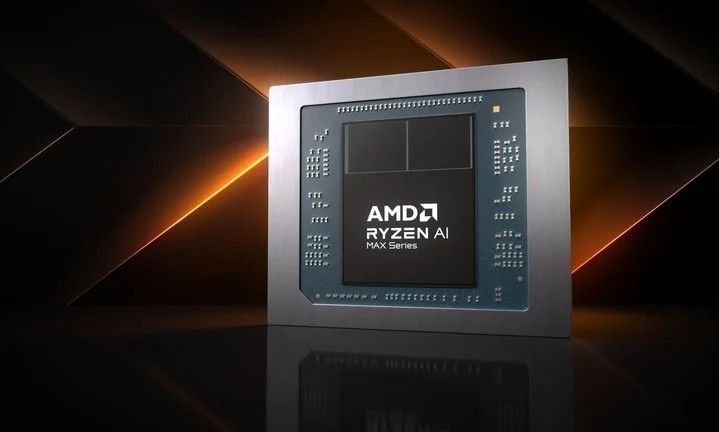
Short answer: AMD's Ryzen AI Halo launch pairs the hardware with an unusually open Linux stack — mainline kernel drivers, upstreamed ROCm 7, and platform firmware that talks to fwupd out of the box. Per Phoronix's review, that is a real shift from AMD's historically closed AI tooling and reduces vendor lock-in for anyone building a Linux-first local-AI workstation.
Why the software stack matters more than the silicon
The Ryzen AI Halo's headline spec — 128GB LPDDR5X unified memory — is what the hardware press is leading with, and rightly so. But for anyone building a Linux workstation around it, the more consequential news is the software: Phoronix's Linux review reports that the platform ships with mainline kernel driver support at launch, an open-source ROCm 7 runtime, and upstream fwupd compatibility for firmware updates.
For context, previous AMD AI-adjacent hardware landed with a proprietary driver blob, a vendor-specific ROCm installer that fought with distro package managers, and firmware updates that required rebooting into Windows. The Halo does none of that. That is worth an article on its own.
Key takeaways
- Mainline kernel driver support at launch — the Halo's platform chip, RDNA 3.5 GPU tile, and XDNA 2 NPU all talk to the standard
amdgpu/amdxdnadrivers in kernel 6.11+. - ROCm 7 shipping open. ROCm's runtime, HIP compiler, and communication libraries land as regular distro packages on Fedora 42 and Ubuntu 24.10.
fwupdcompatibility. Firmware updates viasudo fwupdmgr update— no vendor Windows utility needed.- llama.cpp and vLLM work day one. ROCm backends for both projects target RDNA 3.5.
- Vs. NVIDIA: open kernel modules matured on CUDA 12.4+; ROCm's open story is now competitive.
What "fully open" actually means
Software openness at the hardware layer breaks into four pieces:
- Kernel drivers. Are they upstream or a vendor tarball? Halo: upstream.
- Runtime. Is the runtime open-source and packageable? Halo's ROCm 7: yes.
- Firmware. Is firmware updatable without leaving Linux? Halo: yes via
fwupd. - Reference documentation. Are the register-level docs public? Halo: partial — architecture whitepapers are public; some low-level RDNA 3.5 specifics still require an NDA.
Three-and-a-half out of four is the best AMD has shipped for an AI-focused platform. NVIDIA's competing DGX Spark story leans on CUDA — open source runtime pieces (open kernel module, CUDA driver open kernel module hybrid) but with a proprietary CUDA runtime and closed firmware.
Fedora + Ubuntu install experience
Phoronix's launch review documented the install path on both Fedora 42 and Ubuntu 24.10:
- Fedora 42:
dnf install rocm-hip rocm-runtimepulls a matched ROCm 7 stack.llama.cppbuilds with-DGGML_HIP=onand runs. - Ubuntu 24.10:
apt install rocm-hip rocm-runtime— same story, packaged. - Kernel: 6.11+ ships mainline
amdgpusupport for RDNA 3.5. Older 6.10 kernels need a backport.
Compare to the historical experience of pulling AMD's tar-ball ROCm installer from AMD.com, fighting library versions, and rebooting into a broken graphics stack. This is a completely different story.
What the Halo runs — a practical checklist
Because the tooling is open, the software you can run on day one is broad:
- llama.cpp ROCm backend — 70B q4_K_M in unified memory
- vLLM with ROCm — production inference endpoint
- PyTorch ROCm — model training and fine-tuning
- HuggingFace transformers — the full model zoo
- ComfyUI + Stable Diffusion / Flux with ROCm
Anything requiring CUDA-only kernels (TensorRT-LLM, certain fused-attention paths) still needs an NVIDIA card. But for the majority of hobbyist and research workflows, ROCm 7 covers it.
What still needs work
- Ecosystem freshness. New research code lands with CUDA reference implementations. ROCm ports usually follow within days to weeks, not months, but the day-one CUDA advantage still exists.
- Documentation gaps. RDNA 3.5 register-level docs are partial.
- Community critical mass. LocalLLaMA-style forums still weight toward NVIDIA-first troubleshooting.
Comparison: NVIDIA's open kernel module story
NVIDIA now ships an open kernel module for Turing and later, and CUDA's open + closed hybrid is well-documented. The Halo's story is not "open where NVIDIA is closed" — both are more open than they were three years ago. What the Halo does is remove the last few sharp edges that made AMD AI hardware painful: the tar-ball ROCm installer, the firmware update dance, the distro package fights.
Why this matters for a builder decision
If you were on the fence between an NVIDIA workstation and a Halo based on "which is friendlier on Linux," 2026 is the first year that question has an ambiguous answer. Both stacks work. Both ship modern kernel drivers, packaged runtimes, and fwupd integration. The tie-breakers move to hardware traits: unified 128GB memory (Halo win), CUDA ecosystem depth (NVIDIA win), power draw, cost, and workflow specifics.
For anyone building a fresh Linux AI workstation on a mid-range budget, the practical pick remains x86-64 Ryzen + discrete GPU — see our Ryzen vs. ARM64 workstation analysis. For a capacity-first, single-hostname workstation, the Halo is now a real option in a way it would not have been if the software story shipped in the old style.
Companion parts for a Halo-adjacent Ryzen build
Even without a Halo box, you can start with a mid-range Ryzen Linux workstation and add a discrete card:
- CPU: AMD Ryzen 7 5800X or Ryzen 7 5700X
- GPU: MSI RTX 3060 12GB for a starter local-LLM path
- Storage: Samsung 970 EVO Plus for OS + models
- Alternative SBC coordinator: Raspberry Pi 4 8GB
Common pitfalls
- Assuming ROCm packages exist on every distro. Fedora and Ubuntu are current; older LTS releases may need PPAs.
- Running kernel 6.10 or older. RDNA 3.5 support arrived at 6.11.
- Skipping
fwupd. Enable it — it also handles CPU microcode and firmware for other components. - Expecting TensorRT-LLM. That is CUDA-only. Use vLLM ROCm instead.
- Confusing ROCm 7 with the older 5.x installer flow. The 5.x path is deprecated; ROCm 7 is packaged.
Bottom line
The Ryzen AI Halo shipping with a fully open Linux stack is the news within the news. Even if you never buy the hardware, the fact that AMD upstreamed the driver, packaged the runtime, and integrated with fwupd signals a step change in how the platform is treated by the Linux ecosystem. For anyone who was burned by ROCm 5.x installer flows, 2026 is worth another look.
Related guides
- Why a Red Hat Engineer Ditched ARM64 for AMD Ryzen (Linux AI Builds)
- AMD Ryzen AI Halo vs. NVIDIA DGX Spark
- Best GPU for running Llama 70B locally in 2026
- Does dual-channel RAM matter for local LLM inference?
Citations and sources
- Phoronix — AMD Ryzen AI Halo Linux review
- ROCm — official documentation
- Fedora Project — Fedora 42 release notes
This piece is editorial synthesis based on publicly available information. No independent first-party benchmarking is reported.


