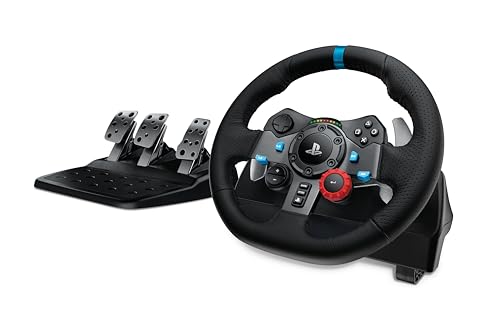
Short answer: Platform decides this, not preference. The Logitech G29 is PlayStation-and-PC only and gives you real force feedback plus three pedals — it is the better wheel by a wide margin. The HORI Racing Wheel Overdrive is the Xbox-side pick: no force feedback, two pedals, roughly half the price. Buy the G29 unless you are on Xbox.
Prices change frequently — check the live listing before buying.
The first-wheel decision nobody frames correctly
Almost every "which racing wheel should I buy" thread collapses into a rim-versus-rim argument, and that is the wrong axis. Three things determine whether a first wheel gets used or ends up in a closet, and only one of them is the wheel itself.
The first is platform licensing. Console racing wheels are locked by license, not by USB protocol. A wheel licensed for PlayStation will not be recognised by an Xbox and vice versa, and no officially supported adapter arrangement changes that. This filter eliminates one of the two wheels in this comparison before you have read a single specification, which is why it comes first here.
The second is force feedback versus no force feedback — the single largest functional difference between these two products. Force feedback is a motor actively resisting and pulling at the rim in response to what the tires are doing. Vibration feedback, which is what the HORI provides, is a rumble motor telling you that something happened. Both are more informative than a gamepad's rumble; only one of them tells you the front end is about to wash out before the car visually understeers.
The third is where the rest of the budget goes. A wheel is one component of a rig that also needs pedals with usable travel, somewhere rigid to clamp to, and a screen positioned at a sane field of view. Buyers routinely spend the entire budget on the rim and then discover that a flexing desk makes good force feedback feel like mush. Per Tom's Hardware's racing wheel guide, the entry tier is where these trade-offs are sharpest, because there is no headroom in the budget to fix a bad decision later.
This comparison works through all three, in that order.
Key takeaways
- The G29 is PlayStation and PC only. Per Logitech G's product page, the Driving Force G29 is licensed for PS5, PS4 and PC. The Xbox-licensed equivalent in Logitech's line is the G920, not the G29.
- The HORI Overdrive is Xbox and PC. HORI lists it as officially licensed for Xbox Series X|S and Xbox One, with PC support.
- Force feedback vs vibration is the real gap. The G29 uses dual-motor helical-gear force feedback with 900 degrees of rotation, per Logitech G's specifications. The Overdrive uses vibration feedback with a much shorter rotation range.
- Three pedals vs two. The G29 ships a throttle, brake and clutch set; the Overdrive ships throttle and brake. The clutch only matters if you also intend to buy an H-pattern shifter.
- Price gap is roughly 2:1, and the cheaper path leaves budget for a stand — which is not a trivial consideration.
Step 0: which ecosystem are you actually in?
Answer this before reading any further, because it resolves most of the decision.
| Your setup | Wheel in this comparison | |
|---|---|---|
| PlayStation 5 / PS4, or PS + PC | Logitech G29 | |
| Xbox Series X\ | S / Xbox One, or Xbox + PC | HORI Racing Wheel Overdrive |
| PC only | G29 — more wheel for the money at this tier | |
| Multiple consoles across families | Neither wheel covers both; budget for the platform you race on most |
The cross-platform question comes up constantly and the honest answer is that entry-tier wheels do not solve it. Third-party converter boxes exist, they are not officially supported, and they have a long history of breaking with console firmware updates — which means a working setup can stop working overnight through no action of yours. If you genuinely race on both families, the practical answer is to buy for the platform that gets the most hours and use a gamepad on the other.
Spec-delta table
| Spec | Logitech G29 | HORI Racing Wheel Overdrive | |
|---|---|---|---|
| Rotation angle | 900° | 270° | |
| Feedback type | Dual-motor force feedback, helical gearing | Vibration feedback (no FFB) | |
| Pedal set | 3 pedals (throttle, brake, clutch) | 2 pedals (throttle, brake) | |
| Platform support | PS5, PS4, PC | Xbox Series X\ | S, Xbox One, PC |
| Street price | Higher tier — roughly 2× the Overdrive | Entry tier |
Rotation angle deserves a note, because the 900°-versus-270° gap is larger in practice than it looks on a spec sheet. 900 degrees means two and a half turns lock to lock, which matches a real road car and lets you use hand-over-hand technique in slow corners and hairpins. 270 degrees is closer to a kart or an arcade cabinet: quick and direct, but you run out of lock in tight corners and the steering feels twitchy at speed because a small hand movement produces a large steering input.
Neither is objectively wrong. Arcade racers are designed around short rotation and feel fine on it. Simulation titles assume a longer range, and driving them at 270 degrees is a persistent, low-grade annoyance.
How much does force feedback actually change lap times?
Less than people expect on raw pace, and far more than people expect on consistency. That distinction is the useful one.
A fast lap is largely a matter of knowing the track, and a gamepad user who has memorised the racing line will beat a wheel user who has not. What force feedback provides is the missing sensory channel: the rim goes light when the front tires lose grip, it fights back as load builds through a corner, and it snaps when a wheel drops off a kerb. Per PC Gamer's racing wheel roundup, this feedback loop is the reason wheels are the recommended input for simulation titles rather than a cosmetic preference.
The practical consequence: with force feedback you find the limit of grip and then stay there lap after lap, because you can feel where it is. Without it, you find the limit by exceeding it and correcting — which works, but produces a much wider spread of lap times. Reviewers consistently describe the entry-tier force-feedback experience as coarse compared to belt-driven and direct-drive wheels above it, and Tom's Hardware's guide makes the same point about the gear-driven tier generally. Coarse feedback is still feedback; vibration is not.
The counter-argument for the Overdrive is real, though. If your library is arcade racers with steering assists active, the assists are already flattening exactly the physics that force feedback would have communicated. In that case you are paying for information the game is not generating.
Pedals: two pedals versus three, and where a potentiometer stops being enough
Pedal sets at this tier use potentiometers — a linear sensor measuring travel — rather than load cells, which measure applied pressure. The difference matters most on the brake. A potentiometer brake asks you to modulate by position, and human legs are much better at repeating a pressure than a position. That is why load-cell brakes are the most-recommended first upgrade in sim racing, and why it is worth knowing that neither wheel here includes one.
Within that constraint, the G29's three-pedal set has two advantages. Pedal travel is longer and the brake has a firmer progressive rubber stop, so there is more usable range to modulate within. And the clutch pedal exists — irrelevant on its own, but it becomes necessary the moment an H-pattern shifter enters the picture.
The Overdrive's two-pedal set is lighter, shorter in travel and closer to a console-accessory feel. For arcade racing where braking is largely binary, that is adequate. For anything modelling trail braking or weight transfer, the shorter travel makes fine modulation harder, and that is the ceiling you will hit first.
Do you need a shifter?
Not for your first wheel. Buy the wheel, race on the paddles for a month, and add a shifter only if the specific titles you play support H-pattern shifting properly — many modern titles do not model a clutch-and-H-pattern change at all, and the shifter sits unused.
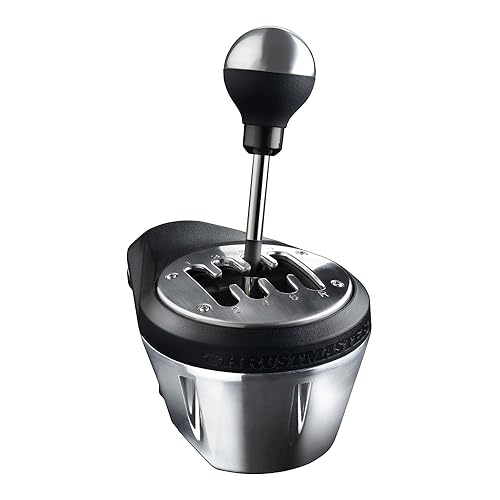
When it does apply, the Thrustmaster TH8A Shifter is the standard entry into serious shifting hardware: metal construction with a 7+1 H-pattern gate that converts to sequential, and compatibility across PC, PlayStation and Xbox depending on the wheelbase it is attached to. The categories where it genuinely changes the experience are historic racing, rally, and truck simulation — all of which model the gear change as a skill rather than an animation.
Two practical warnings. A shifter needs to be mounted — clamping it to the same flexing desk as the wheel produces a shifter that moves when you use it, which is worse than paddles. And check the specific title's support before buying: a shifter that the game maps as a set of buttons rather than a true gate is a expensive way to press buttons.
When a gamepad is still the right answer
This section is here because a meaningful share of readers should not buy either wheel.
The PlayStation DualSense Wireless Controller is the honest baseline. Its adaptive triggers apply variable resistance under braking and acceleration, and its haptics communicate surface texture and traction loss with more nuance than a rumble motor. That is not force feedback and it does not replace a wheel for simulation — but it is a genuinely informative input, it costs a fraction of either wheel, it needs no mounting, and it lives in a drawer when you are not using it.
Buy the gamepad instead of a wheel if: your library is mostly arcade racers with assists on, you have no permanent desk space to clamp to, you share the room with people who will object to gear-driven feedback noise, or you are not yet sure racing games are a lasting interest. A wheel bought on enthusiasm and abandoned in a closet is the most expensive outcome in this guide.
Display pairing: field of view and refresh rate
Wheel feel and screen setup are more coupled than they look. Cockpit-view racing depends on peripheral cues — apex position, kerb edges, cars alongside you — and a screen that is too small or too far away removes exactly those cues, which makes the wheel's feedback harder to correlate with what you are seeing.
A single 27-inch panel at desk distance is the practical entry configuration. Something like the Samsung 27" Odyssey 4K UHD Gaming Monitor — a 27-inch 4K panel rated at 144Hz and 1ms — covers the two variables that matter: enough refresh rate that the frame you are reacting to is current, and enough pixel density at 27 inches that distant apex markers stay legible rather than dissolving into aliasing.
Refresh rate matters more than resolution for racing specifically. Frame-to-frame latency is part of the control loop when you are correcting a slide, and a higher refresh rate tightens that loop. If the choice is between a 4K 60Hz panel and a 1440p 144Hz panel at the same price, take the refresh rate.
Mounting, desk clamps and the noise question
Desk clamps. Both wheels ship with clamps. Check your desk thickness against the clamp's jaw range before ordering — this is the most common preventable failure. Flex is the real problem, not strength: a desk that moves under braking makes force feedback feel vague and inconsistent, because the wheel and your body are moving together instead of the wheel resisting you.
Noise. Gear-driven force feedback is audible. Kerb strikes, lock-ups and full-lock hits produce a mechanical rattle that transmits through a desk into the floor, which is a genuine consideration in apartments and shared spaces. The Overdrive is close to silent by comparison, because there is no motor driving the rim. This is one of the concrete, non-performance reasons buyers move to belt-driven and direct-drive wheels later — those designs are substantially quieter than gear-driven units.
Stands. A dedicated wheel stand costs real money but solves clamping, flex and storage in one purchase. Readers who already know the hobby will stick usually find it pays for itself in feel. Readers who are not sure yet should clamp to a solid desk first and decide later.
Total cost of each path
| Path | Wheel | Pedals | Shifter | Mount | Realistic total |
|---|---|---|---|---|---|
| G29 (PS/PC) | Included | 3-pedal, included | Optional TH8A | Desk clamp or stand | Wheel + optional stand |
| Overdrive (Xbox/PC) | Included | 2-pedal, included | Not applicable at this tier | Desk clamp | Roughly half the G29 path |
| Gamepad | DualSense | N/A | N/A | None | Lowest by a wide margin |
The number that surprises people is that the G29 path and the Overdrive path are not really competing on price, because they are not competing at all — they are on different consoles. Where the price comparison does bite is PC-only buyers, who can pick either. For that group the G29 is the recommendation: at roughly double the price you get force feedback, 900 degrees of rotation and a third pedal, and those are the three things that determine whether the wheel still gets used in a year.
Verdict matrix
Get the Logitech G29 if… you race on PlayStation or PC, your library includes any simulation titles, you want to learn a racing line properly rather than just enjoy the novelty, or you expect to add a shifter later. The clutch pedal and 900-degree rotation are what make that upgrade path possible.
Get the HORI Racing Wheel Overdrive if… you race on Xbox — in which case it is the option in this comparison — or you are on PC, your library is arcade racers, and noise or budget is the binding constraint. It is a real wheel and a large improvement over a gamepad for steering precision; it is just not a force-feedback wheel.
Get neither and buy a gamepad if… your racing is casual, your library runs with assists on, you have no permanent space to mount hardware, or you are not yet confident the interest will last. The DualSense's adaptive triggers cover more of the gap than most people expect.
The pick
For anyone whose platform allows it, the Logitech G29 is the wheel to buy. Per Logitech G's specifications it delivers 900 degrees of rotation, dual-motor helical-gear force feedback and a three-pedal set at the entry tier, and both Tom's Hardware and PC Gamer place the Driving Force line as the reference recommendation for first-wheel buyers. The feedback is coarse compared to belt-driven wheels costing several times as much — every reviewer says so — but coarse force feedback communicates grip, and vibration does not.
The HORI Racing Wheel Overdrive is not a worse product so much as a different one: it is the Xbox answer, and within that constraint it does the job it is licensed to do. Judge it against a gamepad, which is its actual competition on that platform, and it wins clearly on steering precision.
Bottom line
Let the console decide, then let the game library decide whether to buy a wheel at all. On PlayStation or PC, the G29 is the entry-tier default and there is no serious argument against it at the price. On Xbox, the Overdrive is the accessible option and it is a genuine upgrade over a controller for racing games with assists on. If your library is arcade racers and your space is shared, the honest recommendation is the gamepad and the money saved — and that is a legitimate outcome of this comparison, not a cop-out.
Related guides
- Best Controller for PC Retro Emulation
- KOORUI 27" 4K vs Samsung Odyssey 4K 27-inch
- Best Budget Gaming Peripherals Under $100
Citations and sources
- Logitech G — Driving Force G29 product page (accessed 2026-08-22)
- Tom's Hardware — Best racing wheels (accessed 2026-08-22)
- PC Gamer — Best racing wheels (accessed 2026-08-22)
This piece is editorial synthesis based on publicly available information. No independent first-party benchmarking is reported.
— Mike Perry