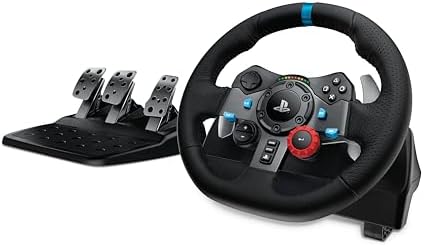
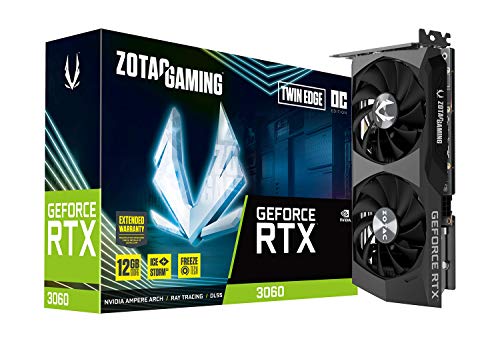
For sim racing specifically, the ultrawide wins — but not for the reason most buyers think. At 3440×1440 you push 4.95 megapixels versus 8.29 at 3840×2160, roughly 40% fewer pixels, and you spend that saving on horizontal field of view rather than density. On a 12GB RTX 3060, that trade is the difference between a stable frame rate and a compromised one.
Who this is for
You own a wheel — a Logitech G29 bolted to a desk clamp, or a Hori Racing Wheel Overdrive if you came in through Xbox. You have a mid-range GPU. You have somewhere between $300 and $500 for one screen, and you are stuck between two shapes: a 34-inch 21:9 ultrawide that wraps further into your peripheral vision, or a 27-inch 16:9 4K panel that resolves distant apex markers more sharply.
Racing is the one genre where this question has a different answer than it does for everything else. In a shooter, resolution and refresh rate dominate. In a spreadsheet, pixel density dominates. In a racing sim you are driving a vehicle whose most important information — the apex you are turning into, the car alongside you, the mirror you are checking before a lane change — lives at the left and right edges of your vision, not in the center. Aspect ratio is not a preference here. It is a functional spec.
That said, this guide is going to argue against a simple "buy the ultrawide" conclusion, because the specific ultrawide most people in this price band land on is a 60 Hz productivity panel with no adaptive sync. That combination is a real constraint for racing, and pretending otherwise would waste your money. The honest answer depends on which of three bottlenecks you actually have.
Diagnose your bottleneck before you buy anything
Work through these in order. The first one that is true is the thing to spend money on, and it is frequently not the monitor.
Is your wheel the limit? If you are driving on a controller or an entry-level wheel with no force feedback, a monitor upgrade will not make you faster or more immersed. Force feedback communicates grip loss and weight transfer through your hands, and no display conveys that. Fix this first.
Is your GPU the limit? If you are already dropping below your refresh rate at 1080p in the sim you play, buying more pixels makes that worse, not better. Neither 3440×1440 nor 3840×2160 is a fix for a GPU that is already saturated.
Is your desk the limit? A 34-inch curved panel is roughly 32 inches wide and wants 24–30 inches of viewing distance to work properly. A wheel clamp pushes you closer to the desk, not further from it. Measure before you order — this is the failure mode that produces a returned monitor.
If none of the three is your binding constraint, then the display genuinely is the next upgrade, and the rest of this guide is about picking the right one.
Key takeaways
- 3440×1440 is 4.95 MPix; 3840×2160 is 8.29 MPix. The ultrawide asks for about 40% fewer pixels per frame at identical settings.
- 21:9 gives you roughly 33% more horizontal image than 16:9 at the same vertical height — that width is where mirrors, apexes and side-by-side traffic live.
- The LG 34WN80C-B in this class is 60 Hz with no FreeSync, an 1800R curve and 99% sRGB. It is a productivity panel that happens to be 21:9, and that matters.
- The RTX 3060 12GB runs 3,584 CUDA cores at a 1.78 GHz boost on a 192-bit bus, which is about 360 GB/s of bandwidth — enough for 3440×1440 at tuned settings, marginal at 4K.
- Sim racing tolerates 60–75 fps with stable frame pacing far better than it tolerates 100 fps with spikes. Frame-time consistency beats peak frame rate here.
Why horizontal field of view matters more than resolution
Put a 27-inch 16:9 panel and a 34-inch 21:9 panel side by side at the same vertical height and the ultrawide is not "bigger" in the way a TV is bigger. It is wider. Both show you the same amount of track ahead; the ultrawide additionally shows you what a 16:9 panel crops off at the left and right edges.
In a racing sim, that cropped region is not decoration. It contains three things you use constantly:
Apex reference points. You turn in by looking at the apex, which sits well off the center of your vision through most of the corner. On a narrow display the apex leaves the frame before you reach it, and you turn in on memory instead of sight.
Mirrors. Most sims render side mirrors at the extreme left and right of the virtual cockpit. At 16:9 they are frequently cropped or shrunk to the point of uselessness, which is why virtual-mirror overlays exist. At 21:9 they land inside the frame at a usable size.
Side-by-side traffic. The car you are racing wheel-to-wheel with is, definitionally, beside you. A wider frame keeps it visible for longer through the corner, which is the difference between a clean pass and a rubbing incident.
None of that is improved by more pixels. Sharpness helps you read a distant braking board a fraction of a second earlier; width changes what is on screen at all. For this genre, the second thing is worth more.
Spec delta: what you are actually choosing between
| Panel | Resolution | Aspect | Refresh / adaptive sync | Pixel count | vs 1080p |
|---|---|---|---|---|---|
| LG 34WN80C-B, 34" IPS, 1800R | 3440 × 1440 | 21:9 | 60 Hz, no FreeSync | 4.95 MPix | 2.39× |
| Typical 27" 4K IPS | 3840 × 2160 | 16:9 | 60 Hz, varies | 8.29 MPix | 4.00× |
| Typical 27" 1440p reference | 2560 × 1440 | 16:9 | 144–165 Hz, adaptive sync | 3.69 MPix | 1.78× |
| 1080p baseline | 1920 × 1080 | 16:9 | 60–240 Hz | 2.07 MPix | 1.00× |
The LG 34WN80C-B's official specification confirms the 34-inch 21:9 IPS panel at 3440×1440 with 99% sRGB coverage, HDR10 and 60 W USB-C power delivery (LG). Independent review coverage fills in the specs LG's marketing page omits, and they are the ones that matter for racing: a 60 Hz refresh ceiling, an 1800R curvature, 5 ms grey-to-grey response, 300 cd/m² brightness, and no FreeSync or adaptive sync of any kind (Display Ninja).
Read that last item carefully, because it is the fact that most ultrawide-versus-4K articles skip. A panel with no variable refresh rate means every frame your GPU delivers off-cadence either tears or waits. In a genre with smooth, predictable camera motion this is survivable in a way it would not be in a shooter — but it is a genuine cost, and it is the strongest argument in this whole comparison for looking at a 1440p 16:9 panel with adaptive sync instead of either option in the headline.
Can an RTX 3060 12GB actually drive 3440×1440?
NVIDIA specifies the RTX 3060 with 3,584 CUDA cores, a 1.32 GHz base and 1.78 GHz boost clock, 12 GB of GDDR6 on a 192-bit interface, and a 170 W total graphics power with a 550 W recommended system supply (NVIDIA). The ZOTAC Twin Edge OC variant runs its 12 GB at 15 Gbps across that 192-bit bus, which works out to roughly 360 GB/s of memory bandwidth.
Here is what that means in practice at each target:
| Target | Pixels/frame | Relative GPU load | Realistic RTX 3060 12GB outcome |
|---|---|---|---|
| 1920 × 1080 | 2.07 MPix | 1.00× | High refresh, headroom to spare |
| 2560 × 1440 | 3.69 MPix | 1.78× | Comfortable at high settings |
| 3440 × 1440 | 4.95 MPix | 2.39× | Achievable at tuned settings, 60–90 fps class |
| 3840 × 2160 | 8.29 MPix | 4.00× | Requires meaningful settings cuts to hold 60 |
The ratios are arithmetic, not benchmark results, and real frame rates depend heavily on the title, the settings preset and whether upscaling is on. But the ordering is reliable, and the conclusion follows from it: 3440×1440 sits in this card's comfortable operating range while 3840×2160 sits at its edge. Pairing a 4K panel with this GPU means either running at reduced settings permanently or leaning on DLSS to render below native and reconstruct — at which point you paid for pixels you are not rendering.
The 12 GB frame buffer is the other half of the argument, and it is the part that ages well. Racing sims are not usually VRAM-hungry compared to open-world AAA titles, but 12 GB removes any concern about texture settings at 3440×1440, and it is materially more headroom than the 8 GB cards in the same performance class carry.
What the wheel changes about the answer
The Logitech G29 is a 900-degree lock-to-lock wheel with dual-motor force feedback driven through helical gears, a steel ball-bearing shaft and a Hall-effect steering sensor (Logitech G). Nine hundred degrees is two and a half full turns, matching a real road car — and that specification is why the display question changes once you own one.
On a controller, you steer with a thumbstick that has maybe 40 degrees of physical travel, and your eyes stay locked forward because your hands never leave the pad. On a 900-degree wheel, hands cross over, your posture shifts through the corner, and your gaze naturally tracks toward the direction of travel. A wider frame is worth more to a driver whose eyes are already moving than to one who is staring straight ahead.
The Hori Racing Wheel Overdrive sits a tier below on force feedback but shares the geometry argument: any wheel that puts your hands at ten-and-two and your eyes on an apex benefits from horizontal image. If you are still on a controller, buy the wheel before the monitor. The ordering is not close.
Does a shifter change your seating distance?
Yes, and it is a bigger deal than it sounds. The Thrustmaster TH8A is a standalone H-pattern and sequential shifter that mounts to the desk or a rig beside the wheel. Adding one changes your body position: you sit closer so your right hand can reach the gate without leaning, and the wheel typically moves nearer to your torso to keep the geometry sane.
Sitting closer increases the angular size of whatever panel you own. That helps the ultrawide — more of your peripheral vision is filled, which is the entire point of buying one — and it hurts the 27-inch 4K panel, because at short viewing distances a dense 4K panel's advantage evaporates. You cannot resolve 163 pixels per inch from 20 inches away any better than you can resolve 110; you just sit inside the image.
So the presence of a shifter tilts the answer further toward the ultrawide, and it does so through desk geometry rather than anything about the display itself. If you run an H-pattern shifter, measure your actual eye-to-screen distance before you buy, because that number decides more than the spec sheet does.
Curvature, desk depth and eye distance
The LG panel's 1800R curve means the screen is a section of a circle with an 1800 mm radius — about 71 inches. At that radius, sitting roughly 28 inches from the center of the screen puts the far edges closer to equidistant from your eyes than a flat panel would. On a 32-inch-wide display that is a real reduction in edge distortion and off-axis color shift, both of which are worse on IPS at extreme angles.
At 27 inches and 16:9 the geometry barely changes across the panel, which is why almost every 27-inch 4K monitor ships flat and loses nothing for it. Curvature is a solution to a width problem; a 27-inch panel does not have a width problem.
The practical numbers to check before ordering:
| Measurement | 34" 21:9 (1800R) | 27" 16:9 4K |
|---|---|---|
| Approximate panel width | ~32 in | ~24 in |
| Comfortable viewing distance | 24–30 in | 20–28 in |
| Minimum desk depth needed | ~30 in | ~24 in |
| Pixel density | ~110 PPI | ~163 PPI |
| Benefits from OS scaling | No | Yes, usually 150% |
That last row is a quietly important cost of the 4K option. At 27 inches, 3840×2160 is too dense to run unscaled for most people, so you enable 150% scaling and give back a chunk of the desktop real estate you paid for. The ultrawide's ~110 PPI runs at 100% scaling natively, which is the same density as a standard 27-inch 1440p panel — familiar, and no scaling artifacts in older sim UI code.
Ultrawide vs triple screens vs single 4K
Triple screens remain the competitive-league standard, and nothing single-panel matches them for total horizontal degrees. The cost is not just the panels:
| Setup | Horizontal coverage | GPU load | Extra cost beyond panels | Non-racing usability |
|---|---|---|---|---|
| Single 27" 4K | Narrowest | Highest per frame | None | Excellent |
| Single 34" 21:9 | ~33% wider than 16:9 | Moderate | None | Excellent |
| Triple 1080p | Widest by far | 3 × 1080p ≈ 6.2 MPix | Mounts, bezel setup, GPU outputs | Poor outside racing |
For a desk that also does work, browsing and non-racing games, one ultrawide is the pragmatic answer. Triples are correct for a dedicated rig that does nothing else, and the moment you try to use them for a spreadsheet or a first-person game with a fixed HUD, you will understand why.
Cost per degree of field of view favors triples on paper and the ultrawide in practice, once you price the mounts, the extra display outputs and the hours of bezel-compensation configuration.
When each option is right — and when it isn't
Get the 34-inch ultrawide if you race more than you shoot, you have 30 inches of desk depth, and your sims handle 21:9 with proper FOV expansion rather than vertical cropping. Accept that a panel in this class may be 60 Hz with no adaptive sync, and that you will be capping frame rate to match rather than chasing it.
Get the 27-inch 4K if the monitor is primarily a work display that also races on weekends, you value text sharpness for code or documents, and you are willing to run reduced settings or upscaling in sims to hold a stable frame rate on a 3060-class GPU.
Get neither if you are still on a controller or an entry-level wheel. A G29-class base changes your lap times and your enjoyment more than any display in this price range, and it costs roughly the same as the monitor you were about to buy.
Do not buy the ultrawide if your main sim has broken 21:9 support. Some older titles and console ports stretch the image horizontally instead of expanding the field of view, which converts the ultrawide's entire advantage into a distortion artifact you cannot patch out. Check your specific game first — this is a five-minute search that saves a $500 mistake.
Do not buy 4K if you also plan to drive in VR or stream while racing. VR bypasses the monitor entirely, and streaming eats GPU headroom that a 4K target does not have to spare on this class of card.
Verdict
For a driver on a G29-class wheel and a 12 GB RTX 3060 who plays sims more than anything else, the 34-inch ultrawide is the better purchase. The horizontal field of view is a functional gain in the genre, the 40% pixel saving lands squarely inside what this GPU does well, and a shifter-equipped seating position amplifies both effects.
The caveat is sharp enough to state plainly: buy it knowing that the popular panel in this class is 60 Hz without adaptive sync, which caps what you can chase and makes frame-time consistency your target rather than peak frame rate. If a 60 Hz ceiling is unacceptable to you, the honest recommendation is neither headline option — it is a 27-inch 1440p panel at 144 Hz with adaptive sync, which costs less than both, runs beautifully on this GPU, and trades width for cadence.
The 27-inch 4K panel wins only when the display's primary job is not racing. If it spends five days a week showing text and two evenings a week showing a race track, buy for the five days.
Related guides
- Best Racing Wheels and Controllers for Sim Racing in 2026
- 34-Inch Ultrawide vs 27-Inch 4K for Coding and Gaming (2026)
- Thrustmaster TH8A vs the G29's Stock Shifter: Is a Standalone H-Pattern Worth It?
- Best GPU for 1440p Ultrawide Gaming in 2026: Performance Tier Breakdown
Citations and sources
- LG — 34" 21:9 UltraWide HDR10 Monitor 34WN80C-B — accessed 28 August 2026. Source for the 3440×1440 resolution, 34-inch 21:9 IPS panel, 99% sRGB coverage, HDR10 support and 60 W USB-C power delivery.
- Display Ninja — LG 34WN80C review — accessed 28 August 2026. Source for the 60 Hz refresh ceiling, 1800R curvature, 5 ms GtG response, 300 cd/m² brightness and the absence of FreeSync.
- NVIDIA — GeForce RTX 3060 family specifications — accessed 28 August 2026. Source for the 3,584 CUDA cores, 1.32/1.78 GHz clocks, 12 GB GDDR6 on a 192-bit interface and the 170 W graphics card power.
- Logitech G — G29 Driving Force Racing Wheel — accessed 28 August 2026. Source for the 900-degree rotation range, dual-motor helical-gear force feedback, steel ball-bearing shaft and Hall-effect steering sensor.
Pixel-count and relative-load figures in this article are arithmetic derived from the published resolutions, not measured frame rates. Prices quoted are SpecPicks catalog listings as of 28 August 2026 and move frequently. This piece is editorial synthesis based on publicly available manufacturer documentation and third-party review coverage. No independent first-party benchmarking is reported.
— Mike Perry · Last verified 28 August 2026