See our review methodology. Prices below are catalog street prices observed in 2026 and move constantly — check the retailer for the live number.
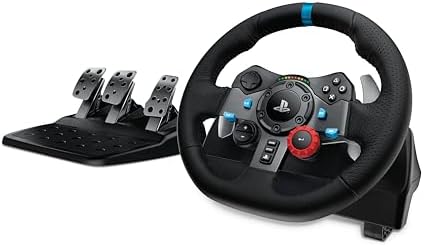
For most people building a first sim-racing setup on PC in 2026, the Logitech G29 Racing Wheel and Pedals is the right buy at around $277 — dual-motor force feedback, 900° of rotation and a three-pedal set in one box. If you have no desk space or no budget for a wheel, a Hall-effect gamepad like the GameSir G7 SE at about $45 is a legitimate answer, not a consolation prize.
The sim-racing entry ladder, and which rung you are actually on
Sim racing has an unusually well-defined upgrade ladder, and almost every bad first purchase comes from skipping a rung rather than from buying the wrong brand. The ladder runs: a good gamepad with precise analog inputs, then an entry force-feedback wheel with a three-pedal set, then add-ons — a shifter, load-cell pedals and a rigid mount — and only after that a stronger wheel base.
The first rung is more defensible than most buying guides admit. A gamepad with high-resolution analog triggers and low-drift sticks is genuinely competitive in arcade-leaning racers and in any title with steering assists, and it costs a tenth of a wheel. It also asks nothing of your room: no clamp, no pedal depth, no storage problem between sessions.
The second rung is where the experience changes rather than the lap times. Force feedback is an information channel — it tells you when the front tyres are washing out and when the rear is stepping away, in a way a rumble motor cannot. That information is what raises your consistency ceiling over months of practice. It is not what makes you fast in week one; expect your lap times to get worse before they get better.
The third rung is where money starts going into things that are not the wheel. A shifter changes which disciplines are fun. Load-cell pedals change how repeatable your braking is, which is the single largest source of lap-time variance for most drivers. A rigid mount changes whether the force feedback you paid for arrives at your hands or gets absorbed by a flexing desk. Buy in that order, because it is the order in which each item removes a real limitation.
The winner below sits on rung two, and it wins because it is the cheapest complete entry to that rung — wheel, force feedback and three pedals in a single purchase, with a documented PC support path.
Step 0 — diagnose your rung before you spend
Answer these three questions honestly before you look at any product.
- Do you have a rigid mounting surface, or a wheel stand? The supplied clamp needs a desk that does not flex when you load the wheel hard. A glass-topped desk, a thin IKEA tabletop or anything with a wobble is a problem you will feel in every corner.
- Do you have roughly 90 cm of clear depth for pedals? Pedal sets need floor space in front of the chair and something to brace against. Carpet without a stop is where entry pedal sets slide away under braking.
- Will the setup have to be packed away between sessions? If a wheel has to come off the desk and go in a cupboard every night, you will use it less than you think. That is the strongest argument for staying on rung one for another year.
If the answer to any of those is no, the honest recommendation is a controller this year and a wheel next year, once the space problem is solved.
Comparison table
| Pick | Best for | Key spec | Price range | Verdict |
|---|---|---|---|---|
| Logitech G29 Racing Wheel and Pedals | Best overall | 900° rotation, dual-motor force feedback, three-pedal set | ~$277 | The complete rung-two entry in one box |
| HORI Racing Wheel Overdrive | Best value wheel | Officially licensed Xbox wheel, no force feedback | ~$120 | Half the price, but not a force-feedback wheel |
| PlayStation DualSense Wireless Controller | Best for haptic immersion | Adaptive triggers, haptic feedback, USB-C | ~$74 | Trigger resistance as a brake-modulation aid |
| Thrustmaster TH8A Shifter | Best performance add-on | H-pattern and sequential modes, magnetic sensors | ~$199 | Transforms rally, classics and truck sims |
| GameSir G7 SE Wired Controller | Budget pick | Hall-effect sticks and triggers, wired USB | ~$45 | The cheapest precise analog input on this list |
Prices are catalog street prices observed in 2026 and change frequently — confirm the live figure at the retailer before buying.
Top picks
🏆 Best Overall: Logitech G29 Racing Wheel and Pedals
Verdict: The cheapest complete entry into force feedback — wheel, pedals and a documented PC path, around $277.
Spec chips: 900° lock-to-lock rotation · dual-motor force feedback · helical gearing with anti-backlash · solid steel ball bearings in the wheel shaft · stainless steel paddle shifters and floor pedals · hand-stitched leather rim · PS5, PS4, PC and Mac support (Logitech G).
Pros
- Three-pedal set with a non-linear brake included in the box — most competitors at this price ship two pedals or none.
- Helical gearing with anti-backlash, which Logitech describes as modelled on automotive transmission gears, keeps the wheel and pedals tight under load (Logitech G).
- Steel ball bearings in the wheel shaft and stainless steel pedal faces mean the wear surfaces are metal, which is the reason decade-old G-series wheels are still in service.
- Exposes a shifter port, so the ladder's next rung does not require replacing the base.
Cons
- Gear-driven force feedback has an audible and tactile notchiness that belt-drive and direct-drive units do not. You will feel the gear teeth on small corrections.
- Firmware and configuration live in Logitech's own software stack; PC and PlayStation are the supported paths, and Xbox is not.
- At around $277 it is roughly six times the price of the budget pick on this list, and the pedal set is the first thing serious users replace.
The G29 has stayed the default first wheel for a decade for a structural reason rather than a marketing one: it is the least expensive way to buy every component of rung two at once. Nothing about it is class-leading in isolation. The force feedback is gear-driven, which is the weakest of the three drive types. The pedals are potentiometer-based rather than load-cell, so your braking repeatability is limited by how consistently your leg can hit a travel position rather than a pressure. What it does is remove every gap in a first setup — you unbox it and you have a wheel, force feedback, a clamp, a throttle, a brake and a clutch, and a supported driver path on Windows.
The specification that matters most for learning is the 900° of rotation. Road and rally cars in most sims model somewhere between 540° and 900° of lock, and having the full range means your hand positions map to the car's rather than to a compressed arcade curve. That is the thing a gamepad cannot replicate at any price.
See price & specs · Price may vary; confirm at the retailer. · See full details →
💰 Best Value: HORI Racing Wheel Overdrive for Xbox Series X|S
Verdict: Half the G29's price and a real wheel — but read the force-feedback caveat before you buy.
Spec chips: officially licensed for Xbox Series X|S · no force feedback · integrated pedal unit · desk clamp mount · around $120.
Pros
- Around $120 puts a wheel-and-pedal form factor within reach of budgets that cannot stretch to a force-feedback base.
- Officially licensed for Xbox Series X|S, which resolves the console-authentication problem that blocks generic wheels on that platform.
- Light enough to mount and unmount daily, which matters more than spec sheets suggest for people racing on a shared desk.
Cons
- No force feedback. This is the defining limitation and it is not a small one — you get steering position and nothing about grip. Wheels without force feedback are an ergonomics upgrade over a pad, not an information upgrade.
- The pedal unit is simpler than the G29's three-pedal set, with no clutch.
- Xbox-first design means PC support should be verified against HORI's own stated compatibility rather than assumed from the console listing.
The honest position on this wheel: it is the right buy for someone who wants the physical act of steering with a wheel and has decided that force feedback is out of budget this year. It is the wrong buy for someone who expects it to teach them car control, because the channel that does the teaching is the one it does not have. If the choice is between this and saving for three more months toward a G29, save.
See price & specs · Price may vary; confirm at the retailer. · See full details →
🎯 Best for Haptic Immersion: PlayStation DualSense Wireless Controller
Verdict: Adaptive triggers give you brake-pressure feedback no other pad on this list can — where the title supports it.
Spec chips: adaptive triggers · haptic feedback · built-in microphone · motion controls · USB-C · around $74 (PlayStation).
Pros
- Adaptive triggers can vary resistance through the pull, which in supported racing titles maps directly onto brake modulation and ABS onset — the closest a gamepad gets to a load-cell pedal's information.
- Haptic feedback is meaningfully higher-resolution than conventional rumble motors, so surface changes and traction loss read as texture rather than as a buzz.
- Steam Input exposes the trigger and haptic APIs to games on PC (Steamworks documentation), so the flagship features are reachable outside PlayStation hardware.
Cons
- Feature support is per-title and per-launcher. Outside Steam, many games see a generic pad and the adaptive triggers do nothing.
- Over Bluetooth several implementations fall back to conventional rumble; USB is the reliable path for the full feature set.
- Battery life is the shortest of the pads here, and stick drift on the standard potentiometer sticks remains the known long-term failure mode.
For racing specifically, the DualSense earns its place through one mechanism: analog resistance in the brake trigger. Modulating a brake by pressure rather than by position is what separates a repeatable braking point from an approximate one, and this is the only sub-$80 device on the list that offers any form of it. The catch is coverage — treat trigger support as a bonus in the titles that implement it well rather than as a baseline you can count on.
See price & specs · Price may vary; confirm at the retailer. · See full details →
⚡ Best Performance Add-On: Thrustmaster TH8A H-Pattern & Sequential Shifter
Verdict: The single add-on that changes which disciplines are enjoyable, around $199.
Spec chips: switchable H-pattern and sequential modes · magnetic (contactless) position sensing · metal shaft and gate · detachable knob · connects over USB or to a compatible wheel base's DIN connector · Windows 10/11 driver package (Thrustmaster support).
Pros
- Switchable between H-pattern and sequential, so one unit covers classic touring cars, rally, drifting and modern sequential-box racing.
- Contactless magnetic sensing on the gate means the wear surface that usually fails on shifters — the contact sensor — is not present.
- Thrustmaster maintains a current Windows 10/11 driver package for this unit, with firmware V29 documented on its support site (Thrustmaster support) — a meaningful signal on a product this old.
- Connects either directly over USB or through a compatible wheel base's DIN connector, which keeps the USB port budget manageable.
Cons
- At around $199 it costs nearly as much as an entry wheel and does nothing at all for GT or formula cars, which use paddles.
- It needs rigid mounting of its own. A shifter that moves when you throw it into third is worse than no shifter.
- Compatibility with your specific wheel base needs checking — the DIN connector path is not universal.
Buy this third, not first. The disciplines it transforms are rally, classic touring cars, drifting and truck sims, where getting the gearchange wrong is part of the skill. In a GT or formula car it is dead weight on your desk.
See price & specs · Price may vary; confirm at the retailer. · See full details →
🧪 Budget Pick: GameSir G7 SE Wired Controller
Verdict: Hall-effect sticks and triggers at around $45 — the cheapest precise analog input here, and the drift problem solved.
Spec chips: Hall-effect joysticks · Hall-effect analog triggers · wired USB · Xbox Series X|S and Windows support · swappable faceplate.
Pros
- Hall-effect sensing on both sticks and triggers removes the resistive wear track that causes conventional stick drift, which is the dominant long-term failure mode on gamepads.
- Wired USB eliminates battery management and 2.4 GHz interference dropouts entirely.
- XInput-native Xbox layout means it works on Windows with no shim, no Steam Input profile and no per-game remapping — the lowest-friction option on this list.
- At roughly $45 it is a sixth of the G29's price, which makes it the correct answer for anyone who has not yet solved the desk-space problem.
Cons
- No force feedback and no adaptive triggers — it is a precise input device, not an immersion device.
- Wired only, so couch play needs a long cable run.
- Analog trigger resolution is good but you are still modulating brake by travel, not by pressure.
The argument for this pad in a racing context is durability plus precision at the entry price. Hall-effect analog triggers give you fine throttle and brake control, and the sensor design means that control does not degrade over two years the way a potentiometer stick does. If you race a few hours a week and are not ready to commit desk space to a wheel, this is the buy — and it remains useful as a second pad after you upgrade.
See price & specs · Price may vary; confirm at the retailer. · See full details →
What to look for in a sim racing setup
Force-feedback type: gear, belt or direct drive
Three drive types dominate, and the difference is what you feel through small steering corrections. Gear-driven wheels — the G29's class — use a geartrain between motor and shaft; they are the cheapest and they transmit a slight notchiness as the teeth engage. Belt-driven wheels replace part of that train with a belt, smoothing the small-signal response at higher cost. Direct-drive mounts the rim straight onto the motor shaft, eliminating the intermediate mechanics entirely and producing the highest torque and finest detail — at several times the price. Logitech's mitigation on the gear-driven class is helical gearing with anti-backlash, which it describes as modelled on automotive transmission gears (Logitech G).
Rotation degrees and what each discipline needs
Rotation is the lock-to-lock travel the wheel allows. Formula cars model roughly 360°, GT cars sit around 540°, and road and rally cars go to 900° or beyond. A wheel that offers 900° covers all of them, because sims scale down; a wheel that offers 270° cannot ever give a road car the right hand positions. This is the specification to check first and the one entry wheels most often compromise.
Pedal set quality and the load-cell upgrade
Entry pedal sets read position with a potentiometer: you brake by moving the pedal a certain distance. Load-cell pedals read pressure instead, which is what a real brake does, and it is the reason load-cell upgrades produce more lap-time improvement than any other add-on at this tier. The G29's three-pedal set is potentiometer-based with a non-linear brake spring that approximates pressure feel. Plan the load-cell upgrade before you plan a stronger wheel base.
Mounting and desk-clamp rigidity
Covered in detail below, because it is the most-missed step.
Platform and firmware support
Check the manufacturer's own stated PC support rather than inferring it from a console listing, and check that a current driver package exists. Thrustmaster publishing a 2024 Windows 10/11 driver package and documented firmware version for the TH8A (Thrustmaster support) is exactly the signal to look for on any older peripheral you are considering.
The most-missed step: mounting
A wheel clamped to a flexing desk is the single most common reason an entry force-feedback wheel feels vague, and it is almost never diagnosed correctly. The mechanism is straightforward. Force feedback works by the motor applying torque against a fixed reference — your hands on one side, the mounting on the other. If the mounting moves, the motor's torque goes into moving the desk instead of into your hands, and the fine detail in the signal disappears into that motion. Worse, the desk springs back, feeding its own resonance into the wheel as a low-frequency wobble that reads as sloppy steering.
The symptoms people report are "the force feedback feels mushy," "there's a dead zone around centre," and "it feels nothing like the reviews said." All three are frequently a rigidity problem rather than a wheel problem, and all three survive every setting change you make in the game's force-feedback menu.
The fix, in order of cost: tighten the clamp properly and check it before every session, since clamps work loose. Put a rubber or foam pad between the clamp and the desktop to stop slipping without denting. If the desktop itself flexes, brace it or move to a thicker one. If none of that is available, a dedicated wheel stand is the answer — and it becomes mandatory rather than optional at the belt-drive and direct-drive tiers, where torque output exceeds what any desk clamp can hold steady.
Do the same for pedals. A pedal set that slides forward under braking makes your braking point a moving target. Carpet grips, a pedal tray, or bracing against a wall all work; sliding on a hard floor does not.
Related guides
- Logitech G29 vs HORI Racing Wheel Overdrive in 2026 — the head-to-head on the two wheels in this guide, in far more detail.
- Best Controller for PC Retro Emulation in 2026 — where the layout and D-pad arguments matter more than analog precision.
- Best Budget Gaming Peripherals Under $100 in 2026 — the rest of the desk, at the same budget as the budget pick here.
- Best Streaming Starter Kit for Twitch in 2026 — if the racing is going on camera.
— Mike Perry
Citations and sources
- Logitech G — G29/G920 Driving Force Racing Wheel and Pedals — dual-motor force feedback, helical gearing with anti-backlash, solid steel ball bearings in the wheel shaft, stainless steel paddle shifters and floor pedals, hand-stitched leather rim, PS5/PS4/PC/Mac support. Accessed 2026-08-24.
- Thrustmaster Technical Support — TH8A Shifter — current Windows 10/11 driver package (2024_TH8RS_1), documented firmware V29, DIN-connector and USB connection paths, product manuals. Accessed 2026-08-24.
- PlayStation — DualSense Wireless Controller — adaptive triggers, haptic feedback, built-in microphone, motion controls, USB-C. Accessed 2026-08-24.
- Steamworks Documentation — Steam Input — PC-side API surface for controller feature support including trigger and haptic handling. Accessed 2026-08-24.
This piece is editorial synthesis based on publicly available information. No independent first-party benchmarking is reported.


