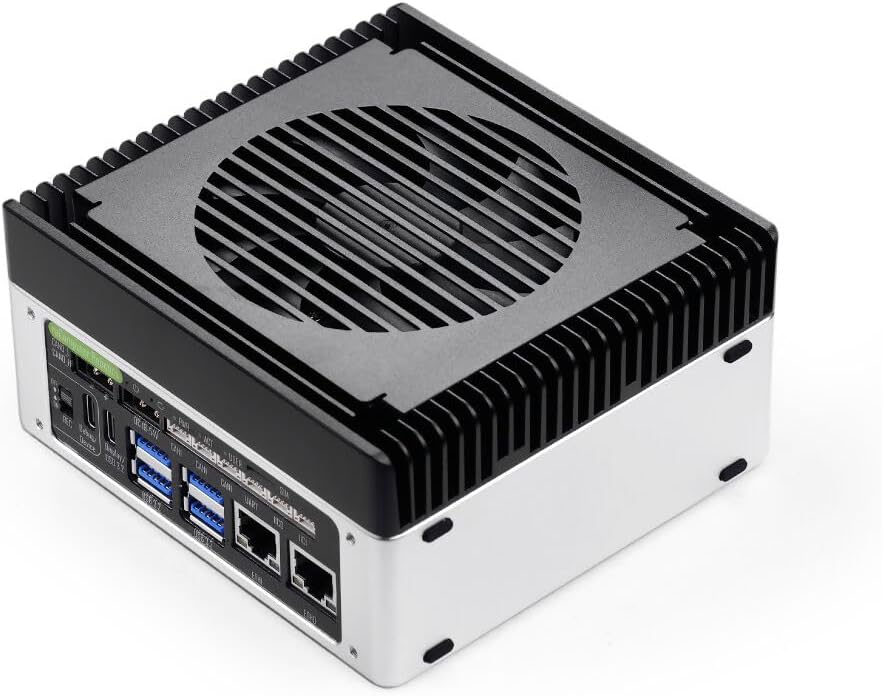
Raspberry Pi's own AI Kit remains the most direct way to add dedicated inference hardware to a Pi 5 without moving to a full GPU rig. It bundles an M.2 HAT+ with a Hailo-8L neural accelerator module, and per raspberrypi.com it has shipped since mid-2024 at a $70 list price. This piece synthesizes the publicly documented specs, how the kit is actually being used, and where its limits show up — without inventing benchmark numbers that no public source has verified.
What's actually in the Raspberry Pi AI Kit
The kit ships two components: an M.2 HAT+ board that clips onto the Raspberry Pi 5's top-mounted PCIe connector, and a Hailo-8L M.2 module that plugs into that HAT. Per raspberrypi.com's documentation, the HAT+ carries the PCIe Gen 3 x1 lane out to the M.2 slot and includes its own cooling arrangement to keep the accelerator within thermal limits during sustained use.
The Hailo-8L itself is a dedicated neural processing unit, not a general-purpose GPU. Per Hailo's own product page, the 8L variant is rated for up to 13 TOPS of INT8 inference throughput — roughly half of the full Hailo-8 chip's 26 TOPS, which Hailo positions for higher-end industrial and automotive modules instead. That distinction matters: the AI Kit is a cost- and power-optimized cut of Hailo's silicon, not the flagship part.
| Component | What it does | Source |
|---|---|---|
| M.2 HAT+ | Breaks out the Pi 5's PCIe Gen 3 x1 lane to an M.2 socket | raspberrypi.com |
| Hailo-8L module | Dedicated NPU, up to 13 TOPS INT8 | hailo.ai |
| Host requirement | Raspberry Pi 5 only (PCIe connector not present on Pi 4) | raspberrypi.com |
| List price | $70 (kit), per 2024 launch pricing | raspberrypi.com |
Why it needs a Pi 5, not a Pi 4
The dependency on Pi 5 isn't arbitrary. Raspberry Pi 5 introduced a PCIe connector on the underside of the board specifically to support high-bandwidth accessories like this one; Pi 4 has no equivalent interface. That's a meaningful upgrade cost for anyone still running a Pi 4 fleet — the AI Kit isn't a drop-in accessory for older hardware, it's part of the reason to move to Pi 5 in the first place. SpecPicks' Raspberry Pi 4 8GB vs Pi 5 vs Mini-PC comparison covers that generational gap in more depth for anyone deciding whether the upgrade is worth it purely for AI workloads.
Power delivery is the other consideration. Raspberry Pi 5 already draws more current under load than Pi 4, and adding an M.2 accelerator on top increases the margin needed from the power supply. Anyone building an AI Kit setup should check they're running an adequate PSU rather than reusing an older Pi 4 charger — see SpecPicks' Raspberry Pi 5 power supply guide for the specifics.
What the AI Kit is good at — and what it isn't
The Hailo-8L is built for vision workloads: object detection, classification, pose estimation, and segmentation models that can be compiled to run on Hailo's runtime. That's a narrower use case than a general-purpose GPU. Community projects built around the AI Kit tend to cluster around:
- Security and monitoring — real-time object detection on a camera feed, offloaded from the Pi 5's CPU to the Hailo accelerator so the board stays responsive for other tasks.
- Robotics and vision-guided automation — low-power inference for navigation or part inspection where a full GPU's power draw isn't practical.
- Prototyping industrial vision systems — using the Pi 5 + AI Kit as a cheap dev platform before committing to Hailo's higher-TOPS industrial modules.
What it is not built for is large language model inference. Transformer-based LLMs have a different compute profile than the CNN-style vision models Hailo's toolchain targets, and the 8L's memory bandwidth and toolchain support don't map well onto that workload. For readers specifically interested in running LLMs on Pi hardware, SpecPicks' Raspberry Pi LLM Projects: What Actually Runs in 2026 and Raspberry Pi LLM GPU Guide are the more relevant references — those pieces cover CPU-only and GPU-offload approaches rather than the Hailo NPU path.
AI Kit vs. clustering vs. a discrete GPU
For readers weighing the AI Kit against other ways to add AI capability to a Pi-based build, the honest framing is that these solve different problems rather than compete head-to-head:
| Approach | Best for | Trade-off |
|---|---|---|
| Pi 5 + AI Kit (Hailo-8L) | Low-power, always-on vision inference | Narrow model support, ~13 TOPS ceiling |
| Pi cluster (multiple Pi 5 boards) | Distributing lightweight workloads, learning distributed systems | Networking overhead, no shared memory benefit for large models |
| Discrete GPU (mini-PC or desktop) | Raw throughput, broad model support including LLMs | Far higher power draw and cost |
SpecPicks' Raspberry Pi LLM Cluster guide and Raspberry Pi vs AMD GPUs for Local LLMs both dig into the cluster and GPU comparisons in more detail — worth reading before assuming the AI Kit is a general substitute for either approach.
Choosing an AI Kit setup: a practical checklist
Before buying, it's worth confirming a few things against the actual project goal rather than the marketing framing:
- Confirm you're starting from a Pi 5. The M.2 HAT+ has no Pi 4 equivalent, per raspberrypi.com's documentation — this isn't an accessory that retrofits onto older boards.
- Match the workload to a vision model, not an LLM. If the end goal is running a chatbot or text-generation model locally, the AI Kit's Hailo-8L isn't the right tool; see the LLM-focused guides linked above instead.
- Budget for adequate power and cooling. A Pi 5 running an M.2 accelerator under sustained load benefits from active cooling and a power supply rated for the combined draw, not the base Pi 5 spec alone.
- Check model compilation support. Hailo provides a toolchain for converting common vision model formats to run on the 8L; projects using unusual or custom architectures should verify compatibility before committing hardware budget.
- Consider whether a broader AI project scope makes more sense. For builders exploring the wider Pi-based AI landscape rather than a single accelerator, SpecPicks' Raspberry Pi AI Projects: A 2025 Builder's Guide surveys more of the options side by side.
Where the AI Kit fits in a broader maker setup
Outside of pure AI inference, Pi 5-based builds often layer on other sensor and monitoring projects — environmental sensing being a common one. SpecPicks' Raspberry Pi Air Quality Sensor Guide is a good example of a complementary, non-AI-Kit project that shares the same Pi 5 platform, for readers building out a multi-purpose home lab rather than a single-function AI box.
The bottom line
The Raspberry Pi AI Kit is a well-documented, officially supported way to add roughly 13 TOPS of dedicated vision-inference hardware to a Pi 5, at a $70 list price, per raspberrypi.com and hailo.ai's published specs. It's a strong fit for low-power, always-on vision tasks — security cameras, robotics, industrial-vision prototyping — and a poor fit for LLM workloads, where SpecPicks' dedicated Pi LLM guides are the better starting point. The core decision for most builders isn't whether the Hailo-8L is capable; it's whether the project in front of them is a vision problem or a language-model problem, since the AI Kit only really solves the former.
Citations and sources
- https://www.raspberrypi.com/products/ai-kit/
- https://www.raspberrypi.com/news/raspberry-pi-ai-kit-available-now-at-70/
- https://hailo.ai/products/hailo-8/hailo-8l-m2-ai-acceleration-module/
- https://www.raspberrypi.com/documentation/accessories/ai-kit.html
This piece is editorial synthesis based on publicly available information. No independent first-party benchmarking is reported.