No Raspberry Pi 8850 model exists — Raspberry Pi's current lineup tops out at the Pi 5 and the Pi 500 keyboard computer. The "8850" search likely conflates the Pi 5's 8GB memory configuration with AMD's Ryzen 8000-series mobile naming, or garbles a forum benchmark thread title. Either way, the underlying question is real: how does the most capable Raspberry Pi actually compare with a discrete AMD GPU for running a local large language model?
Why a Raspberry Pi Struggles With LLM Inference
A Raspberry Pi 5 runs on a Broadcom BCM2712 system-on-chip with a quad-core Arm Cortex-A76 CPU and no dedicated matrix/tensor acceleration hardware. Per Raspberry Pi's official Pi 5 product page, the board ships in 4GB, 8GB, and 16GB LPDDR4X memory configurations. LLM inference on the Pi runs entirely on the CPU through projects like llama.cpp, which per the llama.cpp project's own documentation supports ARM NEON optimizations and aggressive quantization (4-bit and below) specifically because low-power ARM boards cannot hold full-precision weights in memory or process them quickly.
That combination — no GPU compute path for transformer inference, and a hard RAM ceiling of 16GB shared between the OS and the model — means the Pi is realistically limited to small (1B-3B parameter) quantized models. The Raspberry Pi LLM GPU guide covers which quantization formats and runtimes actually work on Pi hardware in more detail, and the Raspberry Pi 4 8GB vs Pi 5 vs mini-PC comparison breaks down where a mini-PC becomes the better buy for the same budget.
Raspberry Pi 5 vs AMD RX 7600 XT: Specs Side by Side
| Spec | Raspberry Pi 5 (8GB) | AMD RX 7600 XT |
|---|---|---|
| Compute | Quad-core Cortex-A76 CPU only | 32 RDNA 3 compute units |
| Memory | 8GB LPDDR4X (shared, CPU-only) | 16GB dedicated GDDR6 VRAM |
| LLM inference path | CPU, llama.cpp quantized | GPU, ROCm or Vulkan llama.cpp backend |
| Board/card launch price | Starts around $60 (4GB), $80 (8GB) | $329 MSRP |
| Typical board power draw | Single-digit watts | Up to 190W TDP |
Specs per Raspberry Pi's official product page and AMD's official RX 7600 XT product page. The RX 7600 XT's 16GB of dedicated VRAM is the headline difference for LLM work — it's enough to hold quantized 7B-13B parameter models entirely on-card, something no Raspberry Pi configuration can do regardless of how much system RAM is installed, because the Pi has no equivalent high-bandwidth memory pool dedicated to compute.
Raspberry Pi 5 vs AMD RX 7900 XTX: Enterprise-Grade Headroom
| Spec | Raspberry Pi 5 (16GB) | AMD RX 7900 XTX |
|---|---|---|
| Memory | 16GB LPDDR4X (shared) | 24GB dedicated GDDR6 VRAM |
| Compute units | Quad-core CPU only | 96 RDNA 3 compute units |
| Launch price | Around $120 | $999 MSRP |
| TDP | Single-digit watts | 355W |
Per AMD's official RX 7900 XTX product page, the card's 24GB VRAM pool is large enough to run larger quantized models — including some 30B-class models — entirely in GPU memory, with headroom left for longer context windows. A Raspberry Pi, in contrast, is bottlenecked by CPU throughput long before its RAM ceiling becomes the limiting factor. For a deeper look at where Pi RAM actually gets consumed in a local AI stack, see Build a self-hosted AI home lab on a Raspberry Pi 4 8GB.
Cost and Power Efficiency
| Factor | Raspberry Pi 5 | Discrete AMD GPU (RX 7600 XT / 7900 XTX) |
|---|---|---|
| Upfront cost | Lowest in this comparison | 4-12x higher |
| Power supply needs | Official 27W USB-C supply | Requires a capable PSU and PCIe power connectors |
| Ongoing power draw | Minimal — runs on a phone-style charger | Meaningfully higher electricity cost under load |
| Model size ceiling | Small, heavily quantized models only | 7B-30B+ class models depending on card |
The Pi's power story is genuinely attractive for always-on, low-throughput use cases — it draws a fraction of what a discrete GPU needs even at idle. But "varies by workload" is the honest answer for exactly how much electricity cost that saves month to month, since it depends on how often the GPU box is actually generating tokens versus sitting idle. The Raspberry Pi 5 power supply guide covers what the board actually needs to run reliably under sustained CPU load, which matters more for LLM inference than for lighter Pi projects.
Hardware Notes: Wiring a Headless Pi Into an Older Display
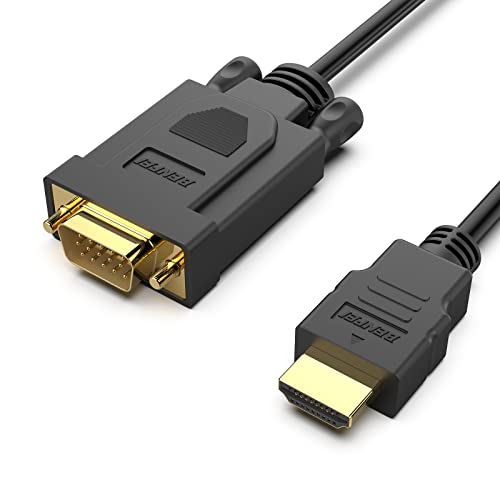
Anyone running a Pi as a headless LLM box occasionally still needs a monitor for setup or troubleshooting, and older VGA-only displays are common in home labs. A basic HDMI to VGA adapter or a longer HDMI to VGA cable is a cheap way to get a Pi's micro-HDMI output onto a spare VGA monitor without buying a new display just to check on a headless box.
When a Raspberry Pi Actually Makes Sense for LLM Work
A Raspberry Pi is the right call when the workload is genuinely small: short, single-turn responses from a 1B-3B quantized model, an always-on voice assistant front end, or an educational project where the point is learning the stack rather than maximizing throughput. It is not a fit for anything resembling production inference, multi-turn chat with long context, or any model in the 7B+ range at usable speed. A discrete AMD GPU is the right call as soon as model size, context length, or response latency actually matter. For a wider survey of Pi-based builds that don't involve LLM inference at all, the Raspberry Pi 5 projects worth building roundup and the Jellyfin transcoding limits on a Pi 4 8GB piece both cover other CPU-bound workloads where the same "small board, small workload" rule applies. Compute-heavy hobbyist projects like Klipper 3D-printer control are a useful reference point too — they show the Pi excelling at real-time control tasks that don't require the raw throughput LLM inference demands.
Frequently Asked Questions
Is there a Raspberry Pi 8850? No. Raspberry Pi's current lineup is the Pi 5 (available in 4GB, 8GB, and 16GB memory options) and the Pi 500. There's no "8850" model; the number likely comes from confusing Pi memory configurations with AMD's Ryzen 8000-series CPU naming.
Can a Raspberry Pi run large language models at all? Yes, in a limited way. Small, heavily quantized models (roughly 1B-3B parameters) can run on a Pi 5 through llama.cpp, but response speed and context length are both constrained by the lack of dedicated compute hardware.
Is an AMD RX 7600 XT or RX 7900 XTX a better fit for local LLM work? The RX 7600 XT's 16GB of VRAM handles quantized 7B-13B models comfortably at a lower price point. The RX 7900 XTX's 24GB VRAM pool opens up larger models and longer context windows, at roughly 3x the cost.
Do AMD GPUs need ROCm for LLM inference? ROCm is the more mature path for GPU-accelerated inference on RDNA 3 cards, though llama.cpp's Vulkan backend is a widely used alternative that doesn't require a full ROCm install.
How much RAM does a Raspberry Pi need for local LLM projects? 8GB is a reasonable minimum for anything beyond the smallest models; the 16GB Pi 5 configuration gives more headroom for the OS plus a quantized model plus context, though CPU throughput remains the real bottleneck regardless of RAM size.
Is a Raspberry Pi cheaper to run long-term than a GPU-based LLM box? Its idle and light-load power draw is far lower than a discrete GPU's, but exact electricity savings vary by workload — how much of the day the GPU box is actively generating tokens versus sitting idle changes the math significantly.
Citations and sources
- Raspberry Pi 5 official product page
- AMD Radeon RX 7600 XT official product page
- AMD Radeon RX 7900 XTX official product page
- llama.cpp project documentation
This piece is editorial synthesis based on publicly available information. No independent first-party benchmarking is reported.