The Raspberry Pi 5 introduced a real jump in power requirements compared to earlier boards, and it catches a lot of builders off guard. If a Pi 4 power brick worked fine for years, it's reasonable to assume the same charger will work for a Pi 5 — it usually boots, but it often runs undervolted the moment a keyboard, SSD, or HAT is attached.
This guide covers what the Raspberry Pi 5 actually needs, why the requirement changed, what symptoms show up when a supply falls short, and what to check before buying a third-party charger.
Why the Raspberry Pi 5's Power Supply Matters More Than the Pi 4's Did
The Pi 5 adds a faster quad-core Cortex-A76 SoC, PCIe for NVMe storage, and support for higher-draw USB peripherals — all of which pull more current than the Pi 4's Cortex-A72 platform. According to Raspberry Pi Foundation documentation, the board is designed around USB Power Delivery negotiation rather than a fixed 5V rail, and it actively communicates with the charger to request the higher current budget it needs (raspberrypi.com).
When that negotiation fails — because the charger doesn't speak PD, or the cable can't carry the current cleanly — the Pi 5's power management IC drops into a reduced-power state and flags it visibly on screen. That's the mechanism behind most of the "random Pi 5 instability" reports that show up in maker forums: it's rarely the board itself, and it's very often the power delivery chain.
If you're planning a build around the Pi 5 — whether it's a self-hosted AI home lab-style project, a Klipper 3D-printer controller, or one of the broader Raspberry Pi 5 projects worth building in 2026 — getting the power supply right first avoids chasing phantom bugs later.
Raspberry Pi 5 Power Requirements: What Changed From the Pi 4
The headline number to remember: the Raspberry Pi 5 is specified for 5V at up to 5A (25W) over USB-C with Power Delivery negotiation, versus the Pi 4's 5V at 3A (15W) spec. Raspberry Pi's official 27W USB-C Power Supply is built specifically to meet that Pi 5 profile (raspberrypi.com).
| Spec | Raspberry Pi 4 | Raspberry Pi 5 |
|---|---|---|
| Connector | USB-C | USB-C |
| Rated current | 5V / 3A (15W) | 5V / 5A (25W) |
| Requires USB-PD negotiation | No (fixed 5V) | Yes, for full 5A |
| Official Raspberry Pi supply | 15.3W USB-C PSU | 27W USB-C Power Supply |
| Behavior on underpowered charger | Undervoltage icon, mild throttling | Undervoltage icon, throttling, peripheral dropouts |
This is also where the research shorthand "3A minimum" that circulates online gets confusing — that figure describes the Pi 4 generation, not the Pi 5. Anyone shopping specifically for a Pi 5 supply should be looking for PD-capable chargers that can hit the 5A tier, not the older 3A spec.
Choosing a Third-Party Raspberry Pi 5 Power Supply
A generic USB-C phone charger can output 5V, but most consumer PD chargers are tuned to negotiate higher voltages (9V, 12V, 20V) at lower currents for laptops and phones — which is the opposite of what the Pi 5 wants. The Pi 5's controller specifically asks for more current at 5V, and not every PD charger's firmware supports that request profile.
When evaluating a supply, check for:
- Explicit 5V/5A (25W) support, not just a generic "PD 3.0, up to 65W" badge that assumes higher-voltage profiles.
- A rated USB-C cable, ideally the one bundled with the charger — thin third-party cables can drop enough voltage under load to trigger undervoltage warnings even with a correctly rated charger.
- Passive cooling headroom if the supply will sit in an enclosed case alongside a Pi 5 running sustained CPU or NVMe workloads.
- A steady 5V rail under load, which is why Raspberry Pi Foundation designs its own PSU in-house rather than relying on generic PD silicon defaults (raspberrypi.com).
If a supply's listing doesn't specify current at 5V — only wattage or voltage tiers for laptops — treat that as a signal to look elsewhere rather than assume compatibility.
Recognizing Undervoltage Symptoms on a Pi 5
The Raspberry Pi Foundation's own documentation describes a lightning-bolt icon that appears in the display output when the board detects a voltage drop below its threshold (raspberrypi.com). In practice, builders report a consistent pattern of symptoms tied to that state:
- Undervoltage icon appearing intermittently, especially when a USB SSD, webcam, or multiple peripherals are attached at once.
- CPU frequency capped below its normal boost clock during sustained loads.
- USB devices — particularly external drives — disconnecting or failing to enumerate under load.
- SD card writes corrupting mid-operation, since a voltage sag during a write is one of the more damaging failure modes.
- Unexpected reboots when a project (a 3D printer controller, a NAS-style share, an LLM inference box) briefly spikes CPU and I/O together.
These symptoms overlap heavily with software bugs, which is why power supply issues are so often misdiagnosed. If a Pi 5 project — like a Jellyfin transcoding box or an Open WebUI inference front-end — starts behaving erratically only under sustained load, checking vcgencmd get_throttled or the on-screen icon before touching software is the faster path to a diagnosis.
Power Accessories Worth Pairing With a Pi 5 Build
Beyond the charger itself, a few accessory categories matter for keeping a Pi 5 build stable:
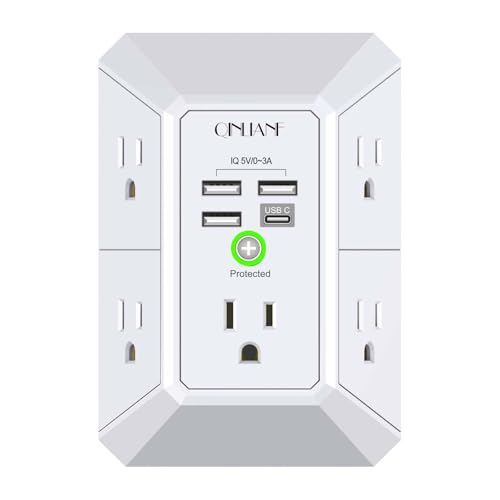
Surge-protected charging strips. A build that lives on a bench or in an enclosure benefits from surge protection on the outlet side, not just a clean charger. The QINLIANF 5-Outlet Surge Protector with 4 USB Charging Ports is a straightforward way to add that layer without dedicating an entire outlet to one project.
USB-C hubs with Power Delivery passthrough. Pi 5 builds that add NVMe enclosures, multiple drives, or displays often route through a powered hub rather than the board's own USB ports. Hubs like the SABRENT 6-Port USB-C Hub & SSD Enclosure with 90W Power Delivery or the SABRENT USB-C Hub with 100W Power Delivery passthrough can carry a laptop-style PD charger through to bus-powered peripherals — useful for offloading storage and I/O load from the Pi's own rails, though neither is a substitute for a properly rated Pi 5 power supply feeding the board itself.
Neither category replaces the board's own charger — the Pi 5 still needs its dedicated 5V/5A source — but they reduce the chance of peripherals pulling current in ways that destabilize the whole chain.
Common Power Supply Mistakes to Avoid
- Reusing a Pi 4 or generic phone charger and assuming it's fine because the board boots. It frequently runs undervolted the moment a real workload starts.
- Ignoring the cable. A charger rated for 5A is meaningless if the attached cable can't carry that current without significant voltage drop.
- Powering high-draw peripherals directly from the Pi 5's USB ports instead of a separately powered hub, which compounds the current draw on a single rail.
- Assuming any "USB-C PD" label is sufficient. Many PD chargers are optimized for higher-voltage, lower-current profiles aimed at laptops, not the Pi 5's specific 5V/5A request.
- Running headless in an enclosure without airflow on a supply pushed near its rated ceiling, which raises the odds of thermal derating over time.
Getting the power chain right at the start avoids most of the intermittent instability that gets misattributed to the OS, the SD card, or the specific project — whether that's a wall-mounted arcade cabinet, a student electronics build from a Pi projects roundup, or something built around the Pico SDK alongside a Pi 5 host.
Citations and sources
- Raspberry Pi 27W USB-C Power Supply — official product page
- Raspberry Pi documentation — power supply specifications
- Raspberry Pi 5: on sale now from $60 — Raspberry Pi Foundation announcement
This piece is editorial synthesis based on publicly available information. No independent first-party benchmarking is reported.