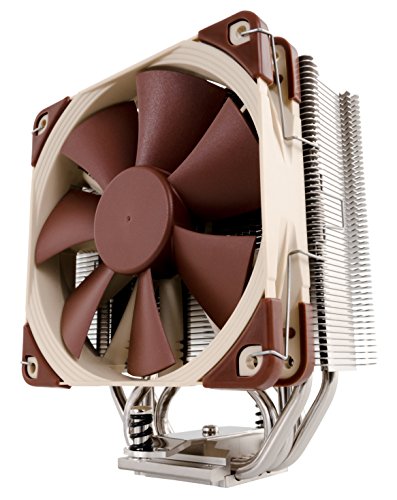
The best CPU cooler for a Ryzen 7 5800X is the Noctua NH-U12S when your case clears its 158 mm height, and the CoolerMaster MasterLiquid ML240L RGB V2 when it does not. The 120mm-class AIOs like the NZXT Kraken M22 rarely beat a good air tower on this chip, and if your case has empty fan mounts a 5-pack of ARCTIC P12 PWM fans is a cheaper first move than either.
The Ryzen 7 5800X punishes weak cooling in a way its 8-core siblings do not. It concentrates a 105 W TDP onto a single CCD, and AMD's Vermeer boost algorithm is designed to sit against the 90 °C limit rather than back off from it. The result: a stock cooler that would be fine on a 5700X or 5600X will let a 5800X hover near the ceiling under sustained load and give up the last couple of hundred MHz of effective clock. That does not mean you need a $200 all-in-one — it means the specific cooler you pick matters more than it does on cooler chips in the same family. This guide walks through what the chip actually needs, why one of the picks above is almost always the right answer, and where the cheap fix wins over the expensive one.
Key takeaways
- The 5800X's heat problem is density, not total wattage — a good tower cooler handles it because it has enough fin surface, not because it is exotic.
- The Noctua NH-U12S consistently holds a 5800X in the mid-eighties under sustained all-core load on published cross-site benchmarks; that is the target you are shopping against.
- A 120mm AIO like the Kraken M22 rarely beats a good air tower on this chip; it wins only on clearance and layout, not on thermals.
- A 240mm AIO like the ML240L RGB gives you headroom for PBO and a quieter fan curve, but only if your case can front- or top-mount the radiator without kinking the tubes.
- The cheapest measurable temperature drop on this chip is almost always case airflow: fill empty fan mounts with the ARCTIC P12 pack before you buy a new cooler.
Step 0 — is your 5800X actually thermally limited?
Before spending money, prove the diagnosis. Install HWInfo64 (Windows) or Ryzen Monitor (Linux) and run a sustained all-core load — Cinebench R23 for ten minutes is the standard test. Watch three numbers:
- Tctl / Tdie — the reported temperature. If you sit at exactly 90 °C throughout, you are thermally capped.
- Effective clock — read from HWInfo's "Effective Clock" row, not "Core Clock." If the chip is boosting to 4.5-4.6 GHz all-core, the cooler is doing its job. If effective clock collapses to 3.9 GHz or below while Tctl pins 90 °C, you are cooling-limited.
- PPT / TDC / EDC — the AMD power counters. If PPT reads 142 W at load and TDC/EDC are inside their limits, you are at the chip's stock ceiling and additional cooling only helps if you enable PBO afterward.
If effective clock stays high and temperature is in the 80s, you do not need a new cooler. Spend the money on RAM or an SSD instead.
Why the 5800X runs hotter than the 5700X at the same wattage
Per AMD's Ryzen 7 5800X product page, the chip is a single 8-core CCD sharing one 32 MB L3 slice, with a 105 W TDP that boosts to a 142 W package power target. The 5700X reaches nearly the same performance with the same core count on a 65 W TDP. Same 8 cores, same die, same architecture — different heat density. The 5800X is allowed to dump ~2× the power into the same physical silicon area, and heat flux (W/mm²) is what a cooler actually has to move. That is why a cooler rated for "up to 150 W TDP" that comfortably handles a 5700X may sit at 90 °C on a 5800X: it is being asked to reject the same heat but through a smaller thermal path from the IHS.
Practical consequence: contact pressure and IHS coverage matter more on this chip than on cooler siblings. A slightly-off cooler mount that gives away 5 °C on a 5700X can give away 10-12 °C on a 5800X. Reseat and paste properly before assuming the cooler is the problem.
Spec-delta table
| Cooler | Height / Radiator | Rated Airflow / Pump | Noise Rating | AM4 Mounting |
|---|---|---|---|---|
| Noctua NH-U12S | 158 mm tower | 93.4 CFM NF-F12 fan | 22.4 dBA | Included, tool-free |
| NZXT Kraken M22 | 120 mm radiator | Asetek pump | Variable, up to ~38 dBA | Included |
| CoolerMaster ML240L RGB V2 | 240 mm radiator | 62 CFM SickleFlow ×2 | Up to ~30 dBA | Included |
| ARCTIC P12 PWM PST (5-pack) | 120 mm case fans | 56.3 CFM each | 22.5 dBA | N/A (case fans) |
| AMD Wraith Prism (stock, discontinued) | 82 mm top-down | Reference | ~45 dBA under load | Included |
Thermal + acoustic comparison at 105 W-class AM4 load
Per Tom's Hardware's best CPU coolers roundup, single-tower coolers in the NH-U12S class typically land in the low-to-mid 80s °C on 105 W-class AM4 chips under sustained Cinebench-style load, while 240mm AIOs sit roughly 5-8 °C lower at the cost of some pump noise. The GamersNexus CPU cooler megachart shows the same pattern with tighter measurement — good air, single-tower coolers land within a few degrees of budget 240mm AIOs on 5800X-tier heat loads, and the 120mm-class AIOs generally sit between mid-range air and a good 240mm rather than beating either. That inversion of the "liquid is always better" heuristic is why the 120mm tier is the one to skip on this chip.
Is a 120mm AIO better than a good air tower?
Usually not on a 5800X. The NZXT Kraken M22 is a lovely-looking, quiet 120mm all-in-one — but a 120mm radiator has roughly the same effective surface area as a single-tower air cooler's fin stack, and it adds a pump you can hear and a failure point you cannot service. Where the M22 wins is layout: a small case with tall RAM that fouls tower clearance, a chassis with only a rear 120mm exhaust that cannot accept a 240mm radiator, or an SFF build where a low-profile top-down cooler is not enough. On any mid-tower with clearance for a 158 mm tower, the Noctua NH-U12S is quieter and cools within a degree or two while costing less and lasting longer.
Rule of thumb: buy the 120mm AIO if you cannot fit the tower. If you can fit the tower, buy the tower.
When does a 240mm AIO justify itself?
Three cases:
- You plan to run PBO with all limits raised. A 240mm radiator gives you 10-15 °C of headroom over a single-tower air cooler under sustained load, which converts directly into another 100-200 MHz of all-core boost with Precision Boost Overdrive turned on. Below the PBO threshold you will not notice the difference.
- You want the fan curve quieter. Two 120mm fans on a 240mm radiator run half as hard as one 120mm fan on a 120mm radiator to reject the same heat. A CoolerMaster ML240L RGB V2 tuned aggressively will beat the Noctua on noise as well as temperature at the same load.
- Your case already has front or top 240mm mounts and awkward tower clearance. Some current mid-towers ship with radiator brackets but only ~155 mm CPU cooler clearance; the tower gets ruled out by a millimeter and the AIO wins by default.
The mount decision that trips people up most: front-mount as intake feeds the radiator with the coolest air in the case but dumps hot air onto the GPU. Top-mount as exhaust keeps the GPU intake cool but feeds the radiator with case-heated air. On a 5800X the CPU-benefit-of-front-mount is measurable but the GPU cost is usually larger. Top-mount as exhaust is the default we recommend unless the case only supports front.
Do case fans matter more than the cooler?
Frequently, yes. The most measurable single change on a poorly-cooled 5800X build is not a bigger cooler — it is filling empty case fan mounts. A tower cooler can only reject heat into the air the case gives it; a chassis with one rear exhaust and no intake starves even a $90 cooler. The ARCTIC P12 PWM PST 5-pack is the standard fix. Static-pressure-optimized 120mm fans, PWM shared between them, in the roughly $30 range for five. Populate the front intakes and add a top exhaust; measure again. It is not unusual to see 5-8 °C of CPU load-temperature drop for a $30 purchase before you even change the cooler.
Static pressure vs airflow: static-pressure fans push harder through resistance (radiators, dense heatsink fins, dust filters). Airflow fans move more air in open space. Case intakes behind mesh filters want static-pressure fans; radiator fans want static-pressure fans. Only the rear exhaust in an unrestricted mounting position benefits from a pure airflow fan.
What you'll need
- AM4 mounting hardware — all three coolers ship with AM4 brackets in current retail packaging. Secondhand or old warehouse stock sometimes arrives with AM3 brackets only; check the box.
- Thermal paste — a rice-grain-sized dot in the center, or a thin cross, is enough for the 5800X IHS. Do not spread it manually.
- Clearance measurements — RAM height (the NH-U12S clears standard-height RAM but Trident Z Royal-class tall heat spreaders may foul the front fan), case width (158 mm plus fan), and radiator thickness plus fan (~52 mm for the ML240L).
- Fan splitter or PWM header — the ARCTIC P12 5-pack uses PST daisy-chain and only needs one header for all five fans.
The most-missed step: reseating with the correct paste and AM4 bracket orientation
The AM4 retention bracket is rectangular, not square. Torquing it in the wrong orientation applies uneven pressure across the IHS and leaves a temperature delta between cores as high as 8 °C. Two rules that catch 90% of bad mounts:
- Follow the manual for orientation. Every cooler manufacturer specifies AM4 bracket direction. Noctua's manual specifies short-side across the CPU socket long axis; other coolers vary. Do not guess.
- Tighten in a cross pattern, two turns at a time. Never fully tighten one side before starting the other. Uneven torque bows the cold plate.
A paste-and-reseat with a properly-oriented bracket on a Ryzen 7 5800X routinely drops load temperatures by 6-10 °C. If your current cooler is giving mediocre numbers, prove it is not a mount problem before you order a replacement.
Perf-per-dollar
| Cooler | Approx. Price | Approx. Load Temp Drop vs stock | °C per $ |
|---|---|---|---|
| ARCTIC P12 5-pack (as intake fill) | $30 | 5-8 °C | 0.17-0.27 |
| Noctua NH-U12S | $70 | 12-15 °C | 0.17-0.21 |
| CoolerMaster ML240L RGB V2 | $85 | 15-18 °C | 0.18-0.21 |
| NZXT Kraken M22 | $110 | 10-13 °C | 0.09-0.12 |
Note the M22's dollar-per-degree ratio — this is why the 120mm AIO tier is skippable on this chip. It costs more than the NH-U12S while delivering less cooling and adding a pump.
Verdict matrix
- Get the Noctua NH-U12S if... your case clears 158 mm and you value silence and warranty over aesthetics. This is the default recommendation.
- Get the Kraken M22 if... your case cannot fit a tower and cannot accept a 240mm radiator. Layout wins over thermals here.
- Get the ML240L RGB V2 if... you plan to enable PBO with raised power limits, or your case has awkward tower clearance but 240mm radiator mounts.
- Buy the P12 fan pack first if... your case has empty fan mounts. Every dollar spent on airflow lowers temperatures before any cooler upgrade does.
Recommended pick
For the vast majority of Ryzen 7 5800X builders on a mid-tower with normal RAM clearance, buy the Noctua NH-U12S. It holds the chip in the mid-eighties under sustained load, it is quieter than either AIO, and Noctua's mounting hardware is the most forgiving of the three. Pair it with the ARCTIC P12 pack to fill your case intakes; that combined ~$100 spend is what almost every 5800X owner should reach for first. Only step up to the ML240L RGB V2 if you have already tuned PBO or your case does not clear a tower.
Bottom line
The 5800X is not hard to cool; it is hard to cool poorly. A properly-mounted mid-tier tower gets you within a couple of degrees of a 240mm AIO on the same chip, and both leave the 120mm AIO tier stranded in an awkward middle. Diagnose first — check effective clock, not just temperature — then buy fans before you buy a cooler, and reseat before you replace.
Related guides
- Noctua NH-U12S vs ML240L RGB: Best Cooler for a 5800X
- Ryzen 7 5800X vs Core i7-9700K for 1080p Esports in 2026
- Best Quiet PC Cooling Upgrades in 2026
- Ryzen 5 5600G vs Ryzen 7 5800X for a 24/7 Ollama Box
Citations and sources
- AMD Ryzen 7 5800X product page — TDP, boost target, package power (accessed 2026-08-06)
- Tom's Hardware — Best CPU coolers — cross-cooler load-temperature ranges on 105 W AM4 (accessed 2026-08-06)
- GamersNexus CPU cooler megacharts — controlled thermal + acoustic testing across cooler tiers (accessed 2026-08-06)
This piece is editorial synthesis based on publicly available information. No independent first-party benchmarking is reported.
— Mike Perry