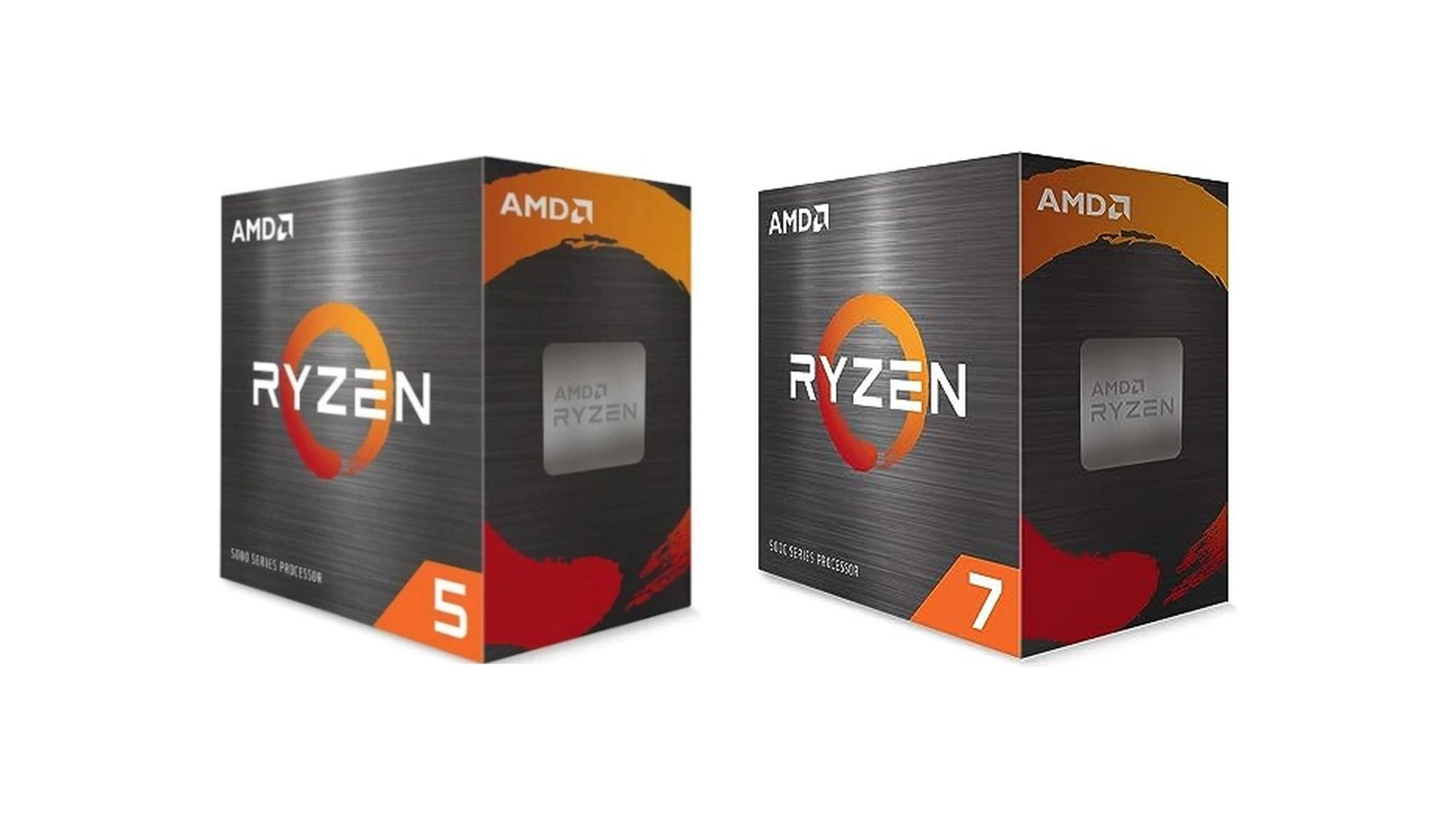
For CPU-only Qwen2.5 14B, no. Public LocalScore runs put a Ryzen 5 5600X at 4.2 tokens/s generation on Qwen2.5 14B Instruct Q4_K_M, while three separate Ryzen 7 5800X submissions land at 3.5, 4.0 and 4.3 tokens/s. The extra two cores buy you nothing on decode, because dual-channel DDR4 runs out of bandwidth first.
That result is counterintuitive enough that it is worth walking through properly, because the reasoning behind it decides not just which AM4 chip you buy, but whether you should be buying a CPU at all.
The people running a 14-billion-parameter model with no discrete GPU in the box fall into a few recognisable groups: someone with a spare AM4 board and a budget that will not stretch to a graphics card this quarter, someone building a silent or low-slot-count machine, and someone who needs a model bigger than any card they can afford to fill. AM4 remains the cheapest honest way to try that, because the platform is mature, boards are plentiful on the used market, and both processors compared here drop into the same B550 socket with a BIOS update. Per AMD's own spec pages, the Ryzen 5 5600X and the Ryzen 7 5800X launched on the same day, 5 November 2020, carry the same 32 MB of L3 cache, and top out at the same DDR4-3200 memory specification. Cores, L2, TDP and the bundled cooler are the only things that actually differ. As of 2026 that makes this a narrower comparison than the model numbers suggest.
Key takeaways
- Measured Qwen2.5 14B Q4_K_M generation on the 5600X is 4.2 tok/s; the three public 5800X runs read 3.5, 4.0 and 4.3 tok/s (LocalScore). The gap is inside run-to-run noise.
- Dual-channel DDR4-3200 tops out at 51.2 GB/s of theoretical bandwidth. A 8.99 GB Q4_K_M weight file therefore caps out near 5.7 tok/s no matter how many cores you add.
- Prompt processing is core-scalable: in llamafile's CPU benchmark thread, moving from a 6-core 5600X to a 16-core 5950X lifted Mistral 7B prefill by 1.77x to 2.01x while generation moved only 1.11x to 1.14x.
- The 5800X carries a 105 W default TDP and ships with no cooler; the 5600X is 65 W with a Wraith Stealth in the box. Budget the cooler before comparing sticker prices.
- A 12 GB RTX 3060 runs the same Qwen2.5 14B Q4_K_M at 26.6 tok/s with a 1.92 second time to first token, against 38 to 56 seconds on either CPU (LocalScore).
Step 0: is your bottleneck cores or memory bandwidth?
Every argument in this piece reduces to one diagnostic, so run it before reading the tables.
Token generation on a CPU is a streaming problem. To emit one token, llama.cpp has to read essentially every weight in the model once. There is almost no arithmetic intensity to hide behind — the cores spend their time waiting on memory. That makes the ceiling a simple division: memory bandwidth divided by model file size.
Both of these processors specify DDR4 at up to 3200 MT/s, per AMD. Two channels at 3200 MT/s and 8 bytes per transfer is 51.2 GB/s of theoretical bandwidth. The bartowski GGUF repository lists Qwen2.5 14B Instruct Q4_K_M at 8.99 GB. That gives a hard ceiling of roughly 5.7 tokens per second, and the measured 3.5 to 4.3 tok/s figures sit at 61 to 75 percent of it — exactly where a real implementation with cache misses and sampling overhead should land.
Prompt processing is the opposite workload. Prefill runs the whole prompt through the model as a batched matrix multiply, which is compute-bound and parallelises across threads. That is where core count shows up, and it is the only place it does.
So the diagnostic is: are you pasting long documents in, or are you chatting? If you paste 8,000-token documents and wait for an answer, prefill dominates and cores matter. If you type a sentence and read the reply as it streams, decode dominates and bandwidth matters. Most interactive local-LLM use is the second case.
Spec delta: what actually separates the 5600X and the 5800X
| Spec | Ryzen 5 5600X | Ryzen 7 5800X |
|---|---|---|
| Cores / threads | 6 / 12 | 8 / 16 |
| L3 cache | 32 MB | 32 MB |
| Default TDP | 65 W | 105 W |
| Base clock | 3.7 GHz | 3.8 GHz |
| Bundled cooler | Wraith Stealth | Not included |
| Street price (SpecPicks catalog, 23 Sep 2026) | $174.45 | $258.72 |
Every spec row above except price comes from AMD's product pages for the 5600X and the 5800X. Prices move; check the live figures on the Ryzen 5 5600X listing and the Ryzen 7 5800X listing before committing.
Two rows deserve emphasis. The L3 cache is identical at 32 MB — a common assumption that the 5800X brings more cache to the problem is simply wrong for this pair. And the cooler row is a real price delta: AMD lists the 5800X's thermal solution as "Not Included", so an inference box running at a 100 percent duty cycle needs a tower cooler added to its budget, which narrows the $84 gap by another $30 to $45.
How fast is Qwen2.5 14B on each CPU?
LocalScore publishes per-submission results with the model, quantization and host memory attached, which makes it the cleanest public source for this specific comparison. All rows below are Qwen2.5 14B Instruct Q4_K_M (14.8B parameters).
| Accelerator | Host RAM | Prompt tok/s | Generation tok/s | Time to first token | LocalScore |
|---|---|---|---|---|---|
| Ryzen 5 5600X | 31.3 GB | 25 | 4.2 | 55.28 s | 12 |
| Ryzen 7 5800X (run A) | 31.9 GB | 24 | 3.5 | 56.18 s | 11 |
| Ryzen 7 5800X (run B) | 63.9 GB | 25 | 4.0 | 55.77 s | 12 |
| Ryzen 7 5800X (run C) | 92.2 GB | 37 | 4.3 | 38.42 s | 16 |
| RTX 3060 12GB | 12 GB | 759 | 26.6 | 1.92 s | 225 |
Read the spread on the three 5800X rows carefully. Generation varies from 3.5 to 4.3 tok/s across identical silicon, which is a wider band than the gap to the 5600X's 4.2. Whatever separates those runs — memory kit, subtimings, thread count, background load — matters more than the two extra cores do. Run C is the interesting one: its 37 tok/s prefill and 38-second time to first token are clearly better than the other two, and it is also the box with 92 GB of RAM, which suggests a four-DIMM high-capacity configuration behaving differently under prefill. LocalScore's numbers are averages across nine prompt-and-generation mixes, so do not line them up against llama.cpp pp512/tg128 rows as like-for-like.
A note on the 1B-class results from the same submissions, because they show the inversion: on Llama 3.2 1B Q4_K_M the 5800X generates 40.8 tok/s against the 5600X's 32.4 tok/s. When the model is small enough to live in cache, the extra cores finally do something. At 14B, they do not.
Quantization matrix: what fits, what it costs
File sizes below are the published artifact sizes in the bartowski Qwen2.5 14B GGUF repo. The ceiling column is the arithmetic roofline at 51.2 GB/s, not a measurement — it is the fastest either CPU could possibly go, and real throughput lands at roughly 60 to 75 percent of it.
| Quant | File size | RAM for weights + modest KV | Bandwidth ceiling at 51.2 GB/s | Practical note |
|---|---|---|---|---|
| Q3_K_M | 7.34 GB | ~10 GB | ~7.0 tok/s | Noticeable quality loss on reasoning; rarely worth it at 14B |
| Q4_K_M | 8.99 GB | ~12 GB | ~5.7 tok/s | The default. Measured 3.5-4.3 tok/s on both parts |
| Q5_K_M | 10.51 GB | ~14 GB | ~4.9 tok/s | Small quality gain, ~15% slower |
| Q6_K | 12.12 GB | ~16 GB | ~4.2 tok/s | Near-lossless; 16 GB systems start to struggle |
| Q8_0 | 15.70 GB | ~20 GB | ~3.3 tok/s | Needs 32 GB. No practical reason on CPU |
| f16 | 29.55 GB | ~36 GB | ~1.7 tok/s | A 5600X measured 1.48 tok/s on 14B f16 in llamafile's thread |
That last row is measured, not derived: the llamafile CPU thread has a 5600X with 96 GB of DDR4-3600 running Qwen2.5-Coder-14B at f16 (27.51 GiB) at pp512 14.64 and tg16 1.48 tok/s. It lands just under the roofline, which is a good sanity check on the whole table.
The practical reading: on 32 GB of DDR4, Q4_K_M and Q5_K_M are the sensible operating points on either CPU. Going higher costs speed you cannot spare. Going lower costs quality on exactly the reasoning tasks that justify running a 14B model instead of an 8B one.
Prefill vs generation: why the extra cores help one and not the other
The cleanest public demonstration of this split is not a 5600X-vs-5800X comparison at all — it is the 5600X-vs-5950X table a contributor posted in the llamafile benchmark discussion. Going from 6 cores to 16 on the same Zen 3 architecture and the same DDR4 platform produced this:
| Model / quant | Test | Ryzen 5 5600X | Ryzen 9 5950X | Speedup |
|---|---|---|---|---|
| Mistral 7B BF16 | pp512 | 26.98 | 51.14 | ~1.90x |
| Mistral 7B BF16 | tg16 | 3.11 | 3.53 | ~1.14x |
| Mistral 7B Q8_0 | pp1024 | 34.54 | 69.41 | ~2.01x |
| Mistral 7B Q8_0 | tg16 | 5.89 | 6.57 | ~1.11x |
| Mixtral 8x7B Q6_K | pp512 | 33.88 | 60.11 | ~1.77x |
| Mixtral 8x7B Q6_K | tg16 | 4.20 | 4.76 | ~1.13x |
Nearly tripling the core count roughly doubles prefill and moves generation about 12 percent. The 5800X adds 33 percent more cores than the 5600X, not 167 percent — scale that curve down and the expected generation gain is low single-digit percent, which is precisely the noise floor the LocalScore rows show.
There is a second reason the returns are flat this early: on a dual-channel Zen 3 desktop, memory saturates well before all cores are busy. That is why a 5600X with well-tuned DDR4-3600 can beat a 5800X with loose DDR4-3000 on this workload. If you already own either chip and want more tokens per second, the upgrade is the memory kit, not the processor.
What context length does to CPU-only throughput
The tokens-per-second figure is the number people quote, but it is not the number that makes CPU-only inference feel unusable. Time to first token is.
Every 5800X row above reports a time to first token between 38 and 56 seconds, and the 5600X reports 55.28 seconds, on LocalScore's standard prompt mix. The RTX 3060 on the same benchmark reports 1.92 seconds. That is a 20x to 29x difference in how long you sit looking at a blank screen before the first word appears.
The relationship is roughly linear in prompt length, because prefill is a per-token compute cost. At around 25 to 37 prompt tokens per second, a 2,000-token document takes about a minute to ingest before generation starts; an 8,000-token document takes four to five minutes. The KV cache also grows with context, eating into the RAM headroom the weights already claimed — which is why 16 GB systems that load Q4_K_M fine at short context start swapping at 16K.
For batch work that runs overnight — summarising a folder of documents, tagging a backlog, generating embeddings-adjacent metadata — none of this matters. For anything interactive, it is disqualifying.
Does adding a 12GB GPU change the answer?
Completely, and this is the section that should change your shopping list.
Per NVIDIA's RTX 3060 family page, the 12 GB card carries 12 GB of GDDR6 on a 192-bit bus, draws 170 W of graphics card power, needs a 550 W system supply and a single 8-pin connector, and runs 3,584 CUDA cores at a 1.78 GHz boost. That 192-bit GDDR6 interface is the whole story. Retail listings for the card, including the MSI 12GB model, specify 15 Gbps memory on that 192-bit bus, which works out to 360 GB/s — about seven times the 51.2 GB/s a dual-channel DDR4-3200 desktop can manage. Bandwidth is exactly what decode is starved of.
The result is the 26.6 tok/s Qwen2.5 14B Q4_K_M row in the table above — six times either CPU. Hardware Corner's RTX 3060 12GB tables corroborate the class of result on a sibling model, measuring Qwen3 14B Q4_K at 31.2 tok/s generation and 972.6 tok/s prefill at 4K context, falling to 22.7 and 678.2 at 16K.
If you cannot fit the whole model in 12 GB, hybrid offload is where the 5800X's extra cores finally earn their keep: the layers left in system RAM are processed on CPU threads, so the core count contributes to the blended figure. That is a real argument for the 8-core part — but only for a reader who already owns a GPU and is pushing past its VRAM ceiling. It is not an argument for a CPU-only build.
Both the MSI RTX 3060 12GB and the ZOTAC Twin Edge OC 12GB carry the same GA106 silicon and the same 12 GB; the benchmark data lives on the RTX 3060 12GB benchmark page.
Where the Ryzen 5 2600 still lands
The Ryzen 5 2600 is the floor of this comparison, and it is here for one reason: a lot of readers already own one and are asking whether to upgrade rather than whether to buy.
Zen+ on dual-channel DDR4 is a slower memory controller and an older core, but the roofline argument applies unchanged — with weights streaming at DDR4 speeds, a 2600 running Q4_K_M 14B lands in the same low-single-digit tokens-per-second band as its Zen 3 descendants, just at the bottom of it. Its prefill is meaningfully worse, so long prompts hurt more. Benchmark coverage for the part lives on the Ryzen 5 2600 benchmark page.
One catalog caveat worth stating plainly: the Amazon listing we track for the 2600 is currently priced above both 5000-series chips in this comparison, which reflects a third-party seller on a discontinued part rather than its real worth. Treat the 2600 as a part you keep, not a part you buy.
Performance per dollar and per watt
Using the measured Qwen2.5 14B Q4_K_M generation figures and the catalog prices above:
| Part | Price | Gen tok/s | tok/s per $100 | Default TDP | Gen tok/s per 100 W |
|---|---|---|---|---|---|
| Ryzen 5 5600X | $174.45 | 4.2 | 2.41 | 65 W | 6.5 |
| Ryzen 7 5800X | $258.72 | 3.5-4.3 | 1.35-1.66 | 105 W | 3.3-4.1 |
| RTX 3060 12GB | $479.99 | 26.6 | 5.54 | 170 W | 15.6 |
The TDP column is AMD's and NVIDIA's rated figure, not a measured wall-power reading, so treat the per-watt column as a comparison of design budgets rather than an electricity bill. The direction is unambiguous either way: the 5600X beats the 5800X on both metrics for this workload, and the GPU beats both by a factor of two to four.
Common pitfalls
- Running single-channel. One DIMM halves your bandwidth, and bandwidth is the entire budget. Two matched sticks in the A2/B2 slots is not optional advice for this workload.
- Leaving memory at JEDEC defaults. A kit sold as DDR4-3600 runs at 2133 MT/s until you enable its XMP/DOCP profile in BIOS. That alone is a larger throughput swing than the difference between these two CPUs.
- Over-threading llama.cpp. Setting
-tto the full thread count including SMT usually costs throughput on a memory-bound decode, because the extra threads contend for the same memory controller. Test 4, 6 and 8 on a 5800X rather than assuming 16 is best. - Buying the 5800X without a cooler. AMD ships it bare. A 105 W part held at a sustained inference load is not a job for a budget cooler that once handled bursty gaming.
- Sizing RAM for the weights only. The KV cache grows with context. A Q4_K_M 14B in 16 GB works at 2K context and thrashes at 16K.
When NOT to build this at all
If your use case is interactive chat, coding assistance or anything with a human waiting on the reply, a CPU-only 14B box is the wrong machine. At 4 tok/s and a 55-second time to first token, a single answer takes minutes. No amount of AM4 tuning closes a 6x throughput gap and a 29x latency gap.
Skip both processors and buy a 12 GB card if: your budget clears roughly $480 for a GPU on top of a host you already own, your case takes a two-slot card, and your power supply is a competent 550 W unit or better.
Verdict matrix
| Situation | Pick |
|---|---|
| CPU-only 14B, interactive use, buying new | Neither. Buy the RTX 3060 12GB |
| CPU-only 14B, batch/overnight work, buying new | Ryzen 5 5600X — same decode speed, $84 less, cooler included |
| You paste 4K-16K token documents constantly | Ryzen 7 5800X — prefill is the one thing cores buy |
| You already own a 12 GB GPU and want to run bigger-than-VRAM models | 5800X, for hybrid layer offload |
| You already own a 2600 or 5600X | Spend the upgrade money on a DDR4-3600 kit, then a GPU |
| Silent or low-power always-on box | 5600X at 65 W, or step down to a 1B-8B model entirely |
Recommended pick
For a first CPU-only 14B box, buy the Ryzen 5 5600X. It matches the 5800X's measured Qwen2.5 14B generation speed inside run-to-run noise, costs roughly $84 less in our catalog as of 23 September 2026, draws 65 W instead of 105 W, and includes a cooler the 5800X does not. Put the saved money into a matched 32 GB DDR4-3600 kit, which will do more for your tokens per second than the 5800X would.
Then be honest about the ceiling. Four tokens per second and a 55-second wait for the first word is a batch-processing machine, not an assistant. The moment the budget allows, the RTX 3060 12GB turns the same model into a 26.6 tok/s, sub-two-second experience — and that is the upgrade that actually changes what you can do with the box.
Live price comparison
Prices on these parts move week to week, and the 2026 memory market is making platform costs move with them. Current listings and live pricing:
- AMD Ryzen 5 5600X — 6C/12T, 65 W, Wraith Stealth included
- AMD Ryzen 7 5800X — 8C/16T, 105 W, no cooler
- AMD Ryzen 5 2600 — Zen+ floor of this comparison
- MSI RTX 3060 12GB — the upgrade that ends the argument
- ZOTAC RTX 3060 Twin Edge OC 12GB — same silicon, alternate cooler
Prices shown on SpecPicks are captured at scrape time and may vary; check the live listing before ordering.
Related guides
- Best CPU for local LLM inference: 5800X vs 5700X vs 5600G
- Ryzen 5 5600X vs Ryzen 5 5600G: CPU-only Gemma 3 12B
- Ryzen 5 2600 vs Ryzen 7 5800X: CPU-only Qwen3 30B-A3B
- Which LLMs fit in an RTX 3060 12GB?
- RTX 3060 12GB benchmark data
Frequently asked questions
How much system RAM do I need for Qwen2.5 14B on CPU only?
A Q4_K_M GGUF of a 14B model occupies roughly 8.5-9 GB of weights, and llama.cpp needs headroom on top for the KV cache, which grows with context length. 16 GB of dual-channel DDR4 is workable at short contexts but leaves almost nothing for the operating system at 16K-32K tokens. 32 GB is the sane target on either CPU, and it costs far less than the gap between these two processors.
Does memory speed matter more than the CPU itself here?
For token generation, largely yes. CPU-only decode is dominated by how fast weights stream out of system memory, so a dual-channel DDR4-3600 kit will do more for generation throughput than two extra cores will. Prompt processing is the opposite — it is compute-bound and scales with threads, which is where the 5800X's eight cores earn their keep. Run both sticks in the correct A2/B2 slots; single-channel operation roughly halves decode speed.
Will a Ryzen 5 5600X bottleneck a 12GB GPU if I add one later?
Not meaningfully for inference. Once the model's layers sit in VRAM, the CPU mostly marshals tokens and handles sampling, which neither part struggles with. The CPU only becomes the limiter in hybrid mode, where some layers stay in system RAM and get processed on cores — that is the one case where the 5800X's extra threads show up in the tok/s figure. For a fully-offloaded 8B-class model, the two CPUs are within noise of each other.
Do I need a new cooler for the 5800X?
Yes, and budget for it before comparing prices. The 5800X ships without a cooler and has a 105 W TDP that a stock-class tower struggles to hold under a sustained inference load, which is a 100%-duty-cycle workload rather than a bursty gaming one. The 5600X is 65 W and includes a Wraith Stealth that is adequate at stock settings. Fold the cooler cost into the 5800X's price before deciding the value question.
When should I skip both CPUs and just buy a GPU?
If your budget can absorb a 12 GB card, buy the card first. CPU-only decode on a 14B model lands in the low single-digit tokens per second on either AM4 part, which is fine for batch summarization overnight and painful for interactive chat. A 12 GB GPU moves the same quantization into double digits. The CPU-only route makes sense when you already own the platform, need the box silent, or want to run models larger than any card you can afford.
Citations and sources
- LocalScore — Ryzen 5 5600X submission #1018 (accessed 23 September 2026)
- LocalScore — Ryzen 7 5800X submission #1070 (accessed 23 September 2026)
- LocalScore — Ryzen 7 5800X submission #762 (accessed 23 September 2026)
- LocalScore — Ryzen 7 5800X submission #846 (accessed 23 September 2026)
- LocalScore — NVIDIA GeForce RTX 3060 submission #43 (accessed 23 September 2026)
- AMD — Ryzen 5 5600X product specifications (accessed 23 September 2026)
- AMD — Ryzen 7 5800X product specifications (accessed 23 September 2026)
- mozilla-ai/llamafile — "Lots of CPU benchmarks", Discussion #450 (accessed 23 September 2026)
- NVIDIA — GeForce RTX 3060 family specifications (accessed 23 September 2026)
- Hardware Corner — RTX 3060 12GB LLM benchmarks (accessed 23 September 2026)
- bartowski — Qwen2.5-14B-Instruct-GGUF file sizes (accessed 23 September 2026)
This piece is editorial synthesis based on publicly available information. No independent first-party benchmarking is reported.


