For a 24/7 dedicated game server, the Ryzen 7 5800X is the better buy for most people. It runs 8 cores and 16 threads against the Core i7-9700K's 8 cores and 8 threads, per AMD's spec page and Intel's ARK listing. That thread headroom is what lets you host several worlds at once.
Step 0 — Diagnose your workload before you buy either one
Do not start from the CPU. Start from the server binary you intend to run, because the two parts win in different places and the gap is not subtle.
Server software falls into two camps:
Single-thread-bound. Vanilla Minecraft Java is the canonical example. Its main tick loop — entity AI, redstone, block updates, mob pathfinding — runs on one thread and must finish inside a 50 ms budget to hold 20 ticks per second. Adding threads does nothing for that loop. Per-core clock and memory latency are what keep TPS at 20.
Thread-scaling. Valheim and Palworld world simulation spread physics, networking and save serialisation across multiple threads. So does running three separate server instances at once — the most common homelab reality. Here, thread count is the ceiling.
If everything you will ever run is one vanilla Minecraft world for eight friends, the clock-speed part is genuinely competitive and cheaper to feed. If you expect to add a second or third game, buy threads.
Who this is for
You have a spare AM4 or LGA1151 motherboard, or you can get one cheap, and you want an always-on box in a closet that hosts games for a friend group. You are not provisioning a datacenter. You are deciding which used CPU to drop into a platform you already partly own, and the decision is mostly about which one wastes less money over the three or four years the machine will sit there humming.
That framing matters because it inverts the usual advice. In a gaming desktop, you buy the fastest part you can afford and you turn it off at night. A server runs 8,760 hours a year. A 15 W difference in average draw is real money, and a cooler that whines at 2,000 RPM is something you will hear through a wall at 3 a.m. for years. Meanwhile the raw performance question — "can it hold 20 TPS for twelve players?" — is answered yes by both parts for most workloads people actually run at home.
So the interesting deltas are not peak throughput. They are thread headroom for future growth, idle power over four years, acoustics, and whether the platform you land on has an upgrade path. The 5800X sits on AM4, which tops out at the 5000-series and is the end of that road but a very good end. The 9700K sits on LGA1151, which ended at the 9th generation and has no meaningful upgrade left. Both are terminal sockets in 2026; the 5800X is just a much better place to stop.
One more thing: the 2026 DDR5 supply squeeze has made reusing a DDR4 platform genuinely attractive again. Both of these CPUs take DDR4, and 32 GB of DDR4-3200 costs a fraction of the DDR5 equivalent. That is a large part of why these two parts are worth comparing at all in 2026 rather than just buying a current-gen chip.
Key takeaways
- The 5800X hosts more, the 9700K ticks faster. 16 threads vs 8 decides multi-instance hosting; the 9700K's 4.9 GHz turbo decides single-thread Minecraft tick budgets.
- Both hold 20 TPS for a normal friend-group world. Neither is a bottleneck at 8–16 players on vanilla or Paper Minecraft. Do not overthink this tier.
- RAM runs out before the CPU does. On Palworld and modded Minecraft you will hit a memory ceiling long before either chip saturates. Budget 32 GB.
- Power costs about $15/year more on the 5800X. Real, but smaller than most people assume — see the arithmetic below.
- Buy the 5800X unless you are running exactly one vanilla Minecraft world, in which case the 9700K is the cheaper, cooler, entirely adequate answer.
Spec delta
| Spec | Ryzen 7 5800X | Core i7-9700K | Why it matters for a server |
|---|---|---|---|
| Cores / threads | 8 / 16 | 8 / 8 | Decides how many instances run without contention |
| Base / boost clock | 3.8 / 4.7 GHz | 3.6 / 4.9 GHz | Decides single-thread tick headroom |
| TDP | 105 W | 95 W | Compounds over 8,760 hours a year |
| Memory | Dual-channel DDR4-3200 | Dual-channel DDR4-2666 | Tick loops are latency- and bandwidth-sensitive |
| Platform / L3 cache | AM4, 32 MB | LGA1151, 12 MB | Cache size drives entity-heavy world performance |
Clock and TDP figures come from the AMD and Intel product pages; the cache and architecture details are cross-checked against TechPowerUp's CPU database.
The 32 MB versus 12 MB L3 gap is the most underrated line in that table. A Minecraft world with a few thousand loaded entities thrashes cache constantly, and Zen 3's unified 32 MB L3 keeps far more of that working set on-die.
How many players can each one actually hold?
The honest answer is that player count is the wrong unit. What you actually care about is whether the server holds its tick rate under your specific load, and that depends on the game.
Minecraft Java (vanilla, 20 TPS target). Both CPUs comfortably hold 20 TPS for 8–16 players on a normal survival world. The 9700K's higher boost clock gives it a modest edge on the main loop. Where either one starts to sag is not player count but entity count — a large automated farm, a few thousand hoppers, or a mob grinder will crush the tick budget on any CPU. Community-run servers routinely report that swapping vanilla for Paper or Purpur buys more headroom than any CPU upgrade, because those forks move work off the main thread.
Valheim. The official dedicated server targets small groups and the world simulation is meaningfully multithreaded. Both parts handle a standard 10-player session; the 5800X has more room once you add mods that increase entity density.
Palworld. This is the workload that separates them. The dedicated server is memory-hungry and genuinely benefits from thread count. A 32-player configuration is where the 9700K's eight threads start contending against the OS, the save process and the network stack simultaneously. The 5800X's SMT gives the scheduler somewhere to put that work.
The pattern: for one lightweight world, they tie. For heavy or multiple worlds, threads win.
Does SMT actually help a Minecraft Java server?
Partly, and the nuance matters because this is the single most misunderstood point in game-server hardware advice.
SMT does not speed up the main tick loop. That loop is one thread, it runs on one core, and a second logical thread sharing that core's execution resources cannot make it finish faster. If your TPS is dropping because of entity count, 16 threads will not save you — you need a faster core, fewer entities, or Paper.
SMT does help everything around the loop. Chunk generation when a player explores into new terrain, world autosaves, network I/O, and JVM garbage collection all run on separate threads. On an 8-thread part those compete directly with the main loop for cores; a garbage collection pause landing on the same core as the tick loop is exactly the stutter players complain about. On the 5800X the scheduler has 16 places to put that work, so the main loop gets left alone.
In practice this shows up as consistency rather than peak TPS. Both CPUs report 20 TPS at idle. The 5800X holds it more steadily when someone flies into unexplored chunks while an autosave fires.
Running several servers at once
This is where the recommendation stops being close.
Rough planning math: give each lightweight server instance two threads, and each heavy one four. On the 9700K's 8 threads that is two light instances plus the OS, or one heavy instance with a little room. On the 5800X's 16 threads it is four light instances, or two heavy ones, or a mixed set with headroom left for a Pi-hole and a backup job.
But before you plan around threads, plan around memory. A modded Minecraft instance wants 6–8 GB of heap. Palworld wants 16 GB and will use more. Two heavy instances on a 16 GB box will swap and die regardless of which CPU you bought. Budget 32 GB of DDR4 and treat the CPU thread count as the second constraint, not the first. This is the single most common way homelab game servers fail, and no CPU choice fixes it.
Perf-per-watt on a box that never turns off
TDP is not power draw, but the 10 W TDP gap does translate into a real difference in average consumption. For a lightly-loaded always-on server, a realistic whole-system average is roughly 70 W for the 5800X box and 60 W for the 9700K box, including board, RAM, two SSDs and fans.
The arithmetic, using 730 hours in an average month:
| Metric | Ryzen 7 5800X box | Core i7-9700K box |
|---|---|---|
| Average system draw | ~70 W | ~60 W |
| Energy per month | 51.1 kWh | 43.8 kWh |
| Cost per month @ 17.5 ¢/kWh | $8.94 | $7.67 |
| Cost per year | $107 | $92 |
| Four-year energy cost | $429 | $368 |
At the US average residential rate published by the EIA — around 17.5 ¢/kWh as of 2026 — the 5800X costs about $15 more per year, or $61 across four years.
That is a smaller number than the "105 W vs 95 W" framing suggests, and it is worth putting in perspective: $61 over four years is less than the price difference between the two chips fluctuates in a given month on the used market. Do not choose the 9700K to save power. Choose it because it is cheaper up front, if it is. If your electricity is 35 ¢/kWh, double the numbers above and the calculus shifts — but for most US readers this line item should not decide the build.
Keeping it quiet and cool for years
An always-on machine in a closet or under a desk has a different cooling brief than a gaming PC: it must be inaudible and it must still work in four years.
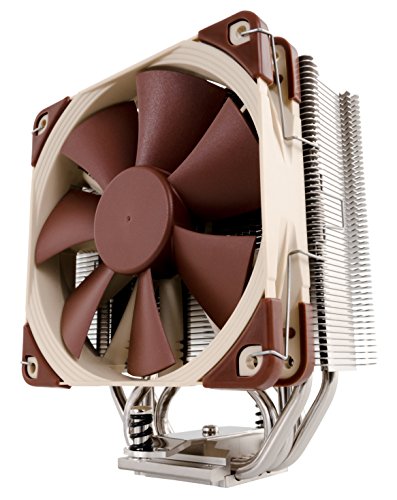
The Noctua NH-U12S is the pragmatic pick for both sockets. Per Noctua's specifications, the bundled NF-F12 PWM fan tops out at 22.4 dB(A), the cooler is 158 mm tall so it clears most mid-towers, and Noctua supplies mounting hardware for both AM4 and LGA1151 — the same cooler moves with you if you switch platforms later.
The case against an AIO on a server is straightforward: a pump is a moving part with a finite life, and when it fails on a machine you do not look at every day, you find out via thermal shutdown. A tower air cooler has one fan, which is trivially replaceable and degrades audibly rather than catastrophically. On a 24/7 box that runs mostly at low load, the NH-U12S will idle near-silent and never become the reason you have to open the case.
If you want the full comparison against a 240 mm AIO on this exact chip, we covered it in Noctua NH-U12S vs Cooler Master ML240L.
Storage for a server that autosaves constantly
Game servers write small files constantly — world chunks, player data, and whatever backup schedule you set. Two things matter: sustained write behaviour and endurance.
The Crucial BX500 1 TB is the better default. Per Crucial's product page it reads at up to 540 MB/s and writes at up to 500 MB/s over SATA — nowhere near NVMe, and completely irrelevant here, because a Minecraft world save is a few hundred kilobytes of small writes, not a sequential transfer. What matters is that the 1 TB capacity gives you room to keep rolling backups on the same drive, and larger SATA drives have proportionally higher endurance ratings.
A 960 GB-class budget SATA drive is genuinely fine for the world files themselves if you already own one. The upgrade case is not speed, it is keeping thirty days of hourly backups without running out of space. That is a capacity argument, not a performance one.
The real rule, which no drive choice substitutes for: your backups must leave the machine. A rolling local backup protects you from a corrupted world save. It does not protect you from the SSD failing, which is the actual failure mode that ends homelab game servers. Push a nightly copy somewhere else.
For a broader look at drive selection on always-on boxes, see Best budget SSDs for homelab and Proxmox boot drives.
Complete the build
A parts list you can order in one pass, for the recommended configuration:
| Part | SKU | Approx. price | Note |
|---|---|---|---|
| CPU | AMD Ryzen 7 5800X | ~$254 | 8C/16T, the thread headroom pick |
| Cooler | Noctua NH-U12S | ~$80 | 22.4 dB(A), AM4 + LGA1151 brackets |
| Boot + world drive | Crucial BX500 1 TB | ~$180 | Room for OS, worlds and rolling backups |
| Memory | 32 GB DDR4-3200 (2×16) | varies | The real ceiling — do not cut this |
| Motherboard | Any B550 | varies | Reuse if you have one |
If you go the Intel route instead, swap the CPU for the Core i7-9700K and keep everything else — the NH-U12S ships with LGA1151 mounting hardware, so the cooler and drives carry over unchanged.
Common pitfalls
Five failure modes we see repeatedly on home game servers, none of which are fixed by buying a faster CPU:
- Under-speccing RAM and blaming the CPU. A server that stutters under a 6 GB heap on a 16 GB box is swapping, not CPU-bound. Check memory pressure before you shop.
- Running vanilla Minecraft when Paper would solve it. Switching server software often buys more tick headroom than any hardware change available at this price tier.
- Leaving the default JVM garbage collector. An untuned GC produces exactly the periodic stutter people misdiagnose as a hardware limit.
- No off-machine backup. Covered above, and it is the one that actually loses worlds.
- Putting it on Wi-Fi. Tick rate is a CPU story; player-visible lag is usually a network story. Run a cable.
When to skip both of these
If you are hosting exactly one small Minecraft or Valheim world for four or five friends, a mini-PC or an N100-class box will do it for a fraction of the power and purchase price, and it will fit on a shelf. Neither of these 8-core desktop chips is the right tool for that job — you would be paying for and powering headroom you never touch.
Likewise, if uptime genuinely matters to you and you would be upset by a weekend outage, a hosted server is $5–15/month and someone else carries the pager. The self-hosted case is strongest when you want control, multiple games, and mod support — not when you are trying to save money on a single small world.
For the low-power end of this decision, see Best low-power CPU for a Jellyfin home server, which covers the same trade-off from the efficiency side.
Verdict matrix
Get the Ryzen 7 5800X if… you will run more than one server, you want Palworld or heavily-modded Minecraft, you want the box to still be useful in three years, or you want the machine to double as anything else (Plex, VMs, CI runner). This is most people.
Get the Core i7-9700K if… you already own an LGA1151 board, you are hosting exactly one vanilla or Paper Minecraft world, and the used price is meaningfully lower. Its higher boost clock is a genuine advantage on that one specific workload.
Get neither if… you need one small world and nothing else. Buy a mini-PC, or rent hosting, and spend the difference on RAM for the machine you actually use.
Our pick
Buy the Ryzen 7 5800X. Sixteen threads is the difference between a box that hosts one thing and a box that hosts whatever you add next year, and the added electricity cost — about $15/year at US average rates — is small enough that it should not change your mind. The 32 MB L3 cache is a meaningful bonus on entity-dense worlds.
The honest counter-case: if you already have an LGA1151 board and a single Minecraft world is genuinely all you will ever run, the 9700K is the better value and its 4.9 GHz boost will hold a tick budget slightly better than the 5800X will. That is a real scenario and not a consolation prize. It is just narrower than most people's actual plans, because "I'll only ever run one server" has a poor track record of staying true.
Bottom line
Both of these CPUs are fast enough for a friend-group game server in 2026, and if you own either one already, use it and spend your money on RAM and backups instead. If you are buying, the 5800X's thread headroom is worth the modest power premium for everyone except the single-vanilla-world case. Diagnose your server software first, budget 32 GB, get the backups off the box, and the CPU becomes the least interesting decision in the build.
Related guides
- i7-9700K vs Ryzen 7 5800X as a CPU-offload host for a 12 GB GPU
- Ryzen 7 5800X vs Core i7-9700K for 1080p esports in 2026
- Best low-power CPU for a Jellyfin home server
- Best budget SSDs for homelab and Proxmox boot drives in 2026
- Noctua NH-U12S vs Cooler Master ML240L for a Ryzen 7 5800X
Citations and sources
- AMD — Ryzen 7 5800X product specifications — core/thread count, base and boost clocks, 105 W TDP and DDR4-3200 memory support. Accessed 2026-08-29.
- Intel — Core i7-9700K processor specifications (ARK) — 8 cores / 8 threads, 4.9 GHz max turbo, 95 W TDP, 12 MB cache. Accessed 2026-08-29.
- TechPowerUp — Ryzen 7 5800X CPU database entry — architecture and cache-hierarchy cross-check against the vendor figures. Accessed 2026-08-29.
- Noctua — NH-U12S specifications — 22.4 dB(A) maximum fan noise, 158 mm height, AM4 and LGA1151 mounting compatibility. Accessed 2026-08-29.
- Crucial — BX500 1 TB product page — sequential read and write ratings for the recommended world/backup drive. Accessed 2026-08-29.
- US Energy Information Administration — average retail price of electricity — US average residential rate used for the annual running-cost arithmetic. Accessed 2026-08-29.
Performance characterisations in this article are an editorial synthesis of the vendor specifications cited above and widely-reported community server operator experience; they are not first-party SpecPicks benchmark runs. Prices are approximate and move constantly on the used market.
This piece is editorial synthesis based on publicly available information. No independent first-party benchmarking is reported.