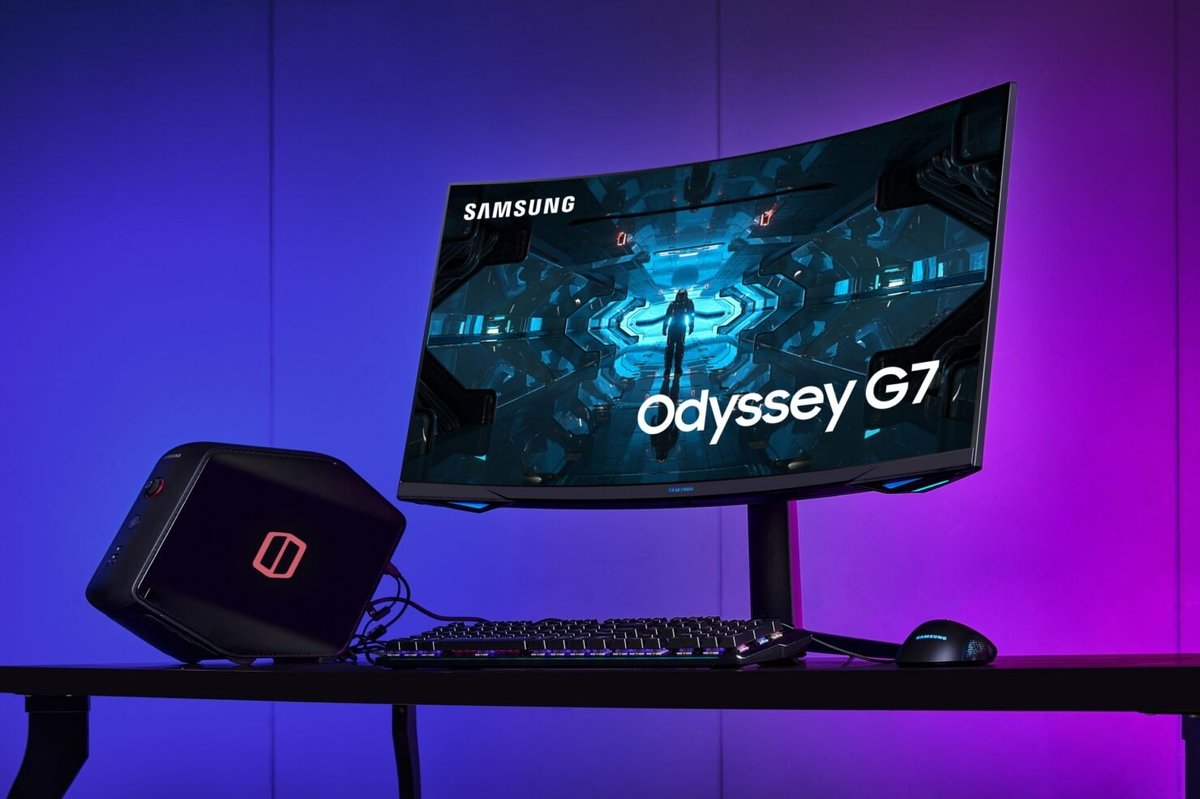
In brief — 2026 · Samsung's 1440p 240Hz gaming monitor is 32% off at $169, one of the most aggressive prices we've seen for that panel spec.
For a 1440p 240Hz panel to land at $169 is unusual value — that's the sort of price point historically reserved for 1080p high-refresh or 1440p at 144-165Hz, and it puts esports-grade motion at a resolution that visibly beats 1080p on modern gaming GPUs like the MSI RTX 3060 12GB. The catch, as always with monitor deals, is that a fast refresh number is only useful if your GPU can actually feed it; the second half of this brief is the pairing math.
What happened
Per Tom's Hardware and other outlets covering the Samsung gaming monitor lineup, the 1440p 240Hz model has dropped to $169 — around a third off its list price. That's within striking distance of budget 1080p/144Hz panels and undercuts most of the 1440p/165Hz competition. The panel targets fast-motion gaming, and at 27 inches (typical for this class) the pixel density is comfortably in the "sharp but not oversharp" band that most players prefer for competitive titles at 1440p.
Deal pricing on monitors moves quickly, so treat any quoted figure here as time-stamped. The meaningful number is the price you see at checkout — a struck-through list price can overstate the discount, and both RTINGS and the various price-history trackers routinely show that "sale" prices anchor against inflated MSRPs. Sanity-check the current street price against the last few months of history before you commit.
Why it matters
The 1440p/240Hz combination is the 2026 esports sweet spot for a specific reason. At 1080p the ceiling for perceived visual quality is limited by pixel count, so more refresh helps but a real 27-inch panel starts to feel soft. At 4K/240Hz the GPU demand is punishing — you're staring down the top-tier GPU market to hit those frame rates outside esports titles. 1440p at 240Hz splits the difference: enough resolution to look sharp on a modern desk, and a refresh ceiling high enough to matter for players who care about motion clarity.
Whether the ceiling matters for you depends on what you play and what GPU you have. Competitive titles like Counter-Strike, Valorant, Overwatch, and Rocket League routinely hit 240fps at 1440p on a wide range of hardware, so the panel earns its refresh on those games. AAA titles at 1440p/240Hz are a different story: even on a strong current-gen card, hitting 240 in demanding titles at reasonable settings is not free.
The GPU angle: what a mid-tier card drives at 1440p/240Hz
The MSI RTX 3060 12GB Ventus 3X is the point of comparison in the mid-tier budget bracket. Per the RTX 3060 spec sheet, the card sits at a compute tier that reliably drives competitive esports titles at 1440p high-refresh but hits ceilings well below 240fps in AAA loads. Rough expectations at 1440p:
| Workload | Expected FPS on RTX 3060 12GB |
|---|---|
| CS2 / Valorant / competitive esports, high settings | 200-350+ |
| Rocket League / Overwatch 2 / mid-esports | 180-250 |
| Modern AAA at 1440p, competitive settings | 60-100 |
| Modern AAA at 1440p, max settings | 40-70 |
Two takeaways. First: the 240Hz ceiling is genuinely useful on the competitive titles the panel is targeted at, even on a modest GPU. Second: pairing this panel with a 3060 for AAA at 1440p means you're using the panel's refresh headroom mostly on esports titles and accepting frame rates around a third of the panel's ceiling elsewhere. That's a perfectly reasonable use case for competitive players; it is not the right pick if your primary usage is 1440p AAA at high settings, where a stronger GPU would be a better investment than a higher-refresh panel.
Cross-shopping: how the in-catalog alternative stacks up
If the Samsung deal has ended by the time you're reading this, KOORUI's 27-inch 4K QD-Mini LED gaming monitor is the in-catalog alternative worth cross-shopping. It plays a different game — the QD-Mini LED backlight targets HDR quality and 4K resolution over pure refresh — but the dual-mode design lets you flip between 4K/160Hz and 1080p/higher-refresh modes depending on the title. For players who want a monitor that also serves as a general-purpose desktop display and a movie/HDR panel, the KOORUI is a more versatile choice at a different price point.
The choice map is:
- Competitive/esports focus, budget priority — the Samsung 1440p/240Hz deal is the aggressive pick.
- Mixed use with HDR movies, higher resolution, some competitive gaming — the KOORUI 4K QD-Mini LED tradeoff.
- AAA gaming at high settings — spend on the GPU first, then the monitor.
Both panels expect at least a mid-tier GPU to feel their best; a 3060 12GB is the floor for the Samsung's 240Hz ceiling to matter in AAA, and the KOORUI's 4K modes want more.
Deal pricing hygiene
A flash monitor deal is worth exactly the current price minus the honest reference price, not the current price minus MSRP. Before committing:
- Check the panel's typical street price over the last 90 days on a price-history tracker.
- Confirm the panel matches the exact SKU the deal describes — Samsung refreshes its gaming lineup often and adjacent SKUs can share a name.
- Read a recent review of that exact panel for real-world backlight, response-time, and HDR behavior. A deal doesn't fix a mediocre panel.
- Check the return policy — for monitors, backlight uniformity is a lottery and you may want the option to exchange.
Setup and pairing checklist
If the deal is live at checkout and you commit, get the pairing right on the first setup:
- Cable. DisplayPort 1.4 or HDMI 2.1 is required for 1440p at 240Hz; older HDMI generations cap the refresh below the panel's rated ceiling. Most sub-$200 panels ship with a workable cable, but double-check the specs of what's in the box.
- Refresh rate in Windows. After first boot, open display settings and explicitly select 240Hz — Windows defaults to the lowest common denominator refresh in many configurations, which silently costs you the panel's headline feature.
- In-game framerate cap. For competitive esports, cap the in-game framerate 3-5 fps below the panel's refresh to keep frame times consistent and reduce tearing when your GPU spikes above the panel's ceiling.
- HDR expectations. A $169 gaming panel is not an HDR panel in any meaningful sense; leave HDR off in Windows and let the panel operate in SDR mode for the cleanest image.
- Backlight break-in. Give the panel a few days of normal use before judging uniformity; some panels settle noticeably after their first 20-40 hours.
- G-Sync/FreeSync compatibility. Confirm the panel's adaptive-sync support matches your GPU vendor; the sub-$200 monitor market often includes FreeSync panels that are advertised as G-Sync compatible but haven't been validated by NVIDIA. It usually still works but occasionally shows brightness flicker in specific games.
Long-term value: is 1440p/240Hz a durable purchase?
Panels rated for competitive gaming tend to hold their value in the used market longer than the equivalent office panels because the specs matter to a specific buyer segment. A $169 1440p/240Hz panel today has a plausible three-to-five-year useful life if it's well built, which turns the effective cost of the purchase into roughly $35-55 per year of use. That framing matters when comparing against pricier panels: if the more expensive option genuinely delivers a better image, its higher upfront price still amortizes reasonably over that lifespan. The Samsung deal is compelling because it lowers the amortized cost floor on a spec that most players won't outgrow in that window.
Related coverage and sources
The linked outlets above track gaming monitor pricing and reviews continuously. Their headline picks change with the market; use them as a sanity check on both the deal price and the panel itself.
Common questions we get on 1440p/240Hz panels
Does 1440p/240Hz replace 4K/60Hz for general use? For gaming it usually does, because motion clarity from a high refresh rate is more valuable than pixel density in fast titles. For desktop productivity and video work, 4K/60Hz remains the better choice — text is sharper, HDR video looks better, and the refresh ceiling doesn't matter. If you use one monitor for both, 1440p/240Hz is the better compromise for most players.
Is 240Hz overkill without top-tier hardware? No, because even mid-tier GPUs hit 240fps in competitive esports titles at 1440p. The refresh ceiling is a headroom benefit — you don't need every game to hit it. Anywhere your frame rate lives above 100fps, the panel's higher refresh reduces perceived stutter and input lag noticeably versus a 60Hz baseline.
What about response times and motion clarity? A refresh number alone doesn't guarantee good motion; response times and overdrive behavior do. Panels in this price band vary widely, so read a recent review of the specific SKU before assuming the 240Hz spec translates into clean motion. RTINGS and equivalents cover this well.
Bottom line
$169 for a 1440p/240Hz Samsung gaming monitor is a strong price if the deal is live at checkout and if your usage is competitive-heavy on a mid-tier or better GPU. Pair it with a RTX 3060 12GB or better for esports titles, or step up to a stronger GPU for AAA at 1440p. If HDR and 4K matter more than raw refresh, the KOORUI 27-inch QD-Mini LED is the alternate lane worth comparing.
Related guides
- Best GPU for Local LLMs Under $350: Why the RTX 3060 12GB Still Wins
- Kimi K3 Just Launched: What You Can Run Locally Instead
Citations and sources
- Tom's Hardware — best gaming monitors coverage
- Samsung — gaming monitor product lineup
- RTINGS — gaming monitor reviews
This piece is editorial synthesis based on publicly available information. No independent first-party benchmarking is reported.


