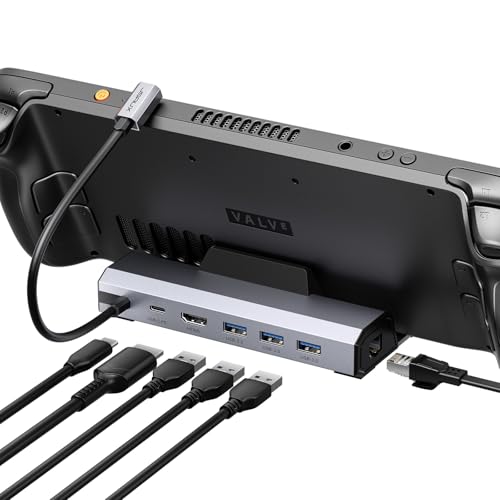
Yes — the Steam Deck's USB-C port supports DisplayPort alt-mode output at up to 8K @ 60 Hz or 4K @ 120 Hz, per Valve's published specifications. What it will not do is render demanding 3D games at 4K. The display pipeline and the 8-CU RDNA 2 GPU are different ceilings. Plan for 4K desktop, upscaled 1080p gameplay.
Step 0: decide what you are actually building
Before you buy a single cable, answer one question, because it picks every other component in this article: what is the docked Deck replacing?
There are three honest answers and they lead to three different shopping lists.
A desktop replacement. You want the Deck to be the machine at your desk — browser, Discord, light productivity, and games at a resolution that looks correct on a 27-inch panel. This is the configuration that most justifies a dual-mode monitor and a full dock with Ethernet, and it is also the configuration where the honest counter-argument (buy a mini-PC) is strongest.
A couch console. You want to drop the Deck into a dock under the TV and play with a pad. Here the monitor question disappears entirely, gigabit Ethernet is the highest-value dock feature because Wi-Fi under a TV cabinet is usually the worst Wi-Fi in the house, and you should spend nothing on a display.
A portable dev box or media machine. Docked for keyboard-and-monitor work, undocked for travel. This configuration cares about USB-A port count and pass-through wattage far more than about HDMI refresh rate.
Most people building a "4K desk setup" are in the first bucket and think they need a 4K-first monitor. The rest of this piece argues they mostly need a dual-mode one, because the Deck's rendering budget and the panel's native resolution are pulling in opposite directions, and one of those is negotiable.
Key takeaways
- The output ceiling is 8K @ 60 Hz or 4K @ 120 Hz over DisplayPort alt-mode, per Valve's specs for both the LCD Deck and the OLED Deck. That is the display pipeline, not the render budget.
- The render budget is 8 RDNA 2 compute units at 1.6 GHz, about 1.6 TFLOPS FP32, per the same specifications, paired with a Zen 2 4-core/8-thread CPU at 2.4–3.5 GHz. That is a 720p-to-1080p class GPU regardless of what the output port supports.
- Pass-through wattage is the single most consequential number on a dock's box. The Deck ships with a 45 W PD3.0 USB-C supply; the JSAUX 6-in-1 at $35.99 advertises 100 W PD pass-through and HDMI 2.1 at 4K @ 120 Hz, well above what the Deck itself draws.
- A dual-mode panel beats a fixed 4K panel for this machine. The KOORUI 27-inch G2741L at $349.99 switches between 4K UHD at 160 Hz and FHD at 320 Hz, which maps exactly onto "desktop at native, games at upscaled 1080p."
- Battery capacity differs by model: 40 Wh on the LCD Deck, 50 Wh on the OLED, which also moves to a 6 nm APU, a 7.4-inch 90 Hz HDR OLED panel, Wi-Fi 6E and Bluetooth 5.3.
- Valve's own dock is $79.00, per the Steam Deck site — and Tom's Hardware's review of it is titled "Nice, But Far From Required", which is a fair summary of the whole category.
What resolution and refresh can the Deck actually output?
The Deck's USB-C port carries DisplayPort alt-mode alongside USB 3.2 Gen 2 data, per Valve. In practice that means the port lends some of its high-speed lanes to video and keeps the rest for data, which is why a dock can simultaneously drive a display, three USB peripherals and gigabit Ethernet without any of them starving.
The published ceiling is 8K @ 60 Hz or 4K @ 120 Hz. Both Deck generations quote the same figure — the OLED specifications list the same "Display port over Type C; up to 8K @60Hz or 4K @120Hz" language as the LCD model — so the newer Deck does not change your monitor math.
Three things to understand about that number:
It is a pipeline ceiling, not a performance promise. The display controller can scan out a 4K @ 120 Hz signal. The GPU deciding what to put in those frames is 8 RDNA 2 CUs at 1.6 GHz, rated at 1.6 TFLOPS FP32. For desktop, video playback, emulation of anything older than the PS3 era, and 2D or lightly-3D indie titles, native 4K is entirely achievable. For a modern AAA title, it is not, and no dock changes that.
Your real workflow is mixed-resolution. SteamOS desktop at 4K, a browser at 4K, and games at an internal render resolution of 1080p or lower with FSR upscaling to fill the panel. This is not a compromise you should feel bad about — it is how every handheld-class APU is meant to be used, and FSR's whole reason to exist is decoupling render resolution from output resolution.
Cable and dock quality is a real failure mode. The lanes carrying DisplayPort alt-mode are the same physical lanes carrying USB 3.x data. A cheap USB 2.0-era cable in the chain will negotiate down and you will get 4K @ 30 Hz, or no signal, or intermittent dropouts — and the symptom looks like a broken dock rather than a broken cable. Use the cable the dock ships with.
Which dock features matter, and which are marketing
Dock marketing is mostly port counts. Port counts are the least interesting thing about a dock. Four specs actually decide whether it is good:
1. Pass-through charging wattage. This determines whether your Deck charges, holds steady, or slowly drains while you play. The Deck ships with a 45 W PD3.0 Type-C supply, which sets the reference point. The JSAUX 6-in-1 Docking Station advertises up to 100 W PD pass-through — comfortably above the Deck's draw, with headroom for peripherals hanging off the USB-A ports. It carries 4.3 stars across 4,196 ratings in our catalog at $35.99 as of August 2026.
2. Whether Ethernet is genuinely gigabit. Some budget hubs hang a 100 Mbit or USB 2.0-limited NIC off the hub controller and still print "Ethernet" on the box. The JSAUX unit specifies gigabit. For a couch-console build this is the highest-value feature on the entire dock, because it removes the single largest source of multiplayer jitter in a living room.
3. HDMI version and what it actually supports. The JSAUX dock specifies HDMI 2.1 at 4K @ 120 Hz — its own listing notes this is an upgrade over the previous 4K @ 60 Hz revision. An HDMI 2.0 dock caps you at 4K @ 60 Hz, which is fine for a machine that will not render 4K anyway, but limits you if you later attach the dock to a more capable handheld. The same JSAUX unit lists ROG Ally X and Legion Go S support, so that is a real consideration.
4. USB-A port count and speed. Three USB 3.0 ports on the JSAUX is the practical minimum for a desk: keyboard, mouse and one free slot for a drive or headset dongle.
What does not matter: RGB, aluminium versus plastic, and "designed for Steam Deck" branding. The angled USB-C connector and stand geometry matter more than the material.
The official-dock question. Valve's own Steam Deck Docking Station is $79.00, and its advantage is firmware-update guarantees and first-party support rather than specs. Tom's Hardware reviewed it under the headline "Nice, But Far From Required", which is the honest read: third-party docks work, and the money saved is better spent on storage.
Spec-delta: what to check on each component
| Component | Spec that matters | Why it matters docked | Catalog price (Aug 2026) | Verdict |
|---|---|---|---|---|
| Dock | PD pass-through wattage | Decides charge-vs-drain under sustained load | $35.99 | JSAUX 6-in-1, 100 W PD, gigabit, HDMI 2.1 |
| Monitor | Dual-mode resolution switching | Native desktop plus high-refresh upscaled gameplay | $349.99 | KOORUI 27" G2741L, 4K 160 Hz / FHD 320 Hz |
| Storage | Sustained sequential throughput | Bulk library that loads faster than microSD | $129.99 | Kingston A400 960 GB, 500/450 MB/s rated |
| Controller (gyro) | Gyro + haptics parity with Deck inputs | Preserves the aiming method you learned handheld | $74.00 | DualSense, 3.5 mm jack, USB-C or BT |
| Controller (wired) | Zero pairing, Hall-effect sticks | No batteries, no drift, instant wake | $44.99 | GameSir G7 SE, Hall sticks and triggers |
Is a 27-inch 4K panel the right monitor for a Deck?
A fixed 4K 60 Hz panel is the obvious buy and the wrong one, because it optimises for the resolution the Deck can output rather than the framerate it can render.
Consider what actually happens on a 27-inch 4K display fed by an 8-CU APU. Desktop and browser look excellent — 4K at 27 inches is roughly 163 PPI, sharp enough that text scaling becomes optional. Then you launch a game, drop the internal render resolution to 1080p, enable FSR, and the panel upscales a 1080p image to 4K. Because 1080p is an exact quarter of 4K, integer scaling maps every source pixel to a clean 2×2 block, which is the best case for upscaling and looks noticeably better than the non-integer mess you get scaling 1080p to 1440p.
Now consider the same situation on a dual-mode panel. The KOORUI 27-inch G2741L at $349.99 switches between 4K UHD at 160 Hz and FHD at 320 Hz, on a fast IPS panel with 1 ms response, FreeSync Premium and G-SYNC compatibility, HDMI 2.1 and DisplayPort 1.4, HDR400, and 95% DCI-P3 coverage, with height, pivot and tilt adjustment. It holds 4.4 stars across 12,616 ratings in our catalog.
The reason this suits a Deck better than a fixed 4K panel is the mode switch itself. In 4K mode you get a native desktop. In FHD mode the panel is running at its own native 1080p signal, so there is no scaling stage at all — you are feeding it exactly what the Deck renders. That removes a processing step, removes the scaling artefacts, and gives you variable-refresh headroom far above anything the Deck will produce, which means FreeSync has room to work across the Deck's entire realistic framerate range without ever hitting the panel's ceiling.
Adaptive sync is the underrated feature here. A docked Deck rendering a modern title will produce an uneven 40–70 fps. On a fixed-refresh panel that is visible judder. With FreeSync Premium active the panel matches the Deck's output frame for frame, which does more for perceived smoothness than any resolution decision on this page.
If you want the direct panel comparison rather than the Deck-specific case, our KOORUI 27" 4K vs Samsung Odyssey breakdown covers the two head to head.
Where does your Steam library live once you're docked?
Undocked, storage is a compromise you accept. Docked — where you are playing longer sessions and switching titles more freely — it becomes the constraint you notice most.
There are three tiers and they are not interchangeable.
Internal NVMe. The OLED Deck ships with 512 GB or 1 TB NVMe; the LCD models came in 64 GB, 256 GB and 512 GB, with the 64 GB base model using slower eMMC rather than NVMe. This is the fastest tier and where your two or three active titles belong.
microSD. Both generations include a high-speed microSD slot supporting SD, SDXC and SDHC over UHS-I. Convenient, cheap per gigabyte, and the slowest of the three. Fine for emulation, indies and anything that loads its assets once at startup. Painful for open-world titles that stream assets continuously.
External USB-attached SSD. This is the tier most docked users under-use. A Kingston A400 960 GB in a USB enclosure is rated at up to 500 MB/s sequential read and 450 MB/s write, saturating the SATA III interface — and the Deck's USB 3.2 Gen 2 port has bandwidth to spare for it. It holds 4.8 stars across 205,349 ratings, the highest-rated component in this entire build.
That is a substantial step up from UHS-I microSD for bulk library duty, and a clear step down from internal NVMe on random-read-heavy load times. The sensible allocation:
- Internal NVMe: the two or three games you are actively playing.
- External SATA SSD: the back catalogue — everything you might play this month.
- microSD: emulation ROMs, indies, and anything under a few gigabytes.
The one real drawback is that the external drive is a docked-only resource. Undock the Deck and those games are gone until you plug back in, so keep the internal slot for anything you play on the move. If you want the full argument with the interface numbers laid out, our NVMe vs SATA SSD comparison for Steam libraries covers it, and the A400 vs BX500 head-to-head covers this specific drive against its closest rival.
Do you still use the built-in controls when docked?
No, and this is the component people forget to budget for.
Docked, the Deck sits in a stand across the desk or under the TV. Its sticks, trackpads, gyro and back buttons are physically out of reach. Unless you are playing exclusively with keyboard and mouse — which the dock's USB-A ports support fine — you need a pad. The decision is which trade you want.
PlayStation DualSense — $74.00, gyro parity. The reason to choose this over a cheaper pad is specific: it has a gyroscope, and the Deck's own gyro is a control method many players learn and then cannot give up. If you have been gyro-aiming handheld — our Steam Deck FPS gyro guide covers why it beats stick aim for precision — a DualSense is the only mainstream pad that keeps that muscle memory intact. It also brings haptic feedback, adaptive triggers, a 3.5 mm headset jack, and connects over USB-C or Bluetooth. It holds 4.7 stars across 11,205 ratings. Steam Input supports it natively; no configuration required.
GameSir G7 SE — $44.99, reliability over features. No gyro. In exchange: Hall-effect joysticks and Hall-effect triggers, the magnetic sensor design that sidesteps the potentiometer wear behind stick drift on conventional pads. It is wired over a removable USB cable — no pairing step, no battery to manage, no controller that has gone flat when you sit down. Two rear back buttons, a 3.5 mm audio jack, and 4.4 stars across 14,044 ratings. For a docked-only pad that lives permanently plugged into the dock's USB-A port, the wired trade is close to free, and Hall sticks mean it will outlast the drift-prone alternatives.
The honest recommendation: if you gyro-aim, DualSense. If you do not, the G7 SE at $44.99 is the better value and the more durable device. If you are building a couch setup where multiple people play, buy the G7 SE first and add a second pad later — our controller guide for PC and retro emulation covers the multi-pad case.
Complete docked-setup budgets
Three tiers, using catalog prices as of August 2026. Deck itself not included.
| Tier | Components | Total | Cost per added capability |
|---|---|---|---|
| Couch console | JSAUX dock $35.99 + GameSir G7 SE $44.99 | $80.98 | ~$40 per capability (big screen, pad) |
| Desk starter | JSAUX dock $35.99 + G7 SE $44.99 + Kingston A400 960 GB $129.99 | $210.97 | ~$70 per capability (adds bulk library) |
| Full 4K desk | JSAUX dock $35.99 + KOORUI 27" 4K $349.99 + A400 960 GB $129.99 + DualSense $74.00 | $589.97 | ~$147 per capability (adds native-res display, gyro parity) |
The interesting row is the middle one. At $210.97 you have a machine that plays your whole library on a TV with a pad and gigabit Ethernet, and the only thing you have not bought is a monitor — which most people building this already own. Jumping to the full tier nearly triples the spend for one component, and that component is exactly where the mini-PC argument below becomes hard to dismiss.
When docking is the wrong answer
A docked Steam Deck is not a mid-range desktop, and it is important to say why in specifics rather than vibes.
The wattage ceiling. The Deck is designed around a 45 W PD3.0 supply for the entire system — APU, display, radios and charging. A desktop GPU alone routinely draws several times that. Docking does not raise the ceiling; the APU's power budget is the same on the desk as it is on a train.
The thermal ceiling. A handheld cooler sized for a 7-inch chassis is what dissipates that budget. There is no dock on the market that adds cooling capacity, and sustained docked sessions are the hardest thermal case the machine faces.
The honest mini-PC comparison. The full-tier build above lands at $589.97 without the Deck. Add the Deck's own cost and the total sits in territory where a small-form-factor mini-PC — no battery to degrade, no thermal ceiling sized for a handheld, higher sustained clocks, and user-upgradeable RAM and storage — is straightforwardly the better desk machine. Tom's Hardware reached a version of this conclusion about the official dock itself in "Nice, But Far From Required".
The docked Deck earns its keep on one axis: it is the same machine undocked. Your saves, your library, your settings, your session, carried to the couch or a plane without syncing anything. If portability is genuinely part of your use case, that is worth real money. If you never actually undock it, you have bought an expensive, thermally-limited desktop.
Common pitfalls
- Buying a fixed 4K 60 Hz panel. It optimises for the output ceiling instead of the render budget, and gives you no variable-refresh headroom in the 40–70 fps range where the Deck actually lives.
- Using a random USB-C cable between dock and Deck. DisplayPort alt-mode shares lanes with USB 3.x data. A USB 2.0-class cable negotiates down and produces 4K @ 30 Hz, dropouts, or nothing — and the symptom looks like a dead dock.
- Ignoring pass-through wattage. A dock that passes less than the Deck draws under load will drain the battery during a docked session, which is the most confusing possible failure because the charge light is on the whole time.
- Putting the whole library on microSD. UHS-I is the slowest tier by a wide margin. Bulk library belongs on a USB-attached SSD; microSD is for emulation and indies.
- Forgetting that external storage disappears when you undock. Anything you want to play on the move must live on internal NVMe or microSD. Plan the split before you install 400 GB in the wrong place.
- Assuming the dock's HDMI refresh rate is the Deck's. A dock advertising HDMI 2.1 4K @ 120 Hz means the dock can carry that signal. What reaches it is still limited by the Deck's published output ceiling and, far earlier, by the GPU.
What you'll need before you order
- A USB-C dock with PD pass-through above 45 W — the Deck's own supply is 45 W, so treat that as the floor, not the target.
- The Deck's original 45 W PD3.0 charger (or better) plugged into the dock's power input. Docks do not generate power.
- A high-quality USB-C cable rated for USB 3.x between dock and Deck. Use the one in the box.
- A monitor with HDMI 2.0 or newer — check whether your panel's advertised high-refresh mode is on HDMI or DisplayPort only, because many are DisplayPort-only.
- A pad, unless you are committing to keyboard and mouse through the dock's USB-A ports.
- An enclosure for your external SSD if you are going the A400 route — the drive is a bare 2.5-inch SATA unit and needs a USB-to-SATA bridge.
- A plan for which games live where — internal NVMe for active titles, external SSD for the back catalogue, microSD for emulation.
Verdict matrix
Build the docked setup if… you genuinely undock the Deck at least weekly, you already own a monitor, and you want one library and one save state across both contexts. The dock-plus-pad-plus-storage tier at $210.97 is the sweet spot and it is a strong buy.
Buy a mini-PC instead if… the desk is where 90% of your play happens. The thermal and 45 W power ceilings are structural, not tunable, and at full-tier spend a mini-PC wins on sustained performance, upgradeability and longevity.
Stay handheld-only if… you play mostly indies, emulation and Steam's verified back catalogue at the Deck's native 1280 × 800. That resolution on a 7-inch panel is already sharp, and $200–600 of docking gear buys you a bigger picture rather than a better game.
Bottom line
For a docked 4K desk, the stack is the JSAUX 6-in-1 dock at $35.99 for 100 W pass-through, gigabit Ethernet and HDMI 2.1; the KOORUI 27-inch G2741L at $349.99 because dual-mode 4K/FHD matches how this machine actually renders; a Kingston A400 960 GB in an enclosure for the back catalogue; and a DualSense at $74.00 if you gyro-aim or a GameSir G7 SE at $44.99 if you do not. Set your expectation correctly before you buy: 4K desktop, upscaled 1080p gameplay, and a machine that is still the same machine when you pick it up and walk away with it.
Related guides
- NVMe vs SATA SSD for a Steam library in 2026 — the interface argument behind the storage tiering above
- How to play FPS games on the Steam Deck: gyro tips — why gyro parity is worth $30 more on a controller
- KOORUI 27" 4K vs Samsung Odyssey 4K 27-inch in 2026 — the two panels head to head
- Best controller for PC and retro emulation in 2026 — the multi-pad and emulation case
- Kingston A400 vs Crucial BX500 for SSD upgrades — the A400 against its closest budget rival
Citations and sources
- Valve — Steam Deck technical specifications (LCD) — APU, GPU CU count and TFLOPS, USB-C DisplayPort alt-mode output ceiling, storage tiers, 40 Wh battery, 45 W PD3.0 supply (accessed 2026-08-26)
- Valve — Steam Deck OLED technical specifications — 6 nm APU, 7.4-inch 90 Hz HDR OLED panel, 512 GB/1 TB NVMe options, 50 Wh battery, Wi-Fi 6E, Bluetooth 5.3 (accessed 2026-08-26)
- Valve — Steam Deck Docking Station — first-party dock pricing and positioning (accessed 2026-08-26)
- Tom's Hardware — Steam Deck Docking Station review: "Nice, But Far From Required" — third-party assessment of the official dock's value relative to alternatives (accessed 2026-08-26)
- JSAUX — Steam Deck docking station product line — manufacturer listings for the 6-in-1 dock family (accessed 2026-08-26)
- AMD — Ryzen processors for Steam Deck — first-party APU documentation (accessed 2026-08-26)
This piece is editorial synthesis based on publicly available information. No independent first-party benchmarking is reported. Prices, rating counts and product specifications are drawn from the SpecPicks catalog and manufacturer listings as of August 2026 and may vary.