Cheap monitors ship with HDMI ports, and pricier ones add DisplayPort (DP) as a bonus rather than a given. That's not an accident of history — it's a deliberate cost decision that starts at the connector and ripples through the entire bill of materials. Here's the synthesis of what's actually driving that choice, and when it's worth paying more for a DP-equipped display.
Why HDMI Dominates Budget Monitor Designs
HDMI has been the default video connector on consumer electronics — TVs, consoles, laptops, budget monitors — for so long that manufacturers have optimized their supply chains almost entirely around it. That matters more than it sounds: a connector that's already tooled, certified, and stocked at scale is cheaper to integrate than one requiring separate procurement and testing lines.
DisplayPort, maintained as a royalty-free open standard by VESA (displayport.org), doesn't carry the same per-unit licensing fee that HDMI's administrators charge under the HDMI specification (hdmi.org). But the licensing model isn't the whole story — DisplayPort's connector and PCB routing requirements are also more demanding, since the standard supports higher bandwidth ceilings and more complex features like multi-stream transport for daisy-chained monitors. For a monitor that's competing on shelf price rather than feature count, that extra design complexity is money the manufacturer doesn't want to spend.
There's also a compatibility argument: nearly every consumer device with a video output — game consoles, streaming boxes, laptops, cable boxes — has an HDMI port. A budget monitor buyer is far more likely to plug in a console or an older laptop than to need DisplayPort's higher-end multi-monitor features. Stocking one HDMI port instead of one HDMI plus one DP port is the connector combination that serves the widest audience for the least added cost.
Is HDMI Worse Than DisplayPort for 1080p Gaming?
At the resolutions and refresh rates budget monitors actually target, the practical difference is smaller than the marketing copy implies. HDMI 2.0's bandwidth is sufficient for 1080p and 1440p at up to 144Hz, which covers the vast majority of budget and mid-range gaming monitors on the market today. DisplayPort's higher-bandwidth revisions unlock higher refresh rates and resolutions, but a monitor has to actually support those higher specs for the extra DP bandwidth to matter — pairing a 144Hz 1080p panel with a DisplayPort 1.4 port doesn't make the picture better, because the panel itself is the limiting factor, not the cable.
Where DisplayPort pulls ahead on gaming-relevant features is Adaptive-Sync / VRR support, multi-monitor daisy-chaining, and headroom for future higher-refresh panels. If none of those apply to your build, an HDMI-only monitor isn't leaving performance on the table.
| Feature | HDMI 2.0 | DisplayPort 1.4 |
|---|---|---|
| 1080p @144Hz | Supported | Supported |
| 1440p @144Hz | Supported (bandwidth permitting) | Supported |
| 4K @60Hz | Supported | Supported |
| Higher refresh / higher-res ceilings | Requires HDMI 2.1 | Native with DSC |
| Multi-monitor daisy-chain (MST) | Not supported | Supported |
| Typical presence on budget monitors | Standard | Optional / premium tier |
Ceilings reflect the published HDMI and DisplayPort specifications per hdmi.org and displayport.org; actual performance depends on the specific monitor panel and GPU port.
Why DisplayPort Isn't Cost-Effective for Entry-Level Displays
Manufacturers building a monitor to hit a specific retail price point make a series of small cuts, and connector selection is one of the easiest ones to make without touching the parts a buyer notices first — panel type, resolution, and brightness. Adding a DisplayPort connector means additional PCB routing, a second connector housing, and separate compliance testing on top of whatever's already required for HDMI. None of that shows up as a headline spec, so it's a low-visibility place to trim cost.
There's also a demand-side argument: the buyer shopping for the cheapest monitor on the shelf is disproportionately unlikely to need DisplayPort's advanced features — high-refresh esports-tier gaming, multi-monitor daisy-chains, or professional color workflows. Those buyers self-select into higher price tiers where DP is standard. Retailers and manufacturers price-segment accordingly: HDMI-only at the entry level, DP added as one of the first features that shows up once the price climbs.
This is the same logic that shapes a lot of budget PC peripherals — see how cheap 80s-era keyboards get modernized with just enough new hardware to hit a price point, or how entry-level Raspberry Pi alternatives ship with the minimum viable I/O rather than every connector imaginable.
How to Maximize Performance With an HDMI-Only Budget Monitor
If your monitor is HDMI-only, the practical steps to avoid leaving performance on the table are about cable quality and GPU pairing, not the port itself:
- Use an HDMI 2.0-rated cable, not a legacy HDMI 1.4 cable. HDMI 1.4 caps out around 60Hz at 1080p, which will bottleneck a 144Hz-capable monitor regardless of what the GPU can push.
- Confirm your GPU's HDMI output bandwidth. Budget and mid-range GPUs generally support HDMI 2.0's full 1080p/1440p high-refresh range — check the specific card's port specs on a database like TechPowerUp's GPU specs pages before assuming a bottleneck.
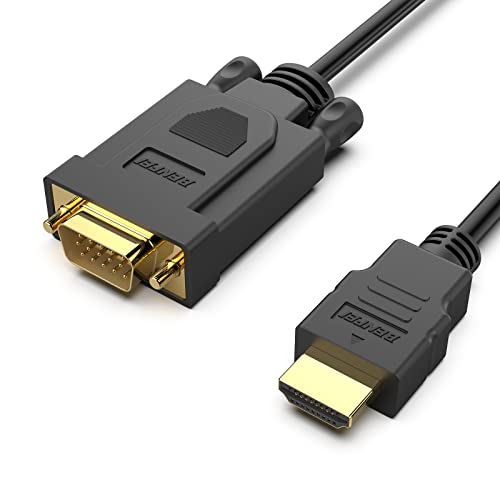
- Don't chain adapters unnecessarily. If you're connecting a modern GPU's HDMI output to an older DVI or VGA display, use a purpose-built adapter cable rather than a generic converter — signal type conversion (digital-to-digital for DVI, digital-to-analog for VGA) needs to happen correctly at the adapter, not be assumed.
| Product | Price | Use case |
|---|---|---|
| Amazon Basics HDMI to DVI Adapter Cable | $6.03 | Bridge an HDMI GPU output to a DVI-only monitor at 1080p |
| Amazon Basics HDMI to DVI Adapter Cable (alt) | $7.19 | Same use case, alternate cable length/finish |
| BENFEI HDMI to VGA 6ft Cable | $7.95 | Drive a legacy VGA-only display, common on CRT and retro setups |
| BENFEI HDMI to VGA 15ft Cable | $13.99 | Same conversion, longer run for desk setups further from the PC |
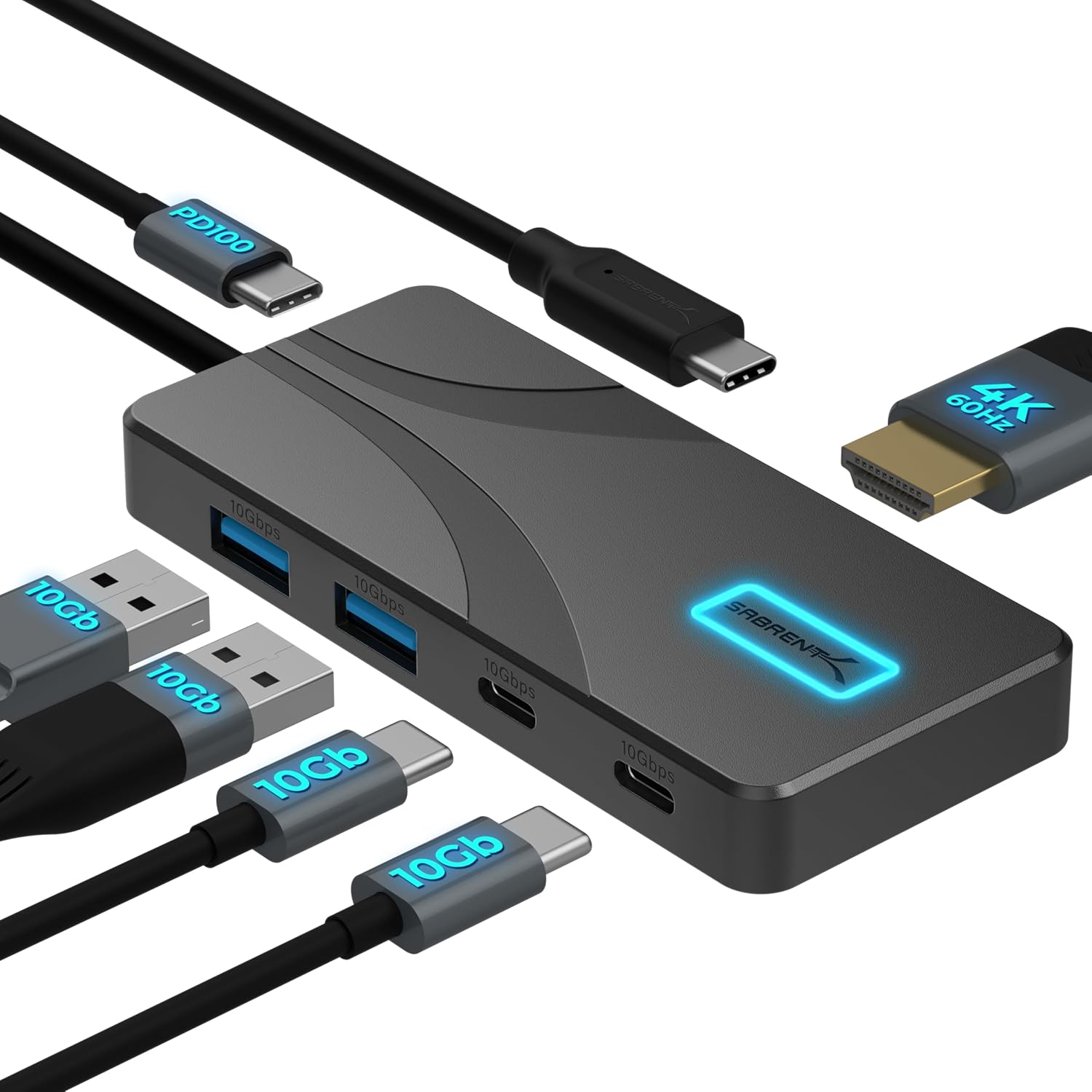
| SABRENT USB-C to 4K@60Hz HDMI Hub | $12.95 | Add an HDMI output to a laptop that only has USB-C |
| SABRENT 5-in-1 USB-C Hub, 4K@60Hz HDMI | $24.95 | Same, plus extra USB-A/USB-C passthrough ports |
| SABRENT 6-Port Hub & M.2 SSD Dock, 4K HDMI | $59.99 | Desk hub combining HDMI output with local SSD storage |
These adapters and hubs are a cheap way to extend the useful life of a budget HDMI-only monitor rather than replacing it outright — a pattern that shows up across budget local-compute builds as well, where reusing existing hardware instead of buying new is the actual cost-per-task lever.
Future-Proofing: When to Pay for DisplayPort in a Budget Build
DisplayPort earns its premium in a few specific scenarios:
- Variable refresh rate (VRR) gaming. If tearing and stutter matter to you, a DP connection with Adaptive-Sync support is the more mature path, particularly at higher refresh rates.
- Multi-monitor setups via daisy-chaining. DP's multi-stream transport lets one port drive multiple displays in sequence — HDMI doesn't support this natively.
- Headroom for a future higher-refresh or higher-resolution panel. If you plan to keep the same GPU but upgrade the monitor later, a DP-equipped GPU output paired with a DP-capable monitor avoids a bandwidth ceiling down the line.
- AI/compute-adjacent multi-display workstations. Builders driving several monitors off one GPU for productivity or local inference dashboards benefit from DP's higher per-port throughput and daisy-chain support more than a single-monitor gaming setup would.
For a single 1080p or 1440p monitor at 60-144Hz off a budget-tier GPU, none of that headroom is likely to matter in practice — the money is generally better spent on the GPU or panel itself, which is the same reasoning that shows up in cost-per-task comparisons for local rigs versus cloud API pricing and in coverage of why a local fallback rig just got cheaper relative to metered cloud services — spend where the bottleneck actually is, not where the spec sheet looks longest.
Citations and sources
- https://www.hdmi.org/
- https://www.displayport.org/
- https://www.techpowerup.com/gpu-specs/
- https://www.rtings.com/monitor
This piece is editorial synthesis based on publicly available information. No independent first-party benchmarking is reported.