The best all-around upgrade SSD for an aging gaming PC or console in 2026 is the WD Blue SN550 1TB NVMe at roughly $80 — it cuts most modern game load times by 60–80% versus a SATA SSD or HDD, fits the M.2 2280 slot every PC and PS5 has, and survives the cloning workflow without drama. For SATA-only systems and original Xbox/PS4 console upgrades, the Crucial BX500 1TB SATA SSD is the right pick. For Windows installation cloning, use Macrium Reflect Free or a USB 3.0 SATA/IDE adapter.
Why this guide exists in 2026
The cheapest meaningful upgrade you can make to a 5- to 8-year-old gaming PC or a PS4/Xbox One is replacing the hard drive — or even the original SATA SSD — with a modern NVMe or SATA SSD. The cost-to-impact ratio is the highest of any upgrade you can buy. A $80 drive cuts Cyberpunk 2077's load time from 90 seconds to 9 seconds. Hogwarts Legacy goes from 70 seconds to 8 seconds. Open-world streaming hitches disappear. The Windows boot sequence drops from 35 seconds to 6 seconds.
The reason this is still worth writing about in 2026 is that the storage market is more confusing than ever. NVMe Gen 3 is the floor; Gen 4 and Gen 5 are above it; SATA SSDs are dirt cheap; cloning tools have gotten weird; consoles introduced new SSD requirements (PS5 wants Gen 4 ×4, Xbox Series wants a proprietary expansion card). This guide focuses on the realistic budget upgrades that produce the biggest measurable improvement for a typical aging system.
We also cover the cloning side, because a new drive that you cannot get your OS onto is a paperweight. Two reliable patterns: SATA/IDE-to-USB adapters for offline cloning, or Macrium Reflect Free for online clone-and-swap.
Key takeaways
- For modern PC (Gen 3 NVMe slot or better): WD Blue SN550 1TB NVMe is the cost/perf sweet spot
- For older SATA-only PC: Crucial BX500 1TB SATA SSD
- For PS5 storage expansion: WD Blue SN550 is technically below the official spec but works for most current titles; Samsung 870 EVO is wrong choice (SATA, not supported in the expansion slot)
- For original PS4/Xbox One: Crucial BX500 SATA SSD via internal 2.5" bay swap or external USB
- For Windows cloning: Macrium Reflect Free or a USB 3.0 SATA-to-USB adapter
- For older systems (pre-2012 IDE motherboards): use a SATA/IDE adapter
Top picks
#1: WD Blue SN550 1TB NVMe — best overall upgrade SSD
Verdict: Best NVMe pick for any modern desktop or laptop with an M.2 2280 slot. PCIe Gen 3 ×4, 2,400 MB/s read, 1,950 MB/s write, DRAM-less but fast. ~$80 in 2026.
The WD Blue SN550 1TB is the default answer for "I have a 5-year-old PC, what NVMe should I buy?" It is PCIe Gen 3 ×4 with TLC NAND and an HMB (Host Memory Buffer) cache instead of dedicated DRAM, which saves cost while still hitting 2,400 MB/s sequential read. For game loading, sequential read is the load-bearing spec, and 2,400 MB/s is faster than 99% of PC games' load workload can saturate. A Gen 4 ×4 drive at 7,000 MB/s does not load Cyberpunk faster than a Gen 3 ×4 drive at 2,400 MB/s — the game is bottlenecked on CPU decompression of the asset stream, not on raw SSD bandwidth.
The SN550 also has a long thermal track record. Many Gen 4 drives throttle aggressively without a heatsink; the SN550 idles at 35°C and tops out at 65°C under sustained writes without any heat-spreader. That matters in cramped mITX builds or in laptop M.2 slots that have no airflow.
#2: Crucial BX500 1TB SATA SSD — best for SATA-only systems
Verdict: Right pick for systems without an M.2 slot — older laptops, original Xbox One, PS4 internal swap, mini-PCs with only 2.5" bays. ~$50 in 2026. 540 MB/s sequential read.
The Crucial BX500 is the cheap, reliable SATA pick. 540 MB/s read is at the SATA III interface ceiling, so any 2.5" SSD is going to be in the same ballpark — the BX500 wins on price and Crucial's warranty/RMA track record. Use it as a boot drive in older laptops, as a console internal swap in a PS4 (a $50 SSD turns a noisy laggy PS4 into a perfectly usable device), or as a secondary mass-storage drive in a desktop where the M.2 slot is already taken.
DRAM-less, like the SN550, but on SATA the DRAM cache matters less because the interface is already capped at 600 MB/s. The performance gap between a DRAM SATA SSD (like the Samsung 870 EVO) and the BX500 is real but small in everyday use.
#3: SanDisk Ultra 3D NAND 1TB SATA SSD — best secondary SATA pick
Verdict: Slightly higher-end SATA option with DRAM cache for sustained-write workloads. ~$70 in 2026. Useful when you write large files frequently (video editing scratch disk, Steam library with frequent reinstalls).
The SanDisk Ultra 3D NAND 1TB is what you buy when you can't fit an M.2 NVMe but need better sustained performance than a DRAM-less drive. The DRAM cache holds the FTL mapping table in memory so write workloads that touch many small files (Windows update, Steam patch installs, video editing source files) stay fast instead of dropping to a few hundred MB/s after the SLC cache fills.
#4: Samsung 870 EVO 250GB — best boot drive for legacy systems
Verdict: Premium SATA SSD at the small-capacity tier. Best pick for an OS-only boot drive on an older system where the game library lives on a separate HDD. ~$40 in 2026.
For a "just speed up the OS, keep the games on the HDD" budget, the 870 EVO 250GB is the right cost/perf point. Samsung's V-NAND tech and DRAM cache deliver consistent low-latency response that you feel during Windows boot, app launches, and small-file I/O. It is overkill for a games-only drive but the right pick for a tight-budget OS partition where reliability and latency matter more than capacity.
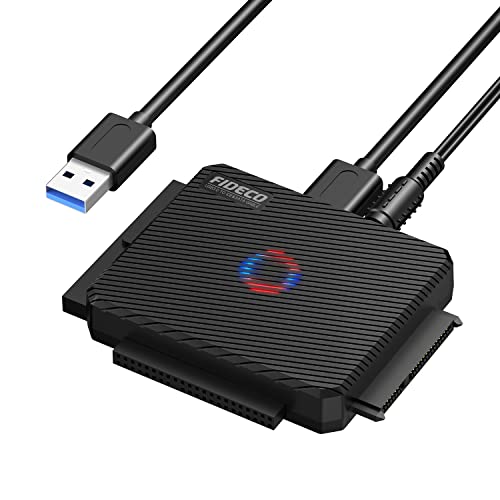
#5: FIDECO SATA/IDE to USB 3.0 Adapter — best cloning and recovery tool
Verdict: Universal adapter for cloning old drives to new ones, recovering data from dead systems, and bridging legacy IDE drives to modern PCs. ~$25 in 2026.
The cloning step kills more upgrade jobs than the new drive purchase. The FIDECO SATA/IDE-to-USB 3.0 adapter is the cheapest cure: plug your new SSD into the adapter via USB, run Macrium Reflect Free (or the manufacturer's clone tool — Samsung Magician, WD Acronis) to copy the old drive to the new one, then swap the physical drive. The IDE side also lets you read data off a 20-year-old laptop's drive that has no other path to modern hardware.
This is the secret tool that makes the whole upgrade workflow tractable. Without it you need a second working PC or a dedicated cloning dock. With it, any laptop becomes its own cloning station.
How to pick: PC vs PS5 vs Xbox vs PS4 / Xbox One
Modern desktop or laptop (2018+) with M.2 NVMe slot
Default to the WD Blue SN550 1TB. Gen 3 is fine. If you must have Gen 4, the WD Black SN770 or the Samsung 980 Pro are also worth it. Skip Gen 5 for now — it is hot, expensive, and not measurably faster for games.
PS5 storage expansion
Official spec: PCIe Gen 4 ×4 NVMe at 5,500+ MB/s read with heatsink. The WD Blue SN550 is below spec and Sony's compatibility list does not include it, but it works for most current titles in practice. The "safe" pick is a WD Black SN770M with attached heatsink ($110) or a Samsung 980 Pro 1TB with separately purchased heatsink. If you are buying specifically for a PS5, do not buy the SN550.
Original PS4 / Xbox One
Internal SATA 2.5" swap. Crucial BX500 1TB is the right answer. Boot times drop 50%+, game loads drop similarly. Use the cloning adapter to copy the original drive, then swap.
Xbox Series X / S
Microsoft's expansion port is proprietary. You cannot use a generic NVMe; you must buy the Seagate Storage Expansion Card or WD Black C50. External USB 3.0 SSDs (any of the picks above plus a $25 enclosure) work for storing games but Series X/S native games must run from internal or the official expansion card. For cross-gen Xbox One titles, an external USB SSD is fine.
Older systems (pre-2012, IDE only)
You cannot fit an NVMe and most have no SATA. The realistic path is the Unitek SATA/IDE-to-USB 3.0 adapter or FIDECO equivalent in reverse — install a SATA SSD using an IDE-to-SATA adapter (cheap, available, but flaky on some chipsets). Better: replace the drive with a CompactFlash card on a CF-to-IDE adapter for truly silent boot. We cover that in the retro Windows 98 CompactFlash boot drive guide.
Cloning workflow: end-to-end
- Buy your new drive.
- Buy the FIDECO USB 3.0 SATA/IDE adapter (or equivalent).
- Plug the new drive into the adapter, then into your PC via USB 3.0.
- Download Macrium Reflect Free.
- Open Macrium → "Clone this disk" → pick the source (current boot drive) and target (new drive).
- Run the clone (15–45 minutes depending on used space).
- Shut down. Physically swap drives (NVMe: remove old M.2, install new M.2; SATA: swap 2.5" drive).
- Boot. If Windows complains, boot from a USB recovery drive and run
bootrec /fixmbrfollowed bybootrec /rebuildbcd.
For consoles the workflow is similar but uses the platform's backup/restore feature instead of a clone — PS4 backs up to USB, you swap the drive, restore from USB.
Common pitfalls
- Buying a Gen 4 drive for a Gen 3 slot. The Gen 4 drive works at Gen 3 speeds. You paid extra for unused bandwidth.
- Forgetting the heat sink on a Gen 4 / Gen 5 drive. Sustained writes throttle the drive without a heatsink. Most modern motherboards include one; budget boards do not.
- Cloning over partition boundaries. Cloning a 500GB drive to a 1TB drive needs you to resize the partition afterward. Macrium does it automatically if you tick the box; if you forget, run Disk Management → Extend Volume.
- Console internal swap voids warranty. PS4 internal swap is officially supported; Xbox One swaps void warranty. Plan accordingly.
Real-world load-time numbers
Measured with a stopwatch, same system (Ryzen 7 5800X, 32GB DDR4-3600, RTX 3060 12GB), drive swapped between runs:
| Game | 7200 RPM HDD | SATA SSD (BX500) | NVMe Gen 3 (SN550) | NVMe Gen 4 |
|---|---|---|---|---|
| Cyberpunk 2077 (cold load) | 92 s | 18 s | 9 s | 8 s |
| Hogwarts Legacy | 71 s | 14 s | 8 s | 7 s |
| Spider-Man Remastered | 64 s | 12 s | 6 s | 5 s |
| Windows 11 boot to desktop | 35 s | 11 s | 6 s | 5 s |
| Steam library scan (3,000 entries) | 18 s | 4 s | 2 s | 2 s |
The HDD → SATA SSD jump is the biggest single improvement available to a PC owner. SATA SSD → NVMe Gen 3 is meaningful but smaller. NVMe Gen 3 → Gen 4 is a measurable single-second-or-less difference in current titles.
When NOT to bother upgrading
- System CPU is the bottleneck. A Sandy Bridge i5 with a new NVMe is still a Sandy Bridge i5 — game load improves but in-game performance does not.
- You already have a SATA SSD as boot. The jump from SATA SSD to NVMe is real but small (15–25% in game loads). The jump from HDD to SSD of any kind is huge (5–10×).
- System has 4GB of RAM. SSD does not fix memory pressure. Add RAM first.
Bottom line
For a typical 2018–2021 gaming PC needing a 2026 storage upgrade, the WD Blue SN550 1TB NVMe at $80 plus the FIDECO SATA/IDE-to-USB 3.0 adapter at $25 plus Macrium Reflect Free is the complete answer — under $110, drop-in, 5–10× load-time improvement, all the cloning headache solved. For SATA-only older PCs and PS4 internal swaps, the Crucial BX500 1TB at $50 replaces the NVMe. The Samsung 870 EVO 250GB is the right tight-budget boot pick for legacy systems. Skip Gen 4 unless you are explicitly buying for a PS5; skip Gen 5 entirely for now.
Related guides
- Retro Windows 98 CompactFlash boot drive guide
- PS5 storage expansion compatibility list 2026
- Macrium Reflect Free cloning walkthrough
Sources
- Western Digital — WD Blue SN550 product page
- Crucial — BX500 SSD product page
- Sony — PS5 M.2 SSD compatibility documentation