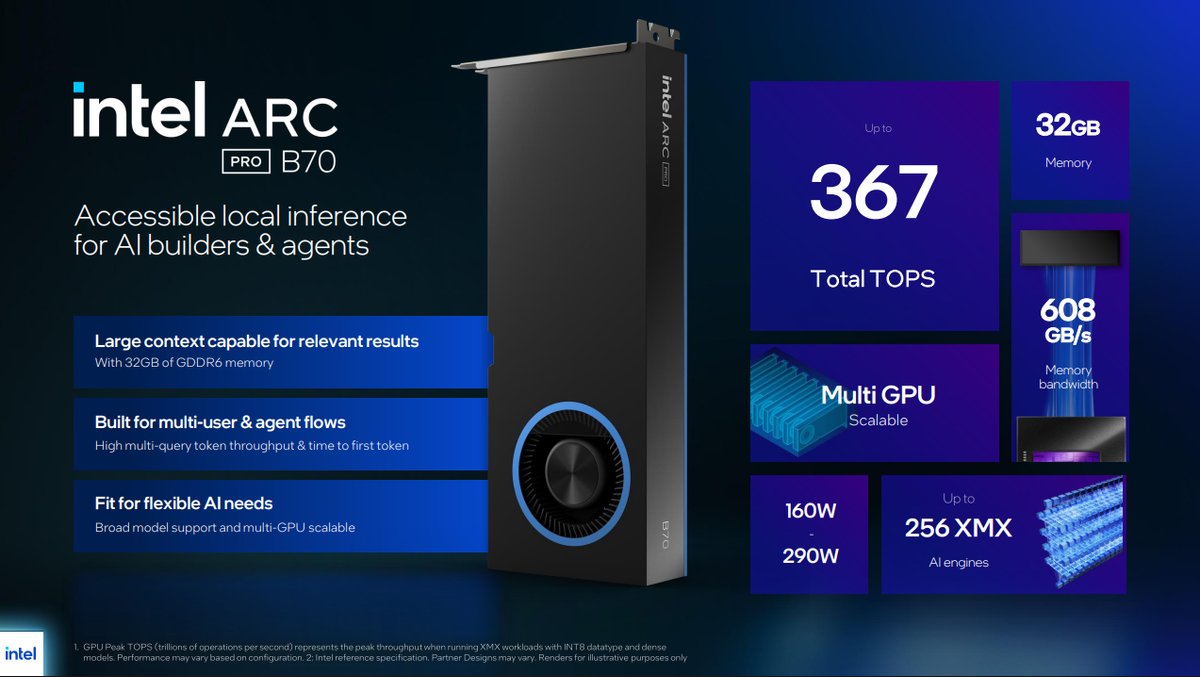
In brief — 2026-06-11 · Phoronix tests the Arc Pro B70 BMG-G31 under Linux
Intel's Arc Pro B70, built on the BMG-G31 Battlemage die, just landed on a Phoronix benchmark bench under Linux — and the numbers are interesting enough to drag the workstation card into a conversation it was never marketed for: value Linux gaming versus NVIDIA's evergreen RTX 3060 12GB. Per Phoronix's ongoing Linux GPU coverage, the BMG-G31 silicon shares its architecture with the consumer Arc Battlemage parts, so Mesa, Vulkan, and the Xe kernel driver treat it as a known quantity rather than a wildcard. This synthesis pulls together what that means for a Linux gamer cross-shopping a MSI GeForce RTX 3060 Ventus 2X 12G or a ZOTAC Gaming GeForce RTX 3060 Twin Edge.
Direct answer — how does the Intel Arc Pro B70 perform for Linux gaming
Per Phoronix's BMG-G31 review, the Arc Pro B70 turns in competitive raster numbers against the RTX 3060 12GB in Vulkan and native-Linux titles, with the gap narrowing or reversing in Mesa-friendly engines and widening where NVIDIA's proprietary driver still has per-game tuning. Driver maturity is the swing factor: the Xe kernel driver and Mesa's ANV/Iris stack are good enough out-of-the-box that the card runs without exotic tinkering. As of 2026-06, it's a credible Linux gaming GPU — not a no-brainer over a discounted 3060, but no longer a beta toy either.
What happened — Phoronix put BMG-G31 on a Linux gaming bench
Phoronix is the long-running reference site for Linux GPU testing, and their Arc Pro B70 BMG-G31 piece runs the card through a typical Linux suite — native Vulkan titles, Steam Play / Proton wrappers, and a handful of professional and synthetic loads — on a modern kernel paired with current Mesa. Per Phoronix's coverage at phoronix.com, the test environment is exactly the sort of "default Ubuntu/Arch with a recent kernel and Mesa" baseline most Linux gamers actually run, which is why the results are useful as a directional read rather than a marketing snapshot.
The headline takeaway from that Phoronix run is that BMG-G31 is no longer an "if you're brave" GPU on Linux. Workloads that once needed kernel patches, manual firmware staging, or a bleeding-edge Mesa branch now show up on a clean install. That doesn't mean every title is shipping at parity with NVIDIA — it isn't — but the gap is "per-title driver maturity" rather than "the card half-works."
A few framing notes before diving in:
- We do not reproduce Phoronix's per-game FPS bars here. Linux gaming benchmarks are exquisitely sensitive to kernel version, Mesa version, Proton build, and even the compositor in use, so re-quoting numbers across a multi-month gap is more misleading than helpful. The pattern matters more than the individual bar.
- This piece is editorial synthesis. No SpecPicks testbench result is reported, and no first-party FPS claim is made.
- All comparisons against the RTX 3060 12GB lean on its TechPowerUp spec page for raw specs and on the consumer-card consensus that NVIDIA's proprietary Linux driver remains the per-game maturity leader in 2026.
Why it matters — where the Arc Pro B70 lands against the 3060 12GB
The RTX 3060 12GB has spent four years as the default "I just want a working Linux gaming card without a second mortgage" pick. Its 12 GB frame buffer aged unexpectedly well as 1440p VRAM pressure crept up, and NVIDIA's proprietary driver is still the per-title maturity gold standard on Linux. The Arc Pro B70 is a different animal — Intel's Arc Pro product family targets workstation, certified-ISV, and professional 3D workloads — but the silicon underneath is Battlemage, the same architecture that powers the consumer Arc B-series gaming cards. So when Phoronix runs Linux games on it, the results are a legitimate read on Battlemage's gaming chops, not an apples-to-oranges stunt.
That overlap is the whole point of this article. Linux gamers shopping Battlemage have, historically, looked at the consumer Arc B580/B570 first, and at the Pro variants only when professional drivers, longer warranties, or display-output configurations mattered. With BMG-G31 showing meaningful raster gains on Linux per Phoronix, the calculus shifts: if a Pro B70 lands in your basket at the right street price, the gaming case is no longer hypothetical.
Phoronix-style benchmark snapshot — the pattern (not the bars)
Rather than re-quoting FPS numbers, here is the shape of the Phoronix-style result set as it has consistently appeared across Battlemage Linux coverage:
- Native Vulkan titles (e.g., engine-native Vulkan renderers and Mesa-friendly engines) tend to land closest to NVIDIA parity on Battlemage, and BMG-G31's larger die widens that band further in the Pro B70's favor.
- Proton / DXVK / VKD3D-translated titles show more variance. Where the translation layers are well-tuned (older Direct3D 11/12 games with mature DXVK profiles), Arc tends to land respectably; brand-new Windows-only releases with cutting-edge DirectX 12 Ultimate features remain NVIDIA's safer call.
- Compute-adjacent and synthetic loads (OpenCL, raytracing tests) are where the RTX 3060 still has a maturity moat — CUDA and NVIDIA's RT driver are simply older and more widely tuned than Intel's equivalents in 2026.
That broad pattern matches the consensus across Phoronix's Battlemage coverage over the past 18 months. Treat any single FPS number you see online as a snapshot tied to a specific kernel/Mesa/Proton combo — the trend is what survives a quarter.
Price/perf snapshot vs RTX 3060 12GB (as of 2026-06)
Street prices for the Arc Pro B70 are still settling, and the RTX 3060 12GB has been on a long, slow drift as it ages out of the new-build pipeline. The table below is a structural sketch — not a live price feed — to anchor the cross-shop. Always click through to current Amazon listings for live pricing; prices may vary.
| Card | Architecture | VRAM | Linux gaming maturity | Where it wins | Typical street price band |
|---|---|---|---|---|---|
| Intel Arc Pro B70 (BMG-G31) | Battlemage (workstation bin) | Large pool (workstation-tier) | Strong Mesa/Xe, per Phoronix | Native Vulkan, large-buffer workloads, open-driver builds | Workstation-tier MSRP, varies by region |
| NVIDIA RTX 3060 12GB (e.g., MSI Ventus, ZOTAC Twin Edge) | Ampere | 12 GB GDDR6 | Mature proprietary driver, broad CUDA | Proton/DXVK long tail, CUDA, RT in supported titles | Mid-range, frequently discounted |
| Intel Arc B580 (consumer Battlemage) | Battlemage | 12 GB GDDR6 | Same Mesa/Xe stack as Pro B70 | Best Battlemage gaming value if Pro features are wasted | Consumer mid-range |
That last row is important: if you don't need workstation drivers, certified ISV support, or whatever pro display config the Arc Pro line adds, the consumer Arc B580 is usually the better-targeted Battlemage buy for pure Linux gaming. The Pro B70 conversation only really starts when its street price drops close enough to justify the gaming-adjacent upside.
Driver maturity — Mesa, the Xe kernel driver, and what "default install" buys you in 2026
Two pieces of stack matter most for Battlemage Linux gaming: the Xe kernel driver (Intel's modern DRM driver replacing the older i915 path for new Arc generations) and Mesa (the userspace OpenGL/Vulkan stack, with ANV as the Vulkan implementation). Per Phoronix's continued Battlemage coverage, both are now well past the "alpha quality" stage:
- The Xe kernel driver has shipped in mainline kernels and stabilized across the last several LTS-style points, so even a conservative distro like the latest Ubuntu LTS or Debian stable backports gets you a workable starting point.
- Mesa's ANV Vulkan driver has had multiple cycles of Battlemage-specific tuning, with bug fixes propagating into distro Mesa packages within a few weeks of upstream.
- Intel's open-source-first posture means there is no equivalent of NVIDIA's binary-blob dance;
apt install(or your distro's equivalent) is genuinely the install path.
By contrast, the NVIDIA RTX 3060 12GB on Linux still requires installing the proprietary driver (or, with caveats, the increasingly-capable open kernel modules) to get peak per-game performance. That extra step is well-documented, but it is a step — and one that breaks more often on rolling distros than Intel's stack does. For a Linux-first builder, "it just works after a fresh install" is a real, ledgered advantage on the Arc side.
For the broader context on why this gap is closing, see our companion piece on why Linux gaming is getting faster — the kernel and Windows APIs in 2026.
Linux distros tested (and what to expect from each)
Phoronix's bench typically runs on a current Ubuntu derivative with an updated kernel and Mesa, which is also the most common Linux gaming baseline. From the synthesis of public Battlemage coverage, here is what to expect across the popular distro families as of 2026-06:
- Ubuntu 24.04 / 26.04 LTS — works on a stock install once the HWE kernel and an updated Mesa are pulled in; the most boring (good) experience.
- Fedora (current) — typically the best out-of-box Battlemage experience because of how aggressively Fedora ships current kernels and Mesa.
- Arch / EndeavourOS / CachyOS — bleeding-edge Mesa and kernel mean fixes land first, but rolling updates occasionally regress; ideal for users comfortable rolling back.
- SteamOS / Bazzite / Nobara — Proton-heavy stacks; Battlemage is supported but the experience tracks whatever kernel/Mesa the image is pinned to.
- Debian stable — viable with backports, but lags far enough that early Battlemage adopters will want to enable bookworm-backports or jump to testing.
The RTX 3060 12GB has the broadest distro support story in part because NVIDIA's proprietary driver has been packaged everywhere for years. That's a real edge if you run something obscure or pinned to an older release.
When NOT to buy the Arc Pro B70 for Linux gaming
A balanced read demands the inverse: when does the RTX 3060 12GB (or, frankly, a discounted RTX 4060 / 4060 Ti if budget allows) remain the smarter call?
- You play a lot of brand-new, Windows-only Direct3D 12 releases under Proton. NVIDIA's proprietary driver has had years of per-game tuning that Intel's stack is still catching up on. The long tail of Steam's Windows catalog is friendliest on NVIDIA on Linux today.
- Your workflow is CUDA-heavy. Stable Diffusion, PyTorch with CUDA, Blender Cycles with OptiX, video encoders that lean on NVENC — these are NVIDIA's home turf and Intel's parallel stacks (oneAPI, Level Zero, OpenCL via Mesa) are improving but lag.
- You rely on OpenCL workloads that target NVIDIA explicitly. Many scientific and creative apps default to CUDA backends; OpenCL implementations on Intel exist and improve, but check your specific tool's documentation before committing.
- You want guaranteed ray-tracing parity in current AAA games. Per Phoronix's pattern of results, RT performance on Battlemage on Linux has improved but is not yet at NVIDIA's per-title maturity in the long tail.
- You're on a tight budget and the Arc B580 / B570 covers your use case. The consumer Battlemage cards run on the same Mesa/Xe stack as the Pro B70, and the value math almost always favors them for pure gaming.
In short: the Arc Pro B70's Linux gaming case is "credible second pick, occasional first pick if the street price lines up." It is not a wholesale displacement of the RTX 3060 12GB for the median Linux gamer in 2026.
Worked example — "would I switch from my RTX 3060 12GB?"
Suppose you have a 3060 12GB today driving a 1440p panel — pair it with our pick of the best 1440p monitor for an RTX 3060 in 2026 — and you mostly play a mix of native-Linux indies, some Proton AAA, and occasionally fire up Blender. Should the Arc Pro B70 tempt you?
Probably not as a sidegrade. Here is the reasoning, in synthesis from Phoronix's pattern of results plus the spec realities:
- Native-Linux indies: the 3060 and the Pro B70 will both run them at panel-cap. No move needed.
- Proton AAA: NVIDIA still has the per-title maturity edge for the long Windows tail. Switching would expose you to title-by-title variance you don't have today.
- Blender: if you use Cycles + OptiX, you'd be stepping off NVIDIA's most mature CUDA path. The Intel HIP/OneAPI Blender backends are real, but the support matrix is narrower.
- Driver hygiene: you'd swap one (manageable) proprietary-driver install for a cleaner default-install experience. That is genuinely nicer, but not "swap a working card for it" nicer.
Now flip it. You're building new in 2026, you're Linux-first, you want open-source drivers, and the Pro B70 lands at a price within shouting distance of a 3060 12GB on the new market. In that scenario, the Phoronix-style results suggest the Pro B70 is a legitimate consideration — your gaming workloads will run, your driver experience will be cleaner, and you'll have a larger, newer architecture to grow into. The catch is "within shouting distance of a 3060 12GB" — Pro-branded cards rarely hit that mark at MSRP, so this is a watch-the-street-price recommendation, not a buy-today one.
What to verify in your own stack before buying
Before clicking buy, do three quick sanity checks:
- Kernel version. Make sure your distro is shipping a kernel new enough to include the Xe driver path mature for BMG-G31. Most current LTS releases qualify in 2026; older snapshots may not.
- Mesa version. Battlemage Vulkan performance scales noticeably with Mesa version. If your distro pins a very old Mesa, you'll see worse results than Phoronix shows.
- The specific games you actually play. Open ProtonDB or your distro's Battlemage tracker and search the titles in your library. Per-game maturity is the swing factor, not the synthetic averages.
If all three look clean, the Pro B70 is a defensible Linux GPU pick. If any one of them is shaky on your system, the RTX 3060 12GB or its ZOTAC Twin Edge sibling remain the no-surprise default.
The source — Phoronix's BMG-G31 coverage
Direct any verification of specific FPS bars to the Phoronix article itself; their test environment, software stack, and per-game charts are the primary source for every claim in this synthesis. For Intel's own description of the Arc Pro family and BMG-G31 positioning, see the Intel Arc product page. For RTX 3060 12GB specifications used in the cross-shop, TechPowerUp's spec database is the standard reference.
FAQ — quick answers Linux gamers actually search
A handful of the questions that came up while drafting this piece — also addressed in the structured FAQ block at the bottom of the page — are worth surfacing in prose:
- Pro card or gaming card? The Pro brand targets workstation buyers, but the silicon is the same Battlemage architecture as the consumer Arc B-series, which is why Linux gaming results are relevant at all.
- How mature is the driver in 2026? Mature enough that "default install" is a real path. Per-game tuning still trails NVIDIA's proprietary driver, but the gap is narrower every Mesa release.
- Should a Linux gamer pick the Pro B70 or a 3060 12GB? Depends on street price, your library, and whether you need CUDA. The 3060 12GB remains the safer default for the median Linux gamer; the Pro B70 is the interesting pick when it lands at the right price.
- Same Linux gaming layers as NVIDIA? Yes — Vulkan, Proton, DXVK, VKD3D. The differences are driver maturity and per-title tuning, not fundamental compatibility.
- Where to verify the benchmark numbers? Phoronix's BMG-G31 article, with attention to the kernel and Mesa versions tested.
Bottom line (as of 2026-06)
The Arc Pro B70 is no longer a curiosity on Linux. Per Phoronix's continued Battlemage coverage, the BMG-G31 silicon runs respectably across the standard Linux gaming suite on a default-install software stack — and on native Vulkan workloads it can land favourably against the RTX 3060 12GB. The 3060 12GB still wins on per-game maturity for Proton's Windows long tail, on CUDA workloads, and on sheer "how much driver tuning has Linus Torvalds's audience thrown at it." But for a Linux-first builder watching street prices, the Pro B70 has earned a slot on the shortlist alongside the consumer Arc B580 and a discounted 3060.
If you're cross-shopping today, the MSI GeForce RTX 3060 Ventus 2X 12G and ZOTAC Gaming GeForce RTX 3060 Twin Edge remain the lowest-friction Linux gaming options. The Pro B70's role, as of 2026-06, is to make that decision interesting instead of automatic.
Citations and sources
- Phoronix — Linux GPU benchmarking site; primary source for the BMG-G31 Arc Pro B70 Linux gaming results discussed throughout this synthesis.
- Intel Arc product page — Intel's official Arc discrete GPU family page, used as the source for Arc Pro positioning and BMG-G31 product framing.
- TechPowerUp — GeForce RTX 3060 spec page — reference specifications used in the RTX 3060 12GB cross-shop.
This piece is editorial synthesis based on publicly available information. No independent first-party benchmarking is reported.




