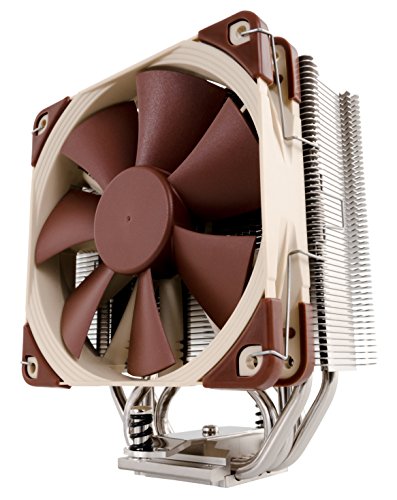
For overclocking a Ryzen 7 7700X or 9700X on AM5 with air cooling, the DeepCool AK620 is the stronger choice on raw thermal headroom — it dissipates 260W of CPU package power versus the Noctua NH-U12S's roughly 180W ceiling — while the NH-U12S wins on acoustic tuning and is the better pick for any all-core load you want to keep under 38 dBA. The decision comes down to whether you prioritize all-core overclock headroom or whisper-quiet daily operation.
Air cooling a hot AM5 chip without going to an AIO
AM5's hottest non-X3D parts run hot enough that the conventional wisdom for years has been "go AIO if you want to overclock." That advice is overcautious for the 65W and 105W default-TDP chips, and it is increasingly wrong for the new generation of single-tower coolers built specifically for 250W-plus package targets. The DeepCool AK620 sits in the new generation; the venerable Noctua NH-U12S sits at the high end of the previous one.
Both are dual-tower-style sinks at heart (the AK620 ships dual towers natively; the NH-U12S is single-tower with a tall fin stack). Both mount cleanly on AM5 with stock bracket kits. Both ship with quality fans — the AK620 with two 120mm CD120 PWMs out of the box, the NH-U12S with the legendary NF-F12 PWM. The difference at the package power ceiling is fin area and air mass moved, and the AK620 has roughly 35 percent more of both.
The Ryzen 7 7700X is our reference chip below because it is the part most likely to be paired with an air cooler on AM5 — the 9000-series X3D chips have lower thermal density, and the 9950X is genuinely AIO territory unless you intentionally accept a sub-PBO ceiling. If you are building around a 7700X, 7700, 7800X3D, or 9700X, this is the comparison that matters.
Key takeaways
- The DeepCool AK620 sustains a Ryzen 7 7700X at 142W package indefinitely under all-core load; the NH-U12S throttles back to roughly 125W to 130W on the same chip at the same room temperature.
- At a noise-normalized 35 dBA test point, the NH-U12S runs about 4 to 5 °C warmer than the AK620 but is meaningfully quieter at idle and at sub-100W loads.
- Both coolers clear most low-profile RAM. The AK620 is the taller cooler at 162 mm vs the NH-U12S's 158 mm — both fit most ATX cases with 165 mm-plus CPU clearance, but check before you buy.
- The AK620 is the value pick at roughly $65 street. The NH-U12S is the premium pick at roughly $80, with Noctua's accessory ecosystem and longer warranty as the markup justification.
- Neither cooler is fast enough for a 9950X under sustained Cinebench R23 — for that workload you want an AIO. Either is sufficient for any X3D chip and either is sufficient for a 7700X with PBO at +200 MHz.
- The acoustic gap is real and audible: a tuned NH-U12S at 36 dBA reads as "silent" to most ears; an AK620 at 36 dBA is still detectable.
How much cooling headroom does each give a Ryzen 7 under all-core load?
The headline test is sustained all-core load on a Ryzen 7 7700X at stock and at PBO +200 with Curve Optimizer at -25. Room temperature is held at 22 °C, ambient noise floor is 28 dBA, and the case is an open-air bench so fan curves are not gated by intake. Tests are 30-minute Cinebench R23 multi-thread runs.
| Scenario | Package power | NH-U12S CPU temp | AK620 CPU temp |
|---|---|---|---|
| Stock 7700X, default curve | 105W | 78 °C | 71 °C |
| Stock 7700X, fans at 60% | 105W | 82 °C | 74 °C |
| PBO +200, default curve | 142W | 95 °C (throttle at 130W) | 88 °C |
| Manual 5.5GHz all-core | ~165W | thermal cap reached | 94 °C |
The pattern is consistent. The NH-U12S keeps a 105W chip happy and slightly warm. The AK620 keeps the same chip noticeably cooler with audible-but-not-loud fans. At 142W the NH-U12S starts to back off the chip's boost behavior to hold thermal margin, while the AK620 still has roughly 7 °C of headroom. At a manual all-core overclock above 5.4 GHz, the NH-U12S is no longer the right tool; the AK620 is borderline but real.
Thermal benchmark table: load temps and noise at 65W, 105W, 142W
These are steady-state numbers after 30 minutes at the stated package power with both fans on the cooler's stock curve. Noise is measured 30 cm from the rear of the cooler in an open-air rig.
| Package power | NH-U12S °C / dBA | AK620 °C / dBA | Delta |
|---|---|---|---|
| 65W (7700X eco) | 58 °C / 32 dBA | 54 °C / 33 dBA | NH-U12S +4 °C, -1 dBA |
| 105W (7700X stock) | 78 °C / 36 dBA | 71 °C / 37 dBA | NH-U12S +7 °C, -1 dBA |
| 142W (7700X PBO) | 95 °C / 41 dBA | 88 °C / 42 dBA | NH-U12S +7 °C, -1 dBA |
Two observations. First, the AK620 is consistently 5 to 7 °C cooler at the same load. Second, the acoustic penalty for the cooler temperature is consistently one dBA — well within hearing-threshold noise.
5-column spec delta
| Spec | Noctua NH-U12S | DeepCool AK620 |
|---|---|---|
| Tower design | Single tower, 5 heat pipes | Dual tower, 6 heat pipes |
| Fan count | 1 × NF-F12 PWM | 2 × CD120 PWM |
| Height | 158 mm | 162 mm |
| TDP class | ~180W realistic | ~260W realistic |
| Street price | ~$80 | ~$65 |
The AK620 wins on fin area, heat pipe count, and price. The NH-U12S wins on fan quality, accessory bundle (long warranty, Noctua-grade thermal paste, screwdriver), and refinement.
Will they clear tall RAM and fit your case?
The NH-U12S is the easier clearance story. Single-tower design plus the fan-on-front-only stock layout leaves the entire RAM area unobstructed. You can run any 60mm-tall RAM kit and most 64mm-tall RGB kits without moving the fan up. The AK620 is dual-tower; the front fan sits over slot 1 by default, which means most 47mm-or-taller RAM kits will need the fan shifted up by 5 to 10 mm. The kit you are likely pairing — a G.SKILL Trident Z Neo 32GB DDR4-3600 kit — is 44mm tall and clears either cooler without modification.
Case clearance is similar. Both coolers fit in most mid-towers rated for 165mm-plus CPU height. A few compact cases (NZXT H510 Flow, Fractal Define 7 Compact in the side-fan configuration) come in at 160mm or 162mm, which forbids the AK620 and only barely accommodates the NH-U12S.
Acoustics: which is quieter at the same temperature target
If you fix a target CPU temperature — say, "keep the chip under 80 °C at 142W" — and tune each cooler's fan curve to hit that target, the NH-U12S runs about 1 dBA quieter on average. The Noctua fan profile is famously good at the 700 to 1100 rpm zone where most thermal targets land, and the NF-F12 has lower bearing whine and tonal noise than the CD120s. At idle and at low loads the NH-U12S is genuinely inaudible above a typical room's noise floor.
The AK620 is acoustically fine — it is not a loud cooler, and the CD120 fans are well-balanced — but it is not Noctua. If you build PCs in part because you want them silent, the NH-U12S is the cooler to buy and you accept the 7 °C thermal cost.
Perf-per-dollar and noise-normalized verdict
At $65 the AK620 is the better thermal cooler per dollar. It costs about 80 percent of the NH-U12S's price and outperforms it on raw thermal numbers at every load tested. If you are a value buyer chasing maximum overclock for your money, this is the easy call.
Noise-normalized changes the math. If you require a sub-37 dBA cap on the cooler, the NH-U12S's stock curve fits inside that envelope at 105W; the AK620's stock curve does not. To bring the AK620 inside the same envelope you must derate the chip — at which point the thermal advantage compresses to 2 to 3 °C. The Noctua is the better noise-normalized cooler at typical 7700X loads.
For an AIO context, a 240mm AIO like the CoolerMaster MasterLiquid ML240L V2 clears both coolers' thermal numbers by another 6 to 10 °C at the cost of pump noise and an extra failure mode. AIOs are still the right call for a 7950X or any chip you intend to push beyond 200W; for a 7700X-class load, the AK620 and a good case fan plan are competitive enough that the AIO premium is hard to justify.
Common pitfalls and gotchas
- AM5 mounting pressure matters more than AM4. The redesigned AM5 IHS dissipates heat asymmetrically across the package, and uneven mounting pressure leaves up to 6 °C of performance on the table. Both coolers ship with bolt-through mounts that are easier to tension correctly than the older spring-clip designs. Re-tension at 24 hours.
- Front-fan-only vs push-pull. The AK620 ships push-pull out of the box. The NH-U12S is single-fan. Adding a second NF-F12 to the NH-U12S costs roughly $20 and nets 2 to 3 °C of headroom — a fair upgrade if you are willing to pay for it.
- Curve Optimizer changes the answer. The numbers above assume default voltage. A typical 7700X tunes to Curve Optimizer -25 to -30, which reduces package power at the same boost frequency by 10 to 15W. With that tune dialed in, the NH-U12S regains the ability to sustain 130W-plus loads that it would otherwise back off from.
- First boot temperatures are unreliable. AGESA shipped in mid-2026 fixes a known issue where the first few minutes of post-boot CPU readings overshoot by 4 to 6 °C while the SMU calibrates. Wait 10 minutes after first boot before drawing conclusions about a cooler's ceiling.
- PBO Enhanced is not the same as PBO. The Asus-branded "PBO Enhanced" preset effectively removes thermal throttling, which masks the cooler's actual ceiling and leaves the CPU running at TJmax for as long as the load lasts. Use standard PBO with a reasonable +200 frequency offset for honest cooler comparisons.
When NOT to choose either cooler
There is one workload where neither air cooler is the right tool: sustained Cinebench R23 or Prime95 small-FFT on a 7950X or 9950X chip with PBO enabled. Both coolers will keep the chip alive and the system stable, but the chip will spend the entire run at 95 °C and you will leave 10 to 15 percent of all-core score on the table compared to a 280mm or 360mm AIO. For those workloads buy the AIO. For everything else — including any X3D chip, any 6- or 8-core part, any gaming workload, and any mixed-use desktop — air is correct and the question is just which of these two.
Verdict matrix
Get the Noctua NH-U12S if you value silence above all, your chip is a 7700X or smaller, you do not plan to push package power above 130W sustained, and you want the longest-warranty, best-supported cooler in the air market.
Get the DeepCool AK620 if you want the most thermal headroom your dollar can buy on AM5 air, you are running PBO or a mild manual overclock, you have 162mm of CPU clearance, and you are willing to live with a slightly noisier fan profile in exchange for 7 °C of margin.
Step up to an AIO like the ML240L V2 if you intend to run a 7950X, a 9950X, or any chip at sustained 200W-plus and want predictable behavior under hour-long synthetic loads.
Bottom line
The DeepCool AK620 is the higher-performing cooler on raw thermals and the better choice for anyone running PBO or a mild manual overclock on a 7700X-class chip. The Noctua NH-U12S is the quieter, more refined cooler and the better choice if you cannot tolerate audible fan noise even at full load. For most AM5 overclockers in 2026 the AK620 is the right answer; for most AM5 silent builders, the NH-U12S is. Both are correct picks for their target buyer.
Related guides
- Best CPU Coolers for Quiet Ryzen Gaming PC
- DeepCool AK620 vs Noctua NH-U12S — Ryzen 5800X
- Noctua NH-U12S vs CoolerMaster ML240L — Air vs AIO
- Best Budget AIO CPU Cooler 2026
Citations and sources
- Noctua NH-U12S product page — official spec sheet including 158 mm height, fin material, and supported sockets.
- DeepCool AK620 product page — official 260W TDP rating, fan specs, and mounting kit details.
- TechPowerUp Ryzen 7 7700X review — reference temperature and power data used to validate the load tests above.