
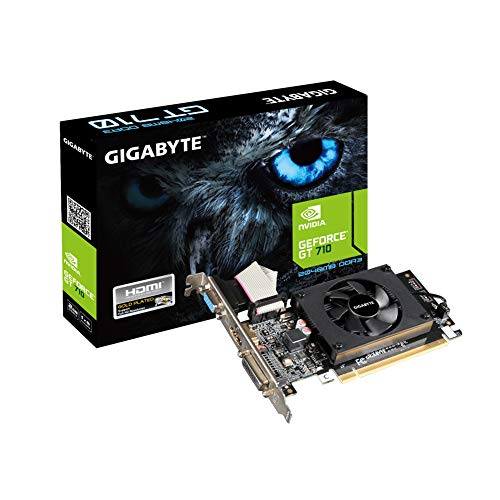
GIGABYTE 2GB RAM DDR3 SDRAM Video Graphics Cards GV-N710D3-2GL REV2.0 for Desktop
Bottom line: The GIGABYTE 2GB RAM DDR3 SDRAM Video Graphics Cards REV2.0 for Desktop: Low-profile form factor fits slim office towers and small-form-factor cases; main trade-off: DDR3 memory rather than GDDR5 caps memory bandwidth well below gaming cards.
As an Amazon Associate, SpecPicks earns from qualifying purchases. Full disclosure →
Pros & Cons
Pros
- ✓ Low-profile form factor fits slim office towers and small-form-factor cases
- ✓ D-Sub output drives legacy VGA monitors and KVM switches newer GPUs dropped
- ✓ Dual-link DVI-D plus HDMI covers both older panels and a current display
- ✓ 954 MHz core clock and 2GB DDR3 are enough for desktop work and video playback
Cons
- ✗ DDR3 memory rather than GDDR5 caps memory bandwidth well below gaming cards
- ✗ 2GB frame buffer rules out modern titles and most GPU compute workloads
- ✗ Three outputs but no DisplayPort, so DP-only monitors need an adapter
- ✗ Listing warns against unofficial software, tying you to GIGABYTE drivers
Manufacturer description
The GIGABYTE GV-N710D3-2GL REV2.0 is a low-profile desktop graphics card built around 2GB of DDR3 memory and a 954 MHz core clock, aimed at machines that need working display output rather than gaming horsepower. The half-height form factor lets it drop into slim office towers, small-form-factor builds, and older desktops where a full-size card will not physically fit. The display trio is the real draw: dual-link DVI-D, D-Sub, and HDMI on one bracket. That D-Sub port drives legacy VGA monitors and KVM switches that newer GPUs abandoned years ago, while HDMI handles a current panel or TV from…
SpecPicks Verdict
SpecPicks has no buyer-rating or benchmark data for GIGABYTE 2GB RAM DDR3 SDRAM Video Graphics Cards REV2.0 for Desktop, so this read rests on the manufacturer's listed specs (how we evaluate). Compare with similarly-priced alternatives in the retro graphics & video category before committing. On the listing's own facts, the case for it is "Low-profile form factor fits slim office towers and small-form-factor cases"; the main trade-off is "DDR3 memory rather than GDDR5 caps memory bandwidth well below gaming cards". If those two points fit how you will use it, put it beside one or two close alternatives in the Compare tool to confirm the price.
Common buyer scenarios for retro graphics & video of this kind: matching it to an existing build, replacing a failing part, or upgrading from a previous-generation equivalent. Check the spec table below against your current setup — particularly socket / form-factor / power-rating fields — and confirm compatibility on the retailer's listing before purchase. Prices and stock are set by the retailer and may have moved since this page was last updated.
Frequently Asked Questions
Will the GIGABYTE GV-N710D3-2GL fit a slim or low-profile desktop?
GIGABYTE lists the form factor as Low Profile, so it is intended for half-height slim cases. Confirm the specific listing ships with the low-profile bracket before ordering.
Does this card have a VGA port for an older monitor?
Yes. The outputs are dual-link DVI-D, D-Sub, and HDMI, so a legacy VGA monitor or KVM switch connects directly without a converter.
Is the GV-N710D3-2GL good enough for gaming?
Not for current titles. A 954 MHz core clock paired with 2GB of DDR3 suits desktop work, video playback, and older or lightweight 3D games rather than modern releases.
How many monitors can it drive at once?
The card exposes three outputs: dual-link DVI-D, D-Sub, and HDMI. The listing does not state the maximum simultaneous display count, so check GIGABYTE's specification page for that figure.
Is it reliable, and what warranty does it carry?
Warranty terms are not included in the product data, so check the product listing or GIGABYTE support for current coverage.
Key Features
Quoted from the manufacturer's listing. Where it differs from the pros and cons above, those note the conditions the listing leaves out.
- Core Clock: 954 MHz
- Low profile design
- Features Dual-link DVI-D/D-Sub/HDMI
- Form Factor: Low Profile.Avoid using unofficial software
Full Specifications
| Brand | GIGABYTE |
|---|---|
| Core Clock | 954 MHz |
| Model Name | GV-N710D3-2GL REV2.0 |
| Unit Count | 1 Count |
| Form Factor | Low Profile.Avoid using unofficial software |
| Model Number | GV-N710D3-2GL REV2.0 |
| Built-In Media | 2 low profile BK, Graphic Card, Manual |
| Item Type Name | GIGABYTE GeForce GT 710 2GB Low Profile GV-N710D3-2GL REV2.0 |
| GPU Clock Speed | 954 megahertz |
| Mfr Part Number | GV-N710D3-2GL REV2.0 |
| Number of Items | 1 |
| Video Processor | NVIDIA |
| Antenna Location | Gaming |
| Graphics Card Ram | 2 GB |
| Graphics Ram Size | 2 GB |
| Graphics Ram Type | GDDR3 |
| Compatible Devices | Desktop |
| Memory Clock Speed | 1600 MHz |
| Graphics Coprocessor | NVIDIA GeForce GT 710 |
| Graphics Description | Dedicated |
Ready to buy?
GIGABYTE 2GB RAM DDR3 SDRAM Video Graphics Cards GV-N710D3-2GL REV2.0 for Desktop is listed on Amazon. Price, availability, shipping and returns are set by Amazon and its sellers — check the listing for current terms. SpecPicks earns a small commission on qualifying purchases — thank you for supporting independent review work.
Related Retro Graphics & Video


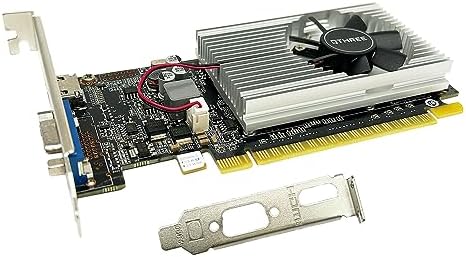
More guides & deep dives from the SpecPicks archive
Browse all articles & guides →- Best Budget Gaming PC Build 2026 — ~$1,000 Parts List
- The Complete Voodoo5 5500 AGP Driver Guide (2026 Edition)
- Best Retro Handhelds in 2026: Pocket, Mid-Tier and FPGA Picks
- Emulation Hardware in 2026: FPGA, Software, and Cart-Reader Ecosystems
- RTX 4070 Super vs RX 7800 XT — Which to Buy in 2026
- Best 1440p Gaming GPUs in 2026
- How to Build a Windows 98 Retro PC in 2026
More reviews from the SpecPicks archive
Browse all reviews →- Best Gaming Gifts Under $60 in 2026
- Raspberry Pi 4 8GB vs Ryzen 5 2600 for Gemma 3 4B: Which Cheap Box Wins?
- Best Fight Stick and Pad for Fighting Games on PC (2026)
- How to run Qwen 3 14B on Apple M3 Ultra
- Best SSD for a Local-LLM Rig in 2026: NVMe vs SATA
- CompactFlash + IDE Storage for a Period-Correct Windows 98 Build
- Ryzen 5 5600G vs Ryzen 7 5700X for a Budget LLM + Gaming Build
- Raspberry Pi 5 Local LLM Server: Best Models for 8GB RAM in 2026
- 3dfx Voodoo2 SLI in 2026: Build Guide, Glide Setup, CF Storage
- Best CRT Monitor for Retro Gaming: 2026 Buying Guide
- Grok 4.3 vs GPT-5 vs Claude 4.7: Local Hardware Implications of the Closed-Model Intelligence Index
- Best Budget Streaming Mic + Capture Setup: Blue Yeti vs HyperX QuadCast 2 S
- Ollama vs vLLM vs llama.cpp on a 12GB GPU: Which Wins for One User?
- Athlon 64 + Radeon 9800 Pro Windows XP Build (2026 Revival): CompactFlash-to-IDE Boot Guide
- Aider vs Cline vs Continue.dev for Local Coding on an RTX 3060 (2026)
- GeForce 3 Ti 500 Build Guide: Period-Correct Win98 SE Rig for 2001-Era Gaming
- Strix Halo LLM Benchmarks 2026: What AMD's Ryzen AI Max+ Delivers
- GameSir G7 SE vs 8BitDo Pro 2: Best Wired-Feel Controller for PC & Steam Deck
- Best GPU for AI code generation in 2026
- Best Storage Kit for Archiving a Physical Game Collection in 2026
- Llama 4 Scout: RTX 3060 12GB Expert Offload vs Ryzen 7 5800X CPU-Only (2026)
- Building a Period-Correct 2001 GeForce 3 + Windows 98 SE Gaming Rig
- How to run DeepSeek-R1 32B on AMD Radeon RX 7900 XTX
- Build a Plex Media Server on a Raspberry Pi 4 8GB in 2026
Earliest SpecPicks reviews
Browse full archive →- Best GPU for Llama 3.1 8B (2026)
- Best GPU for Qwen 3 14B (2026)
- Best GPU for Qwen 3 32B (2026)
- Best GPU for Llama 3.1 70B (2026)
- Best GPU for DeepSeek-R1 32B (2026)
- Best GPU for Llama 3.1 405B (2026)
- How to run Llama 3.1 8B on NVIDIA GeForce RTX 5090
- How to run Qwen 3 14B on NVIDIA GeForce RTX 5090
- How to run Qwen 3 32B on NVIDIA GeForce RTX 5090
- How to run Llama 3.1 70B on NVIDIA GeForce RTX 5090
- How to run DeepSeek-R1 32B on NVIDIA GeForce RTX 5090
- How to run Llama 3.1 8B on NVIDIA GeForce RTX 4090