As an Amazon Associate, SpecPicks earns from qualifying purchases. See our review methodology.
A CD-ROM title averages well under its 700 MB nominal capacity and a DVD-era title rarely fills a 4.7 GB disc, so a 300-title mixed shelf usually lands in the low hundreds of gigabytes — one Crucial BX500 1TB covers it with room to spare. Box scans are what blow the budget, not the games.
Who this is for
You own a shelf. Some of it is 1995-to-2010 PC games in jewel cases and big boxes, some of it is console discs, and a few of the CD-Rs at the end are burns you made yourself and can no longer identify. The shelf has been fine for twenty years, which is the problem: it looks exactly as fine as it did the day before a disc stops reading.
Optical media does not fail on a schedule you can plan around. Pressed discs are durable but not immortal — the reflective layer is the weak point, and oxidation at the edge propagates inward invisibly until a sector count comes back wrong. Burned discs are worse and were always worse; dye-layer degradation is measured in years, not decades, and the adhesive paper labels people used in 2001 are actively destructive as they shrink and warp the substrate. Console cartridges are the exception and hold up remarkably well, though their save batteries do not.
None of that is a reason to panic. It is a reason to treat this as an inventory problem before it is a hardware problem: work out how big the job actually is, buy storage sized to that number rather than to a vague sense that "games are big now", and then dump in passes rather than in one heroic weekend. The hardware side is genuinely cheap. The time is not, which is why sizing correctly the first time matters.
Key takeaways
- Capacity is per media type, not per title. Floppies are noise, CD-ROM images average a few hundred megabytes, DVD titles are the only line item that scales.
- Two smaller drives beat one large one. One online working copy, one cold spare, and the 3-2-1 principle stops being an abstraction.
- The physical tier matters as much as the digital one. Retiring shelf space is the whole reason most people start, and a case migration is irreversible for packaging.
- CompactFlash is working media, never archive media. Its job is to be a silent boot drive in the vintage machine you are dumping from.
- Scans dominate the footprint. Archival-resolution manual and box art scans routinely double or triple the size of the disc images they accompany.
How big is your collection, really?
Run this before you buy anything. Count titles by media type and multiply.
| Media type | Typical image size | 50 titles | 300 titles |
|---|---|---|---|
| 3.5" floppy set (5 disks) | ~7 MB | 0.4 GB | 2 GB |
| CD-ROM, single disc | 300–650 MB | ~24 GB | ~140 GB |
| CD-ROM, multi-disc (3–4) | 1.2–2.6 GB | ~95 GB | — |
| DVD-5 title | up to 4.7 GB | ~200 GB | ~1.2 TB |
| Cartridge dump | 512 KB – 64 MB | ~1 GB | ~6 GB |
| Big-box scan set (600 dpi) | 150–400 MB | ~14 GB | ~80 GB |
Two things fall out of this immediately. First, a shelf that feels enormous is usually a few hundred gigabytes, because the CD-ROM era — which is most of what collectors own — has a hard 700 MB ceiling per disc and most titles never approached it. Second, the moment DVD-era titles or high-resolution scans enter the count, the number multiplies. A 300-title collection that is 80% CD-ROM fits comfortably on a terabyte; the same 300 titles skewed toward DVD does not.
Do the count. It takes twenty minutes and it is the difference between buying once and buying twice.
What to look for in an archive drive
An archive drive has a different job from a boot drive, and the specs that matter are not the ones on the front of the box. Sequential read speed is nearly irrelevant — you write each image once at the speed of an optical drive, which is glacial by comparison. What matters is endurance, retention when powered down, and whether the controller behaves predictably on large sequential writes.
The specific thing to avoid is the cheapest QLC part in the aisle. QLC stores four bits per cell, which means smaller voltage margins between states, which means both lower write endurance and faster charge drift in cold storage. For a drive that will sit unpowered on a shelf between verification passes, that is the wrong trade for the twenty dollars it saves.
| Drive | Capacity | Interface | Rated sequential read | Notes |
|---|---|---|---|---|
| Crucial BX500 1TB | 1 TB | SATA III 6 Gb/s | up to 540 MB/s | The single-drive answer for most shelves |
| Kingston A400 960GB | 960 GB | SATA III 6 Gb/s | up to 500 MB/s | DRAM-less; fine for sequential archive work |
| SanDisk SSD Plus 480GB | 480 GB | SATA III 6 Gb/s | — | Sized as the cold spare, not the primary |
The Kingston A400 product page publishes the SATA Rev 3.0 interface and the rated sequential figures; the drive is DRAM-less, which shows up in random-write workloads and essentially never in "write a 600 MB image, move on". For this job that omission costs you nothing measurable. We compared these two capacities head-to-head under a different workload in the A400 versus BX500 comparison, and the budget SATA SSD guide covers the wider field.
How do you actually pull the data off?
Three separate problems, and people usually only anticipate the first.
Reading the discs. Most modern optical drives read pressed CD-ROMs without complaint. Trouble starts with mixed-mode discs that carry Red Book audio tracks alongside data, and with the subchannel data that period copy protection wrote into places a normal read never looks. Preservation projects favour specific older drive models precisely because those drives expose subchannel reads that current hardware skips — which is why a verified dump and a plain ISO are not the same artifact. Redump maintains the reference database of verified disc dumps and documents which drives and which read modes produce a match.
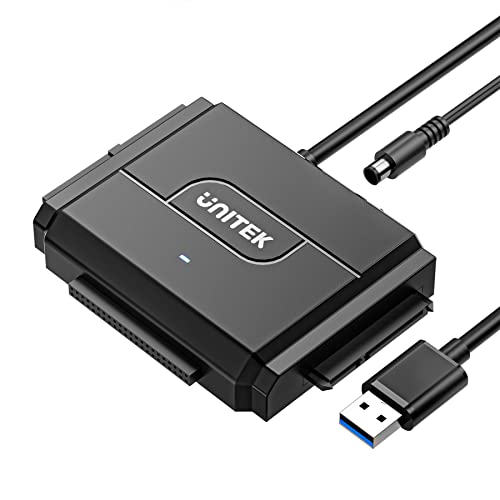
Reading the old drives. This is the step that stops most people, because the game data is not always on optical media — a meaningful chunk of a 1998-era collection lives on the IDE hard disk still installed in the beige tower in the closet. A Unitek SATA/IDE USB 3.0 adapter is the piece that unlocks that: it handles 2.5-inch and 3.5-inch IDE plus SATA, with the separate power brick that 3.5-inch IDE drives need and bus-powered adapters cannot supply.
Two gotchas on that path. First, drives from that era frequently carry ghost partitions and host-protected areas that a file-level copy silently skips — image the whole device, not the visible volume. Second, an IDE drive that has not spun in fifteen years is a one-shot resource; if it spins up, image it immediately and completely rather than browsing it first. The USB-to-IDE versus CF-to-IDE comparison covers when each approach is the right one.
Verifying. A dump you have not checksummed is a rumour. Hash every image on creation, store the hashes alongside, and re-verify on every copy operation. This is what separates an archive from a folder.
Where CompactFlash still belongs
CompactFlash occupies an odd, genuinely useful niche here, and it is not the one the name suggests.
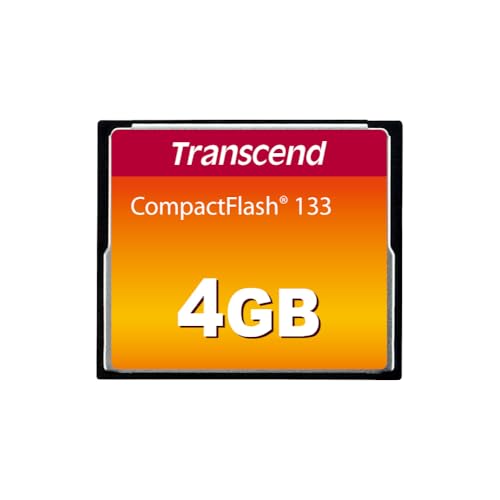
CF implements True IDE mode, which means a CF-to-IDE adapter is passive — a pinout change, not a protocol translation. That makes a CF card the simplest possible replacement for a failing IDE mechanical drive in a period-correct machine, with no controller compatibility surprises and no BIOS gymnastics. A Transcend 4GB CompactFlash card rated at up to 50 MB/s is enormously faster than the 1998 drive it replaces and completely silent, which matters when the machine's job is to sit next to you reading discs for three hours.
So the CF card is the working volume on the dumping machine. It boots the period OS, it runs the imaging tools, it holds a staging area. It is expected to be rewritten constantly and it is expendable.
What it is not is the copy of record. Four gigabytes of old-generation flash is neither large enough for a collection nor endurance-rated for long-term retention, and unpowered charge retention on consumer flash is a real constraint measured in years. Never let archive media and working media be the same card. If the only copy of a dump is on the card you are also booting from, you have a staging directory, not an archive.
Cataloguing the physical side
Most people start this project because the shelf is full, and the shelf is what they actually want back. That makes the physical tier a real part of the kit rather than an afterthought.
A sisma 64-slot game case is the standard shelf-to-box migration step: sixty-four discs or cartridges in a fraction of the linear footprint, in a rigid case that protects better than a stack of jewel cases with cracked hinges.
Be honest about the trade, because half of it is irreversible. You gain space, protection, and a portable unit. You permanently lose original packaging — manuals, box art, registration cards, the map that came with the big box, and the collector value that attaches to a complete-in-box copy rather than a loose disc. If any of that matters to you even slightly, scan the printed material at 600 dpi before the packaging goes, and store the scans with the disc image. That is the step nobody regrets and everybody skips.
What about the second copy?
One drive is not an archive. It is a single point of failure with a nicer label.
The working shape for a shelf-sized collection is two drives: the primary online, and a cold spare that spends its life powered down and disconnected. A SanDisk SSD Plus 480GB sized under the primary is deliberate — it forces you to decide what the irreplaceable subset is, which is a useful exercise, and it costs less than doubling the primary.
Rotation discipline, in three rules:
- An always-connected backup is not a backup. Ransomware, a bad
rm, a controller failure that corrupts on write — all of them reach every mounted volume. The spare's value is that it is unplugged. - Verify on a schedule. SSDs left unpowered for years do experience charge drift. An annual reconnect, checksum pass and rewrite is the usual compromise between paranoia and effort.
- Keep one copy off-site if the collection is genuinely irreplaceable. That is the third leg of 3-2-1, and for most people it means a cheap cloud bucket holding the checksummed images, not a second shelf.
For a sense of what the preservation world does with verified dumps at scale, the Internet Archive's MS-DOS software library is the public-facing version of exactly this workflow — imaged media, catalogued, checksummed and served.
Verdict matrix
- Get the 1 TB BX500 if your count came in above roughly 400 GB, or has any meaningful DVD-era component, or you plan to scan packaging at archival resolution. Headroom is cheaper bought once.
- Get the 960 GB A400 if your shelf is CD-ROM-dominant and the count came in comfortably under 500 GB. The capacity difference is marginal; the price difference is not.
- Get both if you want the two-drive rotation without buying a third device later. Primary online, secondary cold, done.
- Get the SanDisk 480 GB instead of a second full-size drive if you have identified a clear irreplaceable subset — your own burns, your saves, anything not in a public database.
- Skip the CompactFlash card if you are not dumping from period hardware. If everything is coming off modern optical drives and a USB adapter, it has no job.
- Skip the game case if packaging condition is part of why you own the collection. That decision does not reverse.
Cost per archived title
The arithmetic is unusually favourable, which is worth stating plainly because the alternative is not.
A terabyte-class SATA SSD covers a 300-title CD-ROM-dominant collection with headroom. Spread across those titles, per-title storage cost lands in the region of small change, and it is a one-time cost against media that is otherwise degrading on its own schedule. Add the adapter and the case and the whole kit is still less than a mid-range GPU.
Paying a service to do it is priced per disc, and per-disc rates multiplied by a three-hundred-disc shelf produce a number several times the hardware. The service buys you time, not capability — and it means shipping irreplaceable physical media, which is its own risk calculation. The honest split: do it yourself if you own the machine to dump from and can spread it over weeks; pay someone if the media is fragile enough that a single expert pass beats three amateur ones.
Common pitfalls
- Sizing from vibes. "Games are huge" is a 2026 intuition applied to 2001 media. Count first.
- File-copying instead of imaging. Copying the visible files loses boot sectors, subchannel data and copy protection structure — and those are exactly what makes a dump verifiable.
- Skipping checksums. A silent bit flip on a copy operation is undetectable later. Hash on creation, verify on every move.
- Dumping the disc and binning the box before scanning the manual. Irreversible, and the manual is often the only place the CD key lives.
- Treating the CF card as the archive. It is a boot volume. See above.
- One drive, always connected. See above, twice.
Bottom line
For a typical 300-title shelf the kit is four items: a 1 TB BX500 as the primary archive, a Unitek SATA/IDE USB 3.0 adapter to read whatever the discs are not on, a 480 GB SanDisk as the cold spare, and a sisma 64-slot case if you are reclaiming the shelf. Add the Transcend CF card only if you are dumping from period hardware. Count your titles before you order any of it.
Related guides
- USB-to-IDE Adapter vs CF-to-IDE for Imaging Retro PC Drives
- Best Storage Upgrades for a Legacy or Retro PC in 2026
- Best SATA SSDs for Reviving an Old PC in 2026
- Kingston A400 960GB vs Crucial BX500 1TB
- Best PCI Serial and IDE Adapters for Retro PCs in 2026
Citations and sources
- Kingston — A400 SATA SSD — accessed 28 August 2026. Source for the SATA Rev 3.0 interface, rated sequential read and write figures, and capacity range.
- Internet Archive — Software Library: MS-DOS — accessed 28 August 2026. Reference for imaged-media cataloguing practice at scale.
- Redump — accessed 28 August 2026. Source for verified disc-dump practice, subchannel read requirements and drive-model sensitivity.
Prices quoted are SpecPicks catalog listings as of 28 August 2026 and move frequently; check the live listing before purchase. Personal-archive rights vary by jurisdiction and nothing here is legal advice. This piece is editorial synthesis based on publicly available manufacturer documentation and preservation-project specifications. No independent first-party benchmarking is reported.
— Mike Perry · Last verified 28 August 2026