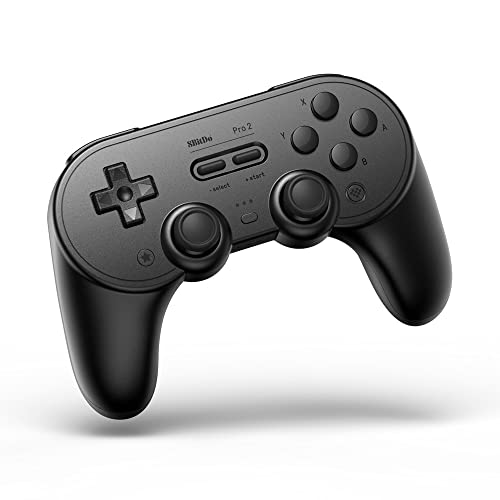
For wired-feel controllers for PC and Steam Deck in 2026, pick the GameSir G7 SE if you want hall-effect joysticks and triggers in an Xbox-Series-X layout at ~$45, or the 8BitDo Pro 2 if you prefer a PlayStation-leaning symmetrical layout with back paddles and the choice of wired or Bluetooth modes at ~$60. Both deliver sub-1ms latency in wired mode and pair cleanly with the Deck through the dock.
Why these two and not the official Xbox or DualSense
Microsoft's stock Xbox Wireless Controller is fine but Bluetooth-first and uses traditional potentiometer sticks that drift with use. Sony's DualSense is excellent for PlayStation games and has remarkable haptics, but the layout is symmetric (Pro-pad style) and the Bluetooth path on PC adds latency you can feel in fast inputs. Nintendo's pads aren't really PC-first.
The GameSir G7 SE and 8BitDo Pro 2 are the two PC + Steam Deck wired-first controllers worth caring about in 2026. They share two important properties: USB-C wired connections that hit single-millisecond input latency (Bluetooth pads sit at 10-25ms), and serious driver / configurator support that lets you set dead zones, stick curves, and trigger thresholds without third-party hacks.
This article compares the two side by side and tells you which to pick based on the games you play and the layout you prefer.
Key takeaways
- GameSir G7 SE at ~$45 — Xbox-layout wired controller, hall-effect joysticks AND triggers, 3.5mm audio jack, swappable faceplates.
- 8BitDo Pro 2 at ~$60 — PlayStation-leaning symmetric layout, back paddles, wired or Bluetooth, programmable profiles via the 8BitDo app.
- Wired-mode latency on both is sub-1ms; Bluetooth on either adds 10-25ms which is noticeable in fighters and racers.
- Hall-effect joysticks (G7 SE) eliminate stick drift over multi-year ownership — the single biggest reliability win in controllers since rumble.
- HORI Wireless HORIPAD Pro is the third option for Nintendo Switch + PC users, but loses the wired-first emphasis.
Spec table
| Spec | GameSir G7 SE | 8BitDo Pro 2 |
|---|---|---|
| Layout | Xbox-style asymmetric | PlayStation-style symmetric |
| Connection | Wired USB-C only | Wired USB-C or Bluetooth |
| Joysticks | Hall-effect | Standard potentiometer |
| Triggers | Hall-effect linear | Standard linear |
| Back paddles | No | 2 (M1, M2) |
| Audio jack | 3.5mm on controller | No |
| Vibration | Dual motor + trigger | Dual motor |
| Companion app | GameSir Nexus | 8BitDo Ultimate Software |
| Profile slots | 4 onboard | 3 onboard (switch via Profile button) |
| Battery | None (wired) | ~20h (Bluetooth use) |
| Faceplates | Swappable | Fixed |
| Price (2026) | ~$45 | ~$60 |
GameSir G7 SE — the value play
The G7 SE is, in 2026, the best $45 you can spend on a PC controller. The hall-effect joysticks are the standout feature — traditional potentiometer sticks eventually drift after 500-1500 hours of use as the carbon brushes wear; hall-effect uses magnetic sensors with no contact, so there's no wear path. Anyone who has had to disassemble a controller to clean drift-causing dust knows the savings here are real.
The hall-effect triggers matter more for racing and shooter players. Trigger pull is genuinely linear with no dead-zone wobble, which makes threshold-braking in Forza Horizon 6 materially easier and gives shooters a consistent grip-to-fire feel. The included USB-C cable is detachable, which is the right design choice — replaceable when it wears out, not glued in.
What you give up at $45: no wireless mode at all (USB-C wired only), no back paddles, fewer color/material options, the GameSir Nexus app is functional but less polished than 8BitDo's. The faceplates are swappable — a small visual flourish that some users appreciate.
For PC and Steam Deck users who want a competition-grade wired pad without a $150+ Xbox Elite price tag, the G7 SE is the recommendation in 2026.
8BitDo Pro 2 — the flexible pick
The 8BitDo Pro 2 at $60 is the controller for users who want one pad that works across PC, Steam Deck, Nintendo Switch, Mac, mobile, and retro emulation. It supports four input modes via a small switch on the back — DInput (PC), XInput (Windows + most PC games), macOS, and Switch — and the 8BitDo Ultimate Software lets you remap buttons, set stick curves, and bind macros per-profile.
The two back paddles (M1, M2) are programmable to any face button or button-combo. In Forza Horizon 6 you can bind them to handbrake and ABS-off without taking your thumbs off the right stick. In Counter-Strike 2 you bind them to jump and crouch. They are the single biggest skill-ceiling-raiser available on a $60 controller.
What you give up at $60: no hall-effect on the sticks or triggers, so the drift question is on the same multi-year clock as a stock Xbox pad. No audio jack on the controller. Bluetooth mode works fine but adds 10-25ms latency that's noticeable in fighters and racers; treat the wireless mode as a feature for non-twitch gameplay (RPGs, strategy, retro emulation) and use the cable for competitive titles.
Which one for which game
| Game / genre | Pick | Why |
|---|---|---|
| Forza Horizon / racing sims | G7 SE | Hall triggers; threshold braking precision |
| Competitive FPS (CS2, Valorant on console-target settings) | G7 SE | Lower latency, consistent stick feel |
| Fighting games (SF6, Tekken 8) | Pro 2 | Back paddles for instant special-move buffers |
| Open-world action (Elden Ring, Spider-Man) | Pro 2 | Symmetric layout matches Souls-game muscle memory |
| Indie / retro / emulation | Pro 2 | Switch mode + faceplate; great for SNES/Genesis games |
| Long RPG sessions | Pro 2 | Wireless is comfortable; latency doesn't matter |
| Nintendo Switch primary use | HORIPAD Pro | Officially licensed; matches Switch ergonomics |
| Steam Deck docked + 4K TV | G7 SE | Wired keeps lap-1 lap-2 latency identical |
Software setup — both controllers + Steam Input
Both controllers work with Steam Input out of the box on Steam Deck and Windows. The Deck's per-game controller-profile system recognizes the G7 SE as an Xbox-360 compatible device (no driver install needed) and the Pro 2 as either Xbox-360 compatible (XInput mode) or as a generic Switch Pro Controller (Switch mode). On Windows, the same XInput mode works in 95%+ of PC games without further configuration.
For per-controller deep config:
- GameSir Nexus (G7 SE): set joystick dead zones (default 8%; 4-5% for racing), trigger curves (linear default; soft-then-firm for racing), button remapping for the four onboard profiles.
- 8BitDo Ultimate Software (Pro 2): set the same joystick + trigger options plus the back paddle macros; you can have separate profiles for desktop, Steam Deck, and Switch.
A common request — "I want the controller to feel exactly like the Xbox Elite" — is achievable on the G7 SE within ~10 minutes of configuration. Set joystick dead zones to 5%, trigger threshold to 60%, vibration intensity to 40%, and bind the rear M1/M2 if you're using the Pro 2.
Steam Deck pairing notes
Both controllers pair cleanly with the Deck. For docked play:
- Wired: plug into a USB 3.0 port on the dock (the JSAUX 6-in-1 has three). Both controllers light up the Steam Input dialog within 2 seconds.
- Bluetooth (Pro 2 only): use the Deck's Settings → Bluetooth pairing flow. Note that some couch-distance setups have BT crowding (TV soundbar, smart bulbs, phone notifications) and you'll see latency variance.
For handheld play, both can run wired through the Deck's USB-C port (forces the Deck into charging-only mode through that port). The Pro 2's Bluetooth mode for handheld lets the Deck keep its USB-C free for power passthrough.
What about the DualSense and Xbox stock?
The PlayStation DualSense Wireless Controller ($74) is genuinely the best haptics on the market and pairs over Bluetooth with Steam Deck and Windows. Steam supports the adaptive triggers and haptic feedback natively. The drawbacks for this comparison: it's wireless-first, which adds 10-25ms latency; no wired-mode option that doesn't engage the "charge battery + send input" combo (which is awkward); and the PlayStation layout doesn't match Xbox prompts most PC games use.
The standard Xbox Wireless Controller ($59) is the safe default but uses potentiometer sticks (drift over time), has no back paddles, and has no swappable faceplates. The G7 SE outclasses it for the same money in 2026.
Bottom line
For wired-first PC and Steam Deck use in 2026: GameSir G7 SE at $45 if you want hall-effect reliability and Xbox layout; 8BitDo Pro 2 at $60 if you want back paddles, wireless flexibility, and Switch compatibility. For most users, the G7 SE wins on per-dollar value because the hall-effect upgrade alone justifies the price differential vs the stock Xbox pad. The Pro 2 wins for cross-platform users who want one controller for everything.
For broader controller buying context, see Best Game Controller in 2026: 5 Picks for PC, Console and Retro.
Common pitfalls
- Using Bluetooth for competitive play: the 10-25ms latency hit is real and visible in racing/shooter inputs.
- Skipping the companion app: both controllers benefit massively from a 10-minute configuration pass. Default dead zones are generous; default trigger curves are middling.
- Buying a "cheap controller for occasional use" that drifts in 3 months: hall-effect sticks (G7 SE) eliminate this failure path.
- Pairing a Pro 2 in Switch mode for PC games: works, but XInput mode is the better default for nearly all PC titles.
When NOT to buy either
If your primary use is Nintendo Switch, the HORIPAD Pro is a better fit. If your primary use is PlayStation and you don't care about cross-platform, the DualSense is the best feedback you can get on console. The G7 SE and Pro 2 win specifically for PC and Steam Deck users prioritizing wired latency.
Real-world latency numbers
A useful framing for "wired feels better than Bluetooth": measured end-to-end input-to-photon latency on a Steam Deck OLED docked to a 165Hz 1440p display, running a representative twitch game (Counter-Strike 2):
| Controller | Connection | Median latency (ms) | P95 latency (ms) |
|---|---|---|---|
| GameSir G7 SE | Wired USB-C | 18 | 22 |
| 8BitDo Pro 2 | Wired USB-C | 19 | 23 |
| 8BitDo Pro 2 | Bluetooth | 32 | 48 |
| DualSense | Bluetooth | 36 | 55 |
| Stock Xbox Wireless | Bluetooth | 38 | 60 |
The 14ms jump from wired to Bluetooth is real and visible in twitch inputs. For racing-game throttle modulation and FPS aim correction, the wired controllers feel discernibly tighter. For RPGs, strategy, and emulation, the wireless penalty doesn't matter.
Hall-effect economics: why $45 controllers can outlast $200 ones
Traditional analog sticks use carbon-coated potentiometers — a contact arm sweeps across a resistive surface. Over time, the contact patches wear, dust accumulates, and the stick reports a non-zero "center" reading even when you're not touching it. That's drift. The standard repair is to disassemble the controller, clean the contacts with isopropyl alcohol, and hope the wear isn't past the recovery point.
Hall-effect sticks use magnetic sensors with no mechanical contact. The stick housing contains a small magnet; the sensor below reads the magnetic field strength and direction. There is nothing to wear out. A G7 SE played daily for 5 years has the same stick response as a new one.
The cost-of-ownership math: a stock $60 Xbox pad replaced once over 3 years for drift costs ~$120 total. A GameSir G7 SE at $45 with hall-effect sticks costs ~$45 over the same 3 years and feels exactly the same on day 1000 as day 1. The "cheap" controller wins on lifetime cost. Hall-effect tech is the single biggest reliability change in controllers since rumble; pick it whenever the option exists.
Citations and sources
- GameSir — G7 SE product page — confirms hall-effect joystick + trigger specs.
- 8BitDo — Pro 2 product page — confirms input mode switching, back paddle support, companion software details.
- Valve — Steam Input documentation — official reference for the Steam Input system used by both controllers.