
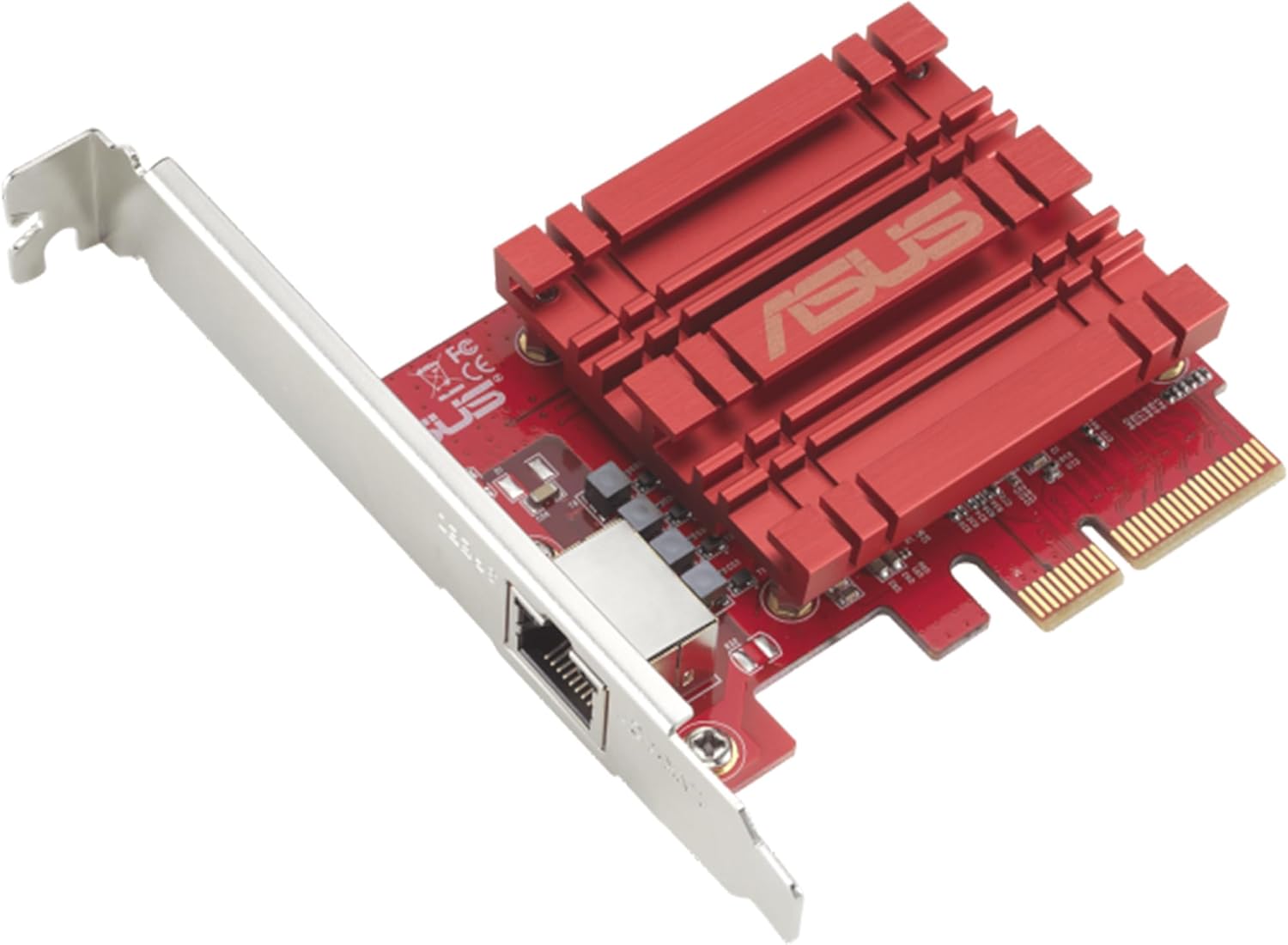
ASUS XG-C100C 10G Network Adapter PCI-E x4 Card
Bottom line: The ASUS XG-C100C 10G Network Adapter PCI-E x4 Card: Up to 10Gbps over 10GBase-T, 10x standard Gigabit Ethernet; main trade-off: single RJ-45 port, so no link aggregation or a second network on one card.
As an Amazon Associate, SpecPicks earns from qualifying purchases. Full disclosure →
Pros & Cons
Pros
- ✓ Up to 10Gbps over 10GBase-T, 10x standard Gigabit Ethernet
- ✓ Falls back to 5, 2.5 and 1Gbps, plus 100Mbps, for mixed networks
- ✓ Uses standard RJ-45 copper cabling, no SFP+ modules or fiber needed
- ✓ Built-in QoS lets you prioritize selected traffic and data packets
- ✓ Official Windows 10/8.1/8/7 and Linux kernel support; TAA compliant
Cons
- ✗ Single RJ-45 port, so no link aggregation or a second network on one card
- ✗ Needs a free PCI-E x4 (or wider) slot, which crowded boards may lack
- ✗ Full 10Gbps requires a 10G switch or NAS on the other end
- ✗ macOS is not on the listed OS support
Manufacturer description
The ASUS XG-C100C is a PCI-E x4 network adapter that brings 10GBase-T networking to a desktop PC through a single RJ-45 port. ASUS rates it at up to 10Gbps, ten times the speed of standard Gigabit Ethernet. That headroom matters for moving large video projects, backing up to a NAS, or pulling multi-gigabyte game libraries across your home or office network. The card works with today's multi-gig standards and falls back to 10, 5, 2.5 and 1Gbps, plus 100Mbps. You can install it now and keep using your current switch, then move to full 10G later. Because it uses standard copper network cables…
SpecPicks Verdict
SpecPicks has no buyer-rating or benchmark data for ASUS XG-C100C 10G Network Adapter PCI-E x4 Card, so this read rests on the manufacturer's listed specs (how we evaluate). Compare with similarly-priced alternatives in the retro networking cards category before committing. On the listing's own facts, the case for it is "Up to 10Gbps over 10GBase-T, 10x standard Gigabit Ethernet"; the main trade-off is "Single RJ-45 port, so no link aggregation or a second network on one card". If those two points fit how you will use it, put it beside one or two close alternatives in the Compare tool to confirm the price.
Before ordering, confirm the board side: this card needs a free PCIe slot of the width the card uses. Your motherboard manual lists which slots share lanes with M.2 sockets or other slots. Prices and stock are set by the retailer and may have moved since this page was last updated.
Frequently Asked Questions
Will the ASUS XG-C100C work with my existing gigabit router or switch?
Yes. The card is backward compatible with 5, 2.5 and 1Gbps links as well as 100Mbps, so it connects to a standard gigabit switch. It runs at the speed of the slowest device on the link, so you need a 10G switch or device to reach 10Gbps.
What kind of slot does the XG-C100C need?
It is a PCI-E x4 card, so it needs a free PCI-E x4 slot or a wider one (x8 or x16) on your desktop motherboard.
Which operating systems does the XG-C100C support?
ASUS lists Windows 10, 8.1, 8 and 7, plus Linux kernels 4.4, 4.2, 3.6 and 3.2. For other operating systems or newer kernels, check ASUS's support page for current drivers.
Do I need fiber or special modules to use this 10G card?
No. The XG-C100C has a single RJ-45 port and uses standard copper network cables, so you don't need SFP+ transceivers or fiber. Use cabling rated for 10GBase-T to reach full speed.
Will I actually get 10Gbps transfer speeds?
10Gbps is the maximum link rate. ASUS states that actual throughput varies with network conditions, traffic volume and network overhead. Your storage speed and the device at the other end also limit real-world transfers.
Key Features
Quoted from the manufacturer's listing. Where it differs from the pros and cons above, those note the conditions the listing leaves out.
- Hyper-fast 10Gbps networking delivers up to 10X-faster data-transfer speeds for bandwidth-demanding tasks
- Full compatibility with current network standards, including 10/5/2.5/1Gbps and 100Mbps, for seamless backward compatibility
- Windows and Linux support for flexible OS integration with Windows 10/8.1/8/7 and Linux Kernel 4.4/4.2/3.6/3.2
- RJ45 port easily upgrades your desktop to 10Gbps networking using standard copper network Cables
- Prioritize your data with built-in Quality-of-Service (QoS) technology, allowing you to prioritize bandwidth and supported data packets for a smooth online experience
Full Specifications
| Brand | ASUS |
|---|---|
| Color | Clear |
| Weight | 10g |
| Unit Count | 1 Count |
| Model Number | XG-C100C |
| Compatibility | Linux |
| Built-In Media | Quick start guide, Warranty card, XG-C100C 10G PCI_E Network Adapter, support CD (user manual and ultility) |
| Item Type Name | ASUS XG-C100C 10G Network Adapter PCI-E x4 Card with Single RJ-45 Port (XG-C100C) |
| Mfr Part Number | XG-C100C |
| Number of Items | 1 |
| Compatible Devices | Computers |
| Data Transfer Rate | 10000 megabits_per_second |
| Hardware Interface | Ethernet |
| Warranty Description | 2 years warranty |
| Item Dimensions L x W x H | 4.73"L x 3.33"W x 0.81"H |
| Global Trade Identification Number | 00889349620045, 04712900620078 |
| Full listing title | ASUS XG-C100C 10G Network Adapter PCI-E x4 Card with Single RJ-45 Port and Built-in QoS for use with Windows 10/8.1/8/7 and Linux Kernel 4.4/4.2/3.6/3.2, TAA Compliant (XG-C100C) |
Ready to buy?
ASUS XG-C100C 10G Network Adapter PCI-E x4 Card with Single RJ-45 Port and Built-in QoS for use with Windows 10/8.1/8/7 and Linux Kernel 4.4/4.2/3.6/3.2, TAA Compliant (XG-C100C) is listed on Amazon. Price, availability, shipping and returns are set by Amazon and its sellers — check the listing for current terms. SpecPicks earns a small commission on qualifying purchases — thank you for supporting independent review work.
Related Retro Networking Cards


More guides & deep dives from the SpecPicks archive
Browse all articles & guides →- The Complete Voodoo5 5500 AGP Driver Guide (2026 Edition)
- RTX 4070 Super vs RX 7800 XT — Which to Buy in 2026
- Emulation Hardware in 2026: FPGA, Software, and Cart-Reader Ecosystems
- Best Budget Gaming PC Build 2026 — ~$1,000 Parts List
- Best Retro Handhelds in 2026: Pocket, Mid-Tier and FPGA Picks
- How to Build a Windows 98 Retro PC in 2026
- Best 1440p Gaming GPUs in 2026
More reviews from the SpecPicks archive
Browse all reviews →- ComfyUI on a 12GB RTX 3060: Install + Stable Diffusion Throughput 2026
- Build a Home AI Assistant on a Raspberry Pi 4 8GB in 2026
- Best Sim Racing Wheel Setup for Beginners in 2026
- Building a Budget Sim Racing Setup: Logitech G920 vs Thrustmaster TH8A Shifter
- Why Direct3D Killed Glide: How the 3dfx Voodoo Empire Lost the API Wars
- Is the RTX 3060 12GB Still the Best Budget 1080p GPU in 2026?
- Intel Arc B580 vs RTX 3060 12GB for Local LLMs in 2026
- Imaging a 90s IDE Hard Drive with a SATA/IDE-to-USB Adapter: The Retro-PC Data-Rescue Workflow
- GLM-5.2 With CPU Offload: Ryzen 7 5800X + RTX 3060 12GB Tested
- Retro Console Mods in Canada: 2026 Legal & Hardware Guide
- Best Mini PC for Local LLM Inference in 2026: Ryzen vs Apple vs Intel
- Best Budget SSD for PC Builds in 2026
- ASUS ProArt PA27USD Lands: 27-Inch OLED Aims at Gaming
- GLM-5.2 vs Qwen3 on a 12GB GPU: Best Open-Weights LLM for an RTX 3060
- OpenAI and Anthropic Are Giving Startups Free Compute — Here's the Local Rig That Replaces It
- Hyperscalers May Soon Outrun Their Cash Flow on AI Buildout
- Blue Yeti vs HyperX QuadCast 2 S: Best USB Mic for New Streamers
- 20GB Homelab Memory Left: What to Add Next
- Ryzen 5 5600G vs Intel i7-9700K for Budget Gaming in 2026
- Ideogram 4.0 Open Weights: Native 2K Image Gen on a 12GB GPU
- Troubleshooting 3dfx Voodoo Cards on Modern AGP Builds: The 2026 Recovery Playbook
- How to run Llama 3.1 8B on Apple M4
- Best Travel Gaming Kit in 2026: 5 Picks for Hotels and Flights
- Ryzen 5 5600G vs Ryzen 7 5700X for a 2026 Home Lab
Earliest SpecPicks reviews
Browse full archive →- Best GPU for Llama 3.1 8B (2026)
- Best GPU for Qwen 3 14B (2026)
- Best GPU for Qwen 3 32B (2026)
- Best GPU for Llama 3.1 70B (2026)
- Best GPU for DeepSeek-R1 32B (2026)
- Best GPU for Llama 3.1 405B (2026)
- How to run Llama 3.1 8B on NVIDIA GeForce RTX 5090
- How to run Qwen 3 14B on NVIDIA GeForce RTX 5090
- How to run Qwen 3 32B on NVIDIA GeForce RTX 5090
- How to run Llama 3.1 70B on NVIDIA GeForce RTX 5090
- How to run DeepSeek-R1 32B on NVIDIA GeForce RTX 5090
- How to run Llama 3.1 8B on NVIDIA GeForce RTX 4090