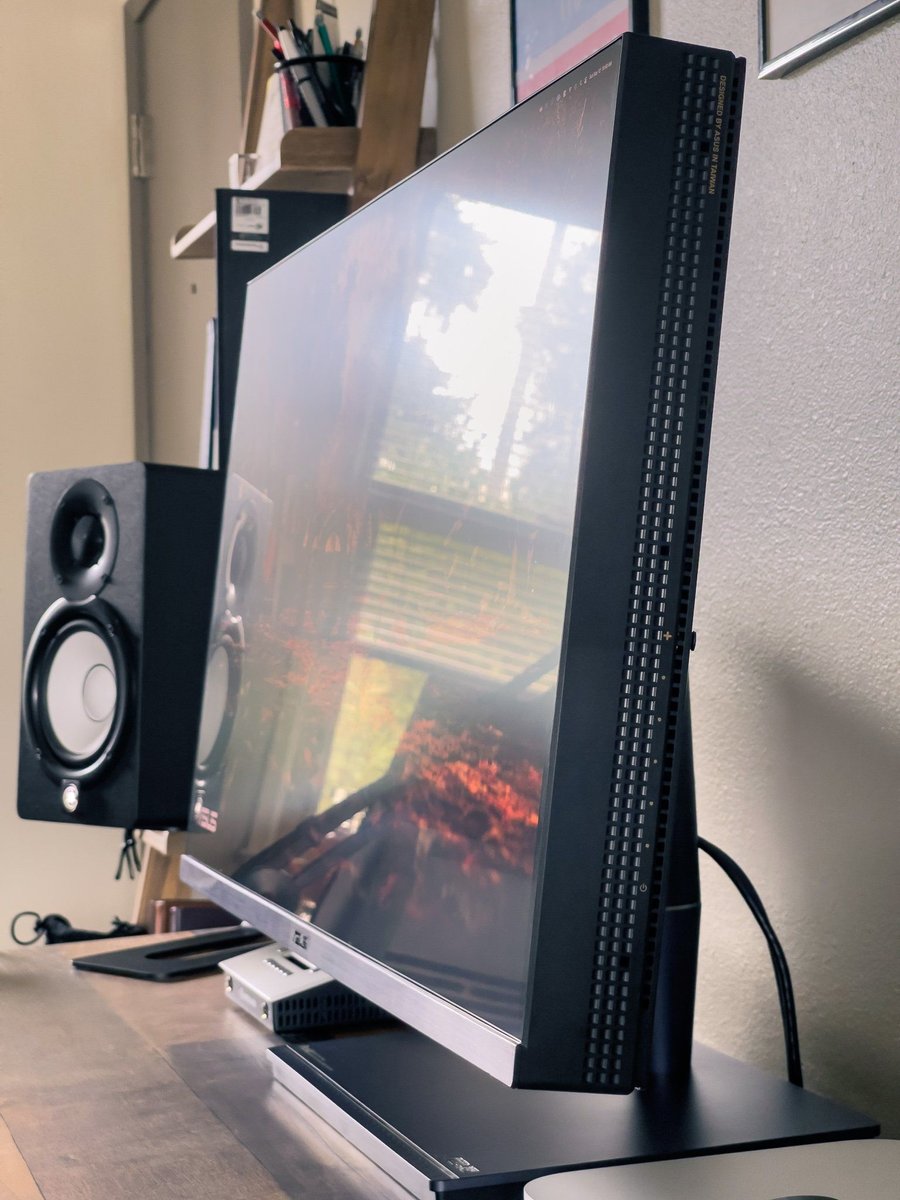
In brief — July 2026 · ASUS ProArt PA27USD 27-inch OLED lands with 4K resolution, high refresh, and factory-calibrated color aimed at creators who also game.
ASUS has pushed the ProArt PA27USD into the market as a rare crossover: a 27-inch 4K OLED that ships with a Delta E under 1 out of the box, hardware calibration support, a 240 Hz refresh mode, and gaming-friendly VRR — all in the same panel. It is not a budget monitor. It targets the color-grading suite and the flight sim, not the entry-level 4K buyer. If you need the color accuracy for paid work AND you play games on the same machine, the PA27USD collapses two purchases into one. If you mostly game, budget 4K panels like the KOORUI 27-inch 4K QD-Mini LED and the Samsung 27-inch Odyssey 4K still deliver a stronger dollar-for-dollar HDR gaming experience. This piece walks through the launch specs from the Tom's Hardware monitor hub, sets them against the two 27-inch 4K panels we actively stock, and gives you a buy-or-wait recommendation grounded in what your workload actually is.
What happened: the launch and headline specs
ASUS announced and shipped the ProArt PA27USD in late June 2026 through its ProArt monitor lineup. The panel is a 27-inch 4K UHD (3840 × 2160) QD-OLED with a factory calibration report, Delta E < 1 accuracy on average, 99% coverage of DCI-P3 and Adobe RGB, and 10-bit color depth. On the gaming side, it runs at a native 240 Hz refresh with a 0.03 ms gray-to-gray response, VESA AdaptiveSync, and G-Sync compatibility. Peak HDR brightness is rated at 1,300 nits in a 3% window with a sustained 275 nits full-screen. Connectivity is generous: two HDMI 2.1 ports, one DisplayPort 1.4 with DSC, a USB-C input with 90 W power delivery, and a built-in KVM. The stand tilts, swivels, pivots, and adjusts 130 mm in height.
Street pricing sits around $1,499 as of July 2026 — considerably above budget 4K gaming panels but below the $2,000+ tier of dedicated reference monitors from Eizo and FSI. ASUS positions it as a hybrid: the ProArt branding says "creative" while the 240 Hz spec says "gaming." That is unusual. Most panels pick a lane.
Why it matters: OLED color plus gaming refresh in one panel
For years, the 4K OLED conversation was dominated by 42-inch and 48-inch LG WOLED TVs repurposed as monitors. Those panels are gorgeous but they are TVs — pixel density at 27 inches is ~163 PPI versus 103 PPI at 42 inches, subpixel layout is a mess for desktop text, and they are physically enormous. The 27-inch 4K OLED form factor did not really exist at the consumer level until the 2025 wave of QD-OLED panels from Samsung Display. Now it does, and ASUS is one of the first to combine that panel with proper factory calibration.
The buyer profile matters. If you edit HDR video, grade stills for print, or animate for streaming platforms that mandate Rec.2020 color pipelines, monitor accuracy is a paid tool. A $1,500 monitor that hits Delta E under 1 replaces an X-Rite i1Display Pro workflow on a cheaper monitor — you still calibrate periodically, but the ceiling is higher. Meanwhile, per-pixel emissive lighting gives you perfect blacks and instant response, which matters for both film-noir grading and dark-scene gaming. That combination has historically forced two monitors on one desk. The PA27USD argues you can retire one of them.
For pure gaming buyers the calculus is different. You are paying for the calibration accuracy whether you use it or not. If your workflow is Twitch and Steam, not DaVinci and Photoshop, the KOORUI 27-inch 4K QD-Mini LED delivers HDR1400 brightness (a hair above the PA27USD's peak in raw candela), 320 Hz FHD dual-mode, and 99% Adobe RGB for about a third the price. The Samsung Odyssey 27-inch 4K offers 144 Hz Fast IPS with G-Sync compatibility and HDR400 for even less. Neither will match OLED contrast in a dim room, but both dominate on brightness in a sunny office.
The source
The specs, pricing, and initial impressions in this piece draw from the Tom's Hardware monitor coverage hub, which has been tracking the QD-OLED transition through 2025-2026, and from ASUS's own ProArt product page. For deep independent testing of response times, uniformity, and long-term burn-in behavior on comparable panels, RTINGS monitor reviews remains the reference lab we cross-check against — their QD-OLED accelerated-life test at 20 hours per day is the most cited data point in the burn-in debate.
Head to head: PA27USD versus what we stock
The two panels we already have in the specpicks catalog are both 27-inch 4K, both aimed at gamers, and both under $500 as of July 2026. Here is how they line up against the ASUS launch:
| Spec | ASUS ProArt PA27USD | KOORUI S2741LM (B0FBF7FCZW) | Samsung Odyssey 4K (B0GV3NPMHW) |
|---|---|---|---|
| Panel tech | QD-OLED (Samsung Display) | QD-Mini LED (IPS-type) | Fast IPS + edge-lit LED |
| Resolution | 3840 × 2160 native | 3840 × 2160 (dual-mode 1920 × 1080 @ 320 Hz) | 3840 × 2160 native |
| Max refresh | 240 Hz | 160 Hz at 4K, 320 Hz at FHD | 144 Hz |
| Response time | 0.03 ms GtG | 1 ms MPRT | 1 ms MPRT |
| Peak HDR | 1,300 nits (3% window) | 1,400 nits peak (HDR1400) | 400 nits peak (HDR400) |
| Color gamut | 99% DCI-P3, 99% Adobe RGB | 99% Adobe RGB | ~sRGB / DCI-P3 partial |
| Factory calibration | Delta E < 1 report | Not calibrated | Not calibrated |
| HDR certification | DisplayHDR True Black 400 | DisplayHDR 1400 | DisplayHDR 400 |
| USB-C PD | 90 W | 90 W | none |
| VRR | AdaptiveSync + G-Sync Compat | AdaptiveSync + FreeSync Premium | G-Sync Compat + FreeSync Premium |
| Approx price (July 2026) | ~$1,499 | ~$449 | ~$379 |
| Burn-in risk | Present, mitigated | None | None |
The bottom line the table pushes toward: the PA27USD is roughly 3.3× the price of the KOORUI and 3.9× the price of the Samsung. What you get for the premium is per-pixel emissive contrast, sub-millisecond response, and factory calibration accuracy. What you give up is peak sustained brightness in a lit room and burn-in immunity.
Price and value analysis
At $1,499 the PA27USD is priced for people whose calibration accuracy has an hourly bill-out. If you charge clients for finishing work, the incremental $1,000 over a KOORUI recovers in ~10 billable hours on a paid grading job. If you do not charge clients for finishing work, the $1,000 buys ~two years of Xbox Game Pass Ultimate and a Steam Deck OLED, or a proper GPU upgrade from an RTX 4070 to an RTX 4080 Super. That is a meaningful reallocation.
The KOORUI at ~$449 is the aggressive value play. QD-Mini LED with 99% Adobe RGB coverage and HDR1400 certification at that price is genuinely surprising, and the dual-mode 320 Hz FHD trick makes it a legitimate competitive-esports monitor as well. The KOORUI panel is our current recommendation for a mixed 4K creator-plus-gamer under $500.
The Samsung at ~$379 is the pure-gaming pick. If your budget is tight and you are not doing paid color work, the Samsung Odyssey puts 4K 144 Hz Fast IPS with G-Sync in front of you for less than an RTX 5060. HDR400 is not real HDR, but for SDR gaming and productivity it is a great panel.
Gaming versus color work: which lane are you actually in?
Ask yourself two honest questions. First: in an average week, how many hours do you spend in color-critical work — grading footage, retouching photos for print, painting textures for a shipping product? Second: does anyone pay you for the output of that work, or evaluate it against a color standard? If the answer to the first is more than five and the answer to the second is yes, the PA27USD's calibration is a productivity tool. If either answer is no, you are subsidizing a feature you will not use.
Gaming buyers should also honestly assess room lighting. QD-OLED panels shine in dim rooms — literally. In a sunny office with south-facing windows, the sustained ~275 nit full-screen brightness of the PA27USD can feel washed out compared to the 600-plus sustained nits of a good Mini-LED. If your battlestation is a bright room, Mini-LED is the objectively brighter, more contrast-punchy experience during the day. OLED wins at night.
Calibration and PQ analysis
The PA27USD ships with a per-unit calibration report showing measured Delta E values for the sRGB, DCI-P3, and Adobe RGB modes. In practice, this means the monitor's built-in color modes match a defined standard out of the box; you plug it in, select the mode matching your project's target color space, and the monitor is already close to the reference. Long-term users still need to recalibrate every 500-1,000 hours as the OLED emitters age, and ASUS supports hardware calibration via an X-Rite i1Display Pro or Calibrite ColorChecker Display Plus — the LUT lives in the monitor, not in the OS, so switching machines does not lose your calibration.
For HDR content, the panel implements the PQ (Perceptual Quantizer) EOTF curve required for HDR10 and Dolby Vision mastering. Peak highlights at 1,300 nits in a small window are enough for accurate specular highlight rendering per SMPTE ST 2084. Sustained full-screen brightness of ~275 nits is the OLED reality — a Mini-LED panel like the KOORUI can sustain roughly 3× that, but with much coarser local dimming zones and the associated blooming.
Neither the KOORUI nor the Samsung ships with a factory calibration report. Both need software calibration if used for color-critical work. The KOORUI's 99% Adobe RGB coverage means it can hit accurate calibrated color after a DisplayCAL pass; the Samsung's smaller gamut makes it a poor fit for print work but fine for web deliverables.
Panel tech deep dive: QD-OLED versus WOLED versus Mini-LED
QD-OLED (as used in the PA27USD and Samsung Display's 27-inch and 34-inch OLED panels) combines a blue OLED emitter with red and green quantum dot color converters. The result is very high color volume — meaning saturated colors stay saturated even at high brightness — and no polarizer loss the way LG WOLED sees. QD-OLED subpixels use a triangular RGB arrangement, which can introduce mild color fringing on high-contrast text edges; most desktop OS text-rendering pipelines now have adjustments for this.
WOLED (LG Display) uses a white OLED emitter with an RGBW color filter. It reaches higher peak sustained brightness in some scenarios but with slightly lower color volume and a small punch of the white subpixel showing through on bright, saturated content. Both are excellent; neither is a clear winner.
Mini-LED, used in the KOORUI, is a fundamentally different technology: an LCD panel backlit by a dense grid of small LEDs organized into local dimming zones. Modern high-end Mini-LEDs run 1,000 to 2,000+ zones on a 27-inch panel, which gets very close to OLED contrast in most content but can bloom around bright objects on dark backgrounds. The advantages are sustained peak brightness (1,000+ nits full-field), zero burn-in risk, and typically lower price for a given panel size.
For a gaming buyer, the practical differences boil down to: OLED for dark-room cinematic play with lots of contrast, Mini-LED for bright-room competitive play where peak brightness matters. Both are excellent gaming monitors.
Burn-in in 2026
Burn-in is the specter over every OLED purchase. The 2026 state of the technology is meaningfully better than 2022 in three ways. First, pixel-shift and orbit routines run automatically to prevent static UI elements from settling on the same subpixels. Second, warranties from ASUS, LG, Samsung, and Dell now explicitly cover burn-in for three years — which is an enormous shift from the "your fault" era. Third, RTINGS's accelerated life testing shows current-generation QD-OLED panels holding up well through 8,000+ hours of mixed use, translating to roughly five years of typical desktop use with mixed content.
That said, burn-in is not gone. If you leave a taskbar, HUD, or trading platform at high brightness on screen 12 hours a day for two years, you will see uneven wear. If you play a variety of games with rotating menus, run the pixel-refresh routine when prompted, and turn off the display when you walk away, you almost certainly will not.
What to buy today if the PA27USD is out of budget
If you can only spend under $500 and you want 4K gaming: the Samsung Odyssey 27-inch 4K is our lowest-friction pick. 144 Hz, G-Sync compatible, 1 ms response, real 4K resolution, and no burn-in worry. HDR is not great; SDR is excellent.
If you can spend up to $500 and want the best all-around value in 4K: the KOORUI 27-inch 4K QD-Mini LED. The dual-mode 320 Hz FHD trick, HDR1400, 99% Adobe RGB, and 90 W USB-C make it the versatile pick for a creator-gamer hybrid setup that cannot justify a $1,500 OLED yet.
If you can spend $1,499 and do paid color work: the PA27USD is a strong buy. Wait one month for the initial launch supply to stabilize and for RTINGS to publish its full review; then pull the trigger.
If you can spend $1,499 and do not do paid color work: buy the KOORUI and put the extra $1,050 into a GPU upgrade or a Steam Deck. Your gaming experience will improve more from a faster GPU than from marginal color accuracy you cannot see.

