
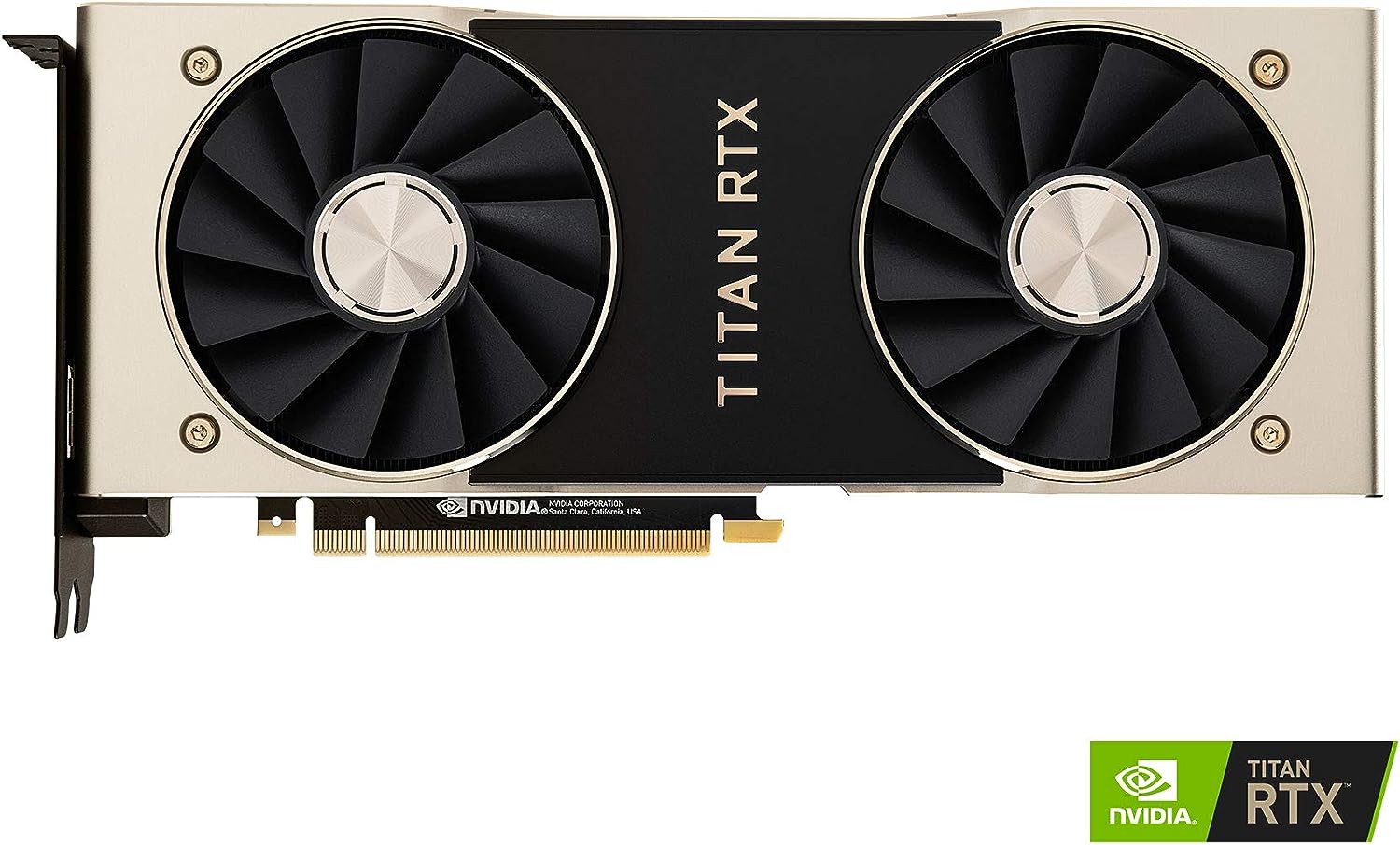
NVIDIA Titan RTX Graphics Card
Bottom line: The NVIDIA Titan RTX Graphics Card: 24GB GDDR6 handles large-model AI work and 8K timelines other Turing cards cannot; main trade-off: 650W PSU minimum, so older or budget power supplies need replacing first.
As an Amazon Associate, SpecPicks earns from qualifying purchases. Full disclosure →
Pros & Cons
Pros
- ✓ 24GB GDDR6 handles large-model AI work and 8K timelines other Turing cards cannot
- ✓ 4,609 CUDA cores at 1,770 MHz boost for top-tier Turing rasterization
- ✓ 576 Tensor Cores deliver 130 Tensor TFLOPs for training and inference
- ✓ 72 RT cores bring hardware ray tracing to renders and supported games
Cons
- ✗ 650W PSU minimum, so older or budget power supplies need replacing first
- ✗ Turing generation lacks DLSS 3 frame generation and newer RTX feature sets
- ✗ Windows 10 April 2018 Update or later required; no listed Windows 11 certification
- ✗ Discontinued card, so stock is secondary-market and pricing swings widely
Manufacturer description
NVIDIA TITAN RTX is the fastest PC graphics card ever built. It’s powered by the award-winning Turing architecture, bringing 130 Tensor TFLOPs of performance, 576 tensor cores, and 24 GB of ultra-fast GDDR6 memory to your PC.
SpecPicks Verdict
SpecPicks scored NVIDIA Titan RTX Graphics Card using a rating × review-volume × price-fit model applied to published specs and reviews across the retro graphics cards category. Compare with similarly-priced alternatives in the retro graphics cards category before committing. Judge it on the specification table and the price rather than on sentiment: check the figures that decide your use case, then put it side-by-side with two or three close alternatives in the Compare tool before clicking through.
Common buyer scenarios for retro graphics cards of this kind: matching it to an existing build, replacing a failing part, or upgrading from a previous-generation equivalent. Check the spec table below against your current setup — particularly socket / form-factor / power-rating fields — and confirm compatibility on the retailer's listing before purchase. Prices and stock are set by the retailer and may have moved since this page was last updated.
Key Features
- OS Certification : Windows 7 (64 bit), Windows 10 (64 bit) (April 2018 Update or later), Linux 64 bit
- 4609 NVIDIA CUDA cores running at 1770 MegaHertZ boost clock; NVIDIA Turing architecture
- New 72 RT cores for acceleration of ray tracing
- 577 Tensor Cores for AI acceleration; Recommended power supply 650 watts
Full Specifications
| Brand | NVIDIA |
|---|---|
| Model Name | TITAN RTX |
| Unit Count | 1.0 Count |
| Model Number | 900-1G150-2500-000 |
| Compatibility | Linux |
| Built-In Media | GPU |
| Item Type Name | TITAN RTX |
| Number of Fans | 2 |
| Mfr Part Number | 900-1G150-2500-000 |
| Video Processor | NVIDIA |
| Antenna Location | Professional |
| OS Certification | Windows 7 (64 bit), Windows 10 (64 bit) (April 2018 Update or later), Linux 64 bit |
| Graphics Card Ram | 11 GB |
| Graphics Ram Size | 11 GB |
| Graphics Ram Type | GDDR5 |
| Compatible Devices | Desktop |
| Memory Clock Speed | 7000 MHz |
| Graphics Coprocessor | Titan X (Pascal) |
| Graphics Description | NVIDIA TITAN RTX GPU with 24GB GDDR6 memory, 1350 - 1770 MHz core clock speed, and 7000 MHz memory clock speed. |
| Item Dimensions L x W | 12.95"L x 6.89"W |
Ready to buy?
NVIDIA Titan RTX Graphics Card is listed on Amazon. Price, availability, shipping and returns are set by Amazon and its sellers — check the listing for current terms. SpecPicks earns a small commission on qualifying purchases — thank you for supporting independent review work.
Related Retro Graphics Cards



More guides & deep dives from the SpecPicks archive
Browse all articles & guides →- Best Retro Handhelds in 2026 — From $35 to $500
- The Complete Voodoo5 5500 AGP Driver Guide (2026 Edition)
- RTX 4070 Super vs RX 7800 XT — Which to Buy in 2026
- How to Build a Windows 98 Retro PC in 2026
- Best Budget Gaming PC Build 2026 — ~$1,000 ($800 on Sale)
- Emulation Hardware in 2026: FPGA, Software, and Cart-Reader Ecosystems
- Best 1440p Gaming GPUs in 2026
More reviews from the SpecPicks archive
Browse all reviews →- Kimi K3 Lands #5 on Coding Agents: What You Can Actually Run Local
- Best 12GB GPU for Stable Diffusion: RTX 3060 in 2026
- Best GPU for Stable Diffusion Under $300 (2026): RTX 3060
- Ryzen 7 5800X + RTX 5060 Combo Drops to $439 with a Free Cooler
- SteamDSXL Yay or Nay? Dual-Screen Steam Deck Dock Review
- SATA/IDE to USB Adapters in 2026: FIDECO vs Unitek vs Vantec for Retro PC Data Recovery
- Build a Frigate AI Security-Camera NVR on a Raspberry Pi 4 8GB in 2026
- Add Wireless Controllers and More Games to Your SNES Classic & Genesis Mini in 2026
- Local Image Generation AI in 2026: AMD Hardware Performance & Setup Guide
- AMD Ryzen AI Halo ($4K) vs a $900 RTX 3060 12GB Local-LLM Build: Buy or Build?
- Best AM4 CPU for Budget Gaming and Local AI in 2026
- Best Budget SSD for 2026: 5 SATA and NVMe Picks
- Raspberry Pi Projects for College Students: 2026 Guide
- Asus ROG Xreal R1: 240Hz AR Glasses Hit Review
- Sound Blaster Audigy FX Deep Dive: Is It Worth It for a 2003 WinXP Period-Correct Gaming Build?
- Best 4K Monitor for an RTX 3060 12GB: KOORUI vs Samsung Odyssey
- Best Storage for a Raspberry Pi Homelab: SATA SSD over USB vs microSD
- How to run Qwen 3 32B on NVIDIA GeForce RTX 5080
- AMD RX 9070 XT Hits All-Time-Low $629 in Amazon Lightning Sale
- Best Hardware for Running Qwen3 Locally in 2026
- 180Hz 1440p Gaming Monitors Hit Entry-Level Pricing
- GPT-5.6 Sol matches Fable 5 near one-third the cost
- How to run Qwen 3 32B on NVIDIA GeForce RTX 5070
- Best Wired Controller for Fighting Games on PC (2026)
Earliest SpecPicks reviews
Browse full archive →- Best GPU for Llama 3.1 8B (2026)
- Best GPU for Qwen 3 14B (2026)
- Best GPU for Qwen 3 32B (2026)
- Best GPU for Llama 3.1 70B (2026)
- Best GPU for DeepSeek-R1 32B (2026)
- Best GPU for Llama 3.1 405B (2026)
- How to run Llama 3.1 8B on NVIDIA GeForce RTX 5090
- How to run Qwen 3 14B on NVIDIA GeForce RTX 5090
- How to run Qwen 3 32B on NVIDIA GeForce RTX 5090
- How to run Llama 3.1 70B on NVIDIA GeForce RTX 5090
- How to run DeepSeek-R1 32B on NVIDIA GeForce RTX 5090
- How to run Llama 3.1 8B on NVIDIA GeForce RTX 4090