
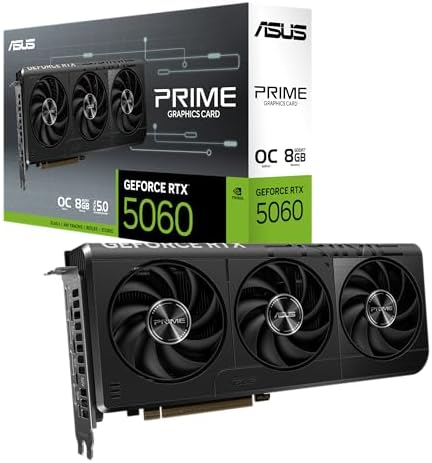
ASUS SFF-Ready Prime NVIDIA GeForce RTX 5060 8GB GDDR7 OC Edition Graphics Card
Bottom line: The ASUS SFF-Ready Prime NVIDIA GeForce RTX 5060 8GB GDDR7 OC Edition ($534.99 on Amazon as of 2026-10-30 20:20 UTC): 8GB GDDR7 on a PCIe 5.0 bus, newest memory standard in the class; main trade-off: 8GB VRAM limits 1440p texture settings in newer titles.
As an Amazon Associate, SpecPicks earns from qualifying purchases. Full disclosure →
*Price sourced from Amazon.com. Last updated 2026-10-30. Price and availability subject to change.
Pros & Cons
Pros
- ✓ 8GB GDDR7 on a PCIe 5.0 bus, newest memory standard in the class
- ✓ 630 AI TOPS via Blackwell architecture with DLSS 4 support
- ✓ SFF-Ready certification fits small-form-factor ITX builds
- ✓ 2595 MHz OC mode clock, up from the 2565 MHz default
- ✓ Dual BIOS plus HDMI/DP 2.1 outputs for high-refresh displays
Cons
- ✗ 8GB VRAM limits 1440p texture settings in newer titles
- ✗ 2.5-slot thickness still blocks an adjacent expansion slot
- ✗ Listing text claims a triple-fan setup on a compact 2.5-slot card
Manufacturer description
Experience primal performance with the ASUS Prime GeForce RTX 5060, an SFF-Ready Enthusiast GeForce Card featuring a 2.5-slot design for expansive compatibility, enhanced by a triple-fan setup for supreme airflow design for supreme cooling.
SpecPicks Verdict
SpecPicks scored ASUS SFF-Ready Prime NVIDIA GeForce RTX 5060 8GB GDDR7 OC Edition… using a rating × review-volume × price-fit model applied to our editorial and benchmark analysis across the retro graphics cards category. Compare with similarly-priced alternatives in the retro graphics cards category before committing. Judge it on the specification table and the price rather than on sentiment: check the figures that decide your use case, then put it side-by-side with two or three close alternatives in the Compare tool before clicking through.
Common buyer scenarios for retro graphics cards of this kind: matching it to an existing build, replacing a failing part, or upgrading from a previous-generation equivalent. Check the spec table below against your current setup — particularly socket / form-factor / power-rating fields — and confirm compatibility on the retailer's listing before purchase. Prices and stock are set by the retailer and may have moved since this page was last updated.
Key Features
- AI Performance: 630 AI TOPS
- OC Edition: 2595 MHz OC mode, 2565 MHz default mode
- Powered by the NVIDIA Blackwell architecture and DLSS 4.
- SFF-Ready Enthusiast GeForce Card.
- Axial-tech fans feature a smaller fan hub that facilitates longer blades and a barrier ring that increases downward air pressure
Full Specifications
| Brand | ASUS |
|---|---|
| GPU Series | NVIDIA RTX 50 Series |
| Model Name | PRIME-RTX5060-O8G |
| OC Edition | 2595 MHz OC mode, 2565 MHz default mode |
| Unit Count | 1 Count |
| Model Number | PRIME-RTX5060-O8G |
| AI Performance | 630 AI TOPS |
| Built-In Media | PRIME-RTX5060-O8G, Speedsetup manual, Thank you card |
| Number of Fans | 3 |
| GPU Clock Speed | 2565 megahertz |
| Mfr Part Number | PRIME-RTX5060-O8G |
| Number of Items | 1 |
| Number of Packs | 1 |
| Video Processor | NVIDIA |
| Antenna Location | Business, Gaming, Professional |
| Graphics Card Ram | 8 GB |
| Graphics Ram Size | 8 GB |
| Graphics Ram Type | GDDR7 |
| Compatible Devices | Desktop |
| Memory Clock Speed | 2565 MHz |
| Full listing title | ASUS SFF-Ready Prime NVIDIA GeForce RTX 5060 8GB GDDR7 OC Edition Graphics Card (PCIe 5.0, 8GB GDDR7, HDMI/DP 2.1, 2.5-Slot, Axial-tech Fans, Dual BIOS), 3 Year Warranty |
Performance Data
View gaming FPS, AI inference throughput, and synthetic scores for the GeForce RTX 5060 — the core hardware component in this product. Benchmarks sourced from TechPowerUp, PassMark, and the r/LocalLLaMA community.
Which local LLMs fit in 8 GB?
8 GB holds an 8B model at Q4 with a few thousand tokens of context; a 12–14B model needs 12 GB.
- ✅ 7–9B models (Llama 3.1 8B, Qwen 3 8B) — fits at Q4
- ❌ 12–14B models (Qwen 3 14B, Phi-4) — needs 12 GB+
- ❌ 20–27B models (Gemma 3 27B, Mistral Small) — needs 20 GB+
- ❌ 30–35B models (Qwen 3 32B, QwQ 32B) — needs 24 GB+
- ❌ 70B models (Llama 3.3 70B, Qwen 2.5 72B) — needs 48 GB+
Across 14 community runs from 4 sources, the GeForce RTX 5060 generates a median 58.5 tok/s on 7–9B models at Q4 (per DatabaseMart (Ollama GPU benchmark)).
Benchmark data for other graphics cards
Ready to buy?
ASUS SFF-Ready Prime NVIDIA GeForce RTX 5060 8GB GDDR7 OC Edition Graphics Card (PCIe 5.0, 8GB GDDR7, HDMI/DP 2.1, 2.5-Slot, Axial-tech Fans, Dual BIOS), 3 Year Warranty is listed on Amazon. Price, availability, shipping and returns are set by Amazon and its sellers — check the listing for current terms. SpecPicks earns a small commission on qualifying purchases — thank you for supporting independent review work.
*Price sourced from Amazon.com. Last updated 2026-10-30. Price and availability subject to change.
Related Retro Graphics Cards


More guides & deep dives from the SpecPicks archive
Browse all articles & guides →- Best Retro Handhelds in 2026 — From $35 to $500
- RTX 4070 Super vs RX 7800 XT — Which to Buy in 2026
- The Complete Voodoo5 5500 AGP Driver Guide (2026 Edition)
- How to Build a Windows 98 Retro PC in 2026
- Best 1440p Gaming GPUs in 2026
- Best Budget Gaming PC Build 2026 — ~$1,000 Parts List
- Emulation Hardware in 2026: FPGA, Software, and Cart-Reader Ecosystems
More reviews from the SpecPicks archive
Browse all reviews →- Handheld Gaming PCs Ranked: 2025's Best, Compared
- Best PC Cooling for High-TDP Builds in 2026
- $2,000 Gaming PC Build 2026: Parts, Cost, 1440p FPS
- RTX 3060 12GB vs 8GB in 2026: Which VRAM Tier Still Holds Up at 1080p
- Logitech G920 vs HORI Racing Wheel: Best Starter Sim Wheel in 2026
- Best Budget Sim Racing Wheel: Logitech G29 vs HORI vs Thrustmaster
- Minimal Raspberry Pi 5 Case: Friction-Fit 3D Printing Guide
- Best CPU Cooler for Intel Core i7/i9 Builds in 2026
- Retro Console Modding Services: What to Expect in 2026
- Ideogram 4.0 Open Weights: Running Text-to-Image on a 12GB GPU
- Intel i7-9700K vs Ryzen 7 5700X for 1080p Gaming (2026)
- Best SSD for a PS4 Pro Upgrade in 2026: 870 EVO vs BX500
- Is the KOORUI 27" 4K QD-Mini LED Worth It for RTX 3060 Gaming?
- RE Requiem and the AAA Games That Prove Steam Deck
- Grok 4.3 vs GPT-5 vs Claude 4.7: Local Hardware Implications of the Closed-Model Intelligence Index
- Self-Host Jellyfin on a Raspberry Pi 4 8GB in 2026
- A Practical Look at the PlayStation Architecture — and Why It Still Matters
- Running Your Own AI Guardrail Model on a 12GB GPU in 2026
- Blue Yeti vs HyperX QuadCast 2 S: Best USB Mic for Streaming
- pxpipe Hides Prompts in PNGs to Cut Claude Code Tokens 70% — Or Just Run Local on an RTX 3060
- Qwen 3.6 35B-A3B KV Cache Deep Dive: Memory, PPL, and Quantization Tradeoffs
- Can Local LLMs Actually Do Anything Useful?
- Logitech G502 Hero in 2026: Is the FPS Mouse King Still Worth It?
- Best Local LLM Parts to Buy Before the 2026 Memory Spike
Earliest SpecPicks reviews
Browse full archive →- Best GPU for Llama 3.1 8B (2026)
- Best GPU for Qwen 3 14B (2026)
- Best GPU for Qwen 3 32B (2026)
- Best GPU for Llama 3.1 70B (2026)
- Best GPU for DeepSeek-R1 32B (2026)
- Best GPU for Llama 3.1 405B (2026)
- How to run Llama 3.1 8B on NVIDIA GeForce RTX 5090
- How to run Qwen 3 14B on NVIDIA GeForce RTX 5090
- How to run Qwen 3 32B on NVIDIA GeForce RTX 5090
- How to run Llama 3.1 70B on NVIDIA GeForce RTX 5090
- How to run DeepSeek-R1 32B on NVIDIA GeForce RTX 5090
- How to run Llama 3.1 8B on NVIDIA GeForce RTX 4090