

FebSmart
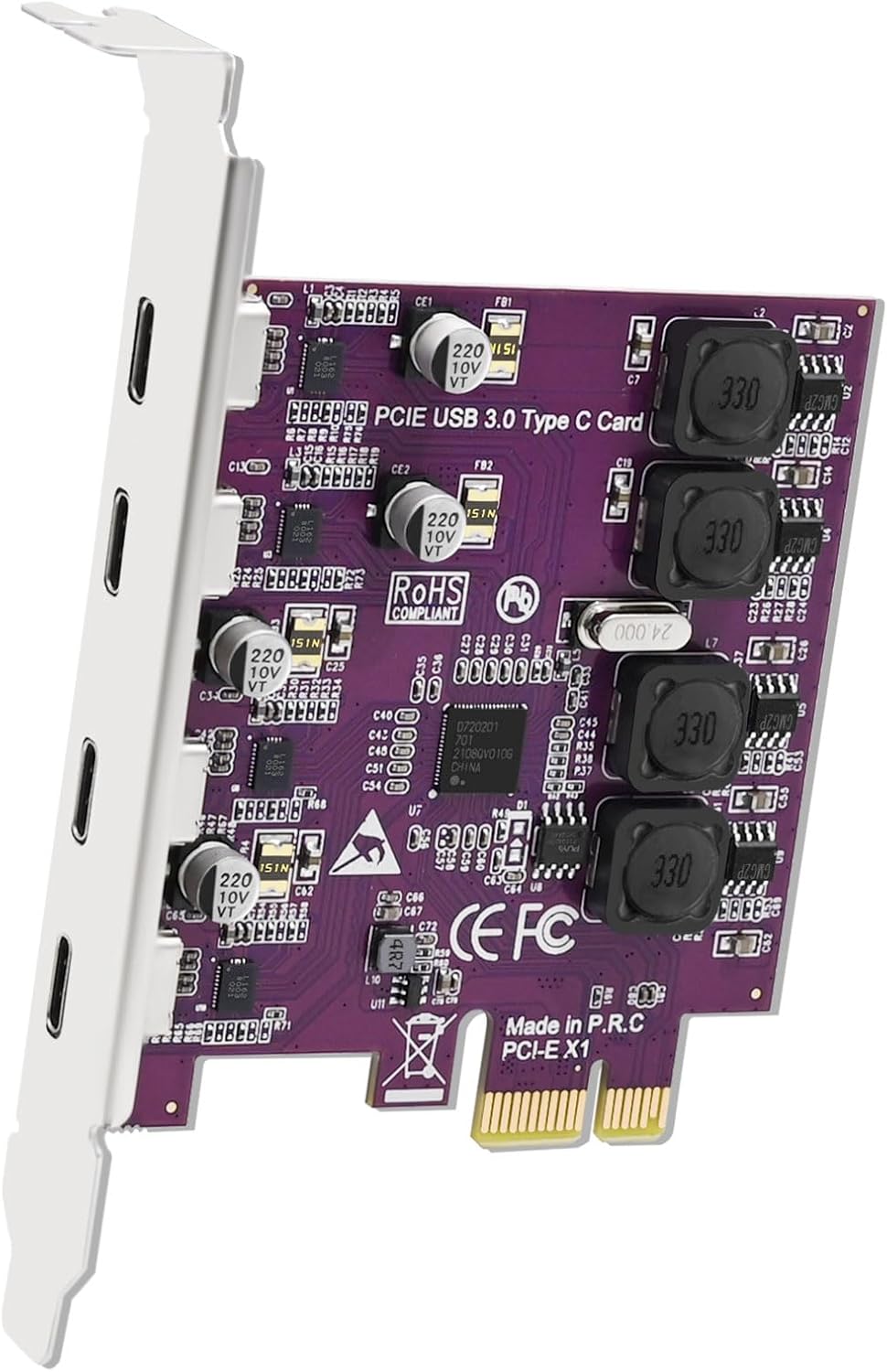
FebSmart 2X 10Gbps Max Speed USB-C Ports PCIE USB 3.1 GEN 2 Expansion Card for Windows
Bottom line: The 2X 10Gbps Max Speed USB-C Ports PCIE USB 3.1 GEN 2 Expansion Card: Two 10Gbps USB 3.1 Gen2 Type-C ports for NVMe enclosures, hubs and VR; main trade-off: needs a PCIe x4, x8 or x16 slot; won't run in x1 or x2 slots.
As an Amazon Associate, SpecPicks earns from qualifying purchases. Full disclosure →
Pros & Cons
Pros
- ✓ Two 10Gbps USB 3.1 Gen2 Type-C ports for NVMe enclosures, hubs and VR
- ✓ Self-powered design: no PSU cable, 5V/3A per port (5V/6A total)
- ✓ ASMedia ASM3142 controller auto-coordinates per-port bandwidth
- ✓ Bundled heat sink keeps components at peak 10Gbps speed
- ✓ Plug and play on Windows 11/10/8.x; driverless on macOS and Linux
Cons
- ✗ Needs a PCIe x4, x8 or x16 slot; won't run in x1 or x2 slots
- ✗ No Thunderbolt; USB-C ports lack ALT-DP video output
- ✗ 5V/6A total power is not rated for fast charging
- ✗ Full 10Gbps requires a PCIe 3.0 slot and Gen2 devices
SpecPicks Verdict
SpecPicks scored 2X 10Gbps Max Speed USB-C Ports PCIE USB 3.1 GEN 2 Expansion Card using a rating × review-volume × price-fit model applied to published specs and reviews across the expansion cards category. FebSmart's expansion cards lineup sits within the broader category mid-tier; price and specs are the deciding factors over brand loyalty here. Judge it on the specification table and the price rather than on sentiment: check the figures that decide your use case, then put it side-by-side with two or three close alternatives in the Compare tool before clicking through.
Common buyer scenarios for expansion cards of this kind: matching it to an existing build, replacing a failing part, or upgrading from a previous-generation equivalent. Check the spec table below against your current setup — particularly socket / form-factor / power-rating fields — and confirm compatibility on the retailer's listing before purchase. Prices and stock are set by the retailer and may have moved since this page was last updated.
Key Features
- 1. FebSmart FS-C2-Pro allow users add 2X 10Gbps USB 3.1 GEN2 Type C port on Desktop PCs, Working Stations, and MAC Pros. The 2X USB 3.1 GEN2 Type C Ports can provide superspeed plus 10Gbps max (16Gbps in total) data tramsfer rate for high power consumption USB 3.1 GEN2 peripheral devices, such as NVME SSD enclosures, SATA SSD/HDD enclosures, VR-Systems, 10Gbps USB hubs and USB-C video adapters.
- 2. Built in FebSmart Self-Powered Technology. No need to plug any power cables from PCs PSU, but each USB 3.1 GEN2 port will get 5V/3A (5V/6A in total, NOT for fast charging) max power supply. Ensure connected USB 3.1 GEN2 devices running superspeed plus 10Gbps max. Enjoy super easy installation with Plug & Play use on most Desktop PCs.
- 3. Based on ASMedia ASM3142 the 3rd generation USB 3.1 GEN2 host controller. Supports USB 3.1 GEN2 Mutiple INs function, will auto-coordinate each USB 3.1 GEN2 port banwidth. The added-on Heat-Sink will help PCIE USB 3.1 GEN2 card core components stay away from overheat, make sure USB 3.1GEN2 devices always stay at peak speed 10Gbps max.
- 4. Compatible System: 1. Plug and Play on Windows 11, 10, 8.x (32/64bit) and Windows Server 2012, 2012R2, 2016, 2019, 2022. 2. Need to install driver on Windows 7 (32/64bit) and Windows Server 2008, 2008R2(32/64bit). 3. Driver Free on MAC OS 10.9.x, 10.10.x, 10.12.x, 10.13.x, 10.14.x, 10.15.x and later system. NOT works on MAC OS 10.11. x. 4. Supports most main stream Linux kernels.
- 5. ATTENTION: 1. PCIE X4 interface design, will compatible with PCIE X4, X8, X16 slot, NOT works on PCIE X1, X2 slot. 2. Please use this PCIE USB card on PCIE 3.0 slot and works with USB 3.1 GEN2 devices or can not get 10Gbps peak speed. 3. Users must make sure PCs have one PCIE X16 slot, before purchase. 4. This is not thunderbolt expansion card, have USB 3.1 GEN2 features only, the USB-C not support ALT+DP function.
Full Specifications
| Brand | FebSmart |
|---|---|
| Style | FS-C2-Pro |
| Style Name | FS-C2-Pro |
| Connectivity | USB-C |
| Model Number | FS-C2-Pro |
| Compatibility | Mac, Linux |
| Item Type Name | PCIE X4 Interface to 2X 10Gbps USB-C Ports Expansion Card |
| Mfr Part Number | FS-C2-Pro |
| Compatible Devices | Personal Computer |
| Hardware Interface | PCIE x 4 |
| Warranty Description | 1 Year Limited Parts Warranty. |
| Item Dimensions L x W x H | 4.72"L x 3.19"W x 0.71"H |
| Full listing title | 2X 10Gbps Max Speed USB-C Ports PCIE USB 3.1 GEN 2 Expansion Card for Windows, MAC OS and Linux PCs, Built in FebSmart Self-Powered Technology, No Need Additional Power Supply (FS-C2-Pro) |
Ready to buy?
2X 10Gbps Max Speed USB-C Ports PCIE USB 3.1 GEN 2 Expansion Card for Windows, MAC OS and Linux PCs, Built in FebSmart Self-Powered Technology, No Need Additional Power Supply (FS-C2-Pro) is vintage hardware; the used and vintage market on eBay carries most of the live inventory. Prices and condition vary by seller and move in real time, so we link the live listing rather than quote a cached price. It also has an Amazon listing — check it for current price and availability. SpecPicks earns a small commission on qualifying purchases — thank you for supporting independent review work.
Related Expansion Cards



More guides & deep dives from the SpecPicks archive
Browse all articles & guides →- How to Build a Windows 98 Retro PC in 2026
- RTX 4070 Super vs RX 7800 XT — Which to Buy in 2026
- Emulation Hardware in 2026: FPGA, Software, and Cart-Reader Ecosystems
- Best Budget Gaming PC Build 2026 — ~$1,000 ($800 on Sale)
- The Complete Voodoo5 5500 AGP Driver Guide (2026 Edition)
- Best Retro Handhelds in 2026 — From $35 to $500
- Best 1440p Gaming GPUs in 2026
More reviews from the SpecPicks archive
Browse all reviews →- RetroPie Handheld Shells in 2026: Pick the Right Pi for Your DIY Handheld
- If Your Steam Deck Broke, Would You Buy Another?
- Home Assistant Air Quality Monitor: 2025 Setup Guide
- Why Preassembled PCs Beat DIY Builds in 2026
- Period-Correct Windows 95 Pentium MMX Build Guide: 3dfx Voodoo 1, AWE32, and Authentic 1996 Gaming
- Best GPU for the Ryzen 7 5800X3D in 2026: No-Bottleneck Picks
- Mistral Leanstral 1.5: Running the New Open Math Model on a 12GB RTX 3060
- Raspberry Pi 4 8GB vs Pi 5 vs Pi Zero W for a 2026 Homelab
- Prime Big Deal Days 2026: Best Mini PC Deals for Local AI and Home Labs
- Best Monitor Deals for Prime Big Deal Days 2026: 5 Picks for Gaming and AI Desks
- Claude Sonnet 5 Closes the Opus Gap: When Local Still Wins
- Qwen MTP on LLaMA.cpp + TurboQuant: What's Actually Verified
- Best Mouse Pad for FPS and MOBA Esports Players (2026)
- Best Capture Device for Recording Retro Consoles and Old PCs in 2026
- Why NVIDIA Killed 3dfx: How the Voodoo Brand Still Haunts Modern GPU Launches
- AI-Driven Driver Install on WinXP: Vision LLM Walks the Audigy FX Setup
- Best Budget SSD for a Gaming PC in 2026: SATA vs NVMe
- Qwen 3.6 27B vs DeepSeek V4: Which Local Model Wins on a Single 5090?
- Claude Opus 4.8 Tops the Intelligence Index: Cloud vs Local on a 3060
- Best Home Office Monitor Under $200 (2026)
- KOORUI 27" 4K QD-Mini LED: Is a Budget 4K Gaming Monitor Enough for an RTX 3060?
- Dumping Big-Box CD-ROM Games in 2026 with an IDE-to-USB Adapter
- MSI RTX 3060 Ventus 2X vs ZOTAC RTX 3060 Twin Edge: Which $300 1080p GPU Wins in 2026?
- ComfyUI on an RTX 3060 12GB: Stable Diffusion & Flux Throughput in 2026
Earliest SpecPicks reviews
Browse full archive →- Best GPU for Llama 3.1 8B (2026)
- Best GPU for Qwen 3 14B (2026)
- Best GPU for Qwen 3 32B (2026)
- Best GPU for Llama 3.1 70B (2026)
- Best GPU for DeepSeek-R1 32B (2026)
- Best GPU for Llama 3.1 405B (2026)
- How to run Llama 3.1 8B on NVIDIA GeForce RTX 5090
- How to run Qwen 3 14B on NVIDIA GeForce RTX 5090
- How to run Qwen 3 32B on NVIDIA GeForce RTX 5090
- How to run Llama 3.1 70B on NVIDIA GeForce RTX 5090
- How to run DeepSeek-R1 32B on NVIDIA GeForce RTX 5090
- How to run Llama 3.1 8B on NVIDIA GeForce RTX 4090