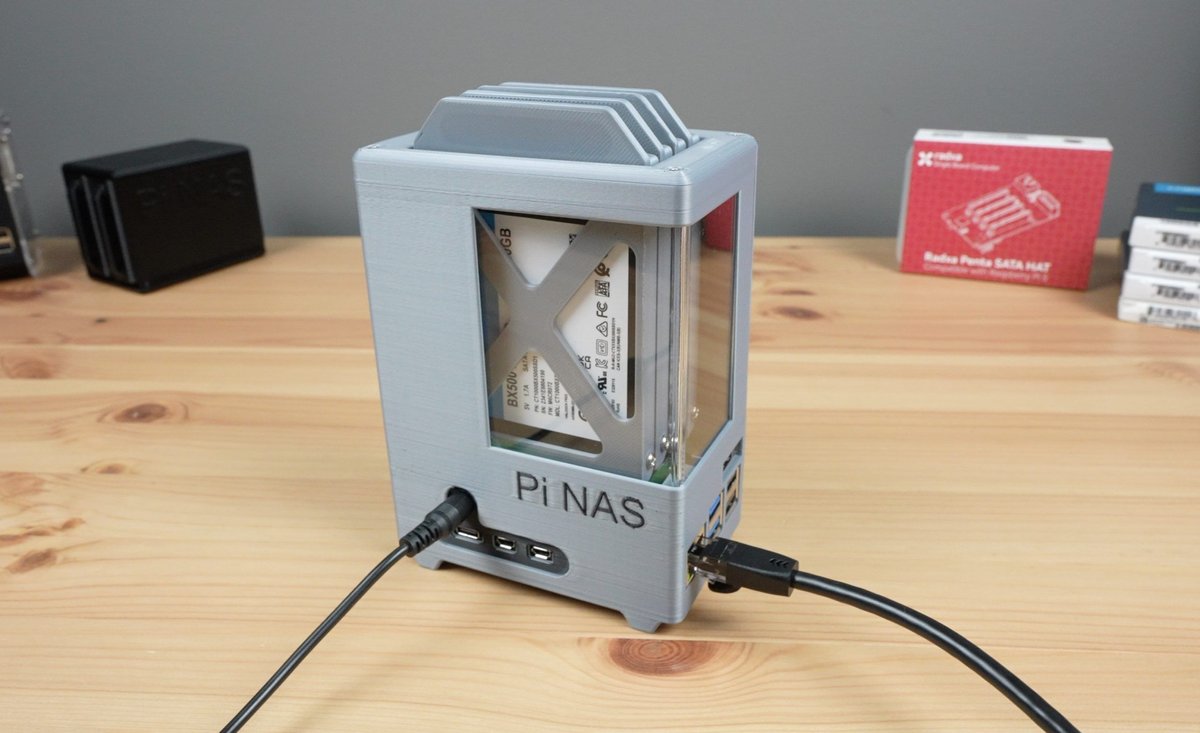
A clean, near-silent Raspberry Pi 5 NAS build is trending on r/raspberry_pi this week, and the appeal is obvious: it pairs a low-power single-board computer with a quiet Noctua-style fan and SSD storage to make an always-on home file server that costs little and makes almost no noise. Here is exactly what goes into it, why builders are copying it, and how to assemble your own — including a more affordable Raspberry Pi 4 8GB version that does the same job for less.
In brief — 2026-05-27 · A clean Noctua-cooled Raspberry Pi 5 NAS build is trending on r/raspberry_pi; here is what it uses and why builders are copying it.
What happened
A builder posted a tidy Raspberry Pi 5 network-attached-storage rig that quickly climbed the maker subreddit's hot list. The build's signature is restraint: a Raspberry Pi 5 board, a low-noise Noctua-style fan for active cooling, and — crucially — an SSD instead of a microSD card as the boot and storage device. The whole thing lives in a compact case small enough to sit on a shelf and quiet enough to forget it is running.
The cooling approach is what gives the build its "Noctua-style" name. Rather than letting the board passively bake or run a screaming 40mm fan, the builder fitted a quiet, larger fan tuned for near-silent operation. For a device that idles most of the day and only spins up during transfers and overnight backups, that low-noise profile is the entire point.
The storage layout is the other half of the story. The Pi boots from and serves files off a solid-state drive — either a SATA SSD in a USB enclosure or, on the Pi 5, an NVMe drive via a PCIe HAT — rather than the SD slot. A modest 1TB SSD such as the Crucial BX500, WD Blue SN550, or SanDisk Ultra 3D gives the server real capacity and the endurance a NAS needs.
Here is the core parts list builders are copying:
| Part | Role | Example |
|---|---|---|
| Single-board computer | The brains and network interface | Raspberry Pi 5, or Raspberry Pi 4 8GB for budget |
| Storage drive | Boot + file storage | Crucial BX500 1TB or WD Blue SN550 1TB |
| Active cooling | Quiet sustained-load cooling | Noctua-style low-noise fan + heatsink |
| Case | Mounting + airflow | Compact NAS-style case with fan cutout |
| Power supply | Stable board power | Official USB-C PSU for the board |
| microSD (optional) | First-boot installer only | 16-32GB card |
Why it matters
A Raspberry Pi NAS is not going to beat a rackmount server, and it does not try to. What it offers is a silent, always-on, low-power home file server that costs a fraction of a prebuilt unit once you account for drives — and that is a combination plenty of people want.
The SSD-over-SD reliability angle is the most important lesson here. MicroSD cards wear out quickly under the constant small writes a NAS generates, and they can corrupt silently — you find out your backups were bad exactly when you need them. A SATA or NVMe SSD offers far higher write endurance, better random performance, and more capacity, which is why nearly every serious Pi NAS build boots and stores data on an SSD rather than the SD slot. If you take one thing from the trending build, make it this: do not run a NAS off a microSD card. The same SSD reliability logic that drives our best SATA SSD for a game library and best budget SSD upgrade guides applies just as strongly to a 24/7 file server.
On cost, the Pi route wins for the right buyer. A Pi NAS with an 8GB board, a case, cooling, and a 1TB SSD typically lands well under the price of a comparable prebuilt two-bay enclosure once you add drives. The tradeoff is more setup work and lower raw throughput over gigabit Ethernet. If you want turnkey convenience and dual-drive redundancy out of the box, buy an appliance. If you want a quiet, cheap, low-power always-on server and do not mind an afternoon of configuration, the Pi is hard to beat.
On power, the Pi is in a class of its own. A full Pi NAS draws a handful of watts at idle, so leaving it on around the clock costs almost nothing on your electricity bill — unlike a repurposed desktop or an x86 mini-PC pulling 20-40W idle.
Pi 5 or Pi 4 8GB?
The trending build uses a Pi 5, and the extra CPU headroom and faster PCIe-based storage are genuinely nice. But you do not need a Pi 5 for a small home NAS. The Raspberry Pi 4 Model B 8GB drives a one-or-two-user NAS comfortably over gigabit Ethernet, and it is the budget on-ramp many builders pick. If your workload is a media library, a backup target, or file shares for a couple of devices, the Pi 4 8GB is an excellent and affordable base for this exact build. Step up to the Pi 5 if you want headroom for containers, faster NVMe storage, or more simultaneous clients.
Picking the storage drive
For the drive itself, capacity and endurance matter more than peak speed — a NAS is bottlenecked by gigabit Ethernet (~110 MB/s) long before it is bottlenecked by any modern SSD. That means a value-tier SATA drive like the Crucial BX500 1TB or SanDisk Ultra 3D 1TB is a smart choice in a USB enclosure, while the WD Blue SN550 1TB NVMe drive makes sense if you are on a Pi 5 with a PCIe HAT. Crucial and the others all publish endurance (TBW) ratings; for a NAS, higher is better, but even value drives far outlast a microSD card.
What software runs on a Raspberry Pi NAS?
The hardware is only half the build. The two common software paths are:
- OpenMediaVault — a friendly, web-managed NAS operating system that handles shares, users, and disk management through a browser. It is the easiest route for newcomers and runs well on an 8GB board.
- Plain Linux + Samba/NFS — a standard Raspberry Pi OS install with Samba (for Windows/macOS shares) and NFS (for Linux clients) configured by hand. More work, more control.
For backups, layer in tools like Syncthing (peer-to-peer sync) or rsync (scheduled pulls). Both give you a flexible home server without the licensing or power cost of a commercial appliance.
Common pitfalls builders hit
- Booting from microSD "just to start." It is fine for the first install, but move the OS to the SSD before you put the NAS into service. Long-term SD boot is the number-one cause of Pi NAS corruption.
- Underpowering the board. USB SSDs and HATs draw real current. Use the official PSU for your board; flaky power causes drives to drop and filesystems to corrupt.
- No active cooling under sustained load. A NAS that idles cool can still throttle during a long parity check or large transfer. The Noctua-style fan in the trending build exists for exactly these moments.
- Expecting 10GbE speeds. The Pi's network interface is gigabit; plan around ~110 MB/s real-world transfers, not SSD sequential numbers.
- No backup of the backup. A single-drive NAS is convenient storage, not redundancy. Keep a copy of anything irreplaceable somewhere else.
Real-world performance: what to expect
It helps to set expectations with concrete numbers before you build. A Raspberry Pi NAS is bottlenecked by its single gigabit Ethernet port, which caps sustained transfers at roughly 110 MB/s in ideal conditions — and real-world Samba transfers often land in the 80-110 MB/s range depending on protocol overhead and the client. That is more than fast enough to stream multiple 4K media files, run backups overnight, or serve documents to a household, but it is not the multi-gigabit throughput a NAS appliance with 2.5GbE or a NIC-equipped x86 box can hit.
| Workload | Pi 4 8GB NAS | Pi 5 NAS | Notes |
|---|---|---|---|
| Gigabit file transfer | ~80-110 MB/s | ~80-110 MB/s | Both saturate 1GbE |
| Simultaneous streams | 2-3 comfortably | Several | Pi 5 has more CPU headroom |
| Idle power draw | A few watts | A few watts | Trivial 24/7 cost |
| Storage interface | USB 3.0 (SATA enclosure) | USB 3.0 or PCIe NVMe HAT | Pi 5 adds native NVMe option |
The Pi 5's advantage is not raw network throughput — both boards saturate gigabit — but headroom: more CPU for parity checks, container workloads, and concurrent clients, plus faster local storage access via a PCIe NVMe HAT. For a simple file-and-backup server, the Pi 4 8GB is genuinely all most people need; the Pi 5 is the choice when you want to run extra services alongside the NAS.
A worked cost example
Consider a realistic budget build on a Pi 4 8GB: the board itself, a compact case with a low-noise fan, the official power supply, a microSD card for first boot, and a 1TB Crucial BX500 in a USB 3.0 SATA enclosure. That bill of materials lands well under what a comparable prebuilt two-bay NAS costs once you add a drive — and the prebuilt's price climbs further as you scale capacity. The Pi route trades your time (an afternoon of setup) for money saved and a quieter, lower-power result. If you value turnkey redundancy and a polished app ecosystem, pay for the appliance; if you value cost and control, the Pi wins.
When a Pi NAS is the wrong choice
Be honest about the limits before you build. A Raspberry Pi NAS is the wrong tool if you need multi-gigabit throughput, hardware RAID across many drives, transcoding several 4K streams simultaneously, or enterprise-grade redundancy and alerting. The single gigabit port and modest CPU cap what it can do, and bolting on USB drive arrays gets fragile fast. For those workloads, a dedicated NAS appliance or a low-power x86 mini-PC with proper SATA ports is the better foundation. The Pi shines specifically at the quiet, cheap, low-power, single-user-or-household tier — push past that and you are fighting the hardware.
Build it yourself: the short version
- Flash Raspberry Pi OS or OpenMediaVault to a microSD for first boot.
- Attach your SSD (USB enclosure on Pi 4; NVMe HAT on Pi 5) and migrate the OS to it.
- Fit the heatsink and the low-noise fan; seat the board in a case with a fan cutout.
- Configure Samba/NFS shares or set up OpenMediaVault through its web UI.
- Add Syncthing or scheduled rsync jobs for backups, and you are done.
Bottom line
The viral Noctua-style Pi 5 NAS is popular because it nails the brief: silent, cheap, low-power, always-on storage. Copy the two decisions that make it work — SSD instead of SD, and quiet active cooling — and the rest is preference. Build it on a Pi 5 if you want headroom, or save money with a Raspberry Pi 4 8GB and a value 1TB SSD; either way you end up with a home server that earns its shelf space and disappears into the background.


