

BEYIMEI
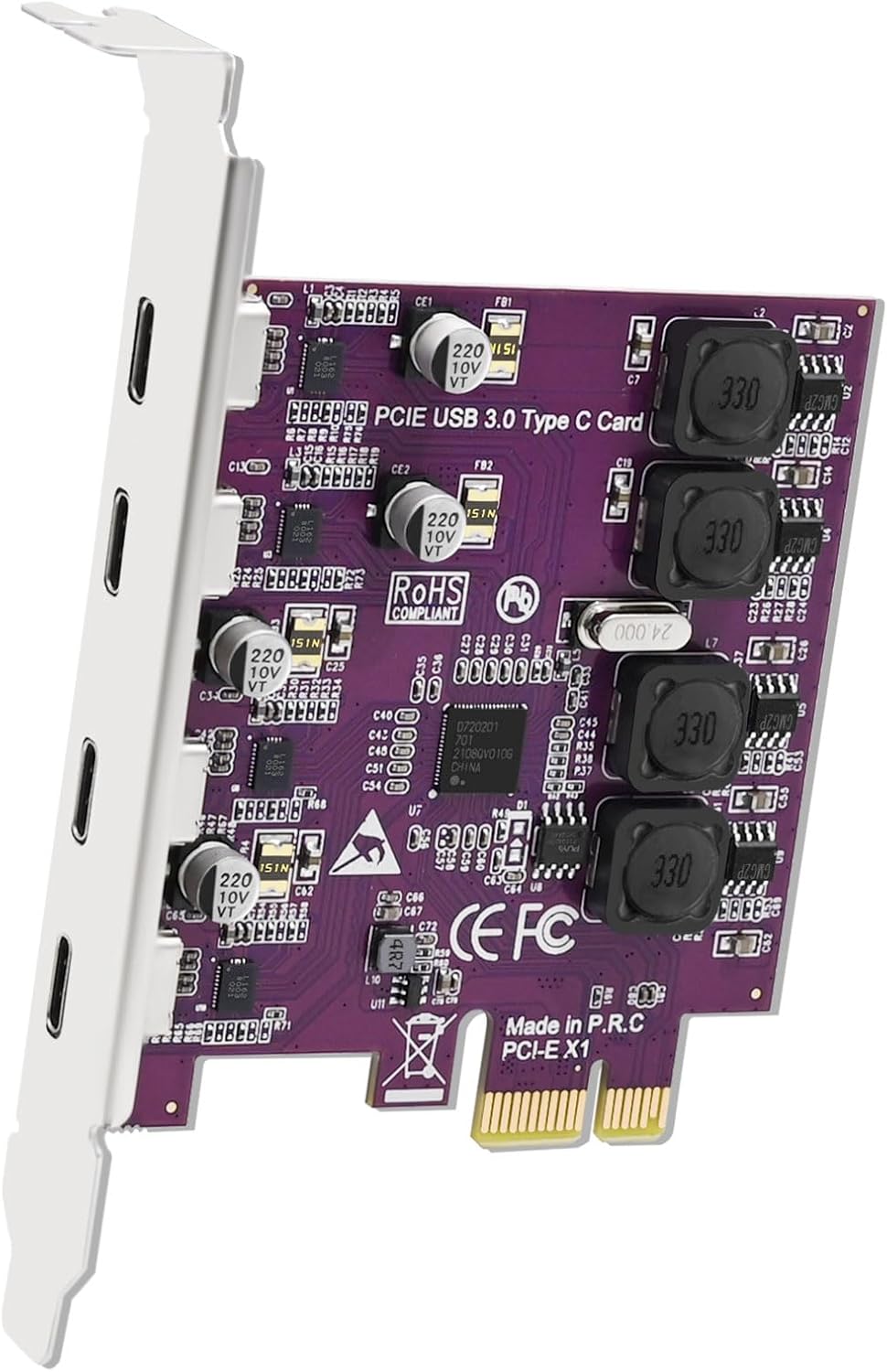
5Gbps Superspeed USB3.0 PCIe X1 Expansion Card 2 External Ports + Internal 19Pin USB3.0 Header PCI-E Controller Adapter Supports Win XP/7/8/10
Bottom line: The 5Gbps Superspeed USB3.0 PCIe X1 Expansion Card 2 External Ports +: Adds 2 rear USB 3.0 Type-A ports plus a 19-pin front-panel header; main trade-off: only 2 external ports, so heavy USB users may run short.
As an Amazon Associate, SpecPicks earns from qualifying purchases. Full disclosure →
Pros & Cons
Pros
- ✓ Adds 2 rear USB 3.0 Type-A ports plus a 19-pin front-panel header
- ✓ Feeds front-case USB 3.0 to old boards lacking a 19-pin header
- ✓ Plug-and-play on Win 10/8; driver only for XP/Vista/7
- ✓ Wide OS support: Windows XP/2003/Vista/7/8/10, 32 and 64-bit
Cons
- ✗ Only 2 external ports, so heavy USB users may run short
- ✗ Uses a PCIe x1 slot you might want for another card
- ✗ XP/Vista/7 need the bundled CD driver installed manually
- ✗ USB 3.1 Gen 1 (5Gbps) only, no 10Gbps Gen 2 speeds
Manufacturer description
Product DescriptionWith the popularity of USB 3.0, more and more computer cases offer a 19-pin USB3.0 port on the front of the case,but the old motherboards do not support USB3.0 or do not have a 19PIN interface!At this point, you can convert the PCI-E signal to the 19-pin USB3.0 port and 2 rear USB3.0 ports via the motherboard's PCI-E slot, and then convert the 19PIN of the panel to the Insert expansion card so that it offers the front super high-speed USB3.0 interface is very practical!Specifications:※ Compatible with the PCI Express specification version 2.0※ Compatible with the USB3.0…
SpecPicks Verdict
SpecPicks scored 5Gbps Superspeed USB3.0 PCIe X1 Expansion Card 2 External Ports +… using a rating × review-volume × price-fit model applied to published specs and reviews across the expansion cards category. BEYIMEI's expansion cards lineup sits within the broader category mid-tier; price and specs are the deciding factors over brand loyalty here. Judge it on the specification table and the price rather than on sentiment: check the figures that decide your use case, then put it side-by-side with two or three close alternatives in the Compare tool before clicking through.
Common buyer scenarios for expansion cards of this kind: matching it to an existing build, replacing a failing part, or upgrading from a previous-generation equivalent. Check the spec table below against your current setup — particularly socket / form-factor / power-rating fields — and confirm compatibility on the retailer's listing before purchase. Prices and stock are set by the retailer and may have moved since this page was last updated.
Key Features
- 【Multiport expansion card】The PCI-E expansion card provides 2 external USB 3.1 Gen 1 ports (2 USB Type-A ports) for your computer. You can connect keyboard, mouse, external hard disks, CD/DVD drives, webcams, USB printers, scanners, game controllers, digital cameras, etc.
- 【Extensive compatibility】 The card is compatible with Windows XP / 2003 / Vista/7/8/10/(32/64 bit). The card only requires the installation of a driver, which you can download from our CD driver if you are using Windows 7. Note: Windows XP,/Vista/7, Server, requires driver installation, Win10/Win8 does not require drivers.
- 【High-Speed】 Supports transfer rates of up to 5 Gbps when copying HD videos, music, photos and data files between USB devices and the computer at lightning-fast speeds. Note: The actual transfer speed is limited by the setting of the connected device.
- 【Stable and easy to use】 The internal USB ports card is provided by the motherboard through the PCI Express 1X slot to ensure a stable connection and improve data transfer speed. Does not lose the connection problem like an external USB hub.
- 【Easy to install】 Shut down the PC, disconnect the power supply, remove the PC case, slide the card into the PCIe socket and tighten the screws, and close the PC case cover, turn on the PC and install the driver. quick and easy installation, a simple solution to connect and use USB 3.0 devices on your standard desktop PC.
Full Specifications
| Brand | BEYIMEI |
|---|---|
| Style | Classic |
| Style Name | Classic |
| Unit Count | 1 Count |
| Connectivity | USB |
| Model Number | PCE4USB-R01 |
| Compatibility | PC |
| Mfr Part Number | usb |
| Compatible Devices | Personal Computer |
| Hardware Interface | USB 3.0 |
| Warranty Description | 1Year |
Ready to buy?
5Gbps Superspeed USB3.0 PCIe X1 Expansion Card 2 External Ports + Internal 19Pin USB3.0 Header PCI-E Controller Adapter Supports Win XP/7/8/10 is vintage hardware; the used and vintage market on eBay carries most of the live inventory. Prices and condition vary by seller and move in real time, so we link the live listing rather than quote a cached price. It also has an Amazon listing — check it for current price and availability. SpecPicks earns a small commission on qualifying purchases — thank you for supporting independent review work.
Related Expansion Cards



More guides & deep dives from the SpecPicks archive
Browse all articles & guides →- RTX 4070 Super vs RX 7800 XT — Which to Buy in 2026
- The Complete Voodoo5 5500 AGP Driver Guide (2026 Edition)
- Emulation Hardware in 2026: FPGA, Software, and Cart-Reader Ecosystems
- Best 1440p Gaming GPUs in 2026
- How to Build a Windows 98 Retro PC in 2026
- Best Budget Gaming PC Build 2026 — ~$1,000 ($800 on Sale)
- Best Retro Handhelds in 2026 — From $35 to $500
More reviews from the SpecPicks archive
Browse all reviews →- GTX 1660 VRAM: Why 8GB Doesn't Exist (Real Specs)
- Active Quake 3 and OpenArena Servers in 2026 — How to Find and Join Them
- Mac Mini M4 vs RTX 3060 12GB for Local LLMs: Which Actually Wins?
- NVIDIA H200 vs B200 for LLM Inference: What Changes in 2026
- Best IDE & CompactFlash to USB Adapters for Retro PCs 2026
- Build a Raspberry Pi 4 Cyberdeck Music Workstation in 2026
- Crucial BX500 vs Samsung 870 EVO vs SanDisk SSD Plus: Best Budget SATA SSD
- DIY Open-Source Photo Frame: Pi Zero 2 W + Immich
- AMD Instinct MI300X vs Consumer GPUs: What Local AI Builders Should Buy in 2026
- CompactFlash as a Hard Drive: The Win98 Retro Storage Guide
- Sound BlasterX G6 for DOS and Win98 Retro Gaming: SBEMU and Real-Mode Audio
- Best GPU for Llama 70B Local Inference in 2026: RTX 3060 12GB Dual vs RTX 3090 vs Gorgon Halo
- RTX 3060 12GB vs Intel Arc B580 for Stable Diffusion
- Hy3-Preview vs DeepSeek V4 Flash: Where the New Open-Weights Model Actually Lands
- Lenovo G02 Retro Handheld Ships Preloaded With Thousands of Games
- RTX 5080 vs RTX 5070: Which Blackwell GPU Should You Buy in 2026?
- ComfyUI for local image generation — the 2026 setup guide
- Jan vs LM Studio: The Best No-Terminal Local LLM App for an RTX 3060 (2026)
- Small Form Factor Gaming PC Build Guide for 2024
- AVX-512 Speeds Up Linux Software RAID by Up to 41% on AMD Ryzen
- Headset Mic vs USB Mic for Discord and Twitch: Recon 50 vs Blue Yeti
- Best Motherboard for Ryzen 7 9800X3D in 2026
- Local LLMs on Refurb M4 Max vs New M5 Max: What the LocalLLaMA Numbers Show
- Self-Hosted Jellyfin on a Raspberry Pi 4 8GB: What 1080p Transcoding Really Costs
Earliest SpecPicks reviews
Browse full archive →- Best GPU for Llama 3.1 8B (2026)
- Best GPU for Qwen 3 14B (2026)
- Best GPU for Qwen 3 32B (2026)
- Best GPU for Llama 3.1 70B (2026)
- Best GPU for DeepSeek-R1 32B (2026)
- Best GPU for Llama 3.1 405B (2026)
- How to run Llama 3.1 8B on NVIDIA GeForce RTX 5090
- How to run Qwen 3 14B on NVIDIA GeForce RTX 5090
- How to run Qwen 3 32B on NVIDIA GeForce RTX 5090
- How to run Llama 3.1 70B on NVIDIA GeForce RTX 5090
- How to run DeepSeek-R1 32B on NVIDIA GeForce RTX 5090
- How to run Llama 3.1 8B on NVIDIA GeForce RTX 4090