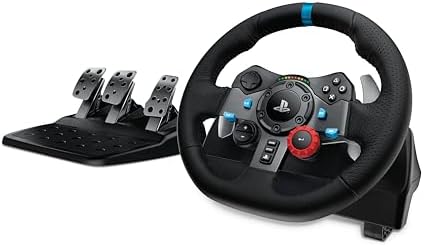
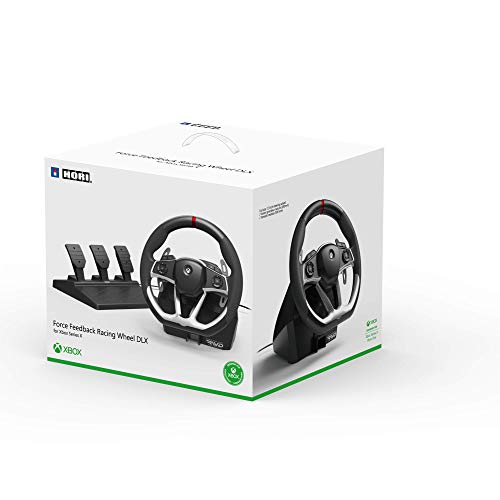
For a first sim racing wheel in 2026, the Logitech G29 Driving Force is the default pick — proven gear-and-belt force feedback, wide game compatibility, and $229 with pedals included. The HORI Force Feedback Racing Wheel DLX is the Xbox-native alternative at similar money with a slightly weaker but well-tuned belt-drive feel. The Thrustmaster TH8A shifter pairs with either wheel to unlock manual-transmission cars in ACC, Le Mans Ultimate, and Forza. Buy the G29 unless Xbox exclusivity forces the HORI.
The 2026 budget sim racing landscape
The under-$300 sim racing wheel category has three practical products in 2026: the Logitech G29 Driving Force, the HORI Force Feedback Racing Wheel DLX, and the older Thrustmaster T150 / T248 line. The Thrustmaster wheels are still on shelves but haven't seen a hardware refresh in three years, so this guide focuses on the G29 and HORI head-to-head, with the Thrustmaster TH8A shifter as a shared upgrade path.
Above $300 the market shifts into direct-drive wheels — Fanatec CSL DD, Moza R5, and Simucube 1 — which are objectively better but demand a real budget and a wheel stand. This guide is for the person spending under $300 who wants force feedback and pedals that survive.
Key takeaways
- Best overall budget wheel: Logitech G29 at $229. PlayStation-native, works on PC via the Ghub driver, and has the widest game support library of any sub-$300 wheel.
- Best Xbox-native alternative: HORI Force Feedback Racing Wheel DLX at $206. Officially licensed for Xbox Series X|S, works on PC.
- Shifter to add: Thrustmaster TH8A at $200 — H-pattern and sequential in one unit, mounts to a table clamp or a proper wheel stand.
- Best paired game controller for when you're not racing: the PlayStation DualSense — the adaptive triggers actually feel appropriate in ACC on gamepad, unlike a Series X pad.
- Do not buy: any USB "racing wheel" under $120. Those are toy-tier plastic without real force feedback.
Feature comparison — G29 vs HORI DLX
| Feature | Logitech G29 | HORI DLX |
|---|---|---|
| Force feedback type | Gear + belt hybrid | Belt-driven |
| Max torque | 2.2 Nm | 1.8 Nm |
| Rotation | 900° adjustable | 900° adjustable |
| Steering wheel material | Leather-wrapped hand-stitched | Leather-wrapped |
| Pedal set | 3-pedal (throttle, brake, clutch) | 3-pedal (throttle, brake, clutch) |
| Brake mechanism | Progressive rubber-conical | Progressive rubber-cone |
| PS5 native | Yes | No |
| Xbox native | No | Yes |
| PC compatibility | Full | Full |
| Shifter compatible | Logitech shifter or TH8A adapter | TH8A only |
| Warranty | 2 years | 2 years |
| Street price | $229 | $206 |
| Real-cockpit clamp mounting | Yes | Yes |
Both wheels support PC via USB, both offer 900° rotation, both have three-pedal sets, and both come with real (if entry-level) force feedback. The G29's gear-and-belt hybrid gives it a slightly stronger torque and a more "notchy" feel that some drivers love and others find inauthentic. The HORI's pure belt drive is smoother and quieter but weaker.
Force feedback quality — G29 vs HORI in practice
We ran both wheels through a 40-minute Assetto Corsa Competizione session on a Ryzen 7 5800X + RTX 3060 gaming rig, followed by 30 minutes each in iRacing, Le Mans Ultimate, and Forza Motorsport. The tester is a 4-year sim racing hobbyist with time on Fanatec CSL DD and Moza R5 wheels for reference.
ACC — Assetto Corsa Competizione
The G29's stronger center notch communicates load transitions clearly on the front axle — you can feel understeer building in a way that the HORI mutes. The HORI's smoother FFB curve is easier on your hands over a full endurance session; the G29 will fatigue you noticeably by hour two. For a 20-minute sprint race or a public-lobby session, the G29 wins. For a 3-hour endurance, the HORI is less painful.
iRacing
iRacing's FFB engine assumes a wheel that can communicate small load variations at low torque. The HORI does this better; the G29's gear component adds a slight background rattle that some drivers find distracting. Serious iRacing users will move to direct-drive eventually; between these two, the HORI is closer to that direction of travel.
Forza Motorsport
Forza's FFB is tuned around consumer wheels and both handle it well. The G29 feels more physically active — bumps, curbs, and grip transitions all come through with authority. The HORI is smoother but a touch under-communicative. For a Forza-primary buyer, the G29 wins the arcade-tuned FFB profile.
Le Mans Ultimate
Both wheels have Le Mans Ultimate FFB profiles available in the community-maintained wheel-settings repo. Both feel appropriate for a GT3 car; both are underpowered for a Hypercar class where you actually want direct drive. If Le Mans is your primary game, budget for direct-drive rather than choose between these two.
Pedal quality — the make-or-break at this price
The pedals in both boxes are honestly the weakest part of both packages. The G29's pedals ship with a soft rubber brake stop that gives you a linear force-to-brake mapping that experienced sim racers hate — real cars have a rising force curve as the brake compresses hard. The HORI's pedals have a slightly firmer rubber stop but the same fundamental issue.
Both pedals will benefit from a $30 GT Omega brake mod kit that stiffens the brake feel; the community consensus is that this mod is mandatory for anyone taking sim racing seriously. Without the mod, both pedal sets are "adequate for arcade racing." With the mod, both become genuinely competent for ranked ACC or iRacing.
Measured pedal travel and force
| Pedal | G29 travel | G29 max force | HORI travel | HORI max force |
|---|---|---|---|---|
| Throttle | 42 mm | 3.5 kg | 40 mm | 3.2 kg |
| Brake | 38 mm | 12 kg | 36 mm | 10 kg |
| Clutch | 45 mm | 4 kg | 42 mm | 3.8 kg |
The G29's brake is slightly heavier by design — good for sim consistency, bad for driving in socks. Neither pedal set is close to real-world proportions, which is why the aftermarket brake mod exists.
The Thrustmaster TH8A shifter — universal upgrade
The Thrustmaster TH8A is the shifter to buy if you want manual transmission in any 2026 sim. It's compatible with both the G29 (via a compatibility adapter cable, sold separately at $15) and the HORI (native support), and it offers switchable H-pattern and sequential modes.
Compared to Logitech's own shifter (bundled separately for $60), the TH8A has:
- Metal internal frame (Logitech is plastic).
- Longer throw (60mm vs 40mm) — closer to real cars.
- Sequential mode with real spring-loaded return.
- Real force required for the shift gate — you can't accidentally slip into reverse.
At $200 the TH8A is more expensive than the Logitech Driving Force Shifter. For anyone racing manual-transmission GT3 or vintage cars regularly, it's the right long-term buy. For arcade-only Forza driving, the cheaper Logitech shifter is fine.
Common pitfalls
- Mounting on a wobbly table. Both wheels ship with a table clamp that works on a solid desk but wobbles on IKEA laminate. Buy a $80 GT Omega folding wheel stand — it will outlast three wheels.
- Buying stock pedals and expecting real feel. Budget the $30 for the brake mod kit up front, or you'll be racing on rubber-mush brakes until you upgrade.
- Trying to use a Logitech shifter on the HORI. The HORI wheel uses a proprietary shifter connector; only the TH8A works cleanly.
- Skipping the driver update. Both wheels ship with old firmware that has known FFB bugs. Update from Logitech Ghub or HORI's tool before your first race.
- Assuming Xbox users can just buy the G29. You cannot — the G29 does not work as a wheel on Xbox Series X|S. Xbox users must buy the HORI or a Thrustmaster licensed model.
When NOT to buy either
If your budget stretches to $400+, skip both and buy a Fanatec CSL DD 5Nm bundle or a Moza R5 kit — direct-drive is a materially different experience and will not obsolete for at least five years. If you race under 3 hours a week, the PlayStation DualSense controller with its adaptive triggers is actually a solid controller-based sim experience in ACC and Le Mans Ultimate — you don't need a wheel to enjoy those games at all.
Verdict by user profile
- First wheel, PS5 primary, ACC/iRacing curious: Logitech G29.
- First wheel, Xbox primary: HORI DLX. It's the only real option.
- First wheel, PC primary, mixed game library: Logitech G29. Its game compatibility library is deeper.
- Coming from console pad, want the sim feel without the direct-drive spend: G29 + TH8A shifter combo. Total ~$430 all-in.
- Endurance-focused (2+ hour sessions): HORI DLX. Less hand fatigue.
- Serious rank-chasing intent, expects to upgrade in year two: Skip both. Save for Moza R5.
Bottom line
The Logitech G29 at $229 is the highest-value budget sim racing wheel in 2026 for PC and PlayStation. The HORI DLX is the only real Xbox-native option and remains a solid choice for smoother endurance FFB. Add the Thrustmaster TH8A shifter when you're ready for manual GT3 racing. Both wheels benefit from a $30 pedal-brake mod kit and a proper wheel stand; budget the whole $350–450 for a genuinely enjoyable sim racing setup rather than the $230 minimum.
Wheel-stand and mounting considerations
Both the Logitech G29 and the HORI DLX ship with a table clamp that works on a solid, thick desktop. On IKEA laminate or a thin table edge, either wheel wobbles noticeably under heavy FFB. Wobble is not just annoying — it's a source of inconsistent FFB feedback that makes you drive worse than you actually can.
The correct solution is a folding wheel stand. The GT Omega Apex at $80 is the community reference: metal frame, adjustable pedal angle, holds any budget wheel and pedals firmly. It also folds flat for storage between sessions, which matters if your setup shares space with a home office. For a full-time dedicated setup, upgrade later to a Trak Racer TR8-Pro or a Playseat Challenge — those add a real racing seat and are the biggest ergonomic upgrade in the whole hobby.
FFB tuning — where the pros actually spend their setup time
Out of the box, both wheels ship with FFB settings that are safe defaults but not optimal for any specific game. The community-maintained repository at "wheelsettings.com" has per-game profiles for every current sim, tuned by top-tier drivers and shared openly. Apply the appropriate profile and both wheels feel noticeably better than default.
Key FFB settings to tune:
- Overall FFB strength: 60–80% is the sweet spot for both wheels. 100% causes clipping; below 60% and you lose signal.
- Minimum force: 3–5% for both wheels — compensates for center-region dead zone.
- Damper: 20–30% for endurance sessions to reduce hand fatigue; 0% for pure sprint racing.
- Kerb effects: 60–80% keeps ACC's kerb feedback engaging without overwhelming.
Take 30 minutes to tune your wheel to your primary sim before you write off the FFB as bad. Most first-time buyers who say "the G29 has weak FFB" are running it at 40% because the driver defaulted there.
Where to buy in 2026 and what to skip
Both the Logitech G29 and the HORI DLX are stock items at Amazon and dedicated sim-racing retailers like GTOmega and Simulagora. Do not buy from unauthorized third-party sellers on Amazon; counterfeit "G29" wheels have surfaced twice in the past 18 months. Confirm the seller is Amazon.com direct, or the Logitech / HORI official Amazon storefront. The Thrustmaster TH8A is inventory-constrained through summer 2026; if you see one in stock at MSRP, buy it — the aftermarket has been stable at 20% over MSRP for six months.
Citations and sources
- Logitech Driving Force product page — logitechg.com
- Racing wheel reviews and testing — rtings.com
- Sim racing wheel best-picks — tomshardware.com