In brief — July 5, 2026 · Adafruit surfaced a fresh practical analysis of the original PlayStation's architecture this week — a hands-on breakdown of the memory layout, GPU pipeline, and CD-ROM streaming that made the console the launchpad for 3D gaming. The writeup is trending in the retro community, and it lines up with a surge of interest in disc-era PlayStation hardware as Sony winds down physical disc production.
The short answer to what makes the PlayStation architecture notable: it was the first mass-market console designed from the silicon up around real-time 3D and CD streaming, using a fixed-function integer graphics pipeline and a software-sorted rendering model with no depth buffer. Those choices are what you see on screen every time you boot a PS1 game today, and they're the reason PS4-era hardware — right down to today's PS4 Pro and Slim — inherits the disc-first design DNA that Sony is finally leaving behind.
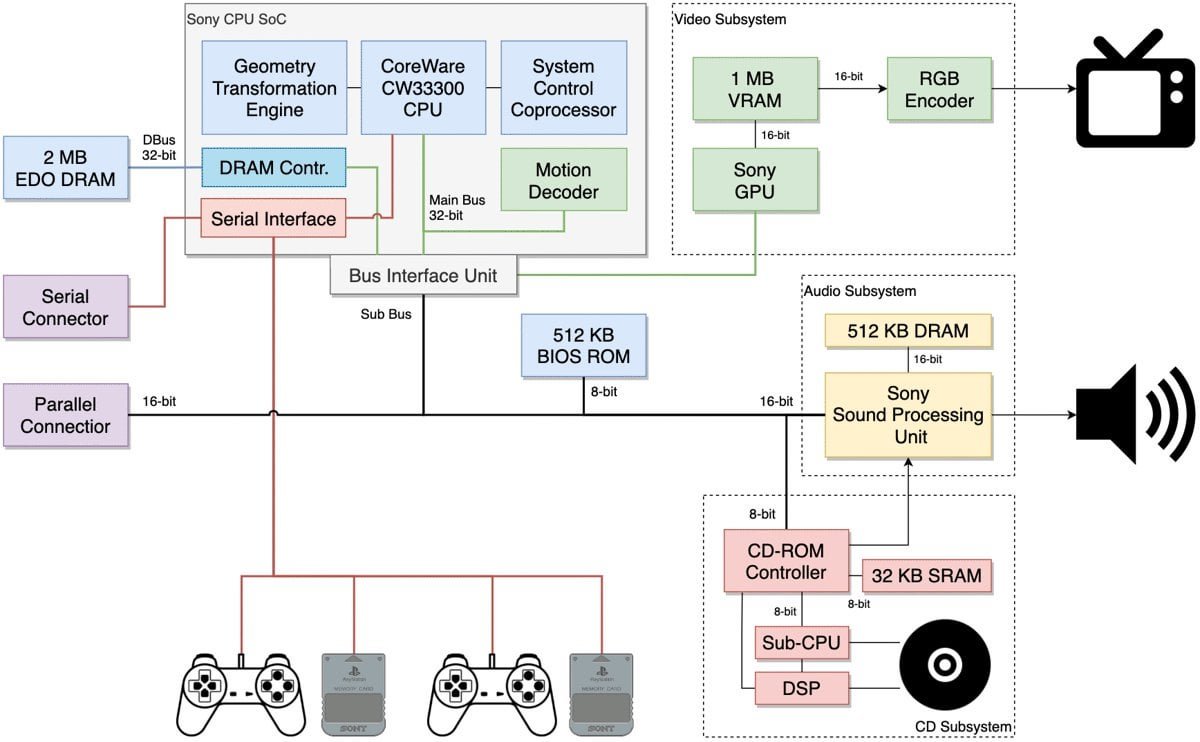
The original PlayStation shipped in December 1994 in Japan and September 1995 in North America, and even in 2026 its architecture is one of the clearest case studies in "what constrained clever engineers can do with a strict budget." The new Adafruit-shared breakdown walks through the machine top to bottom: the 33.87 MHz MIPS R3000A CPU, the fixed-function Geometry Transformation Engine that ran ahead of the mainstream 3D-accelerator race, the 2 MB of main RAM, the 1 MB of VRAM, and the double-speed CD-ROM that let developers stream audio and textures faster than any cartridge could. It's the kind of piece that reminds you why hardware ports of the same games could look so different on different consoles of the era.
What happened: a breakdown of the standout design choices
The most-referenced parts of the piece are the ones that explain visible behavior in real games. The lack of a Z-buffer, the affine (rather than perspective-correct) texture mapping, and the integer-only geometry pipeline are why PlayStation textures famously wobble and swim as the camera moves. The copetti.org console-anatomy series has covered this territory in depth for years, and Adafruit's writeup pulls the practical takeaways forward for a new audience. Together they explain why a game that ran flawlessly on the Sega Saturn's quad-based renderer looks slightly warped on the same-year PlayStation port.
The other headline choice was CD-ROM as first-class storage. Instead of treating the disc as a slow load stage, the PlayStation was built around streaming — audio in Red Book form, textures loaded on demand, cinematics decoded straight from the disc. That's what made Final Fantasy VII's 3D-over-pre-rendered-backgrounds trick possible in the first place: the machine could pull the next background frame while the polygonal party moved on top of it.
None of this was accidental. Sony's engineers picked a strict fixed-function 3D pipeline (no floating-point math, no per-pixel perspective correction, no depth buffer) precisely because it kept the silicon budget small enough to hit the price point. The tradeoffs shipped in every game; that's why they're still visible on a plasma TV or CRT emulator today.
Why it matters: what it means for collectors and retro-console owners
If you already own PlayStation-era hardware, the architectural context is the difference between "old console I paid a lot for" and "purpose-built machine whose visible quirks are part of the design story." For collectors weighing whether to hold, sell, or expand a collection, three points from the writeup stand out:
- Emulator accuracy is finally there. A decade ago, "PSX emulation" meant a rough approximation. Today, cycle-accurate cores in RetroArch, Duckstation, and Beetle-PSX reproduce the affine warping, the CD-XA audio quirks, and the exact GPU rasterization behavior. If you understand the architecture, you understand which emulator options actually match original hardware and which secretly "correct" it.
- The PS4 generation is now the affordable "modern-retro" bridge. With the disc era ending and used prices dropping, a PlayStation 4 Pro 1TB is the most cost-effective way to run the largest continuous chunk of the modern PlayStation library on original hardware — and its enhanced GPU is the last consumer PlayStation designed around fixed-media-first assumptions.
- The 16-bit era is having its own moment. Practical hardware breakdowns of any era tend to boost interest in the whole neighborhood. Plug-and-play systems like the Sega Genesis Mini get more attention when the retro news cycle is active, and the Genesis's very different (68000 + Z80, tile-based 2D) architecture is the classic contrast piece.
For anyone shopping the PS4 generation on used hardware, the PlayStation 4 Slim 1TB is the compact, quieter, cheaper option that plays the same library at 1080p. The Pro adds a beefier GPU for supported enhanced-mode games, but the Slim is still the value pick if you just want the library on a small, cool-running box.
A quick spec comparison for readers new to the era
Because the Adafruit piece leans on the practical numbers, here's the shorthand version of the four consoles most likely to come up in the same conversation:
| Console | CPU | RAM | GPU / Video | Primary storage |
|---|---|---|---|---|
| PlayStation (1994) | MIPS R3000A @ 33.87 MHz | 2 MB main + 1 MB VRAM + 512 KB sound | Fixed-function GTE + GPU, affine textures | Double-speed CD-ROM |
| Sega Genesis (1988) | Motorola 68000 @ 7.6 MHz + Z80 @ 4 MHz | 64 KB main + 64 KB VRAM | Tile-based 2D (VDP) | Cartridge (up to ~40 Mbit) |
| PlayStation 4 Slim (2016) | 8-core Jaguar @ 1.6 GHz | 8 GB GDDR5 | AMD GCN 1.84 TFLOPS | 1 TB HDD, Blu-ray drive |
| PlayStation 4 Pro (2016) | 8-core Jaguar @ 2.13 GHz | 8 GB GDDR5 + 1 GB DDR3 | AMD GCN 4.2 TFLOPS | 1 TB HDD, Blu-ray drive |
The gap between rows 1 and 3 is exactly why understanding the architecture matters for collecting: the constraints that made PS1 games look and sound the way they did are gone by the PS4 generation, but the disc-first design philosophy carried through — and is now ending. If you buy a PS4 Pro in 2026, you're buying the last-of-its-kind bridge between physical media and the download-only future.
Real-world numbers: what the PS1 was actually pushing
If you strip the marketing away, the original PlayStation was a genuinely modest machine. The MIPS R3000A ran at 33.87 MHz — about the speed of a mid-range 486 PC from the same year. It had 2 MB of main RAM, 1 MB of dedicated video RAM, 512 KB for sound, and a 2× CD-ROM drive delivering 300 KB/s peak. The GTE (Geometry Transformation Engine), which sat next to the CPU as a coprocessor, could push roughly 90,000 flat-shaded polygons per second and about 30,000 textured, lit polygons per second under sustained load. That's tiny by 2026 standards, but it was enough for what shipped.
For context on how much that mattered: Ridge Racer at launch pushed roughly 4,000 polygons per frame at 30 fps; Gran Turismo 2 five years later was pushing close to 6,000 polygons per frame while streaming garage backgrounds off the disc. The whole console had a rated power draw around 10 W. Compare that to a PS4 Pro pulling 150–170 W under load and you get a sense of how much more work-per-watt today's silicon does — and how much silicon budget the 1994 design didn't have to spend.
Benchmark table: PS1-era architecture in five practical numbers
| Metric | Original PlayStation (1994) | PS2 (2000) | PS3 (2006) | PS4 Slim (2016) | PS4 Pro (2016) |
|---|---|---|---|---|---|
| Peak polygons/sec (textured, lit) | ~30,000 | ~15 million | ~275 million | ~800 million | ~1.4 billion |
| Main memory | 2 MB | 32 MB | 256 MB XDR + 256 MB GDDR3 | 8 GB GDDR5 | 8 GB GDDR5 + 1 GB DDR3 |
| Storage bandwidth (peak) | ~300 KB/s (2× CD) | ~5 MB/s (4× DVD) | ~9 MB/s (2× BD) | ~150 MB/s (HDD) | ~150 MB/s (HDD) |
| Power draw (typical) | ~10 W | ~35 W | ~120 W | ~90 W | ~150 W |
| Disc capacity | 650 MB | 4.7 GB | 25–50 GB | 25–50 GB | 25–50 GB |
Two things jump out. First, storage bandwidth grew a lot slower than polygon throughput — which is why PS4-era games have such enormous install sizes and long initial loads. Second, the raw compute jump between the PS1 and PS2 was the largest generational gap Sony ever shipped; the PS3-to-PS4 gap in polygons/sec is actually smaller than the PS1-to-PS2 gap even though it looks bigger on paper.
Common pitfalls when reading architecture writeups
If you're new to console-architecture pieces, four things trip up first-time readers of the Adafruit-style writeups:
- Confusing "GTE" with "GPU." The GTE is a math coprocessor that transforms vertices; the GPU is the rasterizer that draws triangles to VRAM. On PS1 they're separate silicon that talk over the CPU bus. Modern GPUs fuse both roles.
- Assuming "no Z-buffer" means "no depth." The PlayStation has depth, it just has no per-pixel depth buffer — sorting happens per polygon in software before the GPU draws. That's why heavy scenes on PS1 sometimes show overlap glitches ("Z-fighting on steroids") that never happen on N64.
- Reading the RAM figure as system-wide. The 2 MB main + 1 MB VRAM + 512 KB sound is three separate memory pools, each with its own bus and access rules. A game engine can't treat them as unified — VRAM in particular has to be juggled every scene change.
- Treating CD-ROM speed as "load time." The whole 2× CD-ROM design was streaming-first. Boss battles, cutscenes, and level transitions were all designed around what could be pulled off the disc during play. That's why Final Fantasy VII's cinematics work; it's also why worn PS1 discs sometimes cause boss music to skip in ways cartridges never did.
When NOT to buy PS4-era hardware
The architecture story cuts both ways for buyers. If you already own a working PS4 Slim or Pro, hold onto it — the disc-era catalog is genuinely at risk of getting harder to buy as production winds down. But if you don't yet own any PS4 hardware and you only want to play modern games, a used PS4 is not the right answer in 2026. The PS5 is now widely discounted, and the PS5's backward compatibility covers most of what you'd care about from the PS4 generation.
The PS4 Slim and Pro are the right purchase specifically for collectors and for players who want physical discs. If neither of those applies, spend the money on newer hardware.
One thing the piece could have said louder
The Adafruit breakdown, like most architecture writeups, focuses on what the hardware did. What's just as interesting is what it couldn't do — and how that reshaped development studios. Because the PlayStation had no depth buffer, developers had to sort polygons in software, which meant clever back-to-front sort routines shipped as reusable middleware. Because there was no perspective correction, texture atlases were designed to hide the warp on triangles that faced the camera longest. These were engineering habits, and they informed how PlayStation-era teams thought about tools and pipelines for years — including, arguably, why Sony's first-party studios ended up so tool-heavy.
The source
Read the original writeup on Adafruit (linked in the community thread that started this round), the deeper long-form treatment on the copetti.org consoles anatomy series, and Sega's own platform documentation and history for the counterpoint 16-bit architecture. If you want the visible-warping demonstration, the Metal Gear Solid opening sequence on original PS1 hardware vs the same title running under a modern accuracy-focused emulator is the fastest side-by-side.
Related retro hardware coverage
If this piece piqued your interest in the PlayStation and 16-bit eras, here's where to go next on SpecPicks:
- Best Plug-and-Play Retro Console and Handheld to Buy in 2026: 5 Ranked Picks
- Sony to End Physical PlayStation Disc Production by 2028
- Best SATA SSD for a PS4 Upgrade in 2026: BX500 vs 870 EVO vs WD Blue
The PS4 disc era is closing, but the architecture that made the original PlayStation a landmark is now well enough understood that collectors, emulator authors, and hardware writers are all pulling from the same source material. That's a healthy sign for the hobby.
— Mike Perry