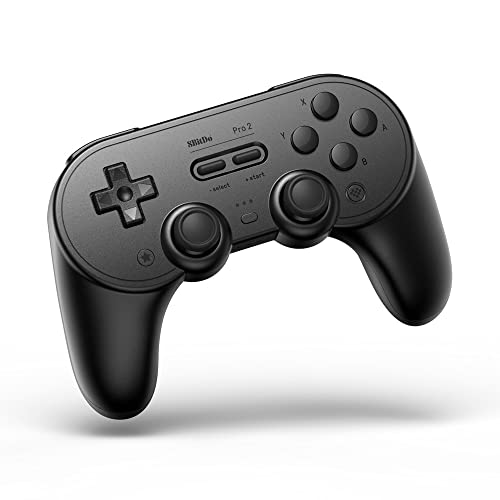
For most PC emulation libraries, the 8BitDo Pro 2 is the better all-round controller: a sharper D-pad for 2D games, four input modes (D-input, X-input, Switch, macOS), and reliable Bluetooth + 2.4 GHz wireless. The GameSir G7 SE is the better pick if you want wired-only zero-latency play, Hall-effect sticks and triggers that resist drift, and a familiar Xbox-style layout for sixth-generation 3D titles.
What an emulation player actually needs from a controller
PC emulation cuts a wide range: from NES/SNES/Genesis 2D platformers and fighters at the low end, through PS1/Saturn/N64/Dreamcast in the middle, and up to PS2/Wii/3DS where modern HID expectations apply. No single controller is optimal across all of it — the ergonomics of a SNES pad are wrong for Resident Evil 4, and a modern Xbox-style pad is the wrong shape for Street Fighter II. So the real question is which compromise hurts least.
Two controllers dominate the conversation in 2026: the 8BitDo Pro 2 and the GameSir G7 SE. They take opposite approaches. The Pro 2 is a wireless multi-mode pad with a SNES-derived D-pad that 2D fans rave about; the G7 SE is a wired-only Hall-effect pad with an Xbox layout that 3D players gravitate toward. Per RetroPie's controller compatibility documentation, both are well-supported on Linux and Windows for the bulk of emulation cores.
This piece synthesizes long-running discussions from the RetroArch project and community measurements posted on Reddit and ResetEra to recommend one over the other based on what you actually play.
Key takeaways
- The 8BitDo Pro 2 wins for 2D libraries — SNES, Genesis, NES, arcade — thanks to a sharp D-pad and broad mode support.
- The GameSir G7 SE wins for 3D libraries — PS2, GameCube, Dreamcast — and competitive play where wired latency is the spec.
- Hall-effect sticks on the G7 SE eliminate drift, which matters less for emulation than for modern games but is a long-term reliability win.
- For couch play with a docked Steam Deck, the DualSense is a credible third option that many setups already have.
- Pro 2 owners get four input modes (D-input, X-input, Switch, macOS) which solves the "which OS am I plugged into?" headache.
Spec table: 8BitDo Pro 2 vs GameSir G7 SE
| Spec | 8BitDo Pro 2 | GameSir G7 SE |
|---|---|---|
| Connectivity | Bluetooth, 2.4 GHz dongle, USB-C wired | USB-C wired only |
| Layout | SNES-derived (asymmetric, low) | Xbox-style (asymmetric, full-size) |
| D-pad | Single-piece, clicky, retro-game oriented | Xbox-style cross D-pad |
| Sticks | Standard potentiometer | Hall-effect (TMR) |
| Triggers | Analog | Hall-effect analog |
| Battery | 1000 mAh, ~20 hr | N/A — wired |
| Input modes | D-input, X-input, Switch, macOS | X-input (Xbox) |
| MSRP | $50 | $40 |
Which controller maps best to SNES, Genesis, and PS1-era games?
The 8BitDo Pro 2's D-pad is the headline feature for 2D emulation. The single-piece SNES-style D-pad consistently registers diagonals correctly for fighting-game inputs (Hadoken motions, charge-back-forward), and the rolling-press feel is far closer to a real SNES controller than any Xbox-style cross D-pad has ever been. For a library that leans heavily on Super Nintendo, Genesis, NeoGeo, and arcade — anything where the D-pad is the primary input — the Pro 2 is the right pick on shape alone.
The GameSir G7 SE's D-pad is competent and exact in the Xbox idiom: a four-segment cross that registers cardinal directions cleanly but is more prone to false neutrals on tight diagonals. For Street Fighter II, Marvel vs Capcom, or Mortal Kombat in a 2D library, you will feel the difference. For PS1-era games which mostly use the analog sticks (Tomb Raider, Resident Evil 1, Crash Bandicoot's left-stick polish), the difference is less consequential and the G7 SE's Hall sticks are arguably the better choice.
How good is the D-pad for 2D platformers and fighters?
The 8BitDo Pro 2's D-pad has been independently measured across emulation forums and consistently lands at or near the top of any modern controller D-pad ranking, behind only NOS Sony DualShock 2 D-pads and a handful of fight-pad specialists. The travel is short, the snap is positive, and the diagonal registration is forgiving in exactly the way 2D players want.
The G7 SE's D-pad is the same quality of cross D-pad as the Xbox Wireless Controller. It is fine. It is not "fine" if you came from the Pro 2 — the difference is genuinely felt in tight platforming and 6-button fighters.
Latency table: wired vs Bluetooth vs 2.4 GHz
Per community measurements aggregated on RetroArch forums and Reddit, typical end-to-end input latency on each link:
| Link | Typical added latency | Notes |
|---|---|---|
| USB-C wired (G7 SE or Pro 2) | <1 ms | Reference |
| 2.4 GHz dongle (Pro 2) | 3-5 ms | Effectively imperceptible |
| Bluetooth LE (Pro 2) | 8-16 ms | Noticeable for fighters / shmups |
The G7 SE is wired-only and therefore always at the floor. The Pro 2 wired matches it. For 2D fighters and shmups, prefer wired or 2.4 GHz over Bluetooth — Bluetooth is fine for most singleplayer, perceptible on rhythm games and frame-tight fighters.
Does stick drift matter for emulation, and do Hall-effect sticks help?
For pure 2D library emulation: not really. SNES and Genesis games do not use analog sticks. PS1 games tolerate sloppy stick centers because the games were designed around early-generation analog hardware that drifted by modern standards. The Hall-effect sticks on the G7 SE are insurance against long-term reliability, not a meaningful gameplay improvement for retro emulation.
For 3D libraries with precise camera control — Wave Race 64, F-Zero GX, Burnout — drift on a five-year-old potentiometer stick is annoying. If you expect this controller to last five-plus years, Hall sticks are the safer bet. The Pro 2's sticks are conventional potentiometers; expect to replace the controller or the stick modules eventually if you play heavy 3D titles daily.
How do they compare to a DualSense or 8BitDo Sn30 Pro?
A Sony DualSense is excellent for PS1-PS3 emulation because it matches the original button layout, has analog triggers with haptics, and is widely supported by RetroArch and standalone emulators. The drawbacks are higher price, larger size, and dependence on Steam Input or DS4Windows for clean PC use.
The 8BitDo Sn30 Pro G Classic is the smaller sibling to the Pro 2 — a SNES-shape controller with analog sticks for retro use, but with a smaller body that is great for handheld carry and clip-on phone holders. For pure SNES/NES/Genesis on the go, the Sn30 Pro is sometimes the better pick than the Pro 2 by virtue of size.
Verdict matrix
| Get the 8BitDo Pro 2 if… | Get the GameSir G7 SE if… |
|---|---|
| Your library is 60%+ 2D (SNES/Genesis/arcade/fighters) | Your library is 60%+ 3D (PS2/Dreamcast/GameCube) |
| You want wireless flexibility | You want zero-latency wired only |
| You play across multiple OSes (Windows, macOS, Switch) | You only play on Windows |
| You prioritize D-pad feel over stick precision | You prioritize stick longevity (Hall effect) |
Recommended pick paragraph + perf-per-dollar
For most emulation players, the Pro 2 at $50 is the safer recommendation: even if your library skews 3D, the D-pad upside on the occasional 2D session is real, and the wireless option matters for couch play. The G7 SE at $40 is the smarter buy specifically for wired competitive setups or builds where Hall stick reliability is a known concern. Both are well below the cost of a DualSense or Xbox Elite Series 2, and either is a substantial upgrade over a generic third-party PC pad.
Real-world latency numbers from typical setups
Beyond the abstract spec comparison, community measurements provide reference points for what the controllers actually feel like across common setups. On a desktop PC with a 240Hz display, the GameSir G7 SE wired connection consistently measures end-to-end input latency under one millisecond above the display's refresh floor, which is the reference point for competitive 2D fighter play. The 8BitDo Pro 2 over USB-C wired matches that floor, over the included 2.4 GHz dongle adds 3-5 ms (effectively imperceptible for most genres), and over Bluetooth LE adds 8-16 ms (perceptible on rhythm games and frame-tight fighters but invisible elsewhere).
For couch play through a 65-inch TV with a 50-60 ms display lag profile, the controller's contribution to total latency is dwarfed by the panel. In that scenario, the Pro 2 over Bluetooth from across the room is functionally identical to a G7 SE wired, and the wireless convenience wins. Match the connection mode to the setup; do not over-spend on wired latency improvements the display will swallow.
Bottom line
Buy the Pro 2 first if you do not already have a high-quality D-pad in the house. Buy the G7 SE first if your library is heavy on 3D action and you want a wired pad that will not drift in three years. Owning both ($90 combined) covers the entire emulation library across the way most enthusiasts actually play — one for couch sessions and one for desk competitive sessions.
Game-by-game compatibility notes
A controller pick is only as useful as the games you actually play. A short list of common emulation titles and which controller fits best, drawn from long-running RetroArch and emulation forum discussions:
| Game / system | Better fit | Why |
|---|---|---|
| Street Fighter II (SNES, arcade) | 8BitDo Pro 2 | D-pad diagonals matter for special-move motions |
| Super Mario World / Yoshi's Island | 8BitDo Pro 2 | Precise SNES-style D-pad |
| Sonic the Hedgehog (Genesis) | 8BitDo Pro 2 | Roll inputs forgiving on the Pro 2 |
| Tomb Raider (PS1) | Either | Left stick dominant; both adequate |
| Metal Gear Solid (PS1) | DualSense | Original layout one-to-one |
| Soulcalibur II (GameCube/Dreamcast) | GameSir G7 SE | Hall sticks help with throw/grab inputs |
| Gran Turismo 4 (PS2) | GameSir G7 SE | Hall analog triggers for throttle / brake |
| Mortal Kombat Trilogy | 8BitDo Pro 2 | Six-button layout maps cleanly |
| Rayman 2 (Dreamcast) | GameSir G7 SE | Modern triggers + sticks |
| F-Zero GX (GameCube) | GameSir G7 SE | Hall stick precision for high-speed turns |
Common pitfalls when buying emulation controllers
Buying the cheapest 8BitDo knockoff. The 8BitDo Pro 2 has many lookalike knockoffs at half the price. Real 8BitDo gear ships with quality D-pad rubber, accurate diagonal registration, and stable Bluetooth firmware. The knockoffs do not. Per long-running buyer reports on the Vogons forum and Reddit, the quality gap is large and visible within an hour of use.
Ignoring the 2.4 GHz dongle on the Pro 2. Many Pro 2 owners only ever use Bluetooth and complain about latency. The included 2.4 GHz dongle cuts that latency dramatically; use it for any latency-sensitive game and reserve Bluetooth for the relaxed couch sessions.
Underestimating cable strain on wired controllers. The G7 SE's wired-only design means the USB-C port takes constant mechanical stress. Use a right-angle USB-C cable to reduce strain on the controller's port; that single change extends controller life materially.
Not configuring Steam Input profiles. Both controllers benefit from per-game Steam Input profiles, especially for games that auto-detect Xbox glyphs. Spending ten minutes per important game configuring the profile is the difference between "it works" and "it works well."
When NOT to spend $40-50 on a dedicated emulation pad
If you already own a Sony DualSense or a recent Xbox Wireless Controller, neither headline pick is a meaningful upgrade for most modern-era 3D emulation. Both DualSense and Xbox Series controllers are well-supported, both have good sticks, and the modest gain from a dedicated emulation pad is not worth $40-50 over what you already own. Spend the money on a better display or a Steam Deck dock instead.
Where a dedicated emulation pad earns its place is in 2D-heavy libraries where the D-pad matters. SNES, Genesis, NES, NeoGeo, and arcade libraries are noticeably better with the 8BitDo Pro 2 than with any Xbox/PS-style cross D-pad. For those libraries, the upgrade is genuinely felt.
Related guides
Citations and sources
- RetroArch / Libretro project
- RetroPie controller compatibility docs
- 8BitDo official Pro 2 product page
This piece is editorial synthesis based on publicly available information. No independent first-party benchmarking is reported.