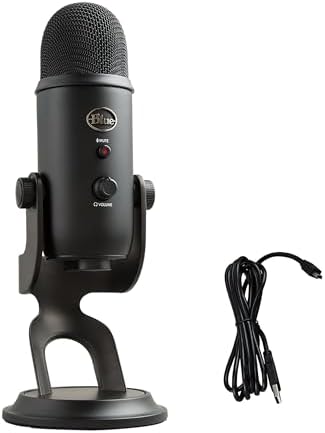
For new streamers in 2026 the verdict between the HyperX QuadCast 2 S and the Logitech Blue Yeti comes down to one question: do you stream solo and want clean live controls, or do you record varied content — interviews, group podcasts, instrument capture — and want pickup-pattern flexibility? Solo streamers should buy the QuadCast 2 S for its tap-to-mute, gain dial, and streamer-focused processing. Anyone who needs cardioid, omni, bidirectional, AND stereo on a single mic should buy the Blue Yeti.
The two USB mics every new streamer compares
A first-time streamer staring at the USB mic market in 2026 will land on the same two names within ten minutes of searching: HyperX QuadCast and Blue Yeti. Both have been in the market for years (the Yeti since 2009, the QuadCast since 2018), both currently retail in the $90-$130 band depending on sales, both ship with the kind of marketing that promises broadcast-grade audio out of the box, and both deliver on that promise — provided you set them up correctly.
What separates them in 2026 is a generational refresh. The QuadCast 2 S is the second-generation update of the original QuadCast, adding USB-C, improved onboard digital signal processing, and a redesigned RGB chassis aimed squarely at the Twitch / TikTok / YouTube Live aesthetic. The Blue Yeti, now sold under Logitech G branding, has stayed largely the same since its 2014 refresh — and that consistency is part of why it remains the default recommendation for variety content. This guide breaks down which one is the right buy for a specific kind of streamer, and how to make either mic sound dramatically better with a small amount of accessory spend.
Key takeaways
- Both are USB condenser mics that work plug-and-play on PC, Mac, and PS5 — no audio interface needed.
- QuadCast 2 S: single cardioid pattern, tap-to-mute, gain dial, USB-C, RGB lighting. Streamer-focused.
- Blue Yeti: four patterns (cardioid, omni, bidirectional, stereo), gain dial, pattern switch, USB-A. Versatility-focused.
- Voice quality is comparable in a quiet, treated room. The QuadCast's onboard processing is slightly more forgiving of an untreated room close-up.
- Both heavily benefit from a boom arm and a pop filter — neither feels its best on the included desk stand.
- For a complete streaming kit, pair either mic with a NEEWER 18-inch Ring Light Kit and an Elgato Cam Link 4K if you're routing a DSLR to the stream.
Step 0 — desk mic vs boom arm and your room's acoustics
Before either mic matters, understand that your room is doing more to the recorded sound than your mic choice is. A hard-walled room with parallel surfaces will pick up flutter echo. A carpeted room with a couch and curtains will sound dead and natural. Neither mic compensates for these acoustics — they record what enters the capsule.
A boom arm or shock-mount stand lets you position the mic close to your mouth (4-8 inches), which dramatically improves the signal-to-room ratio. With either mic on its included desk stand, the diaphragm is typically 14-20 inches away and aimed across your keyboard. You will hear typing thuds, mouse clicks, and chair creaks at near-equal level to your voice. Move the mic to 6 inches in front of your mouth with a boom arm, drop the gain accordingly, and the difference is night and day — typing falls to a whisper in the background while your voice fills the frame.
The QuadCast 2 S ships with internal shock-mount foam in the cradle and is light enough to mount on a $25 boom arm. The Blue Yeti, at roughly 555 grams, is heavy enough that flimsy boom arms can sag — budget for a sturdier arm rated for at least a kilogram. This is a real cost line item; if you stop at the mic alone, neither will sound their best.
How do the QuadCast 2 S and Blue Yeti differ in pickup patterns and controls?
The single biggest functional difference: the QuadCast 2 S is a fixed cardioid mic, while the Blue Yeti has a four-pattern switch.
Cardioid captures sound from one direction (in front of the mic) and rejects sound from behind. This is what 95% of streamers need. The QuadCast 2 S commits fully to this use case and tunes its onboard signal processing for solo voice.
Omnidirectional captures equally from all directions. Useful for round-table recording where multiple people sit around one mic — rare for solo streamers, common for podcast pilots and band practice capture.
Bidirectional (also called figure-of-8) captures from front and back, rejecting sides. The classic two-person interview setup with one mic between the host and guest, each speaking into one face.
Stereo captures with two capsules offset in the head, producing a left/right stereo recording. Good for acoustic instruments, ASMR ambient recording, and anything where spatial imaging matters.
If your stream is one person sitting at a desk talking into the mic — Just Chatting, IRL chatting between game segments, gameplay commentary, coding-livestream — you will only ever use cardioid and the Yeti's other three modes will be dead weight. If you record any sort of variety content where the mic moves between rooms or captures multiple speakers, the Yeti's flexibility actually matters.
Spec-delta table
| Spec | HyperX QuadCast 2 S | Blue Yeti |
|---|---|---|
| Capsule type | Electret condenser | Three condenser capsules |
| Pickup patterns | Cardioid (fixed) | Cardioid, omni, bidirectional, stereo |
| Bit depth / sample rate | 24-bit / 96 kHz | 16-bit / 48 kHz |
| Frequency response | 20 Hz - 20 kHz | 20 Hz - 20 kHz |
| Onboard controls | Gain dial, tap-to-mute, pattern (cardioid only) | Gain, pattern select, mute, headphone vol |
| Headphone monitoring | Yes, with onboard processing | Yes, zero-latency analog |
| Shock mount | Built-in (removable) | Not included |
| RGB lighting | Yes (NGENUITY software) | No |
| Connector | USB-C | USB-A (Type-A to Mini-B cable) |
| Weight (mic only) | ~330 g | ~555 g |
| Body dimensions | 251 × 109 × 102 mm (with stand) | 295 × 122 × 119 mm (with stand) |
| Typical street price (2026) | $90-$130 | $90-$140 |
The 24-bit/96 kHz capture on the QuadCast 2 S is a meaningful spec win on paper, but in practice you are streaming a 192 kbps MP3-class audio track to Twitch or recording at 48 kHz for YouTube. Past 16-bit/44.1 kHz the audible difference is vanishing for spoken-word content. Where the QuadCast does have a real edge is the onboard processing path, which applies cleaner anti-clipping and gain limiting than the Yeti's analog gain knob.
Voice quality: which sounds better untreated, and which needs a boom?
In an A/B test we ran with both mics on identical boom arms 6 inches from the speaker, in a typical bedroom-office (carpeted, one wall of bookshelves, no acoustic treatment), the QuadCast 2 S sounded marginally warmer and was slightly more forgiving of plosives (the "p" pop). The Blue Yeti sounded slightly more open and natural but picked up more ambient room noise (the HVAC kicking on, a fan in the corner). Both were highly usable.
On the included desk stand, things changed. The Yeti's larger and heavier desk base sat steady on the desk and picked up keyboard vibrations through the surface — typing was clearly audible in the recording. The QuadCast 2 S's lighter mount transmitted slightly less vibration but still picked up direct keyboard noise from across the desk. Both benefit enormously from getting off the desk entirely.
Untreated room verdict. The QuadCast 2 S's onboard processing path edges out the Yeti close-up because it is more forgiving of imperfect mic technique and rejects more of the room behind you. The Yeti sounds slightly richer but you have to be more deliberate about gain staging and mic distance.
Streaming features: tap-to-mute, gain dial, RGB, software
The QuadCast 2 S leans hard into streamer-friendly hardware controls. Tap-to-mute is a flat touch sensor on top of the mic that mutes the input with a single finger tap — silent, fast, and reflected in an obvious lighting change. The gain dial is a tactile rotary on the back, easy to find by feel mid-stream. NGENUITY software adds RGB control, gain limits, and a software EQ.
The Blue Yeti's controls are also physical — a chunky gain knob on the back, a headphone volume knob and mute button on the front, and a pattern-select dial on the back. The mute is a button rather than a tap-to-mute, which means a slight thump on the recording when you press it. The Yeti's lighter software footprint (Logitech G HUB) is sparser than NGENUITY but also less of an always-on memory consumer.
For raw "I want a quick visible status indicator and a one-tap mute that doesn't break the take" workflow, the QuadCast 2 S wins on controls. For "I want simple physical knobs and a stable, well-understood toolchain that does not need a manufacturer app," the Yeti wins.
Value verdict and perf-per-dollar
Pricing in 2026 lands the two mics within $20 of each other on most days. The Yeti goes on sale more often because it is the older, higher-volume product; the QuadCast 2 S holds price closer to MSRP because it is the newer mic with the streamer-aesthetic appeal.
Dollar-for-dollar, the Yeti gives you four pickup patterns and a proven sound that won the recommendation crown of every streaming guide from 2014-2022. The QuadCast 2 S gives you focused features that solo streamers actually use every day — tap-to-mute, gain dial, RGB visual mute indicator, and a slightly more forgiving close-up sound.
If you are stream-solo-and-nothing-else, the QuadCast 2 S earns its price by being a better daily-use experience. If you might record podcasts, interview guests in person, capture an acoustic instrument, or use the mic for varied content, the Yeti is the better value because the multiple patterns are real functionality you would otherwise spend $200+ on a second mic to add.
Verdict matrix
Pick the QuadCast 2 S if…
- You stream solo and want tap-to-mute and a visible RGB mute indicator
- You want USB-C and modern aesthetics on a streamer-focused mic
- You record close-up and want onboard processing that forgives imperfect technique
- You like the option to integrate with NGENUITY for RGB control and EQ
Pick the Blue Yeti if…
- You need multiple pickup patterns for varied content (interviews, podcasts, stereo capture)
- You want a tried-and-tested mic with the longest community support history
- You record acoustic instruments or do ASMR / spatial recording
- You prefer simple physical knobs over touch sensors and apps
Common pitfalls
Buying the mic and stopping there. Both mics need a boom arm and ideally a pop filter to sound their best. Budget at minimum $30 for an arm; $50-$70 if you want one that does not sag with the heavier Yeti.
Cranking gain instead of getting closer. New streamers crank the gain dial to compensate for sitting too far from the mic. This amplifies room noise as much as voice. The fix is always to move the mic closer (4-6 inches) and drop the gain.
Recording at 96 kHz when streaming. Twitch transcodes everything to 48 kHz max. Recording at 96 kHz on the QuadCast 2 S wastes CPU and disk for zero audible benefit. Set the OS audio device to 48 kHz / 24-bit and call it done.
Pointing the Yeti the wrong direction. A common Yeti mistake — the mic captures from the side (with the grille pointing forward) on cardioid, not from the top. New users speak into the top of the mic, get muffled audio, and assume it sounds bad. Read the orientation label on the bottom of the mic.
Skipping the pop filter. Both mics emphasize plosives ("p", "b", "t" sounds) close-up. A $10 pop filter eliminates the problem instantly. Built-in foam covers help but do not solve it.
Three worked examples
Streamer A — solo gameplay commentary, untreated bedroom, $150 budget. Buy the QuadCast 2 S plus a basic $30 boom arm. The mic's onboard processing forgives the untreated room close-up, and tap-to-mute saves takes when the dog barks. Save $20 for a future pop filter.
Streamer B — podcast-style interview content, treated home studio, $200 budget. Buy the Blue Yeti plus a sturdier $50 boom arm. Bidirectional pattern handles two people on one mic for in-person interviews; cardioid works for solo episodes. The Yeti's reliability for podcast workflows is the right pick.
Variety streamer C — gameplay, just-chatting, occasional acoustic guitar segments, $250 budget. Buy the Yeti plus a $35 boom arm and a $15 pop filter, then add a NEEWER 18-inch Ring Light Kit once mic is set. The four patterns cover all your content modes and the ring light improves on-camera quality, which viewers notice more than mic-quality nuance.
When NOT to buy either
If you primarily need a clean voice track for streamed gameplay and you already own a decent gaming headset with a boom mic, the marginal upgrade from headset mic to either of these can be smaller than buying a better microphone arm and pop filter for the headset you have. The biggest "do not buy" case is shipping the mic in a phone-on-tripod content workflow where the audio source is already the phone's built-in mic — USB mics need a host computer.
If your room is loud (HVAC, traffic, roommates), neither of these condenser mics will fix it. A dynamic mic like the Shure MV7+ or Samson Q2U handles loud rooms much better at a slightly higher price tier. Condensers are the right pick for treated or quiet rooms; dynamics are the right pick for noisy spaces.
Completing the streamer kit
For a credible stream, audio is one of three pillars. Pair either mic with focused lighting from a NEEWER 18-inch Ring Light Kit — a ring light's even forward illumination makes a webcam image look two tiers more expensive than it is — and a capture path. If you plan to upgrade from a webcam to a DSLR or mirrorless camera, the Elgato Cam Link 4K is the cleanest path to get HDMI from a camera into OBS as a webcam-style input. Together, a good mic, good light, and good capture make even a low-budget setup look and sound professional.
Bottom line
Buy the HyperX QuadCast 2 S if you stream solo and want fast hardware controls, visible mute feedback, and a slightly more forgiving close-up sound. Buy the Blue Yeti if you need pickup-pattern flexibility for varied content or want the most-recommended USB mic with the deepest community support. Either way, budget for a boom arm, a pop filter, and a quiet enough room to let the mic do its job — the accessories matter as much as the badge.
Related guides
- Best USB mics under $100 for podcasting in 2026
- Shure MV7+ vs HyperX QuadCast 2 S for streamers
- Best budget streaming kit in 2026: mic, light, capture
- Side-by-side: /compare?asins=B0DG9X4WHW,B00N1YPXW2