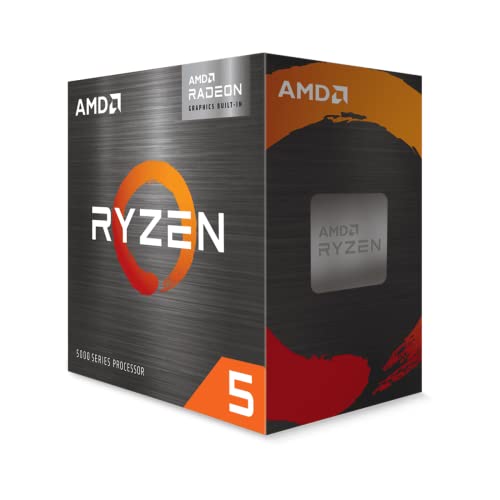
Yes, the AMD Ryzen 5 5600G can game at 1080p in 2026 without a separate graphics card — but with strings attached. Its integrated Vega graphics handle esports titles like CS2, Valorant, Rocket League, Dota 2, and lighter modern games at 1080p with reduced settings; demanding AAA titles need settings dialed down and may target 720p for smooth frame rates. It's a credible GPU-less budget build, and an upgrade-friendly one.
The GPU-less budget audience
GPU-less budget builds come up every time discrete card prices spike or a buyer has a tight initial budget but wants a real PC that games. The Ryzen 5 5600G has been the most popular APU answer for this audience for years per AMD's product page — a 6-core, 12-thread CPU with capable integrated Vega graphics on a standard AM4 socket, drop-in compatible with B450/B550 motherboards.
The audience splits into three groups:
- First-PC builders on a tight budget. $300-500 total budget, want something now, can upgrade later.
- Returning gamers. Used to play, taking a break, want something that runs current games but isn't committing to a full GPU build yet.
- Backup/HTPC builds. Want a working PC that occasionally games, doesn't need a discrete card.
For all three, the question is the same: how much gaming does the 5600G's iGPU actually deliver, and when does the GPU-less plan stop making sense?
Per Tom's Hardware's 5600G review, the chip is competitive with low-tier discrete GPUs from a few generations back for integrated gaming — capable, not powerful, and very sensitive to RAM choice.
Key takeaways
- The 5600G's integrated Vega 7 graphics handle esports titles at 1080p high settings and AAA at 1080p low or 720p settings.
- Fast dual-channel DDR4 RAM (3200-3600MHz) is the single biggest performance lever for iGPU gaming.
- A discrete card like the RTX 3060 12GB added later is the natural upgrade path.
- Skip the 5600G if you want stable 1080p high settings in modern AAA — get a CPU like the Ryzen 7 5800X plus a discrete GPU instead.
- The 5600G drops into a standard AM4 board with a PCIe slot, so adding a GPU later doesn't require a rebuild.
- 1080p low-medium with FSR/upscaling extends what the iGPU can play.
How does the 5600G's integrated Vega graphics perform at 1080p?
Per TechPowerUp's hardware database and the broader benchmark community, the 5600G's Vega 7 iGPU sits at roughly the performance level of a low-tier discrete GPU from earlier generations — usable for 1080p gaming with the right settings, dramatically slower than a current-gen discrete card.
The pattern in published benchmarks:
| Game | 1080p settings | Approx fps on 5600G iGPU |
|---|---|---|
| CS2 / Counter-Strike 2 | Low-Medium | 90-140 |
| Valorant | Medium | 100-160 |
| Rocket League | Medium | 100-150 |
| Dota 2 | Medium | 70-110 |
| League of Legends | Medium-High | 100-180 |
| Fortnite | Performance Mode 1080p | 55-90 |
| GTA V | Medium 1080p | 50-75 |
| Forza Horizon 5 | Low 1080p + FSR | 45-60 |
| Cyberpunk 2077 | 720p Low + FSR | 30-40 |
| Modern AAA (general) | Low 720p-1080p | 25-45 |
Direction of magnitude, not exact numbers — actual results depend heavily on RAM speed, system tuning, game patches, and driver version.
Which games run well and which need settings dialed back?
Runs well at 1080p:
- All major esports titles (CS2, Valorant, Apex, Fortnite, Rocket League, LoL, Dota 2).
- Most indie and pixel-art titles.
- Older AAA (anything pre-2020 generally fine at medium-high 1080p).
- Strategy and turn-based games.
Needs settings dialed back:
- Modern AAA: typically 1080p low or 720p medium.
- Open-world titles: heavy demands on integrated bandwidth.
- Ray-tracing-heavy titles: don't bother enabling RT.
- Highest-settings showcase games: dial down or skip.
Skip entirely:
- Anything that requires high-end discrete GPU for usable performance.
- Triple-A flagship titles at high or ultra at 1080p+.
The 5600G is the right choice for someone whose game library is dominated by esports and older AAA. It's the wrong choice for someone whose top-three list includes modern flagship single-player titles at high settings.
Spec table: 5600G iGPU vs adding an RTX 3060 12GB later
| Configuration | Cores/Threads | Graphics | 1080p target | Approx total cost (2026)
|---|---|---|---|---|
| Ryzen 5 5600G alone | 6/12 | Vega 7 iGPU | esports + 1080p low/medium AAA | $130-180 |
| 5600G + RTX 3060 12GB (later) | 6/12 | Discrete RTX 3060 | 1080p high, 1440p medium | $400-500 total |
| Ryzen 7 5800X + RTX 3060 12GB | 8/16 | Discrete RTX 3060 | 1080p high, 1440p high | $480-580 total |
The upgrade path from 5600G to 5600G + discrete card is real and easy. The chip drops into a B550 board, the discrete card slots into PCIe 4.0 x16, and the system uses the discrete card automatically when present.
How much does RAM speed matter for the iGPU?
Significantly. Because integrated graphics share system memory, fast dual-channel RAM directly improves iGPU frame rates — often more dramatically than the same RAM upgrade helps a discrete-GPU build.
Practical RAM guidance for a 5600G build:
| RAM configuration | Approx iGPU performance |
|---|---|
| Single-channel 2666MHz | Baseline (terrible) |
| Dual-channel 2666MHz | ~50% faster than single-channel |
| Dual-channel 3200MHz | +15-25% over dual 2666 |
| Dual-channel 3600MHz | +5-15% over dual 3200 |
The single biggest mistake builders make on a 5600G build is using a single stick of RAM (single-channel mode). Frame rates drop by 30-50% versus dual-channel on the same total capacity. Always use two matched sticks.
Running 3200MHz or 3600MHz dual-channel is the sweet spot — the 5600G's memory controller handles those speeds reliably on most B550 boards, and the iGPU benefits clearly. Higher speeds (3800+) provide diminishing returns and may not boot stably on all kits.
When should you skip the iGPU plan?
Skip the 5600G-only build if:
- Your priority game list includes modern AAA at 1080p high or above.
- You want ray tracing.
- You want to game at 1440p or 4K.
- You can afford to add a discrete card from the start.
In those cases, a Ryzen 7 5800X plus a discrete RTX 3060 12GB is roughly the same ceiling for the long run and avoids the temporary-iGPU phase entirely. The 5800X has stronger CPU performance for current games and gives more headroom for the GPU.
What's the upgrade path?
The 5600G's upgrade path is straightforward:
- Build with the 5600G, dual-channel 3200MHz+ RAM, a B550 motherboard with a PCIe 4.0 x16 slot, and a 550W+ PSU (so a GPU drops in without a PSU swap).
- Game on the iGPU until budget allows a discrete card.
- Install the GPU. Vega iGPU stays available as a backup output, but the system uses the discrete card by default.
- Optionally, eventually swap the 5600G for a stronger CPU like the Ryzen 7 5800X for higher CPU-bound performance, since AM4 is upgrade-friendly.
This staged path lets a buyer get a working PC for ~$400-500 total in 2026 and upgrade to a discrete-GPU build for another ~$250-350 when budget allows.
Perf-per-dollar: 5600G alone vs cheap discrete GPU build
A 5600G-only PC at $400-500 total beats any "$200 PC plus an entry discrete card" build on long-term value, because the 5600G CPU side is genuinely capable (6c/12t Zen 3, the same architecture as the 5600X) and the upgrade path is open. Cheaper alternatives that pair an Athlon or older quad-core with a low-end discrete card lock the buyer into a weaker CPU and a similar gaming ceiling, with no clean upgrade path.
The exception: a used market discrete card (used 1070, used RX 5600 XT, used GTX 1660 Super) in the $80-130 range paired with a discrete-graphics CPU can beat the 5600G iGPU at the same total budget, at the cost of buying used components.
Power supply and case considerations
Build the 5600G plan with a future GPU in mind. A 550-650W PSU from a reputable brand handles both the 5600G alone today and the 5600G + RTX 3060 12GB later — no PSU swap needed. A 450W bargain PSU works today and forces a swap when adding a 170W GPU.
Case airflow matters less for iGPU-only builds (the CPU is the only heat source) but matters when a discrete card joins. Plan front intake and rear exhaust from the start.
A realistic $500 build around the 5600G
For the budget-bound buyer the article targets:
- Ryzen 5 5600G — $130-180
- B550 motherboard with PCIe 4.0 x16 — $90-130
- 16GB (2x8) DDR4-3200 dual-channel — $40-60
- 500GB NVMe SSD — $40-60
- 550-650W 80+ Bronze PSU — $50-70
- Mid-tower case with front intake — $40-70
- Display, keyboard, mouse — assume already owned or budgeted separately
Total: $390-570, depending on price tier. The build runs cool, plays esports and lighter AAA at 1080p, and has a clear upgrade path to a discrete card without a single component swap.
Common pitfalls
- Single-channel RAM. The #1 build mistake — wrecks iGPU performance. Always use two matched sticks.
- Slow RAM. 2666MHz dual-channel is the baseline; 3200MHz is the floor you should target.
- Underpowered PSU. 450W boots a 5600G but doesn't leave room for a future GPU.
- No PCIe x16 slot in the case. Some mini-ITX cases skip discrete-GPU mounting; check the case if upgrade matters.
- Forgetting the integrated graphics need video output on the motherboard. Some B550 boards have only one or two display outputs; verify HDMI/DP availability.
- Old BIOS. B450 boards sometimes need a BIOS update to support the 5600G; flash before assuming the chip is bad.
What settings should you actually use?
For the typical 5600G iGPU 1080p target:
- Resolution: 1080p for esports and older AAA; 720p for modern AAA.
- Preset: Low or Medium. Custom-tuned settings sometimes beat the presets.
- Upscaling: Enable FSR or game-specific upscaling. The 5600G benefits significantly from upscaling — render at lower resolution, upscale to display resolution.
- Shadows: Drop to low or medium; shadows are GPU-heavy.
- Textures: Keep medium-high if RAM allows; doesn't cost much.
- Anti-aliasing: FXAA or TAA only; skip MSAA and SSAA.
- Ray tracing: Off.
The most-missed step is just enabling FSR in titles that support it. It's free performance for a small visual cost.
When NOT to bother with the 5600G
Skip the 5600G plan entirely if:
- Your priority game list includes modern AAA at high settings.
- You want 1440p or 4K gaming.
- You play with ray tracing.
- You're never going to add a discrete card — in that case a CPU-only build doesn't game well enough.
- You can afford a discrete card from the start.
For all those cases, the Ryzen 7 5800X + RTX 3060 12GB discrete-GPU plan is the right answer.
Bottom line
The Ryzen 5 5600G-only build is the right answer for a specific buyer: someone on a tight initial budget who plays mostly esports and lighter modern games at 1080p, expects to add a discrete card later, and wants to build a real PC now. Pair it with dual-channel 3200MHz+ RAM, a B550 motherboard with a PCIe 4.0 x16 slot, and a 550W+ PSU sized for a future GPU.
It is not the right answer for someone who wants stable 1080p high-settings AAA performance from day one. For that buyer, Ryzen 7 5800X plus RTX 3060 12GB is the more capable build at not much more total cost.
Right person, right plan: the 5600G is the most capable iGPU-only gaming option on AM4 in 2026 and a credible bridge to a full discrete-GPU build.
Related guides
- Best budget gaming PC build under $500
- Ryzen 5 5600G vs 5700G for iGPU gaming
- Best GPU for 1080p gaming
Citations and sources
- AMD — Ryzen 5 5600G product page
- Tom's Hardware — Ryzen 5 5600G review
- TechPowerUp — hardware database and reviews
This piece is editorial synthesis based on publicly available information. No independent first-party benchmarking is reported.