

EDUP
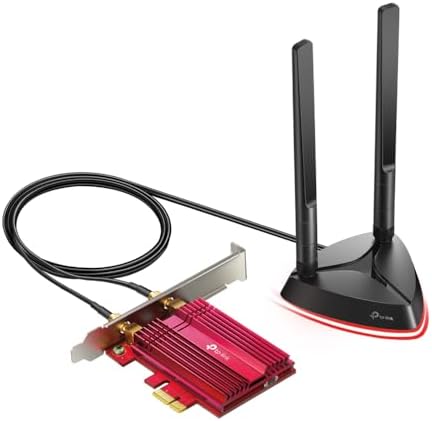
EDUP® PCIE WiFi 7 Card BE6500 Wi-Fi 7 Wireless Network Card for PC
Bottom line: The EDUP® PCIE WiFi 7 Card BE6500 Wi-Fi 7 Wireless Network Card for PC: MT7925 tri-band Wi-Fi 7: 688Mbps 2.4GHz, 2882Mbps 5GHz, 2882Mbps 6GHz; main trade-off: no Mini PCIe or M.2 CNVio2 support: needs a true PCIe x1/x4/x8/x16 slot.
As an Amazon Associate, SpecPicks earns from qualifying purchases. Full disclosure →
Pros & Cons
Pros
- ✓ MT7925 tri-band Wi-Fi 7: 688Mbps 2.4GHz, 2882Mbps 5GHz, 2882Mbps 6GHz
- ✓ MLO combines bands at once to cut lag and packet loss on busy networks
- ✓ Bluetooth 5.4 onboard pairs up to 7 devices from the same card
- ✓ Low-profile and full-height brackets both included for SFF or mid-tower
- ✓ WPA3/WPA2/WPA encryption with hardware acceleration to lower CPU load
Cons
- ✗ No Mini PCIe or M.2 CNVio2 support: needs a true PCIe x1/x4/x8/x16 slot
- ✗ Drivers must be downloaded from szedup.com, not bundled on media
- ✗ Linux requires kernel 6.7 or newer; older distros need a kernel upgrade
- ✗ Windows 11 64-bit only in the listed support; no Windows 10 or macOS claim
Manufacturer description
The EDUP PCIE WiFi 7 Card BE6500 brings tri-band Wi-Fi 7 to any desktop with a free PCIe x1, x4, x8, or x16 slot. Built on the MediaTek MT7925 chipset, it advertises combined throughput up to 6.5Gbps across three bands: 688Mbps on 2.4GHz, 2882Mbps on 5GHz, and 2882Mbps on 6GHz. Multi-Link Operation is the headline feature for gamers, combining bands simultaneously so your session rides out congestion instead of spiking in latency when the network fills up. Bluetooth 5.4 is integrated on the same card and handles up to seven simultaneous devices, so your headset, keyboard, mouse, and…
SpecPicks Verdict
SpecPicks scored EDUP® PCIE WiFi 7 Card BE6500 Wi-Fi 7 Wireless Network Card for PC using a rating × review-volume × price-fit model applied to published specs and reviews across the retro networking cards category. EDUP's retro networking cards lineup sits within the broader category mid-tier; price and specs are the deciding factors over brand loyalty here. Judge it on the specification table and the price rather than on sentiment: check the figures that decide your use case, then put it side-by-side with two or three close alternatives in the Compare tool before clicking through.
Common buyer scenarios for retro networking cards of this kind: matching it to an existing build, replacing a failing part, or upgrading from a previous-generation equivalent. Check the spec table below against your current setup — particularly socket / form-factor / power-rating fields — and confirm compatibility on the retailer's listing before purchase. Prices and stock are set by the retailer and may have moved since this page was last updated.
Frequently Asked Questions
Will this WiFi 7 card work in my motherboard's M.2 slot?
No. The EDUP BE6500 is a PCIe card and needs a standard PCIe x1, x4, x8, or x16 slot. EDUP states it is not compatible with Mini PCIe or M.2 CNVio2 slots.
Do I need a Wi-Fi 7 router to use this card?
To hit the advertised tri-band speeds and use Multi-Link Operation you need a Wi-Fi 7 router broadcasting 6GHz. The card still connects on 2.4GHz and 5GHz with older routers, at those bands' rates.
Does it fit a small form factor case?
Yes. EDUP includes both a low-profile and a full-height bracket in the box, so the card mounts in SFF chassis and standard mid-towers without buying an adapter.
Does this card work on Linux?
EDUP lists Linux kernel 6.7 and newer as supported, using the MediaTek MT7925 chipset. Older kernels are not listed as compatible, so check your distribution's kernel version first.
How do I install the drivers?
EDUP directs you to download the current driver from szedup.com/pcie-adapters/EPBE9726.html. Disable your PC's built-in Bluetooth before installing so the card's Bluetooth 5.4 radio does not conflict with the onboard stack.
Key Features
- 🔹【Next-Gen Wi-Fi 7 PCIe Card – Tri-Band up to 6.5Gbps】: Upgrade your desktop PC to the latest Wi-Fi 7 standard with the powerful MT7925 chipset. This PCIe WiFi card supports Tri-Band (2.4GHz/5GHz/6GHz) with blazing-fast speeds up to 6.5Gbps. Enjoy ultra-low latency, higher throughput, and stable connections for gaming, 4K streaming, and video conferencing. (Max speeds: 2.4GHz: 688Mbps, 5GHz: 2882Mbps, 6GHz: 2882Mbps)
- 🔹【Ultra-Low Latency Gaming with Multi-Link Operation (MLO)】: Experience uninterrupted online gaming and streaming with MLO (Multi-Link Operation) technology. MLO intelligently combines multiple frequency bands for a more stable and faster connection, reducing lag and packet loss even in crowded networks — ensuring smooth and responsive gameplay.
- 🔹【Bluetooth 5.4 Adapter Included for Seamless Wireless Devices】: Equipped with the latest Bluetooth 5.4 technology, this PCIe card supports up to 7 connected devices simultaneously. Easily connect your Bluetooth headset, keyboard, mouse, or controller with improved range and reduced interference. 💡 Tip: Disable your PC’s built-in Bluetooth before installing this adapter.
- 🔹【Wide Compatibility & Easy Installation for Desktop PCs】: Designed for desktop computers with a standard PCIe x1/x4/x8/x16 slot, this card includes both a low-profile and full-height bracket for flexible installation. Fully compatible with Windows 11 (64-bit) and Linux Kernel 6.7+, supporting Intel and AMD platforms. ❌ Not compatible with Mini PCIe or M.2 CNViO2 slots.
- 🔹【Secure, Efficient & Reliable Connection】: Stay protected with WPA3/WPA2/WPA encryption, ensuring a safe wireless experience. The optimized RF design and hardware acceleration reduce CPU load, enhance stability, and maintain strong signal performance over longer distances — all while consuming less power.
- 🔹【Driver Installation】: Download the latest driver for this card from our official website: 👉 szedup.com/pcie-adapters/EPBE9726.html
Full Specifications
| Brand | EDUP |
|---|---|
| Color | Black |
| Weight | 6g |
| Unit Count | 1 Count |
| Connectivity | Bluetooth, WiFi, 2.4GHz |
| Model Number | EP-BE9726 |
| Compatibility | PC, Linux |
| Built-In Media | 1* EDUP PCIE WiFi 7 Card |
| Connection Type | Wireless |
| Mfr Part Number | EP-BE9726 |
| Compatible Devices | Desktop |
| Data Link Protocol | 802.11 be/ax/ac/b/g/n |
| Data Transfer Rate | 6500 megabits_per_second |
| Hardware Interface | Bluetooth 5 |
| Warranty Description | 3 years arranty |
| 🔹【Driver Installation】 | Download the latest driver for this card from our official website: 👉 szedup.com/pcie-adapters/EPBE9726.html |
| Full listing title | EDUP® PCIE WiFi 7 Card BE6500 Wi-Fi 7 Wireless Network Card for PC | Bluetooth 5.4 Tri-Band 6G/5G/2.4Ghz OFDMA 802.11be, Compatible with Intel/ AMD Windows 11 (64-Bit) |
Ready to buy?
EDUP® PCIE WiFi 7 Card BE6500 Wi-Fi 7 Wireless Network Card for PC | Bluetooth 5.4 Tri-Band 6G/5G/2.4Ghz OFDMA 802.11be, Compatible with Intel/ AMD Windows 11 (64-Bit) is vintage hardware; the used and vintage market on eBay carries most of the live inventory. Prices and condition vary by seller and move in real time, so we link the live listing rather than quote a cached price. It also has an Amazon listing — check it for current price and availability. SpecPicks earns a small commission on qualifying purchases — thank you for supporting independent review work.
Related Retro Networking Cards


More guides & deep dives from the SpecPicks archive
Browse all articles & guides →- Best 1440p Gaming GPUs in 2026
- Best Budget Gaming PC Build 2026 — ~$1,000 ($800 on Sale)
- Best Retro Handhelds in 2026 — From $35 to $500
- RTX 4070 Super vs RX 7800 XT — Which to Buy in 2026
- The Complete Voodoo5 5500 AGP Driver Guide (2026 Edition)
- Emulation Hardware in 2026: FPGA, Software, and Cart-Reader Ecosystems
- How to Build a Windows 98 Retro PC in 2026
More reviews from the SpecPicks archive
Browse all reviews →- Pushing a 6GB VRAM Laptop to Its Limits With Qwen3.6-35B-A3B
- Kingston 2GB DDR Modules: Identifying and Buying RAM for a 2004-Era Retro PC
- Reviving the LAN Party in 2026: Arcade Sticks, Classic Consoles, and Local Multiplayer
- HyperX QuadCast 2 vs Blue Yeti for Streaming in an Untreated Room
- ComfyUI on an RTX 3060 12GB: Stable Diffusion Throughput and VRAM Limits in 2026
- Best Buy Cuts $900 Off an Asus 64GB Gaming Laptop — Is a Desktop Smarter?
- Ryzen 9 9950X3D2 vs Ryzen 7 5800X: Is the Upgrade Worth It?
- Best Raspberry Pi Starter Kit for Beginners in 2026
- Intel Arc LLM Performance: A770, B580 & Pro B60 Guide 2025
- Best GPU for Gemma 3 27B in 2026: Where 12 GB Stops Being Enough
- Build a Raspberry Pi 4 Pi-hole + Unbound Ad-Blocker in 2026
- 3dfx Voodoo5 5500 PCI Boots in a Modern ASUS Z77 Board
- One Monitor, Two PCs: Monitor KVM vs Dual-Input for a Gaming Rig and AI Box
- Best PC Gaming Gear for Console Players Making the Switch in 2026
- Best Cooler for a Ryzen 7 5800X: Noctua NH-U12S vs CoolerMaster ML240L
- AA-AgentPerf: What the New Agentic Benchmark Means for Local Coding Rigs
- Best Compact DIY NAS Setup in 2026: A Buyer's Guide
- Self-Host Jellyfin on a Raspberry Pi 4 8GB in 2026
- Best Budget SSDs for Homelab and Proxmox Boot Drives in 2026
- Imaging Big-Box CD-ROMs to CompactFlash for a Windows 98 Retro PC
- Noctua NH-U12S vs CoolerMaster ML240L: Air or AIO for 5800X
- Google's 'Frozen v2' Chip Bakes Gemini Into Silicon: What It Means for Local Rigs
- AA-Briefcase's 800x Cost Spread: What It Means for Local Agentic Rigs
- SATA SSD vs NVMe for a Ryzen 5 5600G Budget Build in 2026
Earliest SpecPicks reviews
Browse full archive →- Best GPU for Llama 3.1 8B (2026)
- Best GPU for Qwen 3 14B (2026)
- Best GPU for Qwen 3 32B (2026)
- Best GPU for Llama 3.1 70B (2026)
- Best GPU for DeepSeek-R1 32B (2026)
- Best GPU for Llama 3.1 405B (2026)
- How to run Llama 3.1 8B on NVIDIA GeForce RTX 5090
- How to run Qwen 3 14B on NVIDIA GeForce RTX 5090
- How to run Qwen 3 32B on NVIDIA GeForce RTX 5090
- How to run Llama 3.1 70B on NVIDIA GeForce RTX 5090
- How to run DeepSeek-R1 32B on NVIDIA GeForce RTX 5090
- How to run Llama 3.1 8B on NVIDIA GeForce RTX 4090