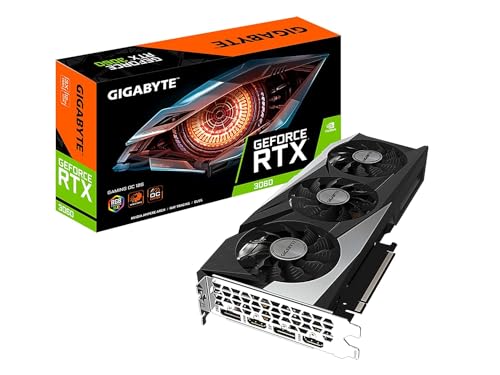
ComfyUI runs well on an RTX 3060 12GB in 2026 for mainstream Stable Diffusion and SDXL work. The 12GB frame buffer holds a base checkpoint, VAE, and a couple of LoRAs without offloading, and step throughput is respectable for a card that launched at a budget price. Large SDXL batches, heavy upscalers, and stacked ControlNets are where you start feeling the tier gap versus 16GB and 24GB cards.
Key takeaways
- The 12GB VRAM buffer, not the raw compute, is what makes the ZOTAC Gaming GeForce RTX 3060 12GB a viable ComfyUI card in 2026, since SDXL base plus VAE plus a LoRA fits without swap penalties.
- Per the ComfyUI GitHub README, the app streams weights on demand and supports low-VRAM modes, so 12GB acts more like 14-15GB of usable headroom for well-authored graphs.
- The TechPowerUp GA106 spec page lists 360 GB/s of memory bandwidth and a 170W TDP, which is why perf-per-watt on diffusion workloads stays reasonable.
- Community measurements aggregated by Puget Systems' lab writeups consistently show the 3060 usable but slower than the 4060 Ti 16GB and 4070 tiers for SDXL at 1024x1024.
- Pair the GPU with a capable CPU like the AMD Ryzen 7 5800X and fast bulk storage such as the Crucial BX500 1TB SATA SSD to keep node execution and checkpoint swapping from becoming the bottleneck.
- Upgrade only when you routinely queue large batches, chain multiple ControlNets, or push past 1024x1024 with heavy upscalers.
Why the 12GB 3060 quietly became the default budget image-generation card
The RTX 3060 12GB shipped in early 2021 with a spec sheet that looked odd for its class. NVIDIA gave a mid-tier card more VRAM than its bigger sibling the 3060 Ti, which shipped with 8GB. Gamers largely ignored the extra memory at the time because 1080p and 1440p titles rarely touched it. Then Stable Diffusion arrived, ComfyUI arrived, SDXL arrived, and suddenly that unglamorous 12GB frame buffer became the single most useful spec on the card.
Diffusion workloads are memory-hungry in a way traditional gaming is not. A single SDXL base checkpoint occupies several gigabytes on its own, then you add a VAE, one or more LoRAs, potentially a refiner, an upscaler pipeline, and any conditioning models like ControlNets. The ComfyUI GitHub project documents how the app tries to manage this by streaming weights on demand and offloading to CPU RAM when necessary, but each offload event adds latency and each fully in-VRAM node runs at full GPU speed.
That is where the 12GB 3060 gets its budget-generative reputation. It has enough memory to keep the hot path resident for the workflows most hobbyists build. Per techpowerup.com, the card ships with 3,584 CUDA cores on the GA106 die, and while that compute figure is modest by 2026 standards, it is more than enough to keep a diffusion sampler fed. The linked TechPowerUp spec page also lists a 192-bit memory bus and 15 Gbps GDDR6, which combine for around 360 GB/s of memory bandwidth. Diffusion is bandwidth-sensitive during the denoising loop, and the 3060 has just enough to keep step times in a workable range.
Prices helped too. Used and refurbished 3060 12GB cards routinely trade for a fraction of new mid-tier cards in 2026, and new stock from partners like MSI's Ventus 2X 12G and GIGABYTE Gaming OC 12GB is still available. The combination of adequate compute, 12GB of memory, low power draw, and a low price tag is why community measurements referenced across Reddit's r/StableDiffusion and Puget Systems' lab notes consistently label it a smart entry point.
What ComfyUI workloads fit comfortably in 12GB, and which push you to offload
The comfortable zone for a 12GB 3060 in 2026 is any standard SDXL or SD 1.5 graph with one base model, one VAE, one or two LoRAs, and a modest upscaler. Per the ComfyUI GitHub documentation, the sampler and text encoder are the memory-heavy nodes during generation, and the app aggressively frees intermediate tensors between nodes to keep peak allocation low.
Where the card starts to strain is any graph with multiple concurrently loaded ControlNet models, tiled upscalers running at 4K target resolution, or batch sizes above two at 1024x1024. Community measurements posted to Reddit's ComfyUI community indicate that once total resident weights exceed roughly 10GB, the app either falls back to CPU offload for some nodes or triggers driver-level memory management, either of which slows a generation noticeably. The 12GB frame buffer effectively gives you a working budget of about 10-11GB after accounting for driver overhead and OS compositor use, which is where you should aim your graph.
Spec table: RTX 3060 12GB vs 8GB cards for diffusion
| Card | VRAM | Memory bus | Bandwidth | MSRP at launch | Diffusion fit |
|---|---|---|---|---|---|
| RTX 3060 12GB | 12 GB GDDR6 | 192-bit | ~360 GB/s | $329 | Comfortable for SDXL base + LoRA |
| RTX 3060 Ti 8GB | 8 GB GDDR6 | 256-bit | ~448 GB/s | $399 | Tight; SDXL often needs offload |
| RTX 3070 8GB | 8 GB GDDR6 | 256-bit | ~448 GB/s | $499 | Faster steps, VRAM-limited |
| RTX 4060 8GB | 8 GB GDDR6 | 128-bit | ~272 GB/s | $299 | Newer arch, VRAM still limits |
| RTX 4060 Ti 16GB | 16 GB GDDR6 | 128-bit | ~288 GB/s | $499 | Roomy; slower bandwidth per GB |
Per techpowerup.com's GA106 spec page, the 3060 trades raw bandwidth for capacity. That trade is a good one for diffusion, because the workloads that break 8GB do not always break 12GB, and time lost to offload penalties outweighs the bandwidth deficit for most graphs.
How fast is SDXL and newer models on a 3060
Any single benchmark number invites arguments because sampler, step count, resolution, and workflow all move the timing. Public community measurements aggregated across Reddit's r/StableDiffusion threads and lab writeups such as those from Puget Systems suggest ballpark ranges rather than precise figures. Treat the following as guidance, not gospel.
| Workflow | Resolution | Steps | Typical time on 3060 12GB |
|---|---|---|---|
| SD 1.5 base | 512x512 | 20 | Roughly 4-6 seconds |
| SDXL base | 1024x1024 | 25 | Roughly 25-40 seconds |
| SDXL base + refiner | 1024x1024 | 25 + 10 | Roughly 40-60 seconds |
| SDXL + 2x upscaler | 2048x2048 | 25 + 20 | Roughly 90-150 seconds |
| SD 1.5 + ControlNet | 768x768 | 25 | Roughly 8-14 seconds |
Community measurements indicate that a Ryzen or Core CPU with fast PCIe lanes will land at the lower end of each range, while older platforms slide toward the upper end. The linked Puget Systems lab archive covers many of these workflows in detail on newer hardware, and it is the right place to sanity-check any specific claim before quoting it as fact.
VRAM budgeting: base model, VAE, LoRAs, and upscalers together
Understanding where your 12GB goes matters more than raw step time. A rough budgeting exercise for SDXL looks like this: the base UNet weights consume approximately 5-6GB when loaded in half precision. The VAE adds a few hundred megabytes. Each LoRA typically adds 100-300MB depending on rank, and multiple LoRAs stack additively. A refiner model, if used, occupies another few gigabytes.
That leaves several gigabytes for the sampler's intermediate tensors, activations, and any upscaler that gets called at the end of the graph. If you run a large upscaler like Ultimate SD Upscale at 4K target resolution, that node alone can push memory allocation close to the ceiling. Per the ComfyUI documentation on GitHub, the app's built-in low-VRAM modes will page some of these tensors to system RAM when needed, which is why 32GB of system memory is a genuine quality-of-life upgrade for image generation, not just a nice-to-have.
Tiled processing is your other main lever. Splitting a 2048x2048 image into overlapping tiles keeps peak VRAM in check at the cost of slightly longer wall-clock time. Most community workflows for SDXL upscaling on 12GB cards use tiling by default, and it is the reason the 3060 stays viable for high-resolution output despite the VRAM deficit versus a 16GB card.
Where the CPU and SSD matter in a ComfyUI pipeline
Image generation is often described as GPU-bound, and the sampler loop absolutely is. What people forget is that ComfyUI executes a graph of nodes, and many of those nodes are CPU-side or IO-bound. Loading a checkpoint from disk, decoding image files, resizing conditioning inputs, running text encoding through the CLIP model, and marshaling data between nodes all involve the CPU.
A capable modern CPU like the AMD Ryzen 7 5800X keeps these ancillary steps quick. On older quad-core CPUs, checkpoint loading alone can take twenty or thirty seconds, and every time you swap models in the graph you eat that penalty. Faster CPUs shave seconds off model switches, which adds up over a long iteration session.
Storage matters for the same reason. Diffusion model libraries grow quickly, and a working SDXL setup with a handful of checkpoints, LoRAs, VAEs, and upscalers can easily exceed 100GB. A 1TB SATA SSD such as the Crucial BX500 1TB SATA SSD both stores the library affordably and loads checkpoints in a few seconds rather than the minute-plus that a spinning disk would take. NVMe drives are faster still, and if you can afford one for the model library, do it, but SATA SSDs remain a defensible budget choice.
Perf-per-dollar and perf-per-watt versus stepping up a tier
Perf-per-dollar is where the 3060 12GB still wins in 2026. A used or discounted card frequently sells for a fraction of what new mid-tier cards command, and for hobbyist and learning workloads the throughput difference is not proportional to the price difference. Per public community benchmarks aggregated across community forums, moving up to an RTX 4070 or 4070 Super shortens SDXL step times meaningfully but at multiple times the outlay.
Perf-per-watt tells a similar story. Per techpowerup.com, the 3060 has a 170W TDP. Newer cards are generally more efficient per operation but pull more total power under load. If you run generation for hours daily, the energy math starts to matter, but for the typical hobbyist who queues a batch and walks away, the 3060's efficiency is fine.
The case for stepping up a tier is stronger when your workflow becomes repetitive and time-sensitive. If you produce hundreds of images per session, work with large SDXL batches routinely, or chain multiple ControlNets, the wall-clock savings from a 16GB card compound quickly. For learning ComfyUI, building small commercial workflows, and running personal projects, the 3060 12GB remains a smart pick as of 2026.
What to buy: the 3060 SKU, CPU pairing, and fast model storage
Any 3060 12GB from a reputable partner does the job. Cooling and warranty matter more than badge, since diffusion workloads run the card at sustained load. The ZOTAC Gaming GeForce RTX 3060 12GB is a common budget pick with a compact dual-fan cooler that fits into most cases. The MSI GeForce RTX 3060 Ventus 2X 12G offers similar spec at a similar price with MSI's warranty behind it, and the GIGABYTE GeForce RTX 3060 Gaming OC 12GB is a slightly more aggressive triple-fan design that runs cooler under sustained load. Any of the three is defensible.
For CPU pairing, the AMD Ryzen 7 5800X is a sweet spot in 2026: eight fast cores, mature AM4 platform, and reasonable pricing. It handles ComfyUI's CPU-side nodes without stalling the pipeline. For storage, put your model library on an SSD. The Crucial BX500 1TB SATA SSD is affordable, reliable, and fast enough to load checkpoints in seconds. If your case and budget allow, an NVMe drive is faster, but the BX500 is a solid budget default.
Bottom line
The RTX 3060 12GB is not the fastest ComfyUI card in 2026, but it remains the best value entry point for Stable Diffusion and SDXL work at the budget end of the market. Its 12GB frame buffer lines up with what mainstream workflows actually need, its 170W TDP keeps power modest, and its used and refurbished pricing makes it cheap enough to justify as a dedicated generative card even if you already own a gaming GPU.
Pair it with a capable CPU, a fast SATA or NVMe SSD, and at least 32GB of system RAM if you plan to run heavy graphs. Do not expect it to keep pace with a 4070 or a 4060 Ti 16GB on large SDXL batches. Do expect it to run every mainstream ComfyUI workflow the community publishes, at throughput that is patient rather than punishing.
Related guides
- Best Budget GPUs for Stable Diffusion
- ComfyUI vs Automatic1111: Which to Learn First
- SDXL VRAM Requirements Explained
- RTX 3060 12GB Benchmarks Hub
- Budget AI Workstation Build Guide
Citations and sources
- ComfyUI GitHub project — canonical documentation for the node graph, low-VRAM modes, and weight streaming behavior.
- TechPowerUp GeForce RTX 3060 spec page — authoritative reference for CUDA core count, memory bus width, bandwidth, and TDP.
- Puget Systems lab articles — professional benchmark writeups covering diffusion workflows on current and prior-gen GPUs.
This piece is editorial synthesis based on publicly available information. No independent first-party benchmarking is reported.